Back injury claims in Scotland: your guide to fair compensation

TL;DR:
- Back injuries in Scotland are often under-claimed despite their serious consequences and high prevalence. The law requires claims to be made within three years of injury or awareness, with exceptions for minors or capacity issues, and gathering strong evidence is crucial. Seeking specialist legal support with a no-win-no-fee arrangement maximizes potential compensation and ensures a proper claim is made.
Back injuries are one of the most frequently misunderstood areas of personal injury law in Scotland. Many people assume the process is too complicated, too slow, or simply not worth pursuing, yet thousands of Scots successfully recover significant compensation every year after suffering workplace and accident-related back injuries. Personal injury claims must generally be raised within 3 years from the date of injury or when you first became aware of it, which means time matters more than most people realise. This guide walks you through every stage, from understanding why back injuries are so commonly under-claimed to building a case that delivers the full compensation you deserve.
Table of Contents
Key Takeaways
| Point |
Details |
| Act promptly |
You must usually start your back injury claim within three years under Scottish law. |
| Gather strong evidence |
Medical records and accident details are vital for proving your case. |
| Understand your compensation |
Back injury payouts in Scotland vary widely, so know what categories of damages to expect. |
| Expert help matters |
Engaging a solicitor early increases your chances for fair compensation. |
| Legal exceptions exist |
Children, those lacking capacity, or late discoveries may have extended deadlines or unique claim rights. |
How back injuries happen and why claims matter
Back injuries are not simply an occupational inconvenience. For many Scots, a serious back injury means months off work, chronic pain, reduced mobility, and genuine financial hardship. The scale of the problem in Scotland is significant, and the statistics paint a stark picture.
Scotland’s fatal injury rate sits at 0.93 per 100,000 workers for 2024/25, which is higher than the GB average. Non-fatal, self-reported injuries run at approximately 1,920 per 100,000 workers across Great Britain. Back pain and musculoskeletal disorders (MSDs) remain the single largest category of work-related illness in the country, accounting for millions of lost working days annually.
Why do back injuries happen so frequently? The causes are often straightforward and entirely preventable:
-
Manual handling without adequate training: Lifting heavy objects, twisting while carrying loads, or being expected to move stock without mechanical aids puts enormous strain on the spine.
-
Unsuitable tools and equipment: Poor workplace equipment forces workers to adopt awkward postures that gradually or suddenly damage the lumbar region.
-
Slips, trips, and falls: Wet floors, uneven surfaces, and inadequate signage cause falls that frequently result in spinal injuries ranging from mild muscle strains to fractured vertebrae.
-
Repetitive strain: Jobs requiring repeated bending, twisting, or vibration exposure, such as driving heavy goods vehicles or operating machinery, cause cumulative damage that can be just as debilitating as a single traumatic incident.
-
Lack of ergonomic assessment: Office workers sitting in incorrectly adjusted chairs for hours a day face real, compensable risk, particularly if their employer has never conducted a display screen equipment assessment.
| Cause of back injury |
Risk level |
Typical work environments |
| Manual handling |
High |
Warehouses, construction, healthcare |
| Slips and falls |
High |
Retail, hospitality, kitchens |
| Repetitive strain |
Moderate to high |
Offices, manufacturing, transport |
| Unsuitable tools |
Moderate |
Engineering, agriculture, logistics |
| Vibration exposure |
Moderate |
Haulage, heavy machinery operation |
The reason claims matter goes beyond individual financial recovery. Every successful claim sends a clear signal to employers that cutting corners on health and safety carries real consequences. Under-claiming does not protect workers; it protects negligent employers.
Who can claim and when: Scottish legal rules explained
Scottish law has its own distinct legal framework for personal injury, and it differs from English law in ways that genuinely matter to claimants. Understanding the rules is the first step towards protecting your right to compensation.
The 3-year time limit is the most critical rule to grasp. Injury claim time limits in Scotland generally require that proceedings are raised within 3 years from either the date of the accident or the date you first knew, or ought reasonably to have known, that your injury was linked to negligence. This second trigger is particularly relevant for gradual onset back conditions, where symptoms may appear long after the original cause.
Exceptions exist, and they are important:
-
Minors: If the injured person was under 16 at the time of the accident, the 3-year period does not begin until their 16th birthday.
-
Lack of legal capacity: Where a person lacks capacity to instruct a solicitor, the limitation period may be suspended until capacity is restored.
-
Court discretion: Under section 19A of the Prescription and Limitation (Scotland) Act 1973, a court may allow a claim to proceed outside the standard time limit where it considers it equitable to do so. However, exceptions to the 3-year limit rely on judicial discretion, and courts exercise this power sparingly.
Pro Tip: Do not assume that because symptoms appeared months after the incident you have missed your chance. The “date of knowledge” rule exists precisely for situations where back injuries manifest gradually. Speaking to a solicitor as soon as you connect your symptoms to a workplace cause is the safest approach, and acting quickly after an accident always strengthens your position.
The distinction between Scottish and English law is not merely academic. Scotland operates under Scots law, which governs procedure, jurisdiction, and certain principles of damages. Claims in Scotland are typically raised in the Sheriff Court or, for larger claims, the Court of Session. Proceedings run differently from the English civil courts, and a solicitor experienced in Scottish personal injury law is essential.
Building a strong back injury claim: evidence and legal standards
Evidence is the backbone of any successful claim. Many people assume that having a doctor’s letter is enough; in reality, a robust claim requires a coordinated body of evidence that addresses three distinct legal requirements.
Proving negligence, causation, and damages is the foundation of any back injury claim. Here is what each means in practice:
-
Negligence (breach of duty): Your employer, occupier, or the responsible party failed to take reasonable steps to protect you. This could be a failure to train staff in manual handling, a failure to repair a known hazard, or a failure to provide appropriate equipment.
-
Causation: The breach of duty directly caused your back injury. This is where medical evidence becomes critical, linking the incident to the specific physical harm you suffered.
-
Quantum (damages): The financial and personal value of your losses, covering everything from pain and suffering to lost earnings and future care costs.
The evidence needed for a claim typically includes:
-
Medical records and GP notes documenting your diagnosis, treatment history, and prognosis
-
Accident report forms completed at the time of the incident, ideally signed by a manager or supervisor
-
Witness statements from colleagues, bystanders, or others who saw what happened
-
Photographs of the scene, any faulty equipment, hazardous surfaces, or visible injuries
-
Proof of financial losses such as payslips, invoices for treatment, and receipts for travel costs
“The strength of a back injury claim often lies not in the severity of the injury itself, but in the quality of evidence that ties the injury directly to an employer’s or third party’s negligence.”
Gathering back injury claim requirements from the outset is far easier than reconstructing evidence months later. Accident report books at your workplace are a legal requirement, so insist on completing one even if your employer seems reluctant. Your solicitor can also obtain CCTV footage, health and safety inspection records, and training logs through legal disclosure processes.
Preparing injury evidence thoroughly at the start will also help with pre-existing conditions. Many claimants worry that a history of back problems will undermine their case. It will not, provided you can demonstrate that the incident made your condition materially worse. The role of evidence in claims is to tell a clear, consistent story, and a good solicitor will help you frame that story effectively.
Pro Tip: Request a copy of your employer’s health and safety policy and any manual handling risk assessments before raising a claim. If these documents do not exist or were never shown to you, that omission itself becomes powerful evidence of negligence.
Compensation amounts: what to expect for Scottish back injury claims
Compensation for back injuries in Scotland is calculated by combining two types of damages. Understanding the distinction helps you set realistic expectations and ensures you do not accept a lowball settlement offer.
General damages cover pain, suffering, and loss of amenity, meaning the impact your injury has had on your daily life, your hobbies, your relationships, and your overall quality of life. These are calculated with reference to the Judicial College Guidelines (JCG), which provide brackets for different injury severities. While the JCG from England and Wales is influential in Scottish courts, Scottish judges apply their own judgement and refer to the concept of solatium (the Scottish equivalent of general damages). Scottish awards can differ from English counterparts, sometimes materially.
Special damages cover your actual financial losses, past and future. These include:
-
Lost earnings during recovery
-
Future loss of earnings if your capacity to work is permanently reduced
-
Medical treatment costs, physiotherapy, and rehabilitation
-
Travel expenses to and from appointments
-
Care costs if you needed help at home during recovery
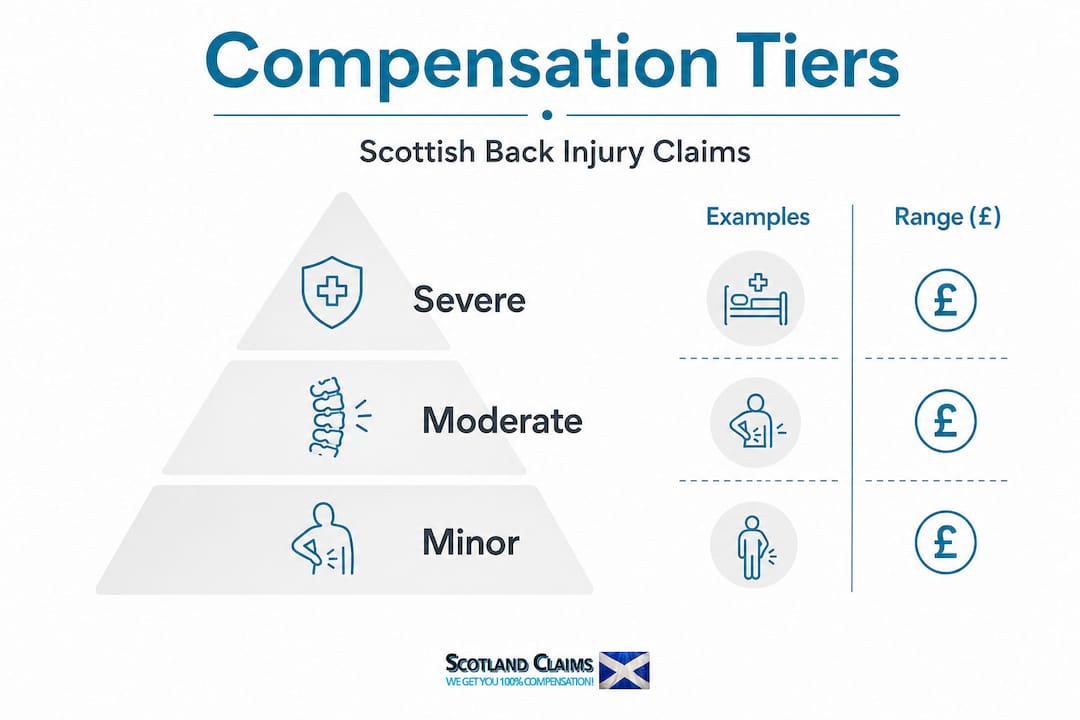
Compensation brackets for back injuries broadly break down as follows:
| Injury severity |
Typical compensation range |
Examples |
| Minor |
Up to £15,000 |
Soft tissue strains, full recovery within 2 years |
| Moderate |
£15,000 to £47,000 |
Disc herniation, nerve damage, partial recovery |
| Severe |
£47,000 and above |
Permanent disability, chronic pain, spinal damage |
Use our injury compensation calculation guide to get a clearer picture of where your injury might sit within these brackets, but remember that every case is unique. A “minor” injury that prevents you from working in your specific trade for an extended period can attract significantly higher special damages.
Important: Never accept a settlement offer from an insurer or employer without first obtaining independent legal advice. Early offers are almost always lower than what a properly prepared claim would achieve.
Key steps: from injury to compensation in Scotland
Knowing what to do and in what order makes an enormous difference to the outcome of your claim. Here is a clear sequence to follow after a back injury:
-
Report the accident immediately. Use your employer’s accident book or, for public place accidents, report to the relevant manager or authority. Get a written record, even a brief one.
-
Seek medical attention promptly. Visit your GP or A&E as soon as possible. This creates a contemporaneous medical record that is difficult for insurers to dispute.
-
Photograph everything. Take pictures of the scene, any equipment involved, visible injuries, and signage (or lack thereof). Time-stamp these images where possible.
-
Note down your account of events. Write a detailed personal statement while the events are fresh. Include times, names, weather conditions, and anything else relevant.
-
Collect witness details. Ask colleagues or bystanders for their names and contact information before they are pressured to stay silent.
-
Contact a specialist solicitor early. The claims process typically moves through medical assessment, negotiation with insurers, and pre-court settlement. Most cases resolve without a courtroom hearing, but early legal involvement dramatically improves outcomes.
-
Attend all medical appointments. Gaps in treatment can be used by insurers to argue that your injury was not as serious as claimed.
-
Keep a pain diary. Record daily entries detailing pain levels, sleep quality, activities you cannot perform, and the emotional impact of your injury.
Claimant representatives in Scotland with specialist back injury experience understand how to negotiate with insurers who routinely attempt to minimise payouts. Having professional representation levels the playing field substantially.
Pro Tip: Even if your employer has been sympathetic and offered to “sort things out informally,” pursue a formal legal claim. Informal arrangements rarely account for the full scope of your losses, particularly future earnings and long-term care needs.
A Scottish solicitor’s view: what most people misunderstand about back injury claims
Most people who delay or avoid making a back injury claim do so for understandable but mistaken reasons. They worry about taking action against an employer they still work for, they assume their injury was partly their own fault, or they believe the claim will be too complex to pursue without guaranteed success. These concerns, while natural, frequently result in genuine victims walking away with nothing.
One of the most consistent mistakes we see is underestimating the evidence required at the outset. Claimants often contact us six months after an injury with little more than a vague memory of the incident and a GP referral letter. Building a compelling case from that starting point is possible, but it requires considerably more effort and carries greater risk than a claim where evidence was gathered within days.
Another misconception concerns pre-existing conditions. Many clients assume that because they had a history of lower back problems before their accident, they have no viable claim. This is incorrect. Pre-existing conditions can still support a claim if work activities exacerbated them, and chronic pain conditions that developed gradually due to workplace factors are also compensable. The question is always whether the employer’s negligence materially contributed to your current state.
The Scottish courts do exercise discretion in appropriate cases, but it is genuinely rare for a court to allow a late claim to proceed under section 19A. Do not gamble on that discretion being exercised in your favour. Every week of delay reduces the strength of your evidence, the availability of witnesses, and ultimately your prospects of recovery.
Maximising compensation in Scottish claims depends far less on the severity of your injury than most people think. It depends on the quality of your legal representation, the completeness of your evidence, and how well your solicitor presents the full picture of your losses. An injury that appears moderate on paper can attract substantial compensation when all special damages are fully quantified and argued.
How to get specialist support for your back injury claim
If this guide has shown you anything, it is that back injury claims in Scotland are absolutely worth pursuing, and that specialist legal support makes the difference between a modest settlement and the full compensation you are entitled to. At Scotland Claims, we connect you with specialist injury lawyers who understand Scottish law and who fight to recover every pound you deserve. Our back injury claims service operates on a No Win No Fee basis, meaning you pay nothing upfront and nothing at all if your case is unsuccessful. You keep 100% of your compensation. Start by using our compensation calculator to get an estimate of your potential payout, then request a callback to speak with a solicitor today.
Frequently asked questions
What is the time limit for making a back injury claim in Scotland?
Most back injury claims must be brought within 3 years of injury, either from the date of the accident or from when you first became aware that your injury was linked to someone else’s negligence.
Are there exceptions to the 3-year rule for children or people lacking capacity?
Yes. Exceptions to the 3-year limit mean that for minors the period starts at age 16, those lacking capacity may have extended deadlines, and courts hold discretion under section 19A to allow late claims in genuinely equitable circumstances.
Can I claim for a back injury made worse by work, not just a new injury?
Yes, pre-existing conditions qualify for compensation if work activities materially exacerbated them, and chronic pain that developed gradually due to workplace negligence is also a valid basis for a claim.
What evidence will I need for a back injury claim?
The key evidence required includes medical records, accident reports, witness statements, photographs of the scene or equipment, and documented proof of financial losses such as lost earnings and treatment costs.
How much compensation can I expect for a minor, moderate, or severe back injury?
Back injury payouts typically range up to £15,000 for minor injuries with full recovery, £15,000 to £47,000 for moderate injuries with lasting effects, and above £47,000 for severe or permanent spinal damage, with special damages added on top.
Recommended