Bus accident compensation in Scotland: your full guide

TL;DR:
- You may be entitled to bus accident compensation in Scotland if another party was at fault. Acting quickly, collecting evidence, and consulting a Scottish personal injury solicitor can preserve your rights within the three-year time limit.
If you were injured in a bus or coach accident in Scotland and another party was at fault, you will very likely be entitled to bus accident compensation. The first thing to do is get medical attention, then preserve any evidence at the scene, and contact a specialist Scottish personal injury solicitor for a free assessment. Under the Prescription and Limitation (Scotland) Act 1973, you generally have three years from the date of the accident to bring a claim, so acting quickly protects your rights. Scotland Claims Injury Lawyers handles exactly these cases, on a No Win No Fee basis with no success fee, meaning you keep every penny of your compensation.
Table of Contents
Who can make a bus accident compensation claim in Scotland?
Most people injured in or around a bus or coach accident can claim, provided another party’s negligence caused the harm. That covers a wide range of situations.
Eligible claimants include:
- Passengers on a bus or coach injured during the journey
- Pedestrians struck or knocked by a bus
- Cyclists hit or forced off the road by a bus
- Drivers of other vehicles injured in a collision with a bus where they were not at fault
- Passengers who fell due to sudden braking, poor road surfaces, or driver error
Special circumstances worth knowing:
- Children: The three-year period does not run while a child is under 16. A young person generally has until their 19th birthday to bring a claim, giving families more time to act.
- Fatal claims: Where a person has died as a result of a bus accident, dependants and relatives can bring a claim under section 18 of the Act, with the three-year period running from the date of death or the date of discoverability.
- Uninsured operators: Bus operators are legally required to hold at least third-party insurance; where a driver is uninsured, alternative routes through the Motor Insurers’ Bureau may be available.
Quick on-scene checklist:
- Seek medical attention, even for minor symptoms
- Note the bus registration number and operator name
- Photograph the scene, your injuries, and any visible damage
- Collect names and contact details of witnesses
- Record the exact time, date, and location
- Ask whether CCTV cameras cover the area or whether the bus has onboard cameras
- Request the driver’s details and the bus company’s contact information
What causes bus and coach accidents in Scotland?
Understanding the cause of an accident matters because it determines who is liable and what evidence will prove it. The most common causes fall into a few clear categories.
Driver error is the most frequent factor: speeding, distraction, fatigue on long coach routes, or misjudging road conditions. Where a driver was tired or using a mobile phone, records from the operator’s tachograph and phone data can be decisive.

Vehicle maintenance failures create liability for the operator rather than the driver. Faulty brakes, worn tyres, defective doors, or inadequate lighting all point to the bus company’s duty to maintain its fleet. Maintenance logs become critical evidence in these cases.
Road and weather conditions can contribute, though a professional driver is expected to adjust speed and behaviour accordingly. If a local authority failed to maintain the road surface, a separate claim against the council may also arise.
Other road users sometimes cause a bus to swerve or brake sharply, injuring standing passengers. In those cases, the third-party driver may bear primary liability.
Loading and standing passenger incidents on coaches are a distinct category. Passengers who were not seated when the vehicle moved, or who were not warned to hold on, may have a claim against the operator for inadequate safety procedures.
Pro Tip: CCTV footage from the bus itself and from nearby cameras is often overwritten within 14–31 days. Write to the bus operator and any relevant local authority or business immediately, requesting that footage is preserved. A solicitor can send a formal preservation letter the same day you instruct them, which is often the fastest and most effective route.
Common bus accident injuries and how they affect your claim value
The type and severity of your injury is the single biggest driver of how much compensation you receive. Scottish courts refer to Judicial College guidelines and past Scottish case authorities when assessing solatium (the Scottish term for general damages covering pain, suffering, and loss of amenity).
Common injuries and their valuation implications:
- Soft tissue injuries and whiplash: Minor cases with full recovery within a few months attract modest general damages. Persistent or recurring symptoms push values significantly higher.
- Fractures: A straightforward fracture with good recovery sits in a mid-range band. Complex fractures requiring surgery, or those leaving permanent restriction, attract considerably more.
- Back and spinal injuries: These vary enormously. A minor lumbar strain differs fundamentally from a prolapsed disc or spinal cord damage. Spinal cord injuries resulting in paraplegia sit at the very top of the general damages scale.
- Head and brain injuries: Concussion with full recovery is valued differently from traumatic brain injury with lasting cognitive or personality changes. Neuropsychological evidence is often needed.
- Psychological injury (PTSD): Recognised as a standalone head of claim. Moderate PTSD following a serious bus crash can attract substantial general damages, particularly where it affects work capacity.
- Catastrophic injuries: Paraplegia, tetraplegia, or severe brain injury attract the highest general damages awards and generate very large special damages claims for long-term care, adapted housing, and loss of future earnings.
Special damages sit alongside general damages and cover actual financial losses: lost wages (past and future), the cost of care provided by family members, travel to medical appointments, private treatment, and any adaptations to your home or vehicle. These are calculated from receipts, payslips, and care diaries, so keeping records from day one matters.
A minor soft tissue claim where you recover fully within three months will look very different from a serious spinal injury requiring surgery and long-term physiotherapy. The latter generates both high general damages and substantial ongoing special damages.
How much compensation could you expect after a bus accident?
Compensation for a bus accident claim in Scotland has two main components.
| Head of loss |
What it covers |
Key evidence |
| General damages (solatium) |
Pain, suffering, and loss of amenity |
Medical records, GP notes, specialist reports |
| Past loss of earnings |
Wages lost from accident to settlement |
Payslips, employer letter, tax returns |
| Future loss of earnings |
Projected income loss if disability is permanent |
Actuarial report, medical prognosis |
| Care and assistance |
Cost of care provided by family or professionals |
Care diary, receipts, carer invoices |
| Medical expenses |
Physiotherapy, surgery, prescriptions, aids |
Receipts, treatment invoices |
| Travel expenses |
Journeys to appointments and treatment |
Mileage records, receipts |
| Services award |
Household tasks you can no longer perform |
Medical evidence, schedule of services |
Illustrative ranges (these are general guides, not guarantees):
- Minor soft tissue injury, full recovery within three months: general damages in the lower range of the Judicial College bands
- Moderate whiplash with symptoms lasting 12–24 months: general damages in the mid-range
- Serious fracture requiring surgery with partial permanent restriction: general damages in the higher range, plus special damages for lost earnings and treatment costs
- Spinal cord injury with permanent disability: general damages at the upper end of the scale, plus potentially very significant special damages running into six figures
For a quick ballpark figure based on your specific injury, use the compensation calculator on the Scotland Claims Injury Lawyers website. It takes a few minutes and gives you a realistic starting estimate before you speak to a solicitor.
What evidence strengthens a bus accident claim?
Evidence does two jobs: it proves who was at fault (liability) and it quantifies your losses (quantum). Strong evidence on both fronts is what moves a claim from a disputed denial to a settled payment.
Core evidence checklist:
- Medical records: GP notes, A&E records, specialist reports, and physiotherapy discharge summaries all document the nature and duration of your injuries.
- Photographs and video: Images of the scene, your injuries, the bus, road conditions, and any visible defects taken as soon as possible after the accident.
- Witness statements: Names, contact details, and brief written accounts from anyone who saw the accident or its immediate aftermath.
- CCTV footage: From the bus itself, nearby businesses, traffic cameras, or dashcams. Request preservation immediately.
- Bus operator report: The operator is required to record serious incidents. Request a copy.
- Police report: If police attended, obtain the incident reference number and request the report.
- Receipts and financial records: For every expense linked to the injury: travel, treatment, aids, and adaptations.
- Clothing and personal items: Damaged clothing or belongings can corroborate the severity of the impact. Preserve them.
Specialist solicitors consistently note that CCTV footage and witness details are frequently the deciding factor in liability disputes, particularly where the bus operator contests fault. Getting those two things secured early can make or break a claim.
Pro Tip: Ask a trusted person to help you keep a daily pain and symptom diary from the day of the accident. Courts and insurers give significant weight to contemporaneous records of how your injury affected daily life, sleep, and work. A diary written at the time is far more persuasive than a reconstruction from memory months later.

What are the time limits for bus accident claims in Scotland?
The standard prescriptive period for a personal injury claim in Scotland is three years from the date of the accident. This is set out in section 17 of the Prescription and Limitation (Scotland) Act 1973. Miss that deadline without a valid exception and your right to claim is extinguished.
Three years sounds like a long time. It is not. Gathering medical evidence, instructing experts, and completing pre-action protocol steps all take time. Most solicitors recommend starting a claim as early as possible, not as close to the deadline as possible.
The three-year period starts on the date you were injured, or the date you became aware (or reasonably should have become aware) that your injury was serious enough to justify a claim and was attributable to another party’s act or omission. This “discoverability” rule matters most where symptoms emerge gradually.
Key exceptions:
- Children: The period is suspended while the claimant is under 16. A child injured in a bus accident generally has until their 19th birthday to raise proceedings.
- Legal disability: Time does not run while a claimant lacks legal capacity due to mental incapacity.
- Fatal claims: Dependants have three years from the date of death or from the date of discoverability of the connection between the death and the accident.
- Court discretion: Under section 19A of the Act, a court has discretion to allow a late claim in exceptional circumstances, but this is not guaranteed and should never be relied upon.
For a detailed breakdown of how Scottish time limits work in practice, see Scotland Claims Injury Lawyers’ guide to claim time limits in Scotland. If you are at all unsure whether your time is running out, contact a solicitor today rather than tomorrow.
How to start a bus accident claim and how fees work
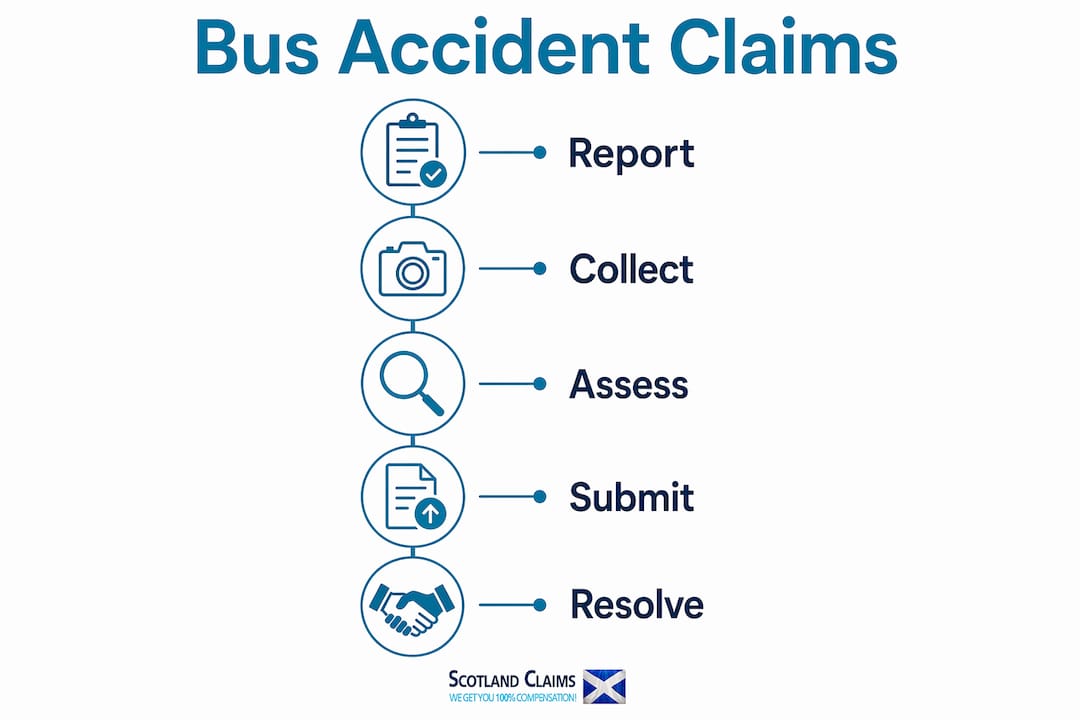
Starting a claim is more straightforward than most people expect. Here is the process from accident to settlement.
- Get medical attention immediately. Even if you feel fine, see a GP or attend A&E. This creates the first medical record linking your injury to the accident.
- Preserve evidence. Follow the checklist above: photographs, witness details, CCTV preservation requests, and a symptom diary.
- Report the incident. Notify the bus operator in writing. If the police attended, obtain the incident reference. Inform your own insurer if relevant, but do not admit fault or accept any early offer from the bus company’s insurer.
- Contact a specialist Scottish solicitor. A free initial assessment will confirm whether you have a viable claim and what steps to take next. Scotland Claims Injury Lawyers offers this at no cost.
- Your solicitor investigates. They gather evidence, instruct medical experts, and send a formal letter of claim to the bus operator’s insurer. Claims worth £25,000 or less follow a Compulsory Pre-Action Protocol before court proceedings can be raised.
- Negotiation or proceedings. Most claims settle without going to court. If the insurer disputes liability or quantum, your solicitor raises proceedings in the appropriate court, which may be the local Sheriff Court or the All-Scotland Sheriff Personal Injury Court.
- Settlement or proof. Once liability and quantum are agreed, compensation is paid. If the case proceeds to a proof (trial), timetables in Scotland are strict: a proof is commonly listed roughly nine months after proceedings begin, with a Pre-Trial Meeting around a month beforehand.
For a realistic picture of how long the process takes, the Scotland Claims guide on how long a road accident claim takes sets out typical timelines clearly.
How No Win No Fee works, and why Scotland Claims is different
Under a No Win No Fee arrangement, you pay nothing upfront and nothing if the case is lost. Most personal injury solicitors in Scotland operate this way. The difference lies in what happens when you win.
Many solicitors deduct a success fee from your damages when the case succeeds. Scotland Claims Injury Lawyers charges no success fee, meaning you keep all your compensation. Other firms sometimes deduct a percentage including VAT from settlements, which reduces the amount claimants receive.
Common fee questions:
- What if I lose? You pay nothing.
- Do I pay anything upfront? No.
- Are there any hidden expenses? Your solicitor will explain any disbursements at the outset. There are no surprises.
Pro Tip: When you call a solicitor for the first time, ask these three questions: What experts will you instruct? What are the likely next steps in the first 30 days? What documents should I send you today? A solicitor who answers all three clearly and specifically is one who knows Scottish personal injury practice.
Why instruct a Scottish specialist solicitor?
Scotland’s civil procedure differs materially from England and Wales. The Sheriff Court system, the All-Scotland Sheriff Personal Injury Court, and the Compulsory Pre-Action Protocol for lower-value claims all operate under Scotland-specific rules that a solicitor unfamiliar with Scottish practice can easily mishandle. A procedural error, a missed protocol step, or an inadvertent failure to interrupt prescription can extinguish a valid claim entirely.
Scotland Claims Injury Lawyers focuses exclusively on personal injury claims in Scotland. The firm offers:
- A free initial case assessment with no obligation
- No Win No Fee representation with no success fee (you keep 100% of your compensation)
- A compensation calculator for a quick estimate before you speak to anyone
- Specialist knowledge of Scottish courts, pre-action protocols, and damages valuation
- Clear contact options: phone, callback request, or online claim form
Pro Tip: To speed up your initial case assessment, upload or send: your GP or A&E records, photographs of the scene and your injuries, payslips covering the period before and after the accident, any receipts for expenses, and the police incident reference if one exists. The more complete your file at the first meeting, the faster your solicitor can advise on value and next steps.
Key takeaways
Bus accident compensation in Scotland is available to any claimant injured through another party’s negligence, and instructing a specialist Scottish solicitor early is the single most important step to protect both your evidence and your right to claim.
| Point |
Details |
| Three-year time limit |
The Prescription and Limitation (Scotland) Act 1973 gives you three years from the accident date to raise a claim. |
| Evidence is decisive |
CCTV footage and witness details are frequently the deciding factor in liability disputes; preserve both immediately. |
| Two types of damages |
General damages cover pain and suffering; special damages cover financial losses such as lost earnings and treatment costs. |
| No success fee |
Scotland Claims Injury Lawyers deducts nothing from your compensation; other firms can take up to 20% including VAT. |
| Free assessment available |
Scotland Claims Injury Lawyers offers a free initial case assessment by phone, callback, or online form. |
Why early instruction matters more than most people realise
The conventional wisdom is that you have three years, so there is no rush. That view costs claimants money and, sometimes, their entire claim.
CCTV footage disappears within weeks. Witnesses move on and their recollections fade. Bus operators’ incident reports get filed and become harder to obtain. Medical records from the immediate aftermath carry far more weight than a GP note written six months later when symptoms are described from memory. Every week that passes without a solicitor involved is a week in which evidence degrades and the insurer’s position hardens.
There is also the litigation timetable to consider. Once proceedings are raised in Scotland, the court moves quickly. A proof can be listed roughly nine months after litigation begins. A solicitor instructed late, with incomplete evidence and no expert reports commissioned, is at a serious disadvantage when that timetable starts running. Early instruction is not just about meeting the three-year deadline. It is about arriving at that proof, if it comes to one, with a complete and well-evidenced case.
The other thing people underestimate is valuation. A solicitor who sees you early can advise on the full range of special damages you are entitled to claim, including care provided by family members, future treatment costs, and loss of future earnings. Many claimants who instruct late discover they have been keeping inadequate records and cannot now recover losses they genuinely suffered.
Scotland Claims Injury Lawyers: specialist help with no success fee
If you have been injured in a bus or coach accident in Scotland, Scotland Claims Injury Lawyers offers specialist No Win No Fee representation with one significant difference from most firms: there is no success fee. You keep 100% of your compensation. Other solicitors can deduct up to 20% including VAT from your settlement when you win. Scotland Claims takes nothing from your damages.
The firm handles personal injury claims across Scotland, including road traffic accident claims involving buses, coaches, and other vehicles. Whether your injury is a whiplash, a fracture, a back injury, or something more serious, a specialist solicitor will assess your case for free and advise on realistic compensation ranges using the online compensation calculator.
Contact Scotland Claims Injury Lawyers today by phone, by requesting a callback, or by submitting your details online. The assessment is free, there is no obligation, and the sooner you act, the stronger your claim.
Useful sources and further reading
- Road crash compensation — mygov.scot: Scottish Government guidance on eligibility, steps to take after a road crash, and how No Win No Fee solicitors work.
- Prescription and Limitation (Scotland) Act 1973, section 17: The primary legislation setting out the three-year prescriptive period for personal injury claims in Scotland.
- 10 things to know about personal injury claims in Scotland — Mondaq: Practitioner overview of Scottish civil procedure, pre-action protocols, court options, and damages assessment.
- National Personal Injury Court — Scottish Courts and Tribunals Service: Official information on the All-Scotland Sheriff Personal Injury Court and its procedures.
- Compensation Calculator — Scotland Claims Injury Lawyers: Quick online estimator for a ballpark compensation figure based on your injury type.
- Claim time limits in Scotland — Scotland Claims Injury Lawyers: Practical guide to prescriptive periods, discoverability, and exceptions under Scots law.
FAQ
How much compensation can I get for a bus accident?
The amount depends on your injury type and severity, plus your financial losses. General damages follow Judicial College guidelines and Scottish case authorities; special damages cover lost earnings, treatment costs, and care. Use the Scotland Claims compensation calculator for a quick estimate.
Can you sue if your bus crashes?
Yes. If the bus driver or operator was at fault, you can bring a personal injury claim against the bus company’s insurer. Passengers, pedestrians, and other road users injured through the operator’s negligence are all entitled to claim under Scots law.
Do buses have to pay insurance?
Bus operators are legally required to hold at least third-party insurance. Where liability is admitted, the operator’s insurer is the party that meets the compensation payment.
What happens if a bus driver hits someone?
The injured person can make a personal injury claim against the bus operator’s insurer. The operator is vicariously liable for the driver’s negligence in the course of employment. Scotland Claims Injury Lawyers can assess the claim for free and advise on next steps.
How long do I have to claim after a bus accident in Scotland?
Under the Prescription and Limitation (Scotland) Act 1973, the standard period is three years from the date of the accident. Children have until their 19th birthday in most cases. Act well before the deadline, as gathering evidence and completing pre-action steps takes time.
Recommended