Brain Injury Claims in Scotland for Families

Yes, you can bring a brain injury claim in Scotland if someone else’s negligence caused your injury, whether that was a road accident, a fall at work, or a slip that wasn’t your fault. Act quickly: preserve every medical record and witness detail now, because the three year limitation period has already started running, and speak to a specialist solicitor before evidence disappears or memories fade.
TL;DR:
- Claims must be initiated within three years from the injury date or when the victim reasonably becomes aware of it, with some exceptions for children and capacity issues.
- Evidence collection—including medical records, witness details, and incident reports—should begin immediately to preserve crucial information before it degrades or memories fade.
- Early intervention, including requesting interim payments and securing rehabilitation funding, significantly improves recovery outcomes and can prevent delays in care.
- Compensation covers pain and suffering, lost earnings, care costs, and home or equipment adaptations, with the final amount dictated by detailed medical and vocational evidence.
- Most claims settle without court appearances, but complex cases can take over three years, and proactive solicitor involvement with early evidence and funding requests helps shorten the process.
Scotland Claims Injury Lawyers
Get Help With Your Brain Injury Claim
Scotland Claims Injury Lawyers connects families with specialist injury lawyers for claims involving accidents or negligence in Scotland.
Table of Contents
What counts as a brain or head injury under Scots law
Brain injuries fall into a few distinct medical categories, and knowing which one applies to your case shapes both the evidence you need and the compensation you might expect. A traumatic brain injury (TBI) results from a direct blow or violent jolt to the head, commonly seen in road traffic collisions and falls from height. Concussion sits at the milder end but can still cause weeks or months of disruption through post-concussion syndrome, where headaches, dizziness, and concentration problems persist long after the initial impact seems to have passed. Acquired brain injury (ABI) covers damage caused after birth by trauma, oxygen deprivation, or other medical events, and it’s the broader legal term you’ll see used in court documents.
Scots law handles these claims through delict, the area of civil law dealing with wrongful harm, and negligence claims aim to restore you, so far as money allows, to the position you’d have been in without the injury. Medical evidence becomes the backbone of your case here, because causation and severity both need to be proven, not assumed.
Symptoms worth documenting from day one include:
- Persistent headaches or dizziness lasting beyond a few days
- Memory lapses, confusion, or difficulty concentrating at work
- Mood changes, irritability, or new anxiety and depression
- Fatigue that doesn’t improve with rest
- Sensory changes, including light sensitivity or tinnitus
Write these down as they happen. A diary kept from week one carries more weight with a medico-legal expert than a memory reconstructed months later.
Who can claim for a brain injury in Scotland and when
The injured person is normally the pursuer, but brain injury cases often involve someone else acting on their behalf. Where a brain injury has left someone unable to manage their own affairs, a curator or guardian can raise the action instead, and close relatives may have their own claim in certain circumstances, such as bereavement or where they’ve taken on caring responsibilities.
Timing matters more here than in almost any other injury type. The Prescription and Limitation (Scotland) Act 1973 sets the standard limitation period, the triennium, at three years from the date of injury or from when you reasonably became aware of the injury and its cause.
The three year rule has real exceptions worth knowing:
- Children generally have a limitation period that starts when they turn 16, rather than from the date of the injury.
- Where a claimant lacks capacity due to the brain injury, the limitation period may be suspended until capacity is regained or a guardian is appointed.
- Courts hold discretion to allow a late claim in limited circumstances, though this is never guaranteed and should not be relied upon
That last exception is a safety net, not a strategy. Courts weigh discretion carefully, and solicitors would rather see a claim raised in year one than argue for late admission in year four.
How does a brain injury claim proceed in Scotland?
Every brain injury claim follows a broadly similar path, though complex cases branch off into extra stages that minor injuries never touch.
- Gather what you can immediately. Medical notes, photographs of the accident scene, witness names and phone numbers, and any incident report filed at work or with the police all matter. The sooner you contact a solicitor, the sooner this evidence gets locked in before it degrades.
- Letter of claim. Your solicitor sends a formal notification to the party at fault (or their insurer), setting out what happened and why they’re liable.
- Defenders’ response. The other side has a set period to investigate and respond, either admitting liability, denying it, or requesting more information.
- Records and expert instruction. Both sides exchange medical records, and your solicitor instructs medico-legal experts, often a neurologist or neuropsychologist, alongside vocational experts and therapists where ongoing care or work capacity is in question.
- Negotiation or court. Most personal injury cases in Scotland settle without a court appearance, but where liability or value remains disputed, proceedings may be issued and the case can end up before the National Personal Injury Court.
Interim payments can be requested at almost any stage once liability looks likely, which matters enormously for brain injury cases where rehabilitation costs mount before a final settlement is reached.
Pro Tip: Ask your solicitor to request an interim payment as soon as liability is accepted, even in principle. Waiting for full settlement before funding rehab can cost you months of recovery time you won’t get back.
Rehabilitation, interim funding and case managers
Early rehabilitation changes outcomes. Getting the right therapy input within weeks of a brain injury, rather than months, consistently produces better recovery than delayed intervention, which is why the Rehabilitation Code exists as shared industry guidance encouraging insurers and claimants’ solicitors to cooperate on early treatment rather than waiting for blame to be settled first.
Way Forward Meetings, where insurers, solicitors, and rehabilitation professionals sit down together early in a case, are becoming a more common route to secure treatment fast in Scotland’s more serious injury claims, cutting through the usual back and forth that delays care.
That collaborative model is gaining ground because it works better than adversarial stand-offs when someone’s recovery window is closing. A case manager coordinates this process practically, organising therapy appointments, liaising with the family, and tracking progress against goals. Look for case managers registered with bodies such as BABICM or CMSUK, which set professional standards for brain injury case management specifically.
Interim payments deserve a mention of their own here:
- They exist to fund rehabilitation, equipment, or lost income before final settlement
- Your solicitor requests them once liability is reasonably clear, even before it’s formally admitted
- Where an insurer refuses to engage, court intervention can compel an interim award in appropriate cases
None of this happens automatically. It takes a solicitor actively pushing for it from an early stage.
What compensation can you claim for a brain injury?
Compensation in Scotland splits into distinct heads of damage, and brain injury cases typically touch on more of them than most other personal injury claims.
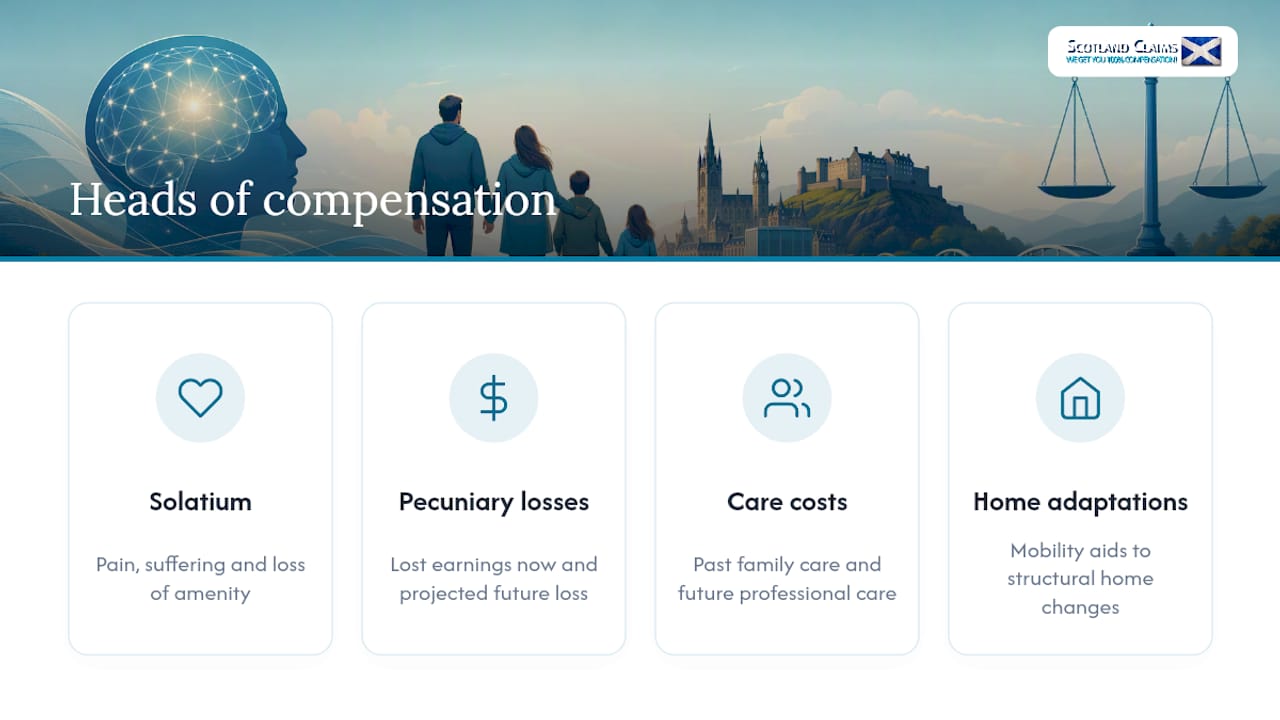
Solatium covers pain, suffering, and loss of amenity, the general damages figure that reflects how the injury has affected your quality of life. Pecuniary losses cover the financial side: lost earnings to date, and crucially for brain injury cases, projected future loss of earnings where cognitive or physical effects limit your ability to work long term. Care costs account for both past care provided informally by family and future professional care needs. Equipment and home adaptations cover anything from mobility aids to structural changes needed for someone who can no longer manage stairs or live independently.
A detailed vocational or medical report drives the value of most of these heads. A mild concussion resolving within weeks looks very different on paper to a moderate injury causing six months off work, which differs again from a severe injury requiring lifelong care.
Which court route your case follows generally comes down to value and complexity, with straightforward, lower-value claims proceeding through simple or summary cause procedure, while higher-value or more contested cases move to ordinary cause or the National Personal Injury Court. You can get an early indication of potential value using a compensation calculator, though a genuine figure only emerges once medical and vocational evidence is in.
Funding a claim: what to check before instructing a solicitor
Most personal injury claims in Scotland run on a conditional fee agreement, commonly known as no win no fee, where you pay nothing upfront and the solicitor’s costs depend on winning. Legal expenses insurance, sometimes already attached to a home or car insurance policy, offers another route, though it’s worth checking whether such cover exists before assuming you need to fund privately. Legal aid rarely applies to private personal injury claims of this kind, so don’t count on it as a backup option.
At Scotland Claims Injury Lawyers, our no win no fee arrangement caps the success fee at 18% including VAT, below the 20% many larger firms take from a client’s settlement, with no hidden extras. That difference alone can run into thousands of pounds on a substantial brain injury award.
Before instructing anyone, ask:
- How many brain injury cases has this solicitor handled personally?
- Do they have direct access to qualified case managers and rehabilitation specialists?
- Will they push for interim payments early, or wait until final settlement?
- Is the fee agreement in writing, and does it clearly state what percentage, if any, comes from your compensation?
Pro Tip: If a solicitor can’t answer the interim payment question with a clear, confident process, that’s a red flag worth taking seriously. Brain injury cases without early rehabilitation funding often see worse long-term outcomes.
How long does a brain injury claim take in Scotland?
Timescales vary enormously depending on severity and how quickly liability gets resolved. A minor concussion claim with clear liability might settle within months. Complex or severe brain injury cases, particularly those involving long-term care needs or disputed liability, frequently take considerably longer, sometimes stretching past 36 months as the full picture of someone’s recovery only becomes clear over time.
Several things routinely cause delay:
- Waiting for medical and vocational experts to become available for assessments
- Gathering complete records from hospitals, GPs, and employers
- Insurers disputing liability or contesting the extent of the injury
- NHS waiting lists slowing access to the rehabilitation needed to establish a realistic prognosis
You can help move things along. Instructing a solicitor early, keeping your own symptom diary, and cooperating promptly with medical appointments all shave time off the process. Pushing for interim payments early also reduces pressure to settle prematurely just to access funds for care, which is one of the most common reasons brain injury claims end up undervalued.
Practical next steps for families
If you’re reading this because someone you love has just suffered a brain injury, here’s what actually matters right now: keep every scrap of medical paperwork, ask the treating team for a written summary of the injury, and get in touch with a specialist solicitor within days, not months.
Don’t let cost worry stop you from calling. A clearly capped success fee, agreed in writing, means the family knows what it will receive, and a good solicitor should be coordinating rehabilitation access alongside the legal claim from week one, not after settlement.
Brain injury recovery is unpredictable, and legal support should feel like one less thing to manage, not another burden on top of everything else.
— Roger
Get help with your brain injury claim in Scotland
Scotland Claims Injury Lawyers doesn’t. Whether your brain injury followed a road traffic accident, a fall at work, or a slip that wasn’t your fault, the same capped fee applies and is agreed in writing before your claim starts.
Our specialist injury lawyers in Scotland work under a genuine no win no fee arrangement, which means no upfront costs and no bill if the claim doesn’t succeed. We help clients access rehabilitation and interim payments early, rather than leaving that until settlement.
Starting is straightforward: fill in the online claim form, request a callback, or call directly. Have your medical records, any incident reports, and witness details ready if you have them, though don’t delay contact while you gather paperwork. Want a rough sense of what your claim could be worth first? Try the compensation calculator before you speak to us.
Sources
This article is general information, not a substitute for advice from a qualified lawyer. Consult a qualified legal professional about your own circumstances before acting on anything here.
FAQ
How much compensation do you get for a brain injury?
It depends entirely on severity, ranging from several thousand pounds for a mild concussion resolving within weeks to substantial six-figure sums for severe injuries requiring lifelong care, equipment, and loss of future earnings. A medico-legal report is what actually determines the figure, not a fixed table.
Is brain injury the same as mental health?
No, a brain injury is a physical injury to brain tissue, while mental health conditions can develop as a consequence of it, and both may need separate medical assessment. If you’re dealing with psychological symptoms alongside a physical brain injury, it’s worth reading our guide to psychological injury claims in Scotland as the two often overlap in a single claim.
What benefits can I claim after a brain injury?
Compensation claims and state benefits are separate systems, and while this guide covers civil compensation claims only, your solicitor can advise on how any benefits you already receive might interact with a settlement.
How much is a brain injury settlement?
Settlements vary hugely by severity and long-term impact, and no two cases value identically because they depend on individual medical evidence, care needs, and lost earnings. Getting a free case assessment from a specialist solicitor is the only reliable way to get a figure specific to your circumstances.
Do I need to go to court for a brain injury claim in Scotland?
Most personal injury claims in Scotland settle through negotiation without a court appearance, though higher-value or disputed cases may proceed through the National Personal Injury Court. Your solicitor will only recommend court action where negotiation genuinely can’t resolve the case fairly.
Recommended