The role of expert assessment in claims

TL;DR:
- Expert assessments are crucial in personal injury claims, providing objective evidence that influences compensation and dispute resolution. They must be conducted independently with transparent methodology to ensure credibility and strengthen your case, especially before appraisal processes or court proceedings. Proper early involvement and careful selection of expert witnesses can significantly improve claim outcomes by establishing clear causation, prognosis, and functional impact.
Most people assume a personal injury claim is straightforward: you were hurt, someone was at fault, and compensation follows. The reality is far more complex. The role of expert assessment in claims is what separates a fair settlement from a figure that barely covers your losses. Without credible expert input, insurers and opposing legal teams can dispute injury severity, causation, and long-term impact with very little to push back against. Understanding how expert assessments work and why they matter is the single most useful thing you can do before pursuing your claim.
Table of Contents
Key takeaways
| Point |
Details |
| Experts determine claim value |
Medical, vocational, and specialist experts provide objective evidence that directly shapes compensation figures. |
| Independence is non-negotiable |
An expert perceived as biased can have their evidence discounted or disqualified entirely by the court. |
| Methodology matters in reports |
Reports without clear, transparent methodology fail evidentiary standards and weaken your claim significantly. |
| Appraisal outcomes are binding |
Once a formal appraisal award is issued, challenging the amount in court becomes extremely difficult. |
| Early expert involvement reduces disputes |
Getting expert assessments organised early prevents delays, gaps in evidence, and costly disagreements later. |
The role of expert assessment in claims explained
An expert assessment in a personal injury claim is a formal evaluation carried out by a qualified professional whose job is to provide objective, evidence-based opinion on a specific aspect of your case. That might be the nature and severity of your injuries, your capacity to work, or the circumstances that caused the accident in the first place.
The types of experts involved vary considerably depending on your claim:
- Medical experts assess injury severity, prognosis, and the causal link between the accident and your condition. These are typically consultants or GPs with relevant specialisms.
- Vocational assessors evaluate how your injury affects your ability to work, both now and in the future.
- Accident reconstruction specialists are brought in for road traffic accidents where the sequence of events is disputed.
- Care experts quantify the cost of ongoing personal or professional care you may require.
- Occupational health professionals examine workplace injuries and what adjustments your employer may or may not have made.
In Scotland and across the UK, experts must meet strict standards of qualification and conduct. Critically, expert witnesses must be independent and objective. If an expert is seen to be advocating for the party that instructed them rather than offering impartial opinion, their evidence can be discounted or disqualified entirely. That objectivity is not just a legal nicety. It is what gives expert evidence its weight.
There is also an important distinction between an expert witness and an assessor. An expert witness provides opinion evidence to the court, subject to cross-examination. An assessor operates more in a procedural context, helping resolve valuation disputes outside formal court proceedings. Both play vital roles, but they operate under different rules and at different stages of a claim.
An expert’s credibility also depends heavily on preparation. Expert reports must be written clearly before trial so all parties can examine them effectively, and the expert must be ready to defend their conclusions under rigorous questioning.
How expert assessments shape your claim outcome
Here is where many claimants are genuinely surprised. They assume the medical records from their GP or hospital visit are enough. In contested claims, they rarely are. An expert assessment translates raw medical data into something a court or insurer can actually evaluate: a clear opinion on causation, prognosis, and functional impact.
Take a whiplash injury following a road traffic accident. Your GP notes confirm pain and restricted movement. But a properly commissioned medical expert report will assess whether those symptoms are consistent with the mechanics of the collision, how long recovery is expected to take, whether there is any risk of long-term complications, and what treatment is required. That level of detail directly influences the compensation figure offered.

The same logic applies to serious injuries. For back injury claims and knee injuries, expert orthopaedic or neurological assessments define whether the injury is temporary or permanent, whether surgery is necessary, and how significantly the injury affects your quality of life. Each of those conclusions carries a financial value in compensation calculations.
Evidence also matters in negotiations before anything reaches a court. A family secured an additional £50,000 in a property appraisal dispute simply through detailed documentation and expert advocacy. The same principle applies in personal injury: a well-evidenced expert report gives your solicitor leverage in negotiations that a bare medical note simply cannot provide.
Pro Tip: Ask your solicitor early whether they intend to commission an independent medical expert report rather than relying solely on NHS records. That single step can significantly affect what your claim is ultimately worth.
Independent appraisal professionals often have experience as insurance adjusters and understand insurer valuation methods well enough to identify errors that claimants would never spot on their own. Having someone in your corner who understands both sides of that equation is enormously valuable.
Key factors expert assessments directly influence in your claim:
- The diagnosis and causation link between the accident and your condition
- The prognosis and expected recovery timeline
- Future care costs and loss of earnings projections
- The strength of your negotiating position before trial
- The admissibility and weight of medical evidence if the case goes to court
Understanding the claims review process
The claims review process is more structured than most claimants realise, and understanding where expert appraisal sits within it helps you make better decisions at each stage.
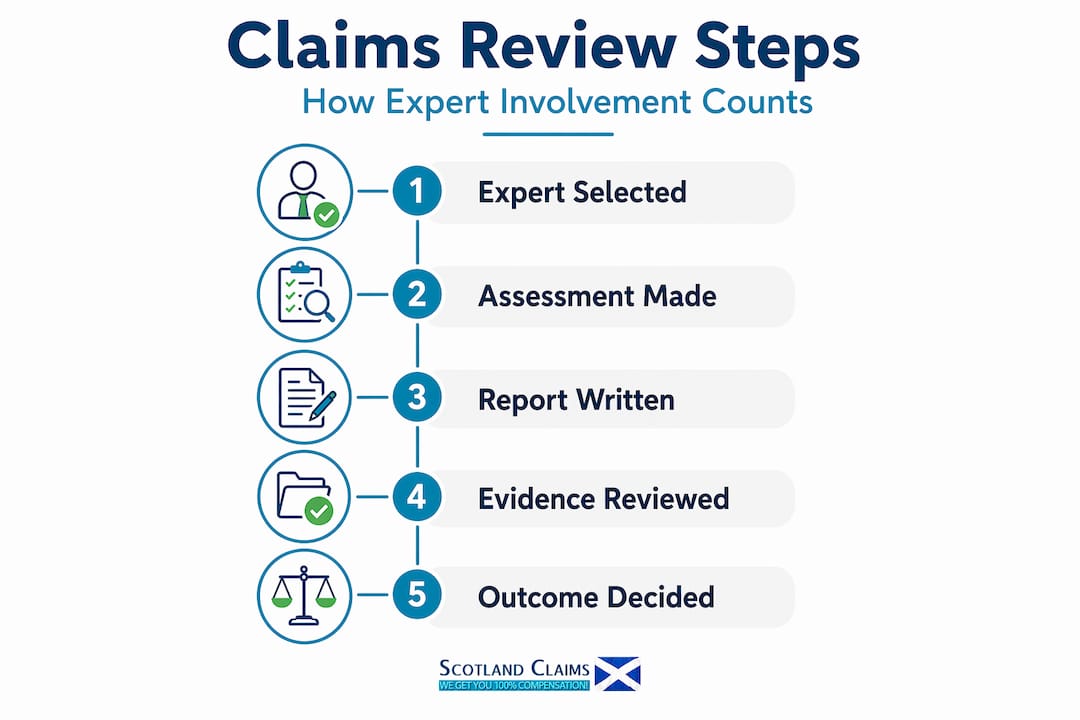
When a dispute arises about the value of a claim, rather than proceeding straight to litigation, many cases go through a formal appraisal process. This is a specific mechanism for resolving disagreements about the financial value of a claim, and it works as follows:
- Both parties appoint their own independent appraiser, each with relevant qualifications and no financial interest in the outcome.
- The two appraisers attempt to reach a mutually agreed figure.
- If they cannot agree, a neutral umpire is appointed to make the final determination.
- The umpire’s decision produces a binding award that is extremely difficult to challenge after the fact.
It is worth being clear about what appraisal is and is not. The table below sets out the key differences between the three most common dispute resolution mechanisms:
| Mechanism |
Scope |
Outcome |
Can it be appealed? |
| Appraisal |
Dollar or pound value disputes only |
Binding award |
Rarely and with difficulty |
| Mediation |
Broad disputes, including liability |
Non-binding agreement |
Yes, parties can walk away |
| Arbitration |
Legal and factual disputes |
Binding decision |
Limited grounds for appeal |
The appraisal route is narrowly scoped to value disputes specifically, which is why it is so important that your expert assessments are accurate and thorough before you enter that process. Once an appraisal award is issued, you are effectively locked into that figure.
For claimants in Scotland, the practical takeaway is this: get expert involvement early, ensure your instructed experts are genuinely independent, and work with a solicitor who understands how evidence standards affect both appraisal and court proceedings.
Common pitfalls in relying on expert assessments
Not all expert assessments are created equal, and the difference between a strong report and a weak one can cost you a significant portion of your compensation.
The most common problem is what practitioners refer to informally as a “hired gun”: an expert who consistently produces reports favouring whichever party instructs them. Courts are alert to this. Expert evidence that shows advocacy rather than objectivity risks being discounted or excluded entirely, leaving your claim without the evidence it depends on.
Methodology is another area where claimants are frequently let down. A proper expert report must explain not just the conclusion but how that conclusion was reached. Reports lacking clear methodology or with unsupported conclusions fail evidentiary standards. In practical terms, that means the report may be challenged and dismissed in court, taking your evidence with it.
Technology is also increasingly relevant here. Automation tools are now used across the claims industry to speed up processing, but automation cannot testify or explain its logic in court. When a claim is disputed, the presence of a qualified human expert who can defend their methodology under cross-examination is non-negotiable.
Pro Tip: Before accepting any expert report as the basis for your claim, ask specifically how the expert reached their conclusions. If your solicitor cannot explain the methodology in plain terms, that is a warning sign.
Watch out for these specific pitfalls:
- Choosing an expert based on availability rather than relevant specialisation
- Accepting reports that do not address causation directly
- Relying on automated assessments without human expert review for complex or high-value claims
- Failing to check whether your expert has recent court experience and a track record of withstanding cross-examination
How to maximise your claim using expert assessments
Understanding what expert assessments do is one thing. Actively using that knowledge to strengthen your position is another. Here is what claimants who secure fair outcomes consistently do differently.
You should also document accident evidence thoroughly from the earliest point, because expert conclusions are only as strong as the underlying evidence they are based on.
Steps that make a genuine difference:
- Instruct your solicitor immediately after the accident. Early legal involvement means expert assessments are organised before memories fade, evidence deteriorates, or the opposing party establishes a competing narrative.
- Request copies of all expert reports instructed on your behalf. You have the right to understand what experts are saying about your injury, and reading those reports helps you ask informed questions.
- Cross-reference expert conclusions with your lived experience. If an expert report understates your symptoms or omits a significant functional limitation, tell your solicitor straight away so the report can be queried or supplemented.
- Use a solicitor who understands the evidence standards required in Scotland. The claims review process has specific procedural requirements, and a solicitor familiar with them will know which experts carry the most credibility.
- Ensure your expert’s conclusions are consistent with all your medical records. Inconsistencies between what your GP recorded and what an expert concludes are the first thing an opposing legal team will attack.
Understanding how evidence quality affects your outcome is worth spending time on. The role of evidence in injury claims goes beyond simply having documents. It is about having the right documents, produced by the right people, in the right format.
My honest view on what expert assessments actually do
I have seen too many claimants walk away from settlements that simply were not good enough, not because their case was weak but because the expert evidence behind it was. There is a persistent belief that getting a medical note and filing a claim is all it takes. It is not.
What I have observed again and again is that claimants who take the time to understand the expert evidence being used in their case get substantially better outcomes. Not because they challenge their solicitor at every turn, but because they ask the right questions at the right times. An expert report that accurately captures the long-term functional impact of a back injury is worth far more than a vague GP letter confirming pain.
The courts are sophisticated about this too. Judges and sheriffs in Scotland are experienced at identifying reports that lack rigorous methodology, and expert testimony admissibility depends on preparation and transparent reasoning. An expert who cannot defend their conclusions confidently under cross-examination does your case active harm.
My advice is simple. Do not treat expert assessments as a formality or a box to tick. Treat them as the foundation of your case, because that is exactly what they are. The compensation you receive will largely reflect the quality of expert evidence that supports your claim.
— Roger
How Scotland Claims Injury Lawyers supports your claim with expertise
If you are beginning to realise how much expert assessment affects what you are actually owed, the right legal support makes all the difference. Scotland Claims Injury Lawyers connects injury claimants across Scotland with specialist solicitors who understand how to build evidence-led claims that hold up to scrutiny.
Scotland Claims Injury Lawyers deducts no success fee on any claim type - whether your claim involves whiplash, slips, trips, workplace accidents, or any other injury, you keep 100% of your compensation. Most large national firms charge up to 20% including VAT, so choosing Scotland Claims Injury Lawyers means every penny of your award stays with you.
Whether you have suffered a knee injury or a more complex trauma, specialist solicitors are available on a no win no fee basis. Speak to the team at Scotland Claims Injury Lawyers injury lawyers today to get your claim properly assessed by people who know what expert evidence can do for your outcome.
FAQ
What does an expert assessment involve in a personal injury claim?
An expert assessment is a formal evaluation by a qualified professional, usually a medical consultant or specialist, who provides an independent opinion on your injury, its cause, and its impact on your life. This evidence is used to support and value your compensation claim.
Why can’t I just use my GP records as evidence?
GP records confirm that you attended and reported symptoms, but they rarely address causation, prognosis, or functional impact in the detail required for a claim. An independent expert report provides the structured, evidence-based opinion that courts and insurers need to accurately value your injuries.
What makes an expert assessment admissible in court?
Expert evidence must be based on reliable, transparent methodology and delivered by a genuinely independent professional. Courts require experts to explain how they reached their conclusions, and evidence produced by a biased or poorly qualified expert can be excluded entirely.
How does the appraisal process differ from going to court?
The appraisal process is a structured mechanism that specifically resolves disputes about financial value, using independent appraisers and a neutral umpire. Unlike court proceedings, appraisal awards are binding and very difficult to challenge once issued.
How do I know if my expert report is strong enough?
A strong expert report clearly explains the methodology used, directly addresses causation, and is consistent with your medical records. If your report lacks these elements or an opposing party challenges it successfully, it can significantly reduce what you receive. Ask your solicitor to walk you through the report’s conclusions and reasoning before any negotiations begin.
Recommended