Three years to act: Scotland asbestos claims and how to keep 100%
Yes, you can make an asbestos claim in Scotland if you were wrongfully exposed and later diagnosed with an asbestos-related condition. You normally have three years from diagnosis, or from when you first knew you had a claim, to act. Speak to a specialist Scottish solicitor as soon as possible after diagnosis. Scotland Claims Injury Lawyers offers a free check to establish whether you have a valid claim.
TL;DR:
- Anyone with a documented wrongful asbestos exposure and diagnosis can potentially file a claim within three years of diagnosis or knowledge of the link.
- Claims can be made by former workers, household contacts, bystanders, and veterans, with liability often resting on employer negligence or failure to warn.
- Compensation averages over £150,000 for mesothelioma, covering pain, loss of earnings, care costs, and bereavement, but varies based on individual circumstances.
- Claimants should gather evidence early, including medical records and employment history, and consult with specialists to preserve evidence before records disappear.
- Early legal advice is crucial, as delaying risks missing the three-year time limit and losing the ability to claim benefits or compensation altogether.
Table of Contents
Who can bring an asbestos claim in Scotland?
Eligibility runs wider than most people expect. It is not just tradesmen who spent decades on building sites.
Anyone who can show wrongful exposure to asbestos, and a resulting diagnosis, may have grounds for a claim under Scots delict law. This covers:
- Former factory, shipyard, power station or construction workers exposed on the job
- Household contacts, such as a spouse who washed contaminated overalls
- Bystanders exposed near industrial sites or during renovation work
- Veterans exposed to asbestos in service buildings or naval vessels
Liability rests on proving the employer, or another responsible party, knew or ought to have known of the danger and failed to protect people from it. Where the person affected has died, a family member acting as executor can bring the claim on their behalf, and this includes gathering the paperwork the estate will need to progress matters through the courts.
The general rule is strict: you have three years from the date of diagnosis, or the date you reasonably became aware of the link between your illness and asbestos exposure, to raise a claim. Miss it, and the court can refuse to hear the case entirely, regardless of how strong the evidence is.
The Damages (Asbestos-related Conditions) (Scotland) Act 2009 changed the landscape for milder conditions. Before it, insurers argued that pleural plaques caused no measurable harm and therefore attracted no damages.
The 2009 Act clarifies that pleural plaques, asymptomatic pleural thickening and asymptomatic asbestosis are not to be treated as “negligible” injuries, and confirms they are actionable under Scots law.
The Act also carries retrospective effect for some older exposures, which can alter how limitation is calculated if your diagnosis relates to exposure decades ago. If your employer has since closed down, that does not stop the clock working in your favour, but it does mean you should contact a solicitor promptly to preserve evidence before records disappear.
A civil claim compensates far more than the diagnosis itself. Scottish courts and insurers assess several separate heads of loss, and each is calculated on its own facts.
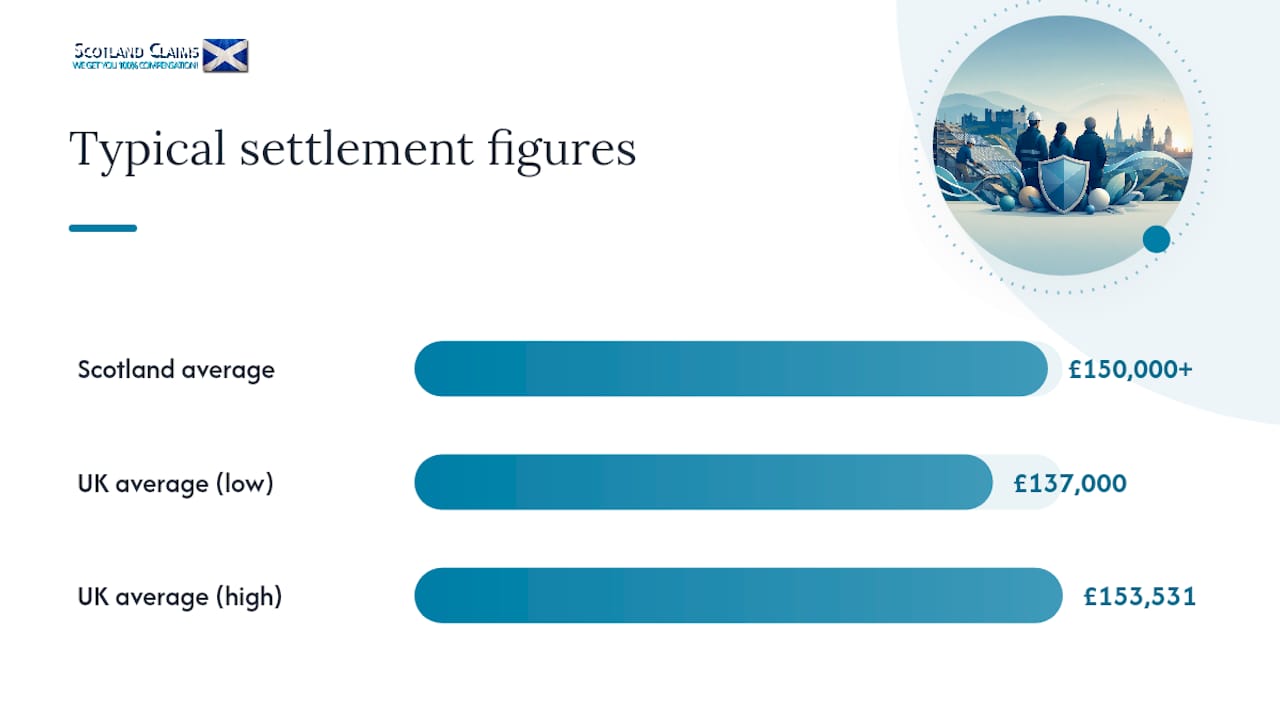
Average mesothelioma compensation in Scotland exceeds £150,000, according to Action on Asbestos, with UK-wide averages cited between roughly £137,000 and £153,531. That range moves considerably depending on age, income loss, and severity, so treat any average as a starting point rather than a promise.
The main components typically claimed are:
- General damages for pain, suffering and reduced quality of life
- Past and future loss of earnings, including pension impact
- Care costs, whether provided by family or paid carers, plus equipment and home adaptations
- Bereavement awards and funeral expenses in fatal cases
Younger claimants with dependants and higher earnings tend to secure larger settlements, largely because future loss of earnings calculations stretch further. Conversely, a claim brought very late, with limited employment records, can settle lower simply because less evidence survives to support it.
Benefits, lump sums and how they interact with compensation
Civil damages are not your only source of financial support. Several state benefits exist specifically for people affected by industrial disease, and in Scotland some now run under different names to the rest of the UK.
Relevant entitlements include:
- Industrial Injuries Disablement Benefit (IIDB), paid regardless of fault where exposure happened through employment
- Adult Disability Payment, the Scottish replacement for PIP, for people of working age
- Pension Age Disability Payment, the Scottish replacement for Attendance Allowance
- Lump-sum payments under statutory schemes, which are separate from and do not automatically reduce civil damages
Macmillan Cancer Support notes that terminally ill claimants can access fast-track processing for these Scottish benefits, cutting through the usual waiting times. A common pitfall is applying for benefits and pursuing compensation without coordinating the two, which can affect timing or entitlement in ways that are hard to reverse. Many of these payments are not means-tested, so a decent household income does not automatically rule you out, but the Scottish Mesothelioma Network advises getting specialist support before submitting anything.
How does an asbestos claim proceed in Scotland?
Most claims follow a recognisable path, even though every case has its own quirks depending on how the exposure happened and how much documentary evidence survives.
- Initial enquiry and free assessment. A solicitor reviews your diagnosis, work history and exposure circumstances to judge whether a claim is viable.
- Investigation. Medical records, employment history and witness statements are gathered, and former employers’ insurers are traced.
- Formal notification and pleadings. A letter of claim goes to the responsible party or insurer, who has a set period to respond.
- Negotiation or court action. Most claims settle without a full court hearing, though proceedings can be raised in the Court of Session or Sheriff Court if needed.
- Settlement and payment. Damages are usually paid by the defendant’s insurer once terms are agreed, as Gov confirms.
Timescales vary, but straightforward claims with clear evidence can resolve in several months, while contested or fatal claims often take longer. Funding is usually arranged on No Win No Fee terms, and Scotland Claims Injury Lawyers charges no success fee at all, so clients keep 100% of their compensation rather than losing up to 20% including VAT to a success fee, as many other firms charge.
Pro Tip: Ask your GP or specialist nurse for copies of your diagnostic reports as early as possible. Solicitors need these dates to calculate the limitation period accurately, and delays in obtaining medical records are one of the most common reasons claims stall.
Solicitor insolvency risk, a genuine worry for some clients, is normally mitigated through professional indemnity insurance, so an ongoing claim does not simply vanish if a firm closes.
Evidence, tracing insurers and claims after death
Strong claims are built on paper trails, not memory alone. The earlier this evidence is gathered, the stronger the case tends to be.
Solicitors typically rely on:
- Medical notes confirming diagnosis and exposure history
- Employment records showing dates, roles and site locations
- Statements from former colleagues who witnessed the same exposure
- Historical company or industry records detailing asbestos use at the site
Where the original employer no longer exists, specialist solicitors can often trace the former liability insurer through industry databases, so a defunct company is rarely a dead end. If the person affected dies before the claim concludes, the executor can continue it, and a Procurator Fiscal post-mortem may be required if the cause of death is not already clear, which can add a short delay before the claim moves forward.
How to start: a practical checklist
Getting organised before your first call saves time and helps a solicitor give you an accurate answer straight away.
- Gather your diagnosis letter and any scans or specialist reports confirming the condition.
- List every employer where you may have been exposed, with rough dates and job titles.
- Note any colleagues who might remember working conditions or asbestos use on site.
- Ask about funding terms upfront, including confirmation there is no success fee to pay.
- Ask how long the initial review will take before you get a decision on whether to proceed.
A genuine free review should give you a clear answer within days, not weeks, and a solicitor with real Scottish asbestos experience will usually recognise the exposure pattern from your job description alone.
Why early advice on an asbestos claim matters
Waiting rarely helps and often hurts. Every month spent deciding whether to call a solicitor is a month closer to the three-year deadline, and it is also a month in which memories fade and records get harder to trace.
What strikes me most about asbestos cases is how often people delay simply because they assume compensation claims and benefits are the same process, or that pursuing one blocks the other. They are not, and untangling that confusion late, rather than early, is what causes real financial loss. Scotland Claims Injury Lawyers takes no success fee on any successful claim, so clients keep the full amount awarded. If you are unsure where you stand, a free check and the compensation calculator are a sensible first step rather than a commitment.
— Roger
Start a no-success-fee asbestos claim with Scotland Claims
If you have read this far wondering what it actually costs to bring a claim, here is the honest answer: with Scotland Claims Injury Lawyers, nothing comes out of your compensation. That difference alone can mean tens of thousands of pounds staying in your pocket rather than an insurer’s.
Getting started takes minutes. Use the compensation calculator to get an early estimate, then request a callback from the injury lawyers team for a free, no-obligation assessment of your asbestos exposure claim. A specialist will talk you through the evidence you already have, flag anything missing, and tell you plainly whether you have a viable case, with no pressure and no fee if things don’t proceed.
Sources
For further reading, consult the Damages (Asbestos-related Conditions) (Scotland) Act 2009 and its explanatory notes for the legal detail. The Scottish Mesothelioma Network, Action on Asbestos and Macmillan Cancer Support all offer practical, patient-focused guidance on benefits and next steps, alongside gov.uk’s guidance on instructing a solicitor.
This article is general information, not a substitute for advice from a qualified lawyer. Consult a qualified legal professional about your own circumstances before acting on anything here.
FAQ
What is the average payout for an asbestos claim in Scotland?
Successful mesothelioma claims in Scotland average over £150,000, with UK-wide figures cited between roughly £137,000 and £153,531, though individual awards vary widely depending on age, earnings and severity.
How much can you claim for asbestos exposure without a terminal diagnosis?
Conditions like pleural plaques and asymptomatic asbestosis, made actionable by the 2009 Act, typically attract smaller awards than mesothelioma, reflecting the lower severity of symptoms rather than a fixed scale.
Can family members in Scotland claim compensation for mesothelioma?
Yes. If the person affected has died, a family member acting as executor can bring or continue a posthumous claim, and dependants may also be entitled to bereavement awards and financial loss payments.
How long do I have to make an asbestos claim in Scotland?
You generally have three years from diagnosis, or from when you first knew your condition was linked to asbestos exposure, to raise a claim before the courts can refuse to hear it.
Does Scotland Claims Injury Lawyers charge a success fee?
No.
Recommended