
Table of Contents
Alternatives to Standard Personal Injury Compensation
Last Updated: July 14, 2026
When someone sustains an injury through negligence or accident, the path to compensation isn't always a straightforward court battle. Alternatives to standard personal injury compensation have become increasingly popular, offering faster resolutions and lower costs for those seeking justice. At Scotland Claims Injury Lawyers, we understand that litigation can be lengthy, emotionally draining, and expensive. Below, we'll examine the various routes available to injured parties across Scotland, from mediation and arbitration to structured settlements and pre-settlement funding options. 📋
Understanding Alternatives to Standard Personal Injury Compensation
The traditional personal injury lawsuit represents just one pathway to recovery. Many individuals don't realise that alternatives exist and often deliver faster, more cost-effective outcomes whilst reducing the adversarial nature of litigation.
Formal alternatives have evolved considerably, giving claimants in Glasgow and throughout Scotland more strategic options than ever before. Whether facing a workplace injury, road traffic accident, or slip and fall, understanding these pathways helps injured parties make informed decisions about their recovery strategy.
The key insight most people miss is that faster resolution often means better financial outcomes. Claimants who resolve matters without protracted litigation preserve resources for their actual recovery rather than legal fees. This guide explores each major alternative, examining how they work, their advantages, and how to determine which suits your situation. 🎯
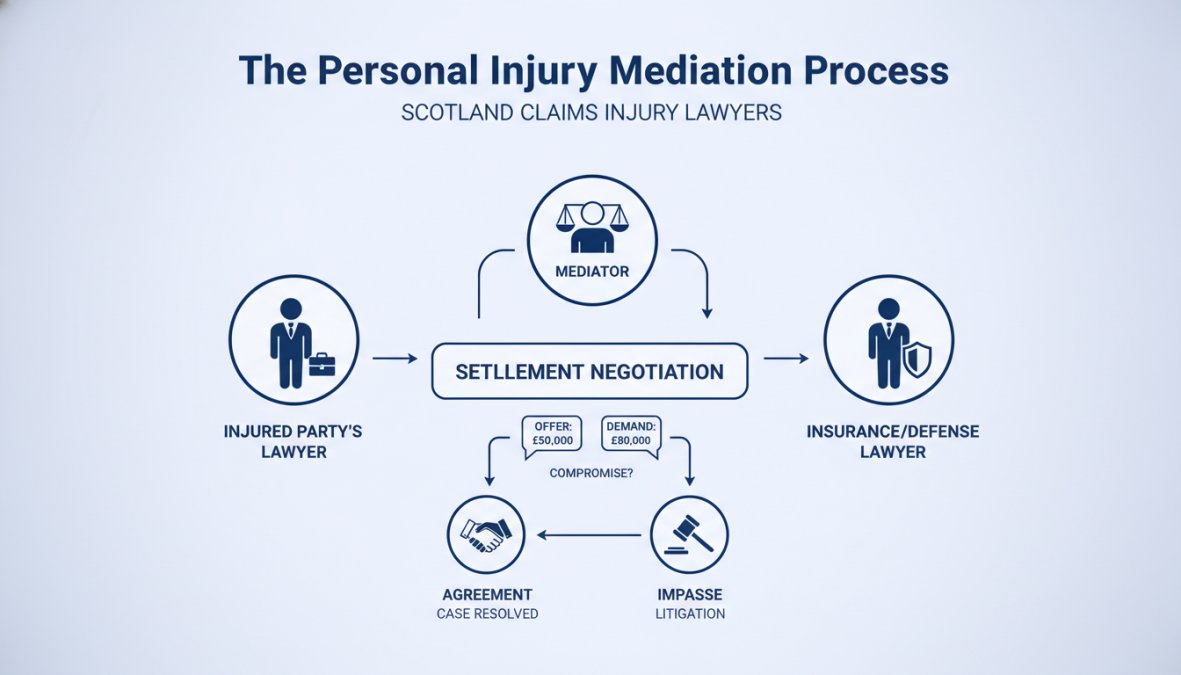
Mediation offers a structured yet flexible approach to resolving personal injury disputes outside the courtroom. A neutral third party, the mediator, facilitates dialogue between claimant and defendant, helping both sides identify common ground and negotiate a settlement agreement. Unlike arbitration or litigation, mediation places control entirely in the hands of the parties involved.
 Two professionals and a mediator seated around a wooden table in a calm, naturally lit meeting room, discussing settlement terms with documents and notepads visible
The process begins when both parties agree to mediate. Each side typically presents their position to the mediator separately, then in joint sessions. The mediator doesn't decide the outcome; instead, they help each party understand the other's perspective, identify realistic valuations, and explore creative settlement options. Mediation is particularly valuable because it preserves relationships when that matters and remains confidential, unlike public court proceedings.
Pro Tip
Request a mediator with specific experience in personal injury cases. Their familiarity with typical settlement ranges significantly improves negotiation outcomes.
Mediation typically follows a structured sequence, though experienced mediators adapt the process to each case's unique circumstances.
Initial consultation: Both parties meet with the mediator to outline the dispute, establish ground rules, and confirm confidentiality.
Separate caucuses: The mediator meets privately with each party to understand their position, priorities, and realistic expectations, allowing candid discussion without adversarial posturing.
Joint session: Parties may meet together to exchange information directly. Some mediations proceed entirely through shuttle mediation, where the mediator carries offers between parties.
Negotiation and refinement: As positions become clearer, the mediator helps identify areas of agreement and suggests compromise solutions.
Settlement agreement: Once parties agree on terms, the mediator typically helps document the agreement in writing.
Mediation works best when both parties genuinely want to resolve the matter without litigation. Success rates are highest when liability is reasonably clear and the dispute centres on valuation rather than fault. For workplace injuries or accidents where the defendant's insurance company is involved, mediation often succeeds because insurers understand the cost-benefit analysis: settling through mediation typically costs less than defending a lawsuit.
Personal injury mediation also succeeds when claimants and defendants have ongoing relationships they wish to preserve. A neighbour's slip-and-fall claim or employment-related injury sometimes benefits from mediation when the employee hopes to return to work.
Key Takeaway
Mediation succeeds approximately 70-80% of the time when both parties enter with realistic expectations and genuine willingness to compromise.
The duration of personal injury mediation varies depending on case complexity and how far apart initial positions are. A straightforward slip-and-fall claim might resolve in a single four-hour mediation session, whilst a catastrophic injury case could require multiple sessions spanning weeks.
Most personal injury mediations conclude within 2-6 weeks from initial contact to settlement agreement. This represents a dramatic time saving compared to litigation, which typically spans 18-36 months. For claimants facing financial hardship whilst awaiting compensation, this accelerated timeline proves invaluable.
| Mediation Stage |
Typical Duration |
Key Activities |
| Initial consultation |
1-2 weeks |
Mediator selection, scheduling, information exchange |
| Preparation |
1-2 weeks |
Document review, position statements, caucus preparation |
| Mediation session(s) |
1 day |
Separate meetings, joint sessions, negotiation |
| Settlement documentation |
3-7 days |
Agreement drafting, legal review, execution |
| Total process |
2-6 weeks |
From agreement to final settlement |
Watch Out
Avoid mediators who promise quick resolution without understanding your case's complexity. Rushing mediation often results in inadequate settlements that claimants later regret.
Pros and Cons of Arbitration vs Litigation
Arbitration and litigation represent two fundamentally different approaches to resolving personal injury disputes. Arbitration is a private process where a neutral arbitrator hears evidence from both sides and issues a binding decision. Litigation proceeds through the public court system, with a judge or jury determining the outcome. Understanding these differences helps claimants choose the pathway most likely to deliver fair outcomes.
Arbitration Advantages and Disadvantages
Advantages:
Arbitration delivers faster resolutions than litigation. Most arbitrations conclude within 6-12 months, compared to 2-3 years for typical court cases. Confidentiality is a major advantage, unlike public court proceedings, arbitration remains private, protecting sensitive medical and financial information. Arbitrators are typically selected for subject-matter expertise, often producing more informed decisions than generalist judges. Arbitration costs less than litigation when cases are straightforward, with no discovery phase and simplified evidence rules.
Disadvantages:
Arbitration awards are final and largely unappealable. If the arbitrator makes a legal error or awards inadequate compensation, claimants have limited recourse. Arbitration can become expensive if the case is complex, with arbitrator fees mounting quickly in multi-party disputes. Limited discovery means claimants receive less information from the defendant before the hearing, potentially disadvantaging parties without full information about the other side's case.
Litigation Advantages and Disadvantages
Advantages:
Litigation provides appellate rights. If a judge errs in law or awards grossly inadequate compensation, claimants can appeal to a higher court. Public court proceedings create accountability, judges must justify their decisions in written judgments subject to scrutiny. Discovery rights are extensive, allowing claimants to compel defendants to produce documents and answer questions. Jury trials can deliver larger awards, particularly in sympathetic cases involving clear negligence.
Disadvantages:
Litigation is slow, typically taking 2-3 years from claim to trial. It is expensive, with court fees, solicitor costs, and expert witness fees mounting significantly. Litigation is public, exposing sensitive medical and financial information. Litigation is unpredictable, judges and juries reach different conclusions from identical evidence, making settlement negotiations difficult.
Key Takeaway
Choose arbitration if speed and privacy matter most; choose litigation if you need appellate protection or believe a jury would award substantially more than an arbitrator.
Restorative Justice in Personal Injury Examples
Restorative justice approaches personal injury differently than traditional compensation models. Rather than focusing solely on monetary damages, restorative justice emphasises understanding, accountability, and genuine repair of harm. Whilst less common in personal injury than in criminal justice, restorative approaches increasingly inform settlement negotiations and out-of-court resolutions.
In a restorative justice framework, the focus shifts from "How much compensation?" to "How can the defendant repair the harm caused?" This might involve the defendant acknowledging responsibility, apologising sincerely, and committing to prevent similar harm in future. For claimants, restorative outcomes sometimes provide psychological closure that money alone cannot.
Consider a workplace injury caused by inadequate safety protocols. A purely compensatory approach awards damages for lost wages and medical costs. A restorative approach might additionally require the employer to implement new safety measures and acknowledge the harm caused. The claimant gains not just compensation but assurance that others won't suffer similarly.
Restorative approaches work best when both parties are willing to engage genuinely. They're less suitable for cases involving intentional harm or where the defendant refuses accountability.
Pro Tip
If emotional closure matters as much as financial compensation, explore whether restorative elements can be incorporated into your settlement agreement, such as a written apology or commitment to prevent future harm.
Structured Settlements as an Alternative to Lump-Sum Awards
Structured settlements offer an alternative to receiving compensation as a single lump-sum payment. Instead, the defendant purchases an annuity that provides periodic payments, monthly, annual, or in custom schedules, over a defined period or the claimant's lifetime.
For claimants with catastrophic injuries requiring lifelong care, structured settlements provide significant advantages. Rather than managing a large sum and risking poor financial decisions, claimants receive regular, guaranteed income ensuring funds are available for ongoing medical care, rehabilitation, and living expenses.
Structured settlements offer substantial tax advantages in the UK. Unlike lump-sum awards, periodic payments from a structured settlement are generally tax-free, meaning claimants retain more of their compensation compared to investing a lump sum.
For example, a claimant with a severe spinal injury might structure their settlement as: £50,000 immediate lump sum for home modifications, then £2,000 monthly for 20 years for care costs, with the remainder as a final payment at age 65. This approach ensures funds are available precisely when needed.
Structured settlements also protect claimants from creditors and financial pressure. Because periodic payments cannot be accessed as a lump sum, they're protected from creditor claims or pressure from family members. However, structured settlements lack flexibility, if circumstances change, accessing additional funds proves difficult.
| Settlement Type |
Payment Structure |
Tax Treatment |
Best For |
| Lump-sum award |
Single payment |
Tax-free |
Claimants wanting immediate access and control |
| Structured settlement |
Periodic payments |
Tax-free |
Catastrophic injuries requiring lifelong care |
| Hybrid arrangement |
Lump sum + periodic |
Tax-free |
Balancing flexibility with security |
Pre-Settlement Funding: Bridging the Financial Gap
Pre-settlement funding provides cash advances to personal injury claimants whilst their cases are pending. For claimants facing financial hardship during lengthy legal processes, this funding can be transformative, enabling them to cover living expenses and medical costs without settling prematurely for inadequate compensation.
The concept is straightforward: a funding company provides cash now, repayable only if the claimant wins their case. If the case fails, the claimant owes nothing. This non-recourse structure removes financial pressure to accept unfavourable settlements simply to access funds immediately.
Pre-settlement funding operates differently from traditional loans. There's no credit check, no employment verification requirement, and no monthly payments during the case. Repayment occurs only from settlement proceeds, typically as a percentage of the final award.
How Pre-Settlement Funding Works
A claimant contacts a funding provider and submits basic information about their case: injury type, liability assessment, estimated claim value, and current financial needs. The funding company reviews the case to assess repayment likelihood. Once approved, funding is typically provided within 24-48 hours.
Amounts vary from a few hundred pounds to tens of thousands, depending on the case's strength and the claimant's needs. Repayment terms are agreed upfront, most funding companies charge either a fixed percentage of the settlement (typically 15-25% of the advance) or a fixed fee plus interest. Importantly, if the case is lost, the claimant repays nothing.
Advantages and Disadvantages
Advantages:
Pre-settlement funding removes financial pressure to settle prematurely, allowing claimants to pursue optimal strategies. Funding is non-recourse, if the case fails, the claimant owes nothing. Funding is rapid, with most approvals within days and funds available within 48 hours. There are no credit checks or employment requirements; funding companies evaluate case strength, not creditworthiness.
Disadvantages:
Pre-settlement funding is expensive, with funding companies charging 15-25% of advances or fixed fees plus interest. Funding reduces final settlement amounts substantially. Funding companies assess case strength conservatively and may decline funding for cases they deem risky. Funding creates incentives for quick resolution, potentially pressuring claimants to accept reasonable settlements rather than pursuing maximum awards.
Watch Out
Compare funding offers carefully. Costs vary significantly between providers, and a seemingly small percentage difference compounds substantially over multi-year cases.
Private Alternative Dispute Resolution (ADR) Mechanisms
Private alternative dispute resolution encompasses mediation, arbitration, and hybrid processes designed to resolve disputes outside the public court system. Professional organisations have established standards, training mediators and arbitrators, and creating enforceable procedures.
In Scotland, private ADR providers offer personal injury specialists with deep expertise in injury valuations, medical evidence, and settlement practices. These specialists often deliver better outcomes than generalist judges unfamiliar with injury-specific issues. JAMS provides comprehensive alternative dispute resolution services including mediation and arbitration specifically designed for personal injury claims.
Private ADR mechanisms offer flexibility unavailable in court litigation. Parties can select their decision-maker based on expertise, choose procedural rules, determine hearing schedules, and maintain confidentiality. Many private ADR organisations now offer "med-arb" procedures combining mediation and arbitration, the process begins with mediation; if parties don't reach settlement, the mediator becomes the arbitrator and issues a binding decision.
No-Fault Insurance Systems: A Different Approach
No-fault insurance systems represent a fundamentally different approach to personal injury compensation. Rather than requiring claimants to prove negligence and liability, no-fault systems provide automatic compensation for injuries regardless of fault. These systems prioritise rapid compensation and rehabilitation over fault-finding and litigation.
In a no-fault system, an injured person receives compensation directly from their own insurance policy or a statutory fund, regardless of who caused the accident. This eliminates the need to prove the defendant's negligence, dramatically accelerating compensation. A claimant receives payment within weeks rather than years.
No-fault systems excel at providing rapid, predictable compensation. Medical expenses and lost wages are typically covered automatically. However, no-fault systems typically provide more limited compensation than fault-based systems. Because no negligence must be proven, awards for pain and suffering are often lower or unavailable.
The UK's motor insurance system includes elements approaching no-fault coverage. Uninsured loss recovery schemes allow claimants to recover compensation even when the defendant is uninsured. Statutory compensation schemes provide automatic payments for certain injuries, regardless of fault.
Key Takeaway
No-fault systems prioritise speed and certainty over maximum compensation. They suit claimants needing rapid access to funds for immediate medical and living expenses.
Comparing Your Options: Which Alternative Suits Your Situation?
Selecting among alternatives to standard personal injury compensation requires careful evaluation of your specific circumstances, priorities, and case characteristics. Different alternatives suit different situations.
Choose mediation if: Liability is reasonably clear and the dispute centres on valuation; you want a faster, less expensive process; you prefer maintaining some relationship with the other party; confidentiality is important; you want maximum control over the outcome.
Choose arbitration if: You want faster resolution than litigation; privacy is essential; you prefer a decision-maker with specific expertise; you're willing to accept finality without appellate rights; cost savings matter significantly.
Choose litigation if: Liability is genuinely disputed; you need appellate rights as a safety net; public accountability matters; you believe a jury would award substantially more than an arbitrator; you want extensive discovery of the defendant's information.
Choose structured settlement if: Your injury is catastrophic and requires lifelong care; you want guaranteed income rather than managing a lump sum; you want tax advantages; you're concerned about creditor claims; you can accept limited flexibility.
Choose pre-settlement funding if: You face immediate financial hardship; you want to avoid settling prematurely; you can afford the funding costs; your case is strong enough to attract funding; you need bridge funding during a lengthy process.
Choose restorative justice if: You value accountability and understanding over pure compensation; you have an ongoing relationship with the defendant; emotional closure matters as much as financial recovery; you want commitment to prevent future harm.
| Alternative |
Speed |
Cost |
Privacy |
Control |
Best For |
| Mediation |
Fast |
Low |
High |
High |
Clear liability, valuation disputes |
| Arbitration |
Fast |
Medium |
High |
Medium |
Expertise needed, confidentiality critical |
| Litigation |
Slow |
High |
Low |
Low |
Disputed liability, appellate protection needed |
| Structured settlement |
N/A |
N/A |
High |
Low |
Catastrophic injuries, lifelong care |
| Pre-settlement funding |
N/A |
High |
High |
High |
Financial hardship, strong cases |
| Restorative justice |
Medium |
Low |
High |
High |
Accountability matters, ongoing relationships |
Consider also your solicitor's recommendation. Experienced personal injury lawyers understand which alternatives work best for specific injury types and circumstances. Most claimants benefit from discussing multiple alternatives with their solicitor before committing to one pathway.
Pro Tip
Many cases evolve, mediation might fail, requiring arbitration or litigation; alternatively, a successful mediation might eliminate the need for more formal processes.
Navigating personal injury claims in Scotland presents genuine challenges, particularly when facing lengthy processes and mounting expenses. Alternatives to standard personal injury compensation exist specifically to address these challenges, offering faster resolutions, lower costs, and greater control than traditional litigation. Scotland Claims Injury Lawyers specialises in evaluating which alternative suits each claimant's unique circumstances, whether that's mediation for straightforward disputes, arbitration for privacy and expertise, or structured settlements for catastrophic injuries. With a No Win No Fee arrangement ensuring you retain 100% of your compensation, exploring your options costs nothing. Contact Scotland Claims Injury Lawyers today to discuss which pathway makes sense for your situation and begin your journey toward fair compensation and recovery.
Frequently Asked Questions
What are the main alternatives to standard personal injury compensation through litigation?
The primary alternatives to standard personal injury compensation include mediation, arbitration, structured settlements, and pre-settlement funding. Mediation involves a neutral third party helping both sides reach agreement. Arbitration is a formal but faster process where an arbitrator makes a binding decision. Structured settlements allow you to receive compensation in periodic payments rather than a lump sum. Pre-settlement funding provides cash advances whilst your case is pending. Each option has distinct advantages depending on your circumstances, timeline, and financial needs.
How long does personal injury mediation take compared to court litigation?
Personal injury mediation typically takes significantly less time than litigation. Most mediations conclude within a few hours to several months, whereas court cases often take 1–3 years or longer. The duration depends on case complexity and parties' willingness to negotiate. Mediation's speed stems from its flexible scheduling and informal nature. Litigation requires discovery phases, motions, and court schedules. If you need faster resolution and wish to avoid prolonged legal proceedings, mediation offers a more efficient path to settlement.
What are the key differences between arbitration and litigation for personal injury claims?
Arbitration involves a private arbitrator making a binding decision outside court, whilst litigation proceeds through the court system with a judge or jury. Arbitration is typically faster, more confidential, and less formal than litigation. However, arbitration offers limited appeal rights and can be expensive depending on complexity. Litigation provides full procedural safeguards and appellate remedies but is slower and more costly. The choice depends on whether you prioritise speed and privacy (arbitration) or formal legal protections and potential appeals (litigation).
Can restorative justice approaches help resolve personal injury claims?
Restorative justice emphasises dialogue, understanding, and repairing harm between parties rather than punitive outcomes. In personal injury contexts, restorative approaches may involve mediated conversations where the responsible party acknowledges harm and agrees to fair compensation. This suits cases where relationships matter or where both parties seek closure beyond financial awards. However, restorative justice works best when both parties are willing to engage constructively. It is less suitable for severe injuries or cases involving significant liability disputes. Many mediators incorporate restorative principles into settlement negotiations.