One Month to Respond: Solicitor Route to Medical Records in Scotland

For a Scottish personal injury claim, your solicitor can request your full medical records free of charge once you have signed a letter of authority. Start with a solicitor-led request to the GP practice or health board; if records are delayed or refused, formal court recovery under Scottish civil procedure forces disclosure.
TL;DR:
- Solicitors can request comprehensive medical records in Scotland for free once a signed letter of authority is in place, speeding up evidence collection.
- Clear, detailed requests specifying record types and dates reduce delays and disputes, especially concerning pre-accident health baseline and follow-up records.
- Formal court procedures are available if providers refuse or delay records, but they involve additional time and costs and are used as last resorts.
- Responding to refusals or delays should follow an escalation process, including internal complaints and ICO complaints, with thorough record-keeping to support legal action.
- Engaging specialist injury solicitors simplifies the process, ensures proper handling of requests, and incurs no upfront costs or success fees if a claim fails.
Table of Contents
How to access medical records in Scotland for a claim
Getting this right starts with knowing what actually counts as useful evidence. A personal injury claim in Scotland lives or dies on whether a medical expert can draw a clear line between the accident and your ongoing symptoms, and that line only holds if the records cover the right period and the right detail.
Ask for these as a baseline:
- GP notes covering a suitable period before the accident and everything since, so the expert can see your health baseline.
- Hospital records, both outpatient and inpatient, for any admission or follow-up linked to the injury.
- A&E cards from the day of the accident, which often contain the first clinical description of your injuries.
- Imaging and reports, including X-rays, MRI scans, and the radiologist’s written findings.
- Physiotherapy notes and prescription logs, which track recovery speed and ongoing pain management.
Pre-accident records matter just as much as post-accident ones. They establish what condition you were in before the incident, which is exactly what an insurer’s medical expert will scrutinise when arguing your symptoms were pre-existing. Vague requests invite disputes. Naming the record type, the treating clinician, and the date range up front means the GP practice or health board can locate the file first time, rather than sending a partial response that triggers a second round of correspondence.
How do solicitors get medical records without a fee?
Once you’ve instructed a solicitor, the informal route is almost always the fastest and cheapest way to get your records into evidence.
- Sign a letter of authority. This gives your solicitor the legal standing to request records on your behalf and should specify exactly which record types and date ranges are covered.
- Submit a solicitor request or subject access request (SAR) to the GP practice, hospital, or health board holding the file.
- Confirm the request is free. Under Law Society of Scotland guidance, GDPR and the Data Protection Act 2018 mean GPs generally cannot charge for standard copies unless a request is manifestly unfounded or excessive.
- Include your NHS number if you know it, along with full name, date of birth, and current address, to avoid identity mismatches that stall processing.
- Specify delivery format. Ask for digital scans or diagnostic-quality imaging rather than paper printouts, which speeds things up considerably when the file later goes to a medical expert.
- Track the response deadline. Providers have a statutory response timescale with a possible extension for complex requests, according to GDPR guidance for claims handlers.
Pro Tip: Ask the provider to confirm receipt of your request in writing with a reference number. If the file goes quiet after three weeks, you have a paper trail ready for a chaser email or, eventually, an ICO complaint.
Delays are common in practice, often down to mismatched Trust or GP procedures rather than any refusal, according to MAPS Medical. A tightly scoped request with clear identifiers heads off most of that friction before it starts.
What if a provider refuses to release records?
Voluntary cooperation covers the vast majority of cases, but Scotland has a formal mechanism for the rest. This is where the Administration of Justice (Scotland) Act 1972 and the procedure known as commission and diligence come in, and Practice Direction 29 sets out how it works step by step.
The process runs like this:
- Your solicitor drafts a specification of documents, listing precisely which records are sought and from whom.
- A motion is lodged with the court asking for authority to recover those documents.
- The specification is intimated to the “haver”, the person or body holding the records, typically the health board or GP practice.
- The court can order production, allow inspection, or appoint a commissioner to oversee recovery where the haver still resists.
This route works, but it is slower and costlier than a straightforward request. Court timescales add weeks, sometimes months, and there are court fees plus solicitor time to factor in. That’s exactly why solicitors treat it as a backstop rather than a default. As one insight from the recovery procedure notes, formal orders can compel wide-ranging material, but the administrative overhead of drafting, lodging, and intimating documents makes them a deliberate last resort, not a first move.
Dealing with delays, refusals and ICO complaints
Most refusals aren’t really refusals. They’re providers testing whether a request is “manifestly unfounded or excessive” under GDPR, which is the only real basis for declining or charging a fee. If a health board tries to charge you for a standard records request, that claim needs to be challenged rather than accepted at face value.
When a request stalls, work through this escalation ladder:
- Chase in writing. Reference your original request date and any confirmation number, and ask for a specific timeline.
- Raise a formal complaint with the provider’s own complaints department if the one-month deadline passes without a response.
- Complain to the Information Commissioner’s Office if internal escalation doesn’t move things, since ICO involvement often prompts swift compliance from NHS bodies.
- Instruct your solicitor to consider a court application under the 1972 Act if the ICO route stalls or the provider still refuses outright.
Keep every piece of correspondence, including dates, reference numbers, and any stated reason for delay. That paper trail is exactly what an ICO complaint or court motion will need to demonstrate the provider missed its obligations.
Getting medical records held abroad or by specialist bodies
Records held outside the UK rarely arrive as cleanly as a Scottish GP file. Foreign providers frequently demand notarised powers of attorney, official translations, or apostilled authority documents before releasing anything, and even then you might only get a summary report rather than the full clinical file, according to MAPS Medical.
Practical steps for this situation:
- Instruct a local agent in the relevant country where the health system won’t deal directly with a UK solicitor.
- Budget extra time. Translation and certification alone can add weeks to a claim timeline.
- Weigh the value of the records against the cost of chasing them. If they’re only marginally relevant to causation, your solicitor may proceed on expert opinion supported by whatever contemporaneous UK notes exist.
- Flag deceased-patient cases early. Different rules apply under the Access to Health Records Act 1990, and you may need to produce grant of probate or executor authority before records are released.
Preparing records for the medical expert and court
A messy bundle slows everyone down, from the expert writing your medico-legal report to the court clerk processing disclosure.
Build a chronological bundle with a clear index, so the expert can see the injury timeline at a glance rather than hunting through pages out of order. Confirm imaging arrives in diagnostic quality, not a compressed screenshot, since a poor scan can force a second request and push back your expert’s report date. Keep the original files secure and only share working copies, redacting genuinely unrelated sensitive material such as unconnected mental health history, while retaining the full original for inspection if the other side challenges the redaction.
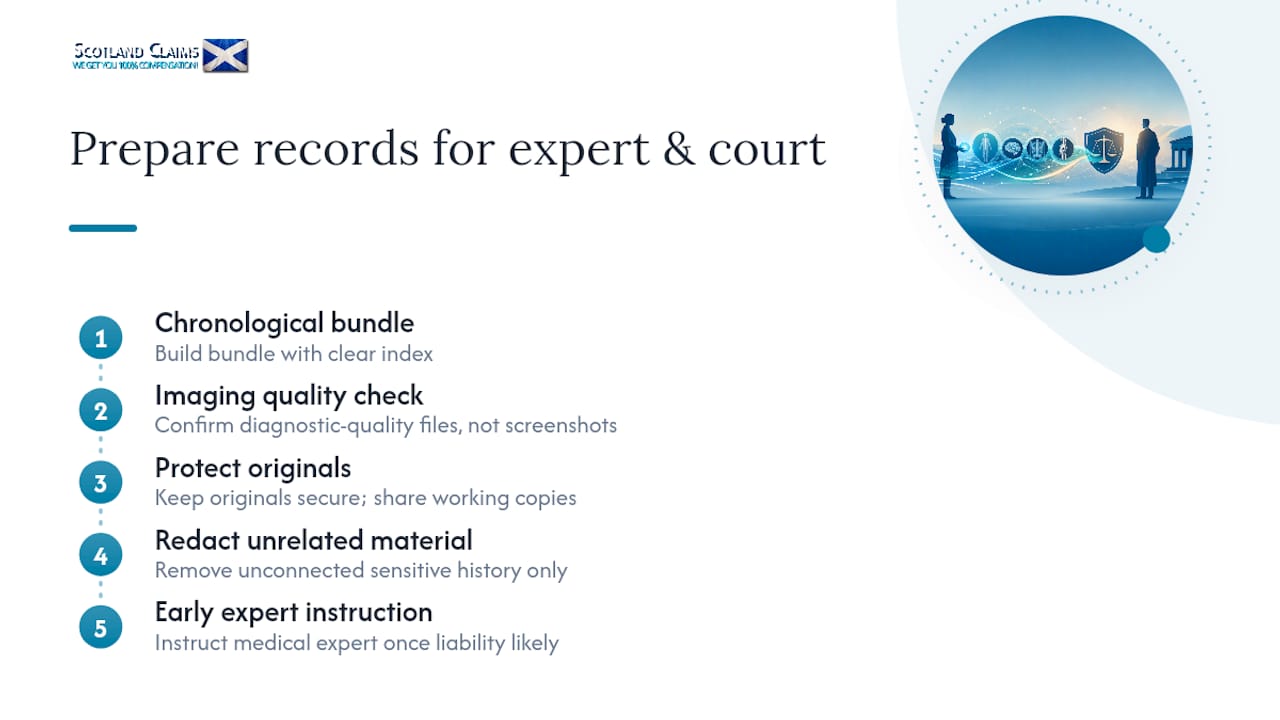
Pro Tip: Instruct your medical expert as early as possible once liability looks likely. Scottish practice guidance recommends starting the medical report process soon after an admission of liability to keep your claim on the fastest realistic timetable, per Brodies’ Scottish claims guide.
Why solicitor-led record recovery matters
Solicitor-led recovery isn’t just a formality. It protects the integrity of the evidence. When a solicitor requests records directly from the provider using a signed authority, there’s no question later about whether the file was altered or selectively shared, which matters enormously if the insurer’s own medical expert challenges causation.
It also speeds things up. A solicitor who knows exactly which record types to name, and how to push back on an unjustified fee or delay, gets your file moving faster than a claimant navigating GDPR rules alone for the first time. That’s the value a solicitor-led service brings to record recovery: handling the authority, the request, and the escalation, so your claim keeps moving while you focus on recovering.
— Roger
Let specialist personal injury solicitors handle your medical records
Chasing GP practices and health boards for records while you’re still recovering from an injury is the last thing you need. Specialist personal injury solicitors handle the entire records process, from the signed authority through to instructing your medical expert, so nothing gets missed and nothing gets delayed by an avoidable paperwork error.
The arrangement is straightforward: no success fee, ever. You pay nothing upfront and nothing from your award. If your claim doesn’t succeed, you owe nothing.
Get a free assessment from an injury lawyer in Scotland today, or check the no win no fee guarantee in full before you start.
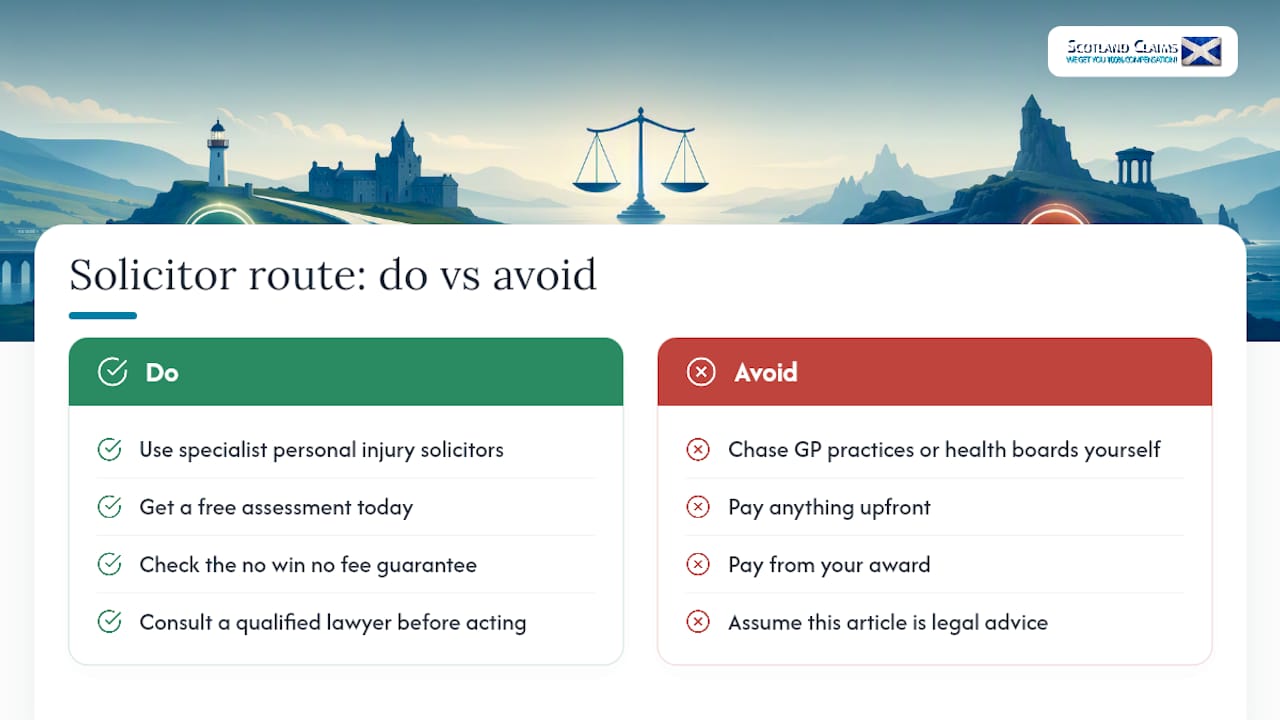
This article is general information, not a substitute for advice from a qualified lawyer. Consult a qualified legal professional about your own circumstances before acting on anything here.
Sources
FAQ
Can I get my own medical records for a claim without a solicitor?
Yes, you can request them yourself under GDPR, but a solicitor-led request usually moves faster because it comes with clear scope, correct identifiers, and an established point of contact at the provider.
Do GPs charge for releasing medical records in Scotland?
No, standard requests are free under GDPR and the Data Protection Act 2018 unless the request is manifestly unfounded or excessive, per Law Society of Scotland guidance.
How long does it take to get medical records in Scotland?
Providers have one month to respond, extendable by a further two months for complex requests, as set out in GDPR guidance for claims handlers.
What happens if a health board refuses to release records?
Your solicitor can escalate through internal complaints, then the Information Commissioner’s Office, and ultimately apply to the court for a specification of documents under the Administration of Justice (Scotland) Act 1972.
Does Scotland Claims Injury Lawyers charge for obtaining records?
No.
Recommended