How to protect claim rights after an injury in Scotland

TL;DR:
- Protecting your claim rights in Scotland requires prompt evidence gathering and strict adherence to a three-year deadline. Early legal advice and careful documentation increase your chances of a successful, fully compensated claim without upfront costs or success fees.
Protecting your claim rights is defined as taking the legal steps needed to preserve your right to compensation after an accident or injury in Scotland. The Civil Liability Act 2018 shapes how certain personal injury claims are handled, particularly for soft tissue injuries, and Scottish law imposes strict time limits that can end your claim permanently if missed. Scotland Claims Injury Lawyers works with injured people across Scotland to safeguard those rights from day one, with no success fees and 100% compensation retained by you. Acting fast, gathering evidence, and getting the right legal support are not optional extras. They are the foundation of every successful claim.
How to protect claim rights: understanding your legal deadlines
Time limits are the single biggest threat to any personal injury claim in Scotland. Scottish law gives you three years from the date of your accident to bring a claim. Miss that deadline and your claim is statute-barred, meaning no court will hear it, regardless of how strong your evidence is.
Three years sounds generous. In practice, it disappears quickly. Injuries take time to fully manifest. Insurers delay responses. Evidence gets lost. Before you know it, months have passed without formal action.
Key deadlines and rules to know:
- Three-year limitation period. The clock starts on the date of the accident, not the date you first felt pain or sought treatment.
- Children and incapacitated claimants. The three-year period does not begin until a child turns 16, or until a person regains mental capacity.
- Motor Insurers’ Bureau (MIB) claims. If the driver who injured you was uninsured or fled the scene, the MIB compensates victims under special agreements with different procedures and shorter notification windows. These claims require specialist handling.
- Protective proceedings. If your deadline is approaching and your claim is not yet settled, a solicitor can issue protective court proceedings to preserve your legal position while negotiations continue.
- Missing claim deadlines leads to dismissal and permanent loss of your right to compensation. Insurers also draw adverse inferences from late notification, which weakens your negotiating position even before a deadline expires.
Pro Tip: Register your claim with a solicitor as early as possible, even if you are still receiving treatment. Early registration locks in your legal position and gives your lawyer time to gather evidence properly.
The first 48 hours after an accident are the most important for protecting your rights. Evidence disappears, memories fade, and witnesses become harder to trace. The steps you take in this window directly affect the strength of your claim.
“Adrenaline masks injuries after an accident. You may feel fine at the scene and wake up in serious pain the next morning. Seek medical assessment the same day, even if you feel uninjured, because contemporaneous medical records are critical evidence that no amount of later testimony can replace.”
Follow these steps in order:
- Prioritise your safety. Move to a safe location if possible. Call 999 if anyone is injured or if the road is blocked.
- Call the police if required. For road traffic accidents involving injury, you are legally required to report the incident. Failure to do so can complicate your claim.
- Exchange details. Collect the name, address, vehicle registration, and insurance details of every other party involved. Do not rely on memory.
- Photograph everything. Take photos of vehicle damage, road conditions, skid marks, traffic signs, your injuries, and the wider scene. Dashcam footage is particularly valuable and should be saved immediately before it overwrites.
- Speak to witnesses. Get names and contact numbers from anyone who saw what happened. Independent witness accounts carry significant weight with insurers and courts.
- Seek medical attention. Visit your GP, an NHS urgent care centre, or A&E the same day. Early medical assessment creates a contemporaneous record that links your injuries directly to the accident.
- Notify your insurer. Failing to notify your insurer promptly can negatively affect your own policy and limit your ability to claim, even if the accident was entirely the other party’s fault.
Pro Tip: Back up all photos and videos to a cloud service immediately. Phones get lost, broken, or reset. Your evidence must survive the claim process.
How do you document and preserve evidence to defend your claim rights?

Strong documentation is what separates a claim that settles quickly from one that drags on or fails. Thorough evidence at the scene significantly strengthens a claim’s validity and deters insurers from disputing liability. Poor documentation, by contrast, gives the other side room to argue.
The types of evidence that matter most in Scottish personal injury claims are:
- Medical records. Every GP visit, hospital attendance, and specialist report connected to your injury. These establish the nature, severity, and duration of your condition.
- Accident reports. Police reports, employer accident book entries, and any official incident reports filed at the time.
- Witness statements. Written accounts from independent witnesses, gathered as soon as possible while details are fresh.
- Photographs and video. Scene photos, injury photos taken over time as bruising develops, and any available CCTV or dashcam footage.
- Financial records. Receipts for medical expenses, travel costs, and any proof of lost earnings directly caused by the injury.
The table below shows how each evidence type supports your claim:
| Evidence type |
What it proves |
| Medical records |
Nature, severity, and cause of injury |
| Accident report |
That the incident was formally recorded at the time |
| Witness statements |
Independent account of how the accident happened |
| Photographs and video |
Visual proof of conditions, damage, and injuries |
| Financial records |
Quantifies your losses beyond physical injury |
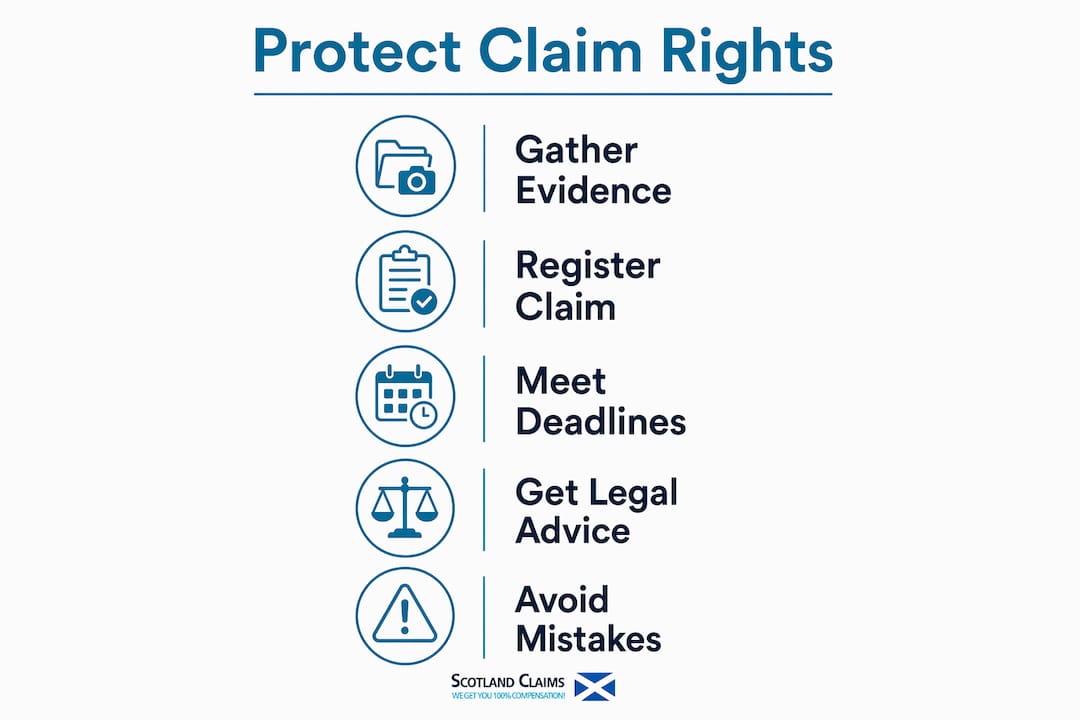
Organise all documents in a single folder, physical or digital, from day one. Scotland Claims Injury Lawyers provides a complete injury claim documents checklist that covers every document you are likely to need for a Scottish personal injury claim.
What common mistakes can jeopardise your claim rights?
Most claims that fail or settle for less than they should do not fail because of weak injuries. They fail because of avoidable errors made in the days and weeks after the accident. Understanding these mistakes is a core part of any rights protection strategy.
The most damaging errors are:
- Delaying legal action. Every week you wait is a week less to gather evidence, trace witnesses, and build your case. Timely claim handling improves the chances of a quick and fair settlement.
- Admitting fault at the scene. Not admitting fault or making inconsistent statements protects your legal position. An apology or casual remark at the scene can be used against you later.
- Skipping medical appointments. Gaps in your medical history suggest your injuries were not serious. Attend every appointment and follow all treatment advice.
- Mishandling evidence. Deleting photos, losing receipts, or failing to save dashcam footage before it overwrites are all avoidable errors that weaken your claim.
- Accepting an early settlement offer. Insurers sometimes offer quick, low settlements before the full extent of injuries is known. Accepting too early can leave you without recourse if your condition worsens.
For a detailed breakdown of claim mistakes to avoid in Scotland, Scotland Claims Injury Lawyers has published a dedicated guide covering the most common pitfalls seen in Scottish personal injury cases.
Pro Tip: Never discuss your claim on social media. Insurers and their legal teams monitor public posts. A photo of you at a social event can be used to dispute the severity of your injuries.
How can a Scottish injury lawyer help you protect and enforce your claim rights?
Legal professionals do more than fill in forms. A specialist Scottish injury lawyer manages every stage of your claim, from the first notification to final settlement, and their involvement directly affects both the outcome and the amount you receive.
The practical benefits of instructing a solicitor early include:
- Deadline management. Your lawyer tracks all limitation periods and issues protective proceedings if negotiations are still ongoing as a deadline approaches.
- Medical and insurance communications. Solicitors handle all correspondence with insurers and arrange independent medical assessments, removing the risk of you inadvertently saying something that harms your claim.
- Evidence gathering. Lawyers know how to obtain CCTV footage, police reports, and expert witness evidence that most claimants cannot access alone.
- Realistic valuation. An experienced solicitor knows what comparable claims have settled for and will not accept an undervalued offer.
- No financial risk. Scotland Claims Injury Lawyers offers no win no fee agreements with zero success fees, meaning you keep 100% of your compensation. Many solicitors charge a success fee of up to 20% of your settlement. Scotland Claims Injury Lawyers charges nothing.
The workplace rights guide from Care Lawyers in Australia provides a useful parallel on how early legal involvement protects claimants’ rights following serious injuries, a principle that applies equally in Scotland.
Early legal advice after an accident in Scotland is the single most effective step you can take to defend your claim rights and maximise your compensation.
Key takeaways
Protecting your claim rights in Scotland requires immediate evidence gathering, strict adherence to the three-year limitation period, and early instruction of a specialist injury lawyer who charges no success fees.
| Point |
Details |
| Three-year time limit |
Claims must be started within three years of the accident date or they are permanently barred. |
| Immediate evidence gathering |
Photographs, witness details, and medical records taken at the time are the strongest proof of liability. |
| Avoid admitting fault |
Any statement at the scene can be used against you; say nothing beyond exchanging required details. |
| Notify your insurer promptly |
Late notification can affect your own policy and reduce your ability to claim, even if you were not at fault. |
| No success fees with Scotland Claims |
Scotland Claims Injury Lawyers retains 0% of your compensation, compared with up to 20% charged elsewhere. |
Why I think most people wait too long before protecting their claim
The pattern I see most often is this: someone is injured, they assume they will feel better in a few days, and they put off doing anything formal. Six months later, the pain has not gone, the witnesses have moved on, and the dashcam footage has long since been overwritten. The claim is still technically alive, but it is now much harder to win.
The legal system in Scotland gives you three years, but that is a safety net, not a recommended timeline. The best claims I have seen handled are the ones where the injured person acted within days, not months. They had photos. They had a GP record from the day after the accident. They had a witness statement taken while the details were still sharp.
The other thing I would push back on is the assumption that legal help is expensive or complicated. Scotland Claims Injury Lawyers operates on a genuine no success fee basis. You pay nothing if the claim fails, and you keep every penny if it succeeds. That removes the financial barrier that stops many people from getting advice early. There is no rational reason to wait.
My practical advice is simple. See a doctor the same day. Save every piece of evidence you can. Then speak to a specialist Scottish injury lawyer before you speak to any insurer. The insurer’s interests are not your interests. A good solicitor’s interests are.
— Roger
Scotland Claims Injury Lawyers: protecting your rights with no success fees
Scotland Claims Injury Lawyers specialises in personal injury claims across Scotland, covering road traffic accidents, workplace injuries, slips, trips, and more. Every claim is handled on a no win no fee basis with zero success fees, so you retain 100% of your compensation if your claim succeeds. Most solicitors in Scotland deduct up to 20% of your settlement as a success fee. Scotland Claims Injury Lawyers deducts nothing. If you have been injured and want to understand your rights, speak to a specialist injury lawyer in Scotland today. There are no upfront costs, no hidden charges, and no obligation to proceed.
FAQ
How long do I have to make a personal injury claim in Scotland?
You have three years from the accident date to bring a personal injury claim in Scotland. Missing this deadline means your claim is statute-barred and cannot proceed.
What should I do first after an accident to protect my claim?
Call the police if required, exchange details with all parties involved, photograph the scene, and seek medical attention the same day. Early medical records are critical evidence that directly supports your claim.
Can I claim if the other driver was uninsured?
Yes. The Motor Insurers’ Bureau compensates victims of accidents involving uninsured or untraced drivers. These claims follow different procedures and shorter notification windows, so specialist legal advice is needed from the outset.
Does admitting fault at the scene affect my claim?
Admitting fault or making inconsistent statements at the scene can be used against you in legal proceedings. Exchange only the required details and let your solicitor handle all formal communications.
Will I have to pay legal fees if my claim fails?
With Scotland Claims Injury Lawyers, you pay nothing if your claim is unsuccessful. The no win no fee arrangement carries zero success fees, meaning you keep 100% of any compensation awarded.
Recommended