Whiplash claims in Scotland: your complete guide

TL;DR:
- Claiming for whiplash in Scotland involves individual assessment based on actual injuries, not fixed tariffs.
- A lawyer’s evidence and medical records are crucial, and claimants have three years from the accident to pursue compensation.
If another party caused your accident, you can claim compensation for whiplash in Scotland right now. Scots law assesses each claim individually using the Judicial College Guidelines, and the fixed tariffs introduced in England and Wales in 2021 do not apply here. That distinction matters in practice: Scottish claimants are not capped by the tariff system, which means your award reflects your actual injury, not a fixed table.
- You must show another party was at fault (a road collision, workplace accident, or slip/trip caused by someone else’s negligence).
- The standard time limit is generally three years from the date of the accident or the date you became aware of the injury.
- Compensation covers general damages (pain, suffering, loss of amenity) and special damages (lost earnings, medical costs, care expenses).
- Scotland Claims Injury Lawyers offer free, no-obligation assessments and a No Win No Fee arrangement where you keep 100% of your awarded compensation.
The single best next step: contact a specialist Scottish personal injury solicitor before speaking to any insurer about liability.
Table of Contents
Who can claim for whiplash in Scotland?
Eligibility turns on two things: fault and causation. You must show that another party was negligent or legally responsible, and that their negligence directly caused your neck injury.
- Drivers and passengers injured in a road traffic collision where the other driver was at fault.
- Pedestrians and cyclists struck by a negligent driver.
- Workers injured through an employer’s failure to provide a safe working environment.
- Individuals hurt in slips, trips, or falls on premises where the occupier owed a duty of care.
Evidence you will need includes medical records, an accident report, witness contact details, photographs of the scene and vehicles, and any employer incident reports where relevant. If the at-fault driver was uninsured or untraceable, claims can be pursued via the Motor Insurers’ Bureau, as mygov.scot confirms.
Pro Tip: Never discuss liability with the at-fault party’s insurer before taking legal advice. Note the insurer’s details, then call a specialist solicitor. Anything you say early in the process can be used to reduce your award.

How compensation for whiplash injuries is calculated in Scotland
Compensation is assessed individually under Scots law. The Judicial College Guidelines serve as the primary reference for valuing pain, suffering and loss of amenity, and Scottish courts and practitioners use them to set realistic ranges based on injury severity and prognosis length.
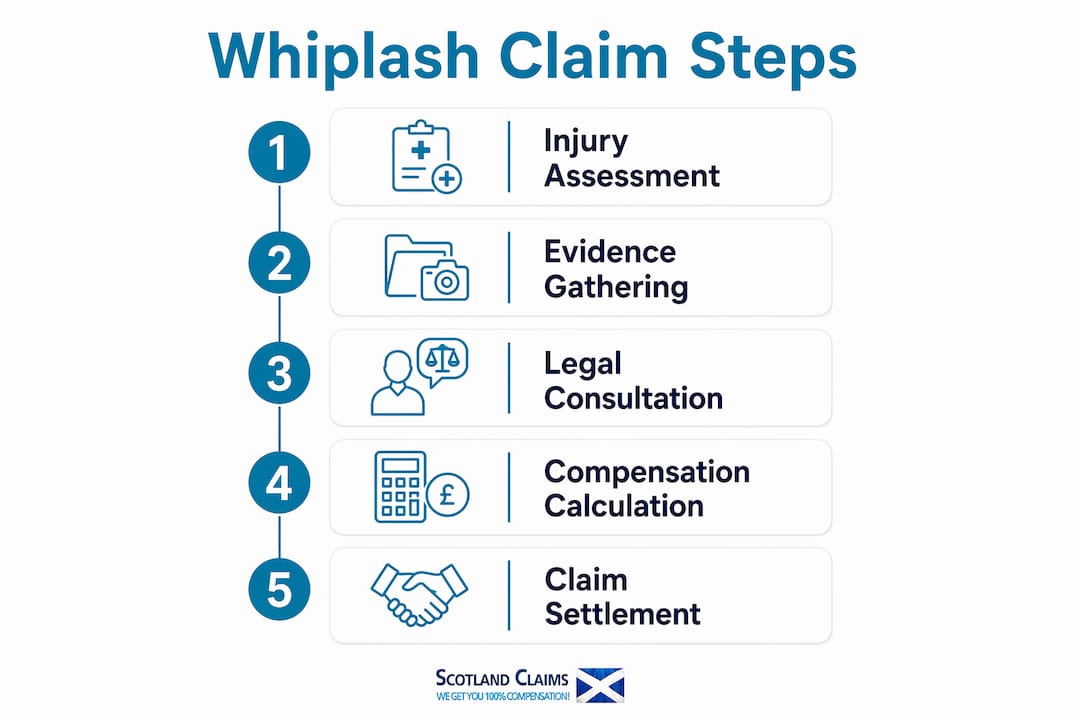
A typical award has two components. General damages cover the pain, suffering and impact on daily life. Special damages recover out-of-pocket losses: lost earnings, travel to medical appointments, physiotherapy costs, and care provided by family members. Where NHS treatment costs are recoverable, the Scottish Law Commission’s 2024 report on personal injury damages sets out the deduction rules that apply.
The table below illustrates why Scots law can produce significantly higher awards than the England and Wales tariff for the same duration of symptoms.
| Symptom duration |
England & Wales tariff (post-2021) |
Scotland: individual assessment range |
| Up to 3 months |
A fixed tariff applies in England and Wales, but Scotland assesses claims individually and usually results in higher awards |
|
| three to six months |
A fixed tariff applies in England and Wales, but Scotland assesses claims individually and usually results in higher awards |
|
| weeks to several months |
A fixed tariff applies in England and Wales, but Scotland assesses claims individually and usually results in higher awards |
|
| several months to over a year |
A fixed tariff applies in England and Wales, but Scotland assesses claims individually and usually results in higher awards |
|
| 1–2 years |
A fixed tariff applies in England and Wales, but Scotland assesses claims individually and usually results in higher awards |
|
Sources: SI 2021/642 tariff figures; Scottish individual assessment per practitioner analysis.
Accurate medical records and a clear prognosis are the single biggest driver of award value. A report that documents symptoms over weeks rather than days, and confirms ongoing treatment, will support a materially higher valuation than a brief GP note.
Key insight: Because Scotland uses individual assessment rather than a fixed tariff, the length and severity of your symptoms directly determine your award. Detailed, contemporaneous medical records are not just useful — they are the foundation of your claim’s value.
Time limits and how long a whiplash claim takes in Scotland
The standard limitation period for personal injury claims in Scotland is three years from the date of the accident or the date you first became aware of the injury. Miss that deadline and your claim is almost certainly barred.
Here is how the process typically unfolds:
- Initial enquiry and free assessment (days to one week): solicitor reviews the facts, confirms eligibility and agrees No Win No Fee terms.
- Medical evidence and records (weeks to two months): your solicitor obtains a medical report from an independent expert; GP and hospital records are requested.
- Letter of claim to the insurer (sent once evidence is ready): the insurer has a set period to investigate and respond.
- Negotiation and settlement (weeks to several months): most straightforward claims settle without court action.
- Court proceedings if required (several months to over a year): if the insurer disputes liability or quantum, Chapter 43 of the Scottish Court rules governs the procedure for personal injury actions.
Straightforward claims with clear liability and a settled prognosis can resolve in three to six months. Where symptoms are still evolving or liability is disputed, twelve months or more is realistic. The whiplash claim time limits guide at Scotland Claims Injury Lawyers covers the key dates in detail.
Do not delay. Three years sounds like a long time, but gathering medical evidence, obtaining records and instructing a solicitor all take time. Starting promptly protects your position.
Step-by-step: how to start a whiplash claim in Scotland
- Record everything at the scene. Exchange insurance and contact details with the at-fault party. Photograph vehicle damage, road conditions and any visible injuries. Collect witness names and numbers where it is safe to do so.
- Seek medical attention immediately. Visit your GP or A&E even if symptoms feel mild. Whiplash symptoms often worsen over 24–72 hours. Ask for your injuries to be formally recorded.
- Contact a specialist Scottish solicitor for a free assessment. Scotland Claims Injury Lawyers offer no-cost, no-obligation reviews. A specialist will confirm whether your claim is viable and explain your options before you commit to anything.
- Let your solicitor handle the insurer. Your solicitor gathers evidence, commissions a medical report and sends a formal letter of claim. They negotiate settlement or issue court proceedings under Scots law if the insurer refuses a fair offer.
- Receive your award. If the claim succeeds, damages are paid by the at-fault insurer. Your solicitor will advise on any benefits repayment obligations under the Scottish Law Commission’s guidance on deductions.
Pro Tip: Keep a daily diary from the day of the accident. Note your pain levels, sleep disruption, tasks you cannot perform, and every expense related to the injury. Courts and insurers take contemporaneous diaries seriously — they are often the most persuasive evidence of how the injury affected your life.
- Keep all receipts for medical treatment, travel, and care.
- Photograph any visible bruising or swelling as it develops.
- Do not post about the accident or your recovery on social media.
No Win No Fee explained for Scottish whiplash claimants
No Win No Fee arrangements (known in Scotland as speculative fee agreements) are standard practice for personal injury claims. You pay nothing upfront, and if the claim fails, you owe your own solicitor nothing.
- If you win: legal fees are recovered from the at-fault insurer, not from your damages.
- Success fees: many solicitors deduct a success fee from your compensation. Citizens Advice Scotland notes that terms vary and claimants should confirm the arrangement in writing before proceeding.
- Scotland Claims Injury Lawyers: the firm’s policy is that claimants retain 100% of their awarded compensation. No success fee is deducted from your damages.
| Arrangement |
Success fee deducted from your award? |
You keep |
| Many Scottish solicitors |
Yes — up to 20% including VAT |
a significant portion of your award |
| Scotland Claims Injury Lawyers |
No |
100% of your award |
Always ask any solicitor, in writing, whether a success fee will be taken from your damages and what the maximum percentage is. The difference between keeping your full award and losing a fifth of it is not a small detail.
The right question to ask any solicitor: “Will any success fee or deduction be taken directly from my compensation?” Get the answer in writing before you sign anything.
Why a specialist Scottish solicitor makes a real difference
Scots law and English law are separate legal systems. A solicitor who primarily practises in England and Wales will apply different procedural rules, different valuation references, and may not be familiar with Scottish court practice.
The more immediate risk is insurer behaviour. UK-wide insurers routinely handle claims across both jurisdictions. Practitioner analysis confirms that some insurers attempt to resolve Scottish claims using England and Wales tariff offers, which can significantly under-value what a Scottish claimant is actually entitled to. A specialist in Scots law will identify and reject those offers.
Local knowledge also matters for evidence. Specialist Scottish solicitors work with medical experts familiar with Scottish court requirements, which strengthens the medical report and the overall case.
Pro Tip: Ask any prospective solicitor two direct questions: “Do you regularly litigate in Scottish courts?” and “Which medical experts do you instruct for whiplash claims in Scotland?” The answers tell you quickly whether they have genuine Scots law expertise or are applying an England and Wales template.
The practical risk of the wrong solicitor: accepting a tariff-based offer from an insurer when Scots law entitles you to individual assessment could mean settling for a fraction of your actual award. That is not a theoretical risk — it happens when claimants are not represented by a Scots specialist.
Key takeaways
Scottish whiplash claimants are assessed individually under Scots law, not subject to England and Wales tariffs, and can retain 100% of their compensation when represented by Scotland Claims Injury Lawyers on a No Win No Fee basis.
| Point |
Details |
| Scotland is exempt from the 2021 tariff |
The England and Wales fixed tariff (SI 2021/642) does not apply; Scots claims are individually assessed. |
| Three-year time limit |
Court proceedings must begin within three years of the accident or date of knowledge. |
| Judicial College Guidelines |
These are the primary reference for valuing pain, suffering and loss of amenity in Scottish claims. |
| No Win No Fee terms vary |
Always confirm in writing whether a success fee will be deducted from your award. |
| Scotland Claims Injury Lawyers |
Claimants keep 100% of awarded compensation — no success fee is deducted from damages. |
Why this guide was written
The volume of misleading information about whiplash claims in Scotland is genuinely frustrating. Most of what appears online is written for an English and Welsh audience, and the 2021 tariff reforms have made that confusion worse. Scots claimants reading those guides may believe their claim is worth far less than it actually is, or that they face the same caps that apply south of the border. Neither is true.
This guide reflects Scots law practice as it stands: individual assessment, the Judicial College Guidelines as the valuation reference, and a three-year prescription period. If you have been injured and another party was at fault, you have a right to pursue full compensation under Scots law. The only way to know what your specific claim is worth is to speak to a specialist.
Scotland Claims Injury Lawyers offer free case assessments with no obligation to proceed. If you would like a review of your situation, request a callback or complete the online form.
Scotland Claims Injury Lawyers: No Win No Fee whiplash service
Most solicitors in Scotland will deduct a success fee of up to 20% (including VAT) directly from your compensation. Scotland Claims Injury Lawyers does not. Every penny of your awarded damages stays with you.
The service covers free case assessments by specialist Scottish personal injury solicitors, full handling of insurer correspondence, medical report commissioning, and court proceedings where needed. There are no upfront costs and nothing to pay if the claim does not succeed.
To get a quick sense of what your claim could be worth, use the compensation calculator on the Scotland Claims website. When you are ready to speak to a specialist, visit the whiplash claims page to request a free, no-obligation assessment or callback. The process takes minutes to start, and you will know where you stand before committing to anything.
This article provides general information about Scots law and personal injury claims. It is not legal advice. For guidance specific to your situation, speak to a qualified Scottish personal injury solicitor.
FAQ
Does the England and Wales whiplash tariff apply in Scotland?
No. The 2021 reforms (SI 2021/642) introduced fixed tariffs for England and Wales only. Scottish claims are assessed individually under Scots law using the Judicial College Guidelines.
How long do I have to claim for whiplash in Scotland?
The standard limitation period is three years from the date of the accident or the date you became aware of the injury. Missing this deadline will almost certainly bar your claim.
Will I have to pay a success fee from my compensation?
Many solicitors deduct up to 20% (including VAT) as a success fee. Scotland Claims Injury Lawyers does not deduct any success fee, so claimants keep 100% of their awarded compensation.
How long does a whiplash claim take in Scotland?
Straightforward claims with clear liability typically settle within three to six months. Disputed claims or those requiring court proceedings under Chapter 43 rules can take twelve months or longer.
What evidence do I need for a whiplash claim in Scotland?
You will need medical records documenting your injury, an accident report, witness details, photographs of the scene and vehicles, and receipts for any expenses caused by the injury. A specialist solicitor will advise on obtaining an independent medical report.
Sources and further reading
- SI 2021/642 Explanatory Memorandum (Whiplash Reforms, England & Wales)
- Road crash compensation — mygov.scot
- Personal injuries — Citizens Advice Scotland
- Damages for Personal Injury, Report No. 266 — Scottish Law Commission (2024)
- Chapter 43: Actions of damages for personal injuries — Scottish Courts
- Damages (Scotland) Act 2011
- Damages (Investment Returns and Periodical Payments) (Scotland) Act 2019
- Scottish road accident injury values not affected by whiplash reforms — practitioner analysis
- Whiplash claims — Scotland Claims Injury Lawyers
- No Win No Fee explained — Scotland Claims Injury Lawyers
Recommended