Top 5 injury lawyers in Glasgow: our recommended choice

Scotland Claims Injury Lawyers is our recommended choice if you have been injured in Glasgow and want specialist personal injury representation without losing a slice of your compensation. Every case handled is a Scotland personal injury claim, including road traffic accidents, workplace injuries, or slips and trips, so the focus stays specialist rather than spread thin across unrelated legal work.
Here’s what the rest of this guide covers, so you can jump to what matters most right now:
- Why this recommendation holds up, with the trust signals you can check yourself
- How to compare any Glasgow solicitor using accreditation, experience, and fee clarity
- What actually happens once you start a claim, and how long it takes
- Typical costs, profiles of leading Glasgow firms, and how to formally instruct one
Key Takeaways
Scotland Claims Injury Lawyers offers a no success fee guarantee, letting Glasgow claimants keep all of their compensation instead of losing a percentage to standard solicitor fees.
| Point |
Details |
| Verify accreditation first |
Check the Law Society’s Find a Solicitor database and look for APIL membership before instructing anyone. |
| Get fee terms in writing |
Confirm whether any success fee applies before signing a client care letter. |
| Act within three years |
Most Scottish personal injury claims must be brought within three years of becoming aware of the injury. |
| Know the court route |
Claims over £1,000 (employer’s liability) or £5,000 (other injuries) may reach the All-Scotland Sheriff Personal Injury Court. |
| Choose Scotland Claims for maximum payout |
No success fee means clients retain 100% of compensation, the lowest cost structure among Glasgow injury law firms. |
This article is general information, not a substitute for advice from a qualified lawyer. Consult a qualified legal professional about your own circumstances before acting on anything here.
Table of Contents
Why Scotland Claims stands out among Glasgow accident claim lawyers
The starting point for trust in any legal service is whether the numbers add up in the client’s favour. Scotland Claims Injury Lawyers takes no success fee at all.
That structure isn’t a marketing line, it shapes how the whole service works. Because the firm’s own economics depend on winning cases rather than skimming a percentage regardless of outcome, the incentive sits with getting claimants the fairest possible payout. The Scotland Claims injury lawyers page sets out this no success fee position alongside curated lists of trusted solicitors working across Glasgow and the rest of Scotland.
Pro Tip: Before instructing anyone, ask them directly: “What percentage of my compensation do you keep if we win?” A genuine no success fee firm will answer with a flat zero, not a hedge about “typically” or “usually.”
Coverage spans the claim types that make up the bulk of genuine personal injury cases in Scotland:
- Road traffic accidents, whether you were the driver or a passenger or were not at fault
- Workplace injuries, including accidents caused by unsafe equipment or poor training
- Slips, trips, and falls in public or commercial premises
Zero cost to check where you stand: the compensation calculator gives a free, no obligation estimate, and a free claim assessment is available before you commit to anything.
This recommendation, and the analysis throughout this guide, is compiled by Roger, drawing on published Law Society and Citizens Advice guidance alongside Scotland Claims’ own published proof points. Readers weighing multiple firms should still confirm individual solicitor credentials and case history directly, something the next section walks through step by step.
How do you choose a personal injury solicitor in Glasgow?
Picking the right injury law firm in Glasgow comes down to four checks: accreditation, relevant experience, fee clarity, and how the firm behaves before you’ve even signed anything — as detailed in this local SEO for lawyers playbook.
- Confirm Law Society of Scotland accreditation. Use the Find a Solicitor database to verify that a firm is registered and practises in personal injury, not just general litigation.
- Look for APIL membership or equivalent accreditation. Citizens Advice Scotland specifically flags the Association of Personal Injury Lawyers as a useful marker of specialist competence, separate from general legal qualification.
- Ask about experience with your specific injury type. A solicitor who has settled dozens of whiplash claims may have handled far fewer complex workplace injury cases, so ask directly and expect specifics.
- Establish whether the case is likely to settle through negotiation or need to go to court. A solicitor with courtroom experience matters more if the insurer disputes liability.
- Get funding terms in writing. Confirm it’s genuinely no win no fee, ask what percentage (if any) is deducted from your compensation on success, and get this in a signed agreement before proceeding.
Watch for warning signs that suggest a firm is more interested in volume than outcomes. Pressure to sign within a single phone call, a reluctance to put fee terms in writing, vague answers about who covers costs if the claim fails, and slow or inconsistent communication once you’ve signed are all reasons to walk away. Our guide on how to choose a personal injury lawyer in Glasgow expands on the interview questions worth asking at that first consultation.
What happens after you start a personal injury claim in Glasgow?
Most claims follow a broadly predictable path, though the length varies enormously depending on how quickly liability is accepted and how severe the injury is. Expect four rough stages: initial assessment of your case, evidence gathering, negotiation with the insurer, and, in a minority of cases, court action.

Solicitors will typically request medical records documenting your injury and treatment, witness statements from anyone present at the time, and any official accident report filed at the time of the incident. Citizens Advice Scotland recommends starting this process promptly, since solicitors can then assemble evidence and open negotiations with insurers while details are still fresh.
Timing matters more than most people realise at the outset. Most personal injury claims in Scotland must be brought within three years of the date you became aware of the injury, a limitation period that has caught out claimants who delayed. Higher value claims, along with certain lower value ones, can end up in the All-Scotland Sheriff Personal Injury Court, which handles employer’s liability claims worth over £1,000 and other personal injury claims over £5,000.
- Initial assessment: free consultation to establish whether you have grounds for a claim
- Evidence gathering: medical records, witness statements, accident reports
- Negotiation: solicitor deals directly with the at fault party’s insurer
- Resolution: settlement out of court, or a hearing at the sheriff court if liability is disputed
Under a no win no fee arrangement, costs are recovered from the losing side’s insurer once the claim succeeds rather than from your own pocket at any stage.
What does hiring a personal injury lawyer in Glasgow actually cost?
Cost is where the biggest gap between firms opens up, and it’s rarely explained clearly until you’re already partway through a claim. The standard model used by many established solicitors is a percentage deducted from your compensation if the case wins, often set at a significant amount including VAT.
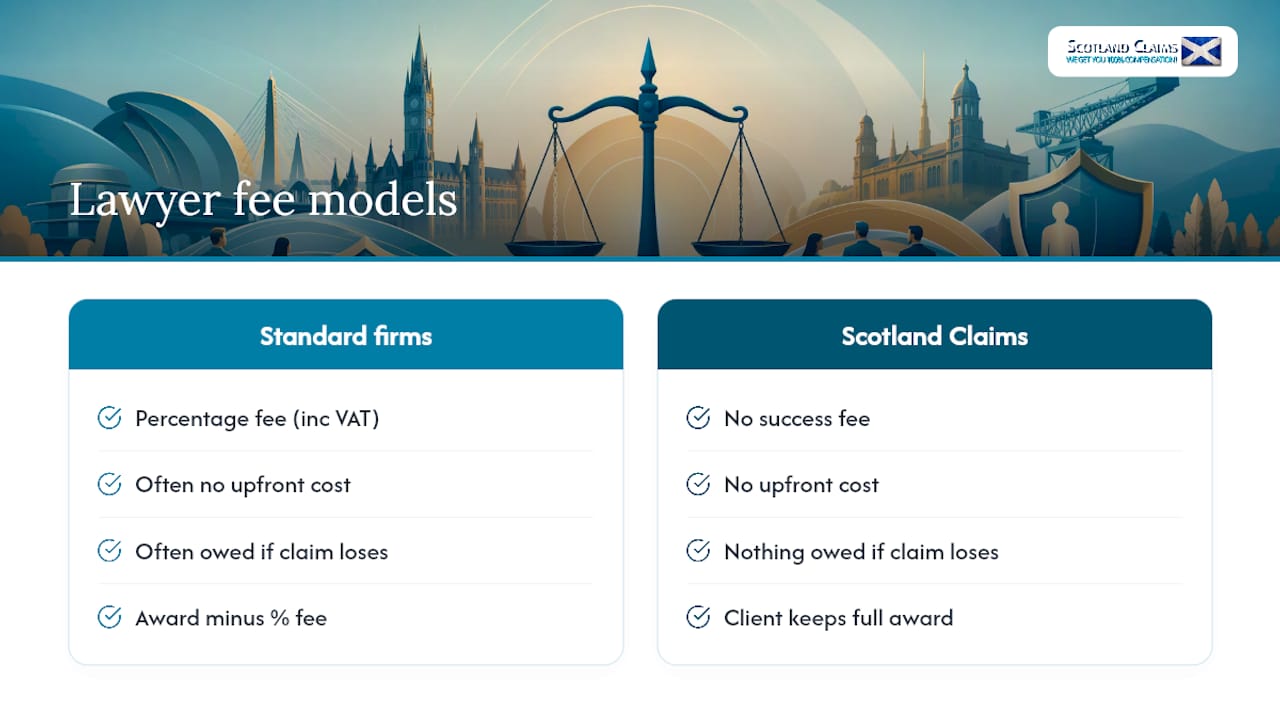
Firms rarely lead with this figure in their marketing, which is why asking about it directly at the first consultation matters so much.
Scotland Claims Injury Lawyers takes a different position entirely: no success fee, meaning clients keep all of their awarded compensation. There are no upfront costs to instruct a solicitor through this route, and nothing is owed if the claim is unsuccessful. This is the lowest cost structure available in the Scottish market for claimants, since the alternative used by most big brand firms still takes a cut regardless of how the case concludes.
When comparing quotes or terms from any firm, ask specifically whether “no win no fee” also means “no success fee.” The two phrases get used interchangeably in advertising, but they mean very different things for what lands in your bank account at the end.
Profiles: the leading injury law firms working in Glasgow
Glasgow has a genuinely competitive market for injury representation, and the right fit depends on your case type, its complexity, and how much you want to keep of any settlement.
It covers the three claim types that make up the vast majority of genuine personal injury cases: road traffic accidents, workplace injuries, and slips or trips, with a published compensation calculator giving an instant estimate.
Beyond that, Glasgow’s injury law market includes established firms with decades of courtroom experience, others built around high volume road traffic claims, and smaller specialist practices focused on complex workplace injury litigation. Track records, client reviews, and notable case outcomes vary considerably between them, and much of that detail isn’t published consistently across firm websites, so it’s worth asking any firm directly for examples of cases similar to yours during that first consultation rather than relying solely on their marketing pages.
The clearest differentiator that you can verify in minutes, rather than trusting to reputation alone, is the fee structure itself. Ask what percentage each firm deducts on a successful claim, then compare that figure directly against the zero taken by Scotland Claims.
Instructing a solicitor is more than a phone call, though the process is simpler than most people expect once you know the sequence.
Start with a free initial consultation, either by phone or online, where you outline what happened, when, and the injuries involved. Most reputable firms, including Scotland Claims, offer this assessment at no cost and with no obligation to proceed.
If the solicitor believes you have a viable claim, they’ll issue a client care letter or funding agreement setting out the terms in writing, including confirmation of the no win no fee basis and, critically, whether any success fee applies. Read this before signing. It’s your primary protection against later disputes over cost.
Once signed, you’ll be asked to provide supporting details: the date and location of the accident, contact information for any witnesses, details of medical treatment received, and any correspondence already exchanged with an insurer or employer. The solicitor then formally opens the claim, notifying the at fault party’s insurer and beginning evidence gathering.
From that point, your solicitor handles negotiation directly. You should expect regular updates rather than radio silence, and a clear point of contact if you have questions. A firm that goes quiet for weeks at a time after instruction is a warning sign worth acting on, even mid claim.
Our honest view on choosing an injury lawyer in Glasgow
The conventional advice on choosing a solicitor focuses almost entirely on experience and reputation, and barely mentions the fee structure until it’s buried in the small print. That’s backwards.
What we’d prioritise first is straightforward: confirm the fee structure in writing before you evaluate anything else. Verify accreditation through the Law Society’s own database rather than taking a firm’s word for it. APIL membership is a genuinely useful filter, not a box ticking exercise, because it signals a solicitor who works in this field consistently rather than occasionally.
The three year limitation period gets mentioned in passing by most guides, but it deserves more weight. Delay costs people their entitlement outright, not just leverage in negotiation. Verify credentials, confirm costs, then move quickly.
— Roger
Start your Glasgow claim with Scotland Claims today
Starting is straightforward. First, gather the key facts: when and where the accident happened, details of your injuries and any medical treatment received, and contact details for witnesses if there were any. Second, run those details through the compensation calculator for a free estimate, or request a free claim assessment directly.
Full detail on how the no win no fee arrangement works is available before you commit to anything, and specific injury pages, including back injury claims, cover claim types in more depth. Request your free assessment today and find out what your claim could actually be worth.
Sources
FAQ
How long do I have to make a personal injury claim in Scotland?
Most personal injury claims must be brought within three years of becoming aware of the injury, after which the right to claim is typically lost.
Does a solicitor need to be accredited to handle my claim?
Confirm accreditation through the Law Society of Scotland’s Find a Solicitor database, and look for APIL membership as an additional marker of specialist experience.
Will I have to go to court for my claim?
Most claims settle through negotiation with the insurer, though higher value claims and some contested cases proceed to the All-Scotland Sheriff Personal Injury Court.
Have the date, location, and circumstances of the accident ready, along with details of any injuries, medical treatment, and witness contact information.
Recommended