Employers in Scotland: RIDDOR checklist and 15 day reporting rule

If a workplace incident causes death, a specified injury, over-7-day incapacity, hospital treatment for a non-worker, an occupational disease, or a dangerous occurrence, it must be reported under RIDDOR. The employer, the self-employed person involved, or whoever controls the premises is the “responsible person” who must act. Report fatal or specified injuries straight away through the HSE online reporting forms, or by phone if it’s fatal or serious.
TL;DR:
- Incidents involving non-workers, such as visitors or members of the public taken to hospital, must be reported if they are work-related and meet RIDDOR criteria.
- Employers, site controllers, and self-employed persons each have specific reporting duties based on who controls the premises or is responsible for the injured individual.
- Deadlines vary: fatal and specified injuries require immediate reporting, while over-7-day incapacitations must be reported within 15 days, including weekends.
- Accidents resulting in a worker being off for more than seven days are often reported late; tracking absences from the first day prevents this common mistake.
- Proper record-keeping involves internal incident files with witness statements, photos, and medical records, kept for at least three years to support inspection and potential claims.
Table of Contents
What incidents must be reported under RIDDOR
RIDDOR only applies to incidents that are genuinely work-related. That means the accident happened because of, or during, work activity, not a coincidental illness or an incident with no connection to the job. A worker who trips over their own shoelace in the staff canteen during a break might not meet the threshold; a worker who falls from scaffolding clearly does.
The categories set out by HSE cover six situations. A work-related death must always be reported, regardless of the cause. Specified injuries include fractures (other than to fingers, thumbs or toes), amputations, loss of sight, crush injuries to the head or torso, serious burns, and any injury causing unconsciousness or requiring resuscitation. Over-7-day incapacitation applies when a worker cannot do their normal job for more than seven consecutive days, not counting the day of the accident, and that count includes weekends. Non-worker hospital treatment covers members of the public or visitors taken to hospital for treatment, not just examination. Occupational diseases include conditions such as certain skin diseases, hand-arm vibration syndrome, and occupational asthma. Dangerous occurrences are near misses with serious potential, such as a scaffold collapse or an unintended electrical short circuit causing fire.
In Scotland, common examples include a fall from height on a construction site, a scalding injury in a care home kitchen, or a manual handling back injury on a farm during lambing season. A near miss where a forklift tips over but nobody is hurt still counts as a dangerous occurrence and still needs reporting.
- A broken wrist from a fall at a warehouse: specified injury, report without delay
- A care worker off sick for nine days after a lifting injury: over-7-day case, report within 15 days
- A visitor scalded by hot water and taken to A&E: non-worker hospital treatment, reportable
- A crane load swinging loose with no injury: dangerous occurrence, reportable
Pro Tip: Keep a simple decision log for every incident, even minor ones. If HSE ever queries why something wasn’t reported, having a dated note explaining your reasoning is far more useful than trying to remember months later.
Who has to report: employers, contractors and site controllers
The responsible person is whoever the law puts the duty on, and it’s rarely the injured person. Employers report incidents involving their own staff. Self-employed people report incidents involving themselves. Whoever controls the premises reports incidents involving visitors, members of the public, or contractors on site who aren’t their direct employees.
Grey areas come up constantly on multi-employer sites. A few common scenarios:
- Agency staff injured on a client’s premises: usually the host employer reports, because they control the work environment, though the agency should also be notified.
- Contractors working on someone else’s site: the site controller typically reports incidents involving the contractor’s workers if the contractor itself has no reporting presence there, but contracts should specify this clearly.
- Lone self-employed workers: they report their own injuries, which is easy to forget since there’s no employer chasing it up.
Put the responsibility in writing before work starts, not after an accident happens. Site inductions, subcontractor agreements and clear internal assignment of the “who reports what” question all reduce disputes later. If you genuinely can’t tell who’s responsible, default to reporting it yourself and let HSE sort out duplication. Two reports cause no harm; a missed one is a criminal offence.
Pro Tip: Build a one-line RIDDOR clause into every subcontractor agreement stating who reports incidents involving that contractor’s staff. It costs nothing and ends the argument before it starts.
How and when to report a RIDDOR incident
Timing depends entirely on the category. Deaths and specified injuries must be reported without delay, meaning as soon as reasonably practicable after the incident and emergency response. Over-7-day incapacitation must be reported within 15 days of the accident, and that clock starts on the day it happened, not the day symptoms worsen or a GP confirms the diagnosis. Incidents causing 3 or more days off work still need an internal record, but they don’t go to HSE unless the absence passes seven days.
The process itself is straightforward:
- Gather the basics first: date, time, location, what happened, who was involved, and any immediate treatment given.
- Choose the correct category on the HSE’s online reporting forms and complete it in full.
- For fatal or specified injuries only, you can also phone the incident contact line on 0345 300 9923 in addition to, or instead of, the online form for urgent cases.
- Save the PDF confirmation the online system generates. This reference number is your proof the report happened.
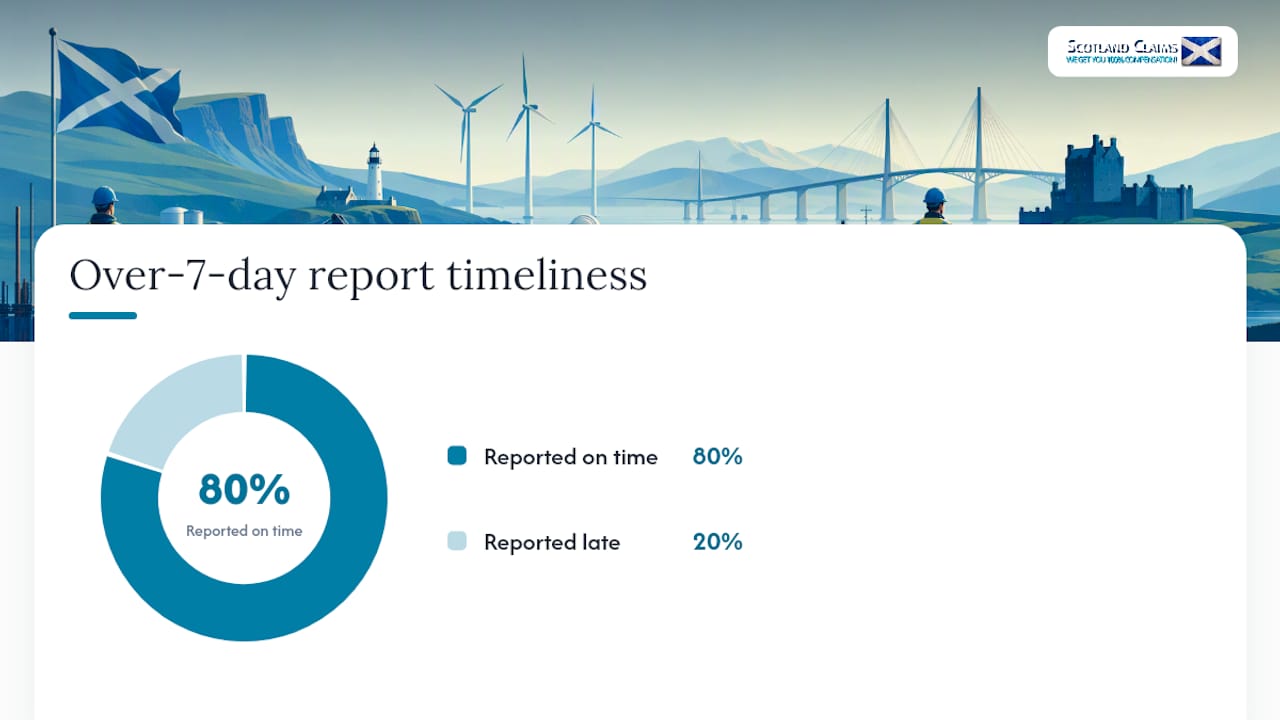
Roughly one in five over-7-day cases gets reported late because employers wait to see if the absence hits seven days before starting the paperwork, according to guidance flagging this as the most common employer error. Track absences from day one so the 15-day clock never catches you out.
File the confirmation PDF in the accident book alongside witness statements, and tell your line manager or safety officer the moment the report goes in, not weeks later.
What records you need to keep after an incident
RIDDOR reporting and internal record-keeping are two separate duties. Any incident causing 3 or more days’ incapacity needs an internal record even if it never gets reported to HSE, because it might escalate, and because inspectors can ask to see it.
A solid incident file includes:
- The completed incident or accident book entry
- Witness statements taken as close to the event as possible
- Photographs of the scene, equipment involved, or hazard
- Medical or ambulance records where treatment was given
- The HSE confirmation PDF with its reference number
- Notes from any internal investigation, including who looked into it and when
Keep these records for at least three years, longer for occupational disease cases where symptoms can surface years after exposure. When an inspector visits, the documents they’ll ask for are almost always this exact list, so an organised file saves a stressful afternoon.
Pro Tip: Store the HSE confirmation PDF and the internal accident book entry together, not in separate systems. Inspectors often ask for both at once, and hunting through two filing systems under pressure never looks good.
Common mistakes that get employers into trouble
Most reporting failures aren’t deliberate. They’re timing errors, misunderstandings, or simple oversight under pressure.
- Starting the 15-day clock too late. The countdown begins on the accident date, not when a doctor confirms the injury or when absence is confirmed to exceed seven days.
- Confusing hospital attendance with hospital treatment. A non-worker taken to A&E for observation and sent home isn’t automatically reportable; actual treatment is what triggers the duty.
- Losing the confirmation reference. Without it, you have no proof a report was ever submitted, which matters enormously if HSE later queries the incident.
- Phoning for non-qualifying incidents. The phone line is for fatal and specified injuries only; using it for over-7-day cases just clogs the system and delays genuinely urgent calls.
When in doubt, ask four quick questions: was it work-related, does it fit one of the six categories, who controls the site or employs the person, and has the deadline already started ticking? If you can’t answer all four confidently, report it anyway rather than risk under-reporting, since there’s no penalty for reporting something that turns out not to need it.
Pro Tip: If you’re unsure whether an incident qualifies, report it. HSE guidance is clear that reporting is not an admission of fault, and over-reporting carries zero legal risk. Failing to report does.
Special cases: offshore, gas and multi-site working in Scotland
A handful of sectors sit outside the standard RIDDOR route, and Scotland’s oil, gas and energy industries mean these come up more often here than in many parts of the UK.
- Offshore installations use the ROGI reporting route through the Offshore Major Accident Regulator, not the standard online form.
- Gas incidents, including suspected carbon monoxide escapes from gas appliances, have their own dedicated reporting contacts separate from general RIDDOR duty.
- Nuclear sites report through the Office for Nuclear Regulation rather than the general HSE system.
- Cross-site working, common in Scottish construction and agriculture where staff move between locations, means the premises controller at each specific site usually holds the reporting duty for that location, not a single head office.
Always check current HSE guidance before assuming the standard process applies if your business touches any of these regulated areas.
What happens after you submit a RIDDOR report
HSE uses reports to spot patterns across industries and target inspections where risk is highest, not to punish every employer who files one. A single specified injury report rarely triggers a visit on its own, but a pattern of similar incidents, or a fatality, usually does.
Failing to report, or reporting late, can lead to an improvement notice or, in serious cases, prosecution. If an inspector does visit, preserve the scene where practicable, cooperate fully, and make sure your internal accident file is up to date before they arrive. Reporting properly the first time is far less hassle than explaining a gap in your records months later.
RIDDOR reporting and your right to compensation
RIDDOR is a regulatory duty, not a compensation process. Submitting a report tells HSE what happened; it doesn’t decide who was at fault or what you’re owed if you were injured. Those are separate questions, and people sometimes assume filing a report settles the matter when it hasn’t even started.
If you’ve suffered a serious injury, a long-term effect on your ability to work, or you’re unsure whether your employer or another party was negligent, that’s when it’s worth getting legal advice alongside the regulatory process. Get proper medical treatment first, keep your own note of what happened, and hold onto anything that supports your account: photos, witness details, the RIDDOR reference if you have it.
Scotland Claims Injury Lawyers handles road traffic accident claims, workplace injury claims, and slips or trips across Scotland on a no win no fee basis. If a workplace incident has left you dealing with real consequences, speaking to an injury lawyer costs nothing to explore, and you can get a sense of what a claim might be worth using the compensation calculator.
— Roger
Sources
For the primary rules and forms rather than secondhand summaries, go straight to HSE and the legislation itself.
This article is general information, not a substitute for advice from a qualified lawyer. Consult a qualified legal professional about your own circumstances before acting on anything here.
FAQ
What injuries must be reported to RIDDOR?
Deaths, specified injuries (fractures, amputations, loss of sight, serious burns), over-7-day incapacitation, non-worker hospital treatment, occupational diseases, and dangerous occurrences all count as reportable under RIDDOR.
What are my rights if I get injured at work in Scotland?
You’re entitled to a safe working environment and, if your employer’s negligence caused your injury, you may be entitled to compensation through a separate legal claim, which is distinct from any RIDDOR report filed about the incident.
Is RIDDOR for staff only?
No. RIDDOR also covers non-workers, including members of the public and visitors, if they’re taken to hospital for treatment following a work-related incident, and the person controlling the premises is usually responsible for reporting it.
How many days before you report to RIDDOR?
Deaths and specified injuries must be reported without delay. Over-7-day incapacitation must be reported within 15 days of the accident date, with the count including weekends and rest days.
Recommended