Keep All Your Compensation After a Passenger Injury in Scotland

If you were injured as a passenger in a road accident in Scotland and someone else’s negligence caused it, you can almost always claim compensation, usually from the at-fault driver’s insurer. Your next step is simple: get medical attention, keep hold of any evidence, and arrange a free legal assessment before memories fade or paperwork disappears.
TL;DR:
- Claims against the at-fault driver or third parties are possible even if the driver was uninsured or fled the scene, thanks to the Motor Insurers’ Bureau.
- Early evidence collection, including photographs and medical records, is crucial to prevent the limitation period from expiring and to strengthen the claim.
- Most straightforward cases settle within several months, but disputed liability or severe injuries may extend the process into court, especially for complex or long-term injuries.
- The three-year claim limit in Scotland can be extended if injury symptoms surface later, but proving the “date of knowledge” is essential to avoid losing the right to claim.
- Scotland Claims Injury Lawyers offers no success fee, ensuring clients retain 100% of their compensation, with straightforward, free assessments available.
Scotland Claims Injury Lawyers
Keep 100% Of Your Compensation
Scotland Claims Injury Lawyers connects Scottish injury victims with specialist lawyers through a straightforward No Win No Fee service.
Start your injury claimTable of Contents
Who can claim and who can be sued: liability explained for passengers in Scotland
Passengers occupy an unusually strong legal position after a road crash. Under the law of negligence, or delict as it’s known in Scotland, a driver owes a duty of care to everyone in the vehicle and to other road users. A passenger has no control over the driving, no steering wheel, no brake pedal, which means the usual arguments insurers raise against drivers (following too closely, misjudging a gap, driving too fast for conditions) simply don’t apply to someone sitting in the passenger seat. This is one reason passenger claims settle relatively cleanly compared with driver-versus-driver disputes, where liability is often contested.
The claim itself is brought against whoever caused the crash, not against the vehicle you were travelling in. That distinction matters more than most people realise before their first conversation with a solicitor.
Typical defenders in a passenger claim include:
- The driver of the car you were travelling in, if their own carelessness caused or contributed to the crash.
- A third-party driver, where another vehicle caused or contributed to the collision.
- An employer, if the journey was work-related, such as a delivery run or a commute in a company vehicle during working hours.
- A bus, taxi, or public transport operator, where operator negligence, poor vehicle maintenance, or driver conduct played a part.
Some cases are messier. If the driver at fault had no insurance, or fled the scene before anyone got their details, you’re not left without recourse. The Motor Insurers’ Bureau exists precisely for this situation, stepping in to compensate victims of uninsured or untraced drivers where the usual insurer route isn’t available.
Shared fault also comes up more often than you’d expect, particularly where a passenger wasn’t wearing a seatbelt or where two vehicles both contributed to a crash. Scots law allows for “contributory negligence,” reducing a payout by a percentage rather than blocking it outright. A passenger found 20% responsible, for example, might still recover 80% of the assessed value of their claim. It rarely stops a genuine claim from succeeding, but it can affect the final figure, which is exactly why early legal advice on liability is worth having before you accept anything an insurer offers.
How to make a passenger injury claim in Scotland: step by step
The process from crash to compensation follows a fairly predictable pattern, though the pace depends heavily on how quickly liability is accepted and how clear the medical picture is.
- Get medical treatment first. Even if injuries feel minor at the scene, adrenaline masks pain, and whiplash symptoms in particular often build over 24 to 48 hours.
- Report the accident, to the police if anyone was injured or if it involved a hit-and-run, and to the relevant insurer as soon as practical.
- Exchange details where it’s safe to do so, including the registration, driver name, and insurer of every vehicle involved.
- Gather evidence while it’s fresh: photographs of the scene and any visible injuries, contact details for witnesses, and requests for dashcam or CCTV footage before it’s overwritten.
- Keep a symptoms diary. Note when pain started, how it’s affecting sleep, work, and daily tasks, and when you first sought medical advice, since this record can matter later if timing is ever questioned.
- Contact a solicitor to establish the facts, check liability, and begin gathering medical records and any expert reports needed to value the claim properly.
- Let negotiations run their course. Most cases resolve through direct negotiation with the at-fault party’s insurer rather than through a courtroom.
Pro Tip: Write down the date you first mentioned your symptoms to a GP or A&E doctor, even if it was just in passing. That single date can become important evidence if there’s ever a dispute about when your injury became apparent.
Once a solicitor has your medical records and a clear picture of liability, they’ll usually open negotiations with the insurer directly. Straightforward whiplash or soft-tissue claims with accepted liability often settle within several months. Cases involving contested fault, more serious injuries, or uncertainty over long-term prognosis take longer, because nobody, insurer or solicitor, wants to settle before the medical picture is stable. Most road traffic personal injury claims in Scotland settle without ever reaching a courtroom, though disputed liability, catastrophic injuries, or complex future-loss calculations are more likely to end up before the Scottish courts, including the National Personal Injury Court for higher-value cases.
Time limits and the three-year rule for injury claims in Scotland
You generally have up to three years to bring a personal injury claim in Scotland, starting from the date of the accident. This comes directly from section 17 of the Prescription and Limitation (Scotland) Act 1973, and missing it usually means losing the right to claim altogether, regardless of how strong the underlying case is.
There’s an important exception built into the same section: the “date of knowledge” test. If you didn’t realise you were injured, or didn’t connect your symptoms to the crash, until some point after the accident itself, the three-year clock can start running from that later discovery date instead. A recent Scottish Law Commission review examined exactly how this discoverability concept should apply in practice, recommending it be retained given how often injuries, particularly psychological ones, surface well after the initial event.
Points worth remembering about limitation in Scotland:
- Children injured in a crash generally have extended timescales, since the three-year clock typically doesn’t start until they turn 16, as confirmed in official guidance on road crash compensation.
- The date-of-knowledge test can shift your deadline later, but proving exactly when you “knew” often depends on medical records and GP visit dates.
- A defender can, in rare cases, agree to waive the time bar, though you should never rely on this happening.
Keep a written note of when your symptoms started and when you first sought medical advice. It sounds like a small administrative task, but it can be the difference between a claim proceeding and one being time-barred on a technicality.
What evidence matters and how compensation is worked out
Evidence does two jobs in a passenger claim: it proves who was at fault, and it proves what the injury actually cost you. Weak evidence on either front tends to shrink a settlement offer, even where liability isn’t seriously in dispute.
The evidence that carries the most weight includes:
- Medical records from your GP, A&E, and any specialist you’ve seen, showing diagnosis and treatment.
- Photographs of the scene, vehicle damage, and visible injuries taken as soon as possible after the crash.
- Witness statements from anyone who saw what happened, ideally noted down while memories are fresh.
- Police reports, where the crash was serious enough to involve officers attending the scene.
- Dashcam or CCTV footage, which insurers increasingly expect and which can settle liability disputes quickly.
- Payslips or accounts records showing lost earnings, if the injury kept you off work.
Compensation in Scotland is split into two broad categories. The first is solatium, covering pain, suffering, and loss of enjoyment of life, assessed against comparable court awards for similar injuries. The second is patrimonial loss, covering the financial side: lost earnings, care costs, travel to medical appointments, and any future loss if the injury has lasting effects. For more serious or long-term injuries, valuing future loss often involves multipliers and a discount rate to convert a projected future cost into a present-day lump sum, a calculation Scottish courts apply when assessing negligence claims of this kind.
Pro Tip: Don’t wait until your case reaches a solicitor to start collecting evidence of financial loss. Screenshot bank statements, save payslips, and note every missed shift as it happens, since reconstructing this months later from memory rarely produces an accurate figure.
Costs and fees: what “no win, no fee” really means
Most personal injury solicitors in Scotland work on a speculative fee agreement, commonly branded “no win, no fee,” meaning you pay nothing upfront and nothing if the claim fails. Citizens Advice Scotland explains that firms and claims companies typically fund the case this way and take a percentage of the payout, commonly a success fee, if the claim wins.
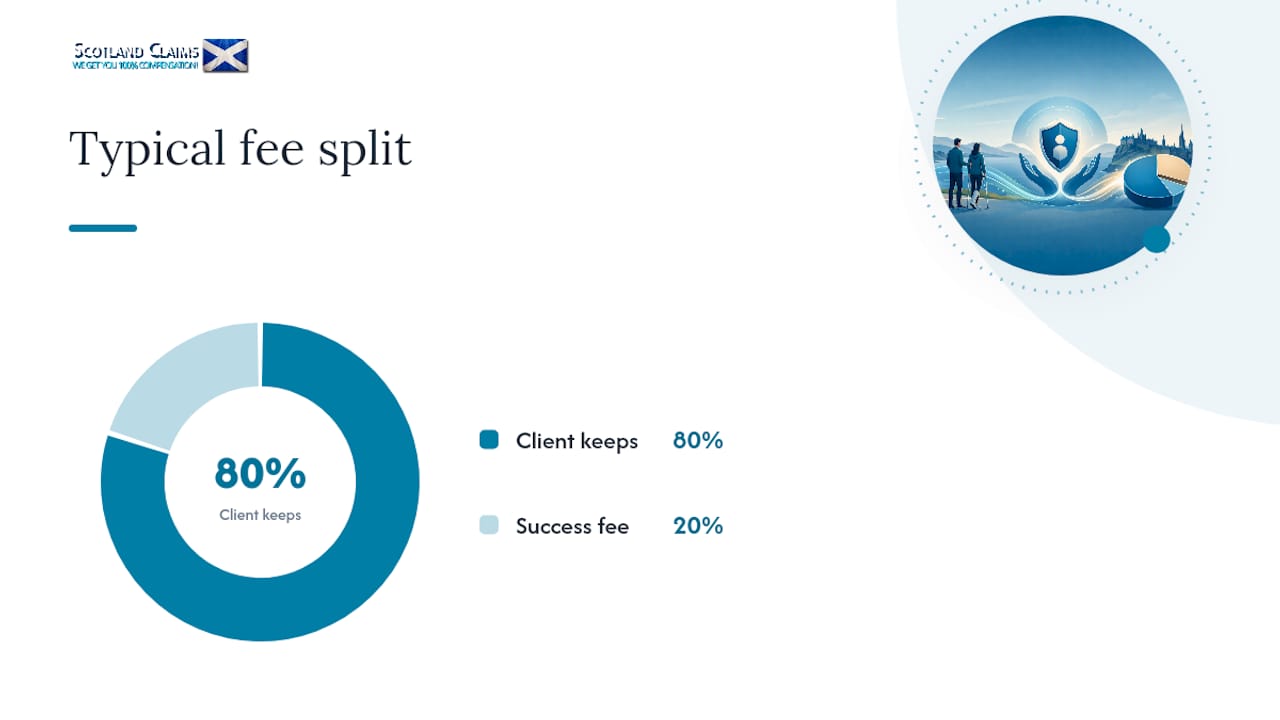
That success fee is where the real difference between firms shows up. Most solicitors and big-brand firms across Scotland commonly take a success fee as a percentage of your compensation, which can be around one-fifth including VAT, meaning a client winning £10,000 could hand over roughly £2,000 before seeing a penny. Scotland Claims Injury Lawyers charges no success fee at all: clients keep 100% of their compensation, whether the claim relates to a whiplash injury, a road traffic accident as a driver or passenger not at fault, or a slip, trip, or workplace accident. There’s no upfront cost, no deduction from the settlement, and no hidden percentage buried in the small print.
Before signing anything with any firm, ask:
- What percentage, if any, is deducted from my compensation if I win?
- Are there any disbursements or admin charges on top of a success fee?
- Is the fee arrangement confirmed in writing before work begins?
- What happens to costs if the claim is unsuccessful?
Getting these answers in writing at the first meeting avoids surprises at settlement stage, when the difference between fee structures can amount to thousands of pounds.
How to choose the right solicitor for a passenger injury claim
Look for a firm regulated in Scotland with genuine personal injury specialism, rather than a general practice that handles injury claims occasionally. Membership or accreditation through bodies such as APIL or the Law Society of Scotland is a reasonable signal of specialist experience, though it’s worth asking directly how many passenger claims a firm has handled.
- Check regulation and specialism first. A solicitor should be able to explain, in plain terms, how Scottish limitation rules and court procedure apply to your specific injury.
- Get fee terms in writing before anything else. Vague answers about “typical” deductions are a red flag worth walking away from.
- Ask about communication. You want updates without having to chase them, particularly during the medical evidence stage.
- Prepare for your first consultation by bringing medical records, photos, and a rough timeline of events, even in note form.
If you’d rather skip the research and speak to a Scottish specialist directly, a free assessment is the fastest way to find out where you stand.
An editorial note on passenger claims in Scotland
The most common mistake passengers make isn’t legal, it’s timing. People wait weeks to see a doctor because the pain feels manageable, then discover months later that proving when their injury started has become the hardest part of their case. Acting early costs nothing and protects everything.
What strikes me most about passenger claims specifically is how rarely fault is genuinely in dispute, and yet how often people assume the process will be a fight. It usually isn’t. The real battle, if there is one, tends to be over value rather than liability, which is exactly where good evidence and a straight-talking solicitor earn their keep.
Scotland Claims Injury Lawyers built its approach around a simple frustration: watching people hand over a fifth of their compensation to a solicitor for doing a job that shouldn’t cost the client anything extra. A free assessment, a compensation calculator, and a fee structure that leaves 100% of the payout with the client aren’t marketing flourishes here, they’re the actual proposition.
— Roger
How Scotland Claims can help with your passenger injury claim
Scotland Claims Injury Lawyers takes no success fee, full stop. Where most big-brand solicitors across Scotland deduct up to 20% including VAT from a winning claim, clients here keep every penny of their compensation, with no upfront cost and nothing to pay if the case doesn’t succeed.
Getting started takes minutes. Use the compensation calculator to get a rough sense of what your injury might be worth, or request a callback for a free assessment with a specialist Scottish personal injury solicitor. At first contact, expect a straightforward conversation about what happened, how you were injured, and whether the other party is likely to be liable, no jargon, no pressure. If you’re ready to find out where your passenger injury claim stands, visit the Scotland Claims injury lawyers page and start your free assessment today.
This article is general information, not a substitute for advice from a qualified lawyer. Consult a qualified legal professional about your own circumstances before acting on anything here.
Sources
FAQ
Can I claim if I was a passenger in a car accident?
Yes. If another driver’s negligence, including that of the driver you were travelling with, caused the crash, you can almost always bring a claim against the at-fault party’s insurer.
How long does a personal injury claim take in Scotland?
Straightforward claims with accepted liability often settle within several months, while cases involving disputed fault, serious injuries, or uncertain prognosis can take considerably longer and may proceed to court.
How much will I get for an injury claim?
Compensation depends on the severity of your injury, its effect on work and daily life, and any financial losses, and is made up of solatium for pain and suffering plus patrimonial loss for costs such as lost earnings and care.
What evidence do I need for an injury claim?
Medical records, photographs of injuries and the scene, witness statements, and any dashcam or CCTV footage are the most valuable evidence, alongside proof of financial losses like payslips.
Do I have to pay a success fee if I win my claim?
Not with Scotland Claims Injury Lawyers. Many other firms in Scotland charge a success fee of up to 20% including VAT, but Scotland Claims takes no success fee, so clients keep 100% of their compensation.
Recommended