
You shouldn't have to sacrifice a large chunk of your compensation just to cover a solicitor's success fee. Many people across the country accept these deductions as a standard cost of justice, but in the Scottish legal system, it is entirely possible to retain the full value of your award. Reviewing pain and suffering settlement examples scotland is the first step toward understanding what your claim is truly worth in 2026. Whether you are struggling with restricted movement after a road accident or the ongoing anxiety of a workplace injury, you deserve a transparent breakdown of your potential payout.
It is understandable to feel overwhelmed by complex terms like "Solatium" and the fear of hidden costs eating into your final cheque. This guide will show you exactly how settlements are calculated using the 17th edition Judicial College Guidelines, which recently saw a 22% inflationary increase. You will learn the key differences between Scottish and English law, including why Scotland's rejection of the whiplash tariff system benefits claimants. We provide clear examples of compensation ranges for various injuries and explain how our specialist approach ensures you keep 100% of your settlement.
Key Takeaways
- Understand the concept of "Solatium" and how Scottish law bundles physical pain and emotional distress into a single, comprehensive award.
- Review specific pain and suffering settlement examples scotland to see how the 2026 Judicial College Guidelines apply to injuries ranging from minor whiplash to severe fractures.
- Learn why the absence of a fixed whiplash tariff in Scotland often leads to higher compensation amounts for soft tissue injuries compared to England and Wales.
- Discover how to secure 100% of your compensation by using a specialist who recovers legal costs from the at-fault party rather than deducting success fees from your award.
- Identify the critical role of medical evidence and why a specialist medical report is the most influential factor in determining your final settlement value.
What is Pain and Suffering (Solatium) in Scottish Law?
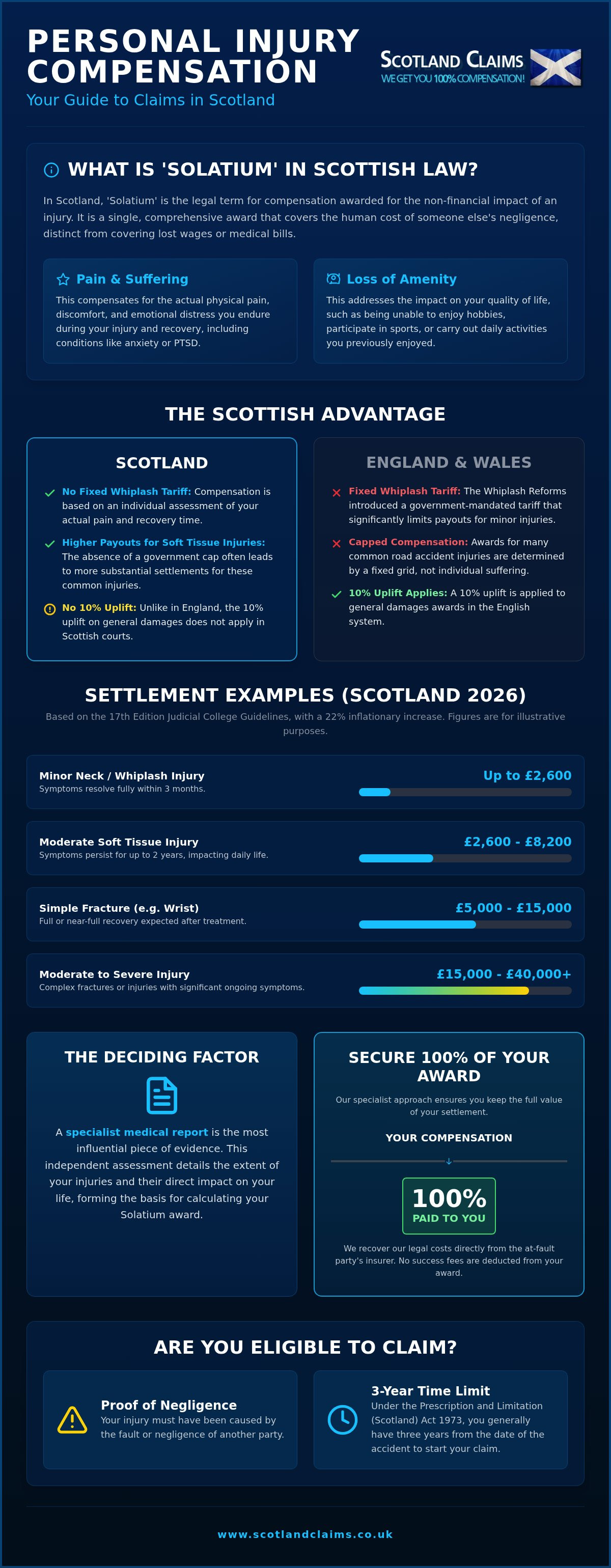
In Scotland, the legal system uses a specific term for the compensation you receive for your injuries: Solatium. While you might hear this referred to as "general damages" in England, Solatium in Scots law covers the non-financial impact of an accident. It bundles your physical pain, emotional distress, and the general loss of your quality of life into one award. This part of your claim doesn't cover lost wages or medical bills. Instead, it focuses entirely on the human cost of the negligence you've experienced. It aims to restore you to the position you were in before the accident occurred. Reviewing pain and suffering settlement examples scotland helps you understand how these complex factors translate into a final figure.
The Scottish personal injury system is distinct from the system in England and Wales. For instance, Scotland does not use the fixed whiplash tariff system that limits payouts for soft tissue injuries down south. This is a significant advantage for Scottish claimants. Your compensation is based on the actual severity of your symptoms and the length of your recovery, rather than a government-mandated cap. However, it's also important to note that the 10% uplift applied to English general damages does not apply in Scotland. This makes having a specialist who understands these nuances vital for your case.
The Two Pillars of Solatium: Pain vs. Loss of Amenity
Solatium isn't just about the initial shock of a broken bone. It accounts for the actual physical pain you endure during the recovery process. If you've spent months in physiotherapy or suffered through sleepless nights, that is factored in. Loss of amenity looks at how the injury has stopped you from enjoying your life. If you can no longer participate in your favourite hobbies or play with your children, you're entitled to compensation for that loss. We also include mental anguish in this pillar. Psychological impacts like PTSD, depression, or travel anxiety are real injuries that deserve a fair settlement.
Who is Eligible to Claim Solatium in Scotland?
To secure a settlement, you must prove that your injury was caused by someone else's negligence. Whether it was a road accident, a slip in a shop, or an injury at work, the fault must lie with another party. You also need to be mindful of the clock. Under the Prescription and Limitation (Scotland) Act 1973, you generally have a three-year time limit to start your claim. This usually begins on the date of the accident, though there are exceptions for "date of knowledge" cases. Acting quickly ensures that evidence is fresh and your right to justice is protected. Consulting with expert Solicitors in Scotland is the best way to determine your eligibility and start the process of keeping 100% of your award.
Minor Injury Settlement Examples: Whiplash and Soft Tissue
Minor injuries like whiplash and soft tissue strains are the most frequent claims following road traffic accidents. While the legal system labels them as "minor," the reality of restricted movement and persistent discomfort is anything but. In England and Wales, recent "Whiplash Reforms" introduced a fixed tariff that significantly slashed payout amounts for these injuries. Scotland has not adopted this restrictive system. This means your compensation is still based on an individual assessment of your pain rather than a government-mandated cap. When reviewing pain and suffering settlement examples scotland, you will notice a direct correlation between the length of your recovery and the final award value.
The legal framework for these awards is supported by the Damages (Scotland) Act 2011, which ensures that claimants have a clear right to seek restitution for their losses. We categorise these injuries based on how long they impact your daily life. A "minor" classification usually refers to an injury where you make a full recovery within a few months. If symptoms persist for over a year, the claim moves into the "moderate" bracket, which commands a higher settlement. Because we operate on a zero success fee basis, you can be confident that the entirety of these calculated amounts stays in your pocket.
Whiplash and Neck Injury Examples
Whiplash is more than just a stiff neck; it often involves radiating pain in the shoulders and recurring headaches. For injuries where recovery is achieved within 3 months, compensation typically ranges from £1,000 to £2,500. However, if your symptoms are more stubborn and recovery takes over two years, the settlement can rise to between £9,000 and £12,000. We also frequently include "travel anxiety" in these claims. If the accident has left you nervous as a passenger or driver, this psychological impact is added to your Solatium award. You can find more specific details on our Whiplash Claims page.
Minor Hand, Wrist, and Ankle Injuries
Sprains to the extremities are common in both road accidents and workplace slips. A minor ankle sprain that heals within a few months might attract a settlement of £2,500 to £5,000. The most important factor in these cases is your medical report. This document provides the objective evidence needed to prove the extent of your suffering. If a doctor identifies ongoing stiffness or a minor permanent ache, the value of your claim increases accordingly. For a deeper look at specific lower limb injuries, see our guide on Ankle Injury Claims in Scotland. If you want to see how these ranges apply to your specific accident, you can check your eligibility at www.scotlandclaims.co.uk.
Moderate to Severe Injury Settlement Examples
Moving beyond minor soft tissue damage, moderate and severe injuries represent a significant shift in both physical impact and financial value. A moderate injury typically involves a fracture or a serious ligament tear that results in ongoing symptoms or a permanent ache. Severe injuries are life-changing events, such as spinal cord damage or traumatic brain injuries, that require lifelong care. When you examine pain and suffering settlement examples scotland for these categories, the figures reflect the profound loss of amenity and the long-term struggle for recovery. These awards are designed to acknowledge that your life has been fundamentally altered by someone else's mistake.
Complex claims require the oversight of a specialist solicitor authorised by the Law Society of Scotland. These cases often involve "Future Loss" calculations alongside your Solatium award. While Solatium compensates for your actual pain and suffering, Future Loss covers the financial void left by an inability to work or the need for professional care. This ensures your settlement provides a robust safety net for the years ahead. We ensure that every penny of this calculated future security remains yours, as we do not deduct success fees from your award.
Broken Bones and Orthopaedic Injuries
Leg and knee fractures often require the surgical insertion of permanent hardware like screws or plates. If you've suffered a fracture that leaves you with a permanent limp or a heightened risk of future arthritis, your settlement will be significantly higher than a standard break. Severe back injuries involving permanent pain and disability typically range between £30,000 and £130,000. Hip injuries are particularly sensitive cases. Factors like your age, the level of mobility lost, and the necessity for future replacement surgery all dictate the final award. For a detailed breakdown of these specific claims, read our Hip Injury Compensation Guide.
Head and Brain Injury Settlements
Head injuries range from minor concussions to devastating traumatic brain injuries. A minor concussion with a full recovery within weeks may settle for a few thousand pounds. In contrast, serious head injuries involving sensory impairment and reduced life expectancy can range from £220,000 to £325,000. We also quantify cognitive impairment and personality changes. If an accident has altered your behaviour, memory, or concentration, the law recognises this as a major part of your suffering. Secure the expert help you need to navigate these high-value claims by visiting our guide on No Win No Fee Head Injury Claims.
How Scottish Settlements are Calculated: The Evidence
Calculating your award isn't a guessing game. Solicitors and judges use the Judicial College Guidelines as their primary reference. The 17th edition, published in March 2024, saw a significant 22% increase in guideline figures to account for high inflation. However, you must remember that Scottish courts apply a 10% reduction to these figures because an uplift used in England and Wales does not apply here. By examining pain and suffering settlement examples scotland, you can see how these technical adjustments impact the final cheque. We use this data to ensure you receive a fair outcome that reflects the current economic reality.
Your medical report is the single most important piece of evidence. It provides an objective assessment of your injuries from an independent professional. While your own account is vital, a specialist's opinion carries the most weight in negotiations. We also use witness statements from family or colleagues to validate how the injury has changed your behaviour or restricted your movement. Be aware that "contributory negligence" can affect your payout. If you weren't wearing a seatbelt during a road accident, a judge might reduce your award by a percentage to reflect your share of the responsibility.
The Role of the Independent Medical Expert
During your claim, you will attend an assessment with an independent medical expert. They will examine your physical condition and ask how the injury has affected your daily life. It is vital to be completely honest; never exaggerate or downplay your symptoms. The expert provides a "prognosis," which is a prediction of your future recovery. This outlook determines which compensation bracket your claim falls into. A permanent injury will always command a higher settlement than one with a full recovery date.
Evidence Beyond the Medical Report
A medical report tells part of the story, but your daily reality adds the necessary depth. We recommend keeping a "pain diary" to document your struggles and any mood changes. This helps prove the "loss of amenity" we discussed earlier. If you had to cancel a favourite hiking trip or can no longer attend your local football matches, keep the evidence. Photos of your recovery, cancelled booking confirmations, and logs of missed hobbies are powerful tools. They prove that your suffering extends far beyond a clinical diagnosis. You can get an instant estimate of your claim's value by using our Compensation Calculator.
Start your risk-free claim today
Securing 100% of Your Award with Scotland Claims Injury Lawyers
You have reviewed the various pain and suffering settlement examples scotland provides for different injury types, but the final amount that reaches your bank account is what truly matters. "Lawyer Fee Anxiety" is a significant hurdle for many people seeking justice. In the standard legal model, many firms deduct a success fee of up to 20% from your final settlement. This means if your award is calculated at £12,000, you might only receive £9,600 after your solicitor takes their cut. We believe this practice is unfair to the victim, which is why we operate on a completely different financial model.
At Scotland Claims Injury Lawyers, we recover our legal costs directly from the at-fault party's insurance company rather than taking a portion of your award. This ensures that every penny of the compensation calculated for your Solatium stays with you. This is the core of our "Risk-Free Justice" approach. By removing the threat of success fees, we ensure that the financial outcome of your claim matches the figures we negotiate on your behalf. You shouldn't have to pay for your own recovery when the accident was caused by someone else's negligence.
Transparency in the Legal Process
We eliminate the stress of hidden charges and surprise deductions through total transparency from day one. As a firm regulated by the Law Society of Scotland, Scotland Claims Injury Lawyers adheres to strict professional standards that put your interests first. Our specialist solicitors focus on building the strongest possible case to maximise your award, without you having to worry about administration fees or success fee percentages. This clear, client-first ethos allows you to focus on your physical rehabilitation whilst we handle the complex negotiations with the insurers.
Start Your Claim Today
Taking the first step toward your recovery is simple and carries no financial risk. Our 24-hour freephone helpline (0800 611 8132) offers immediate access to professional advice and a no-obligation assessment of your claim. We provide a fast, efficient path to justice, ensuring you understand exactly where you stand from the very first call. Scotland Claims Injury Lawyers is dedicated to securing the full value of your award so you can move forward with the financial security you deserve.
Start your 100% compensation claim online
Secure Your Full Compensation Today
You now have a clear understanding of how Solatium is assessed in the Scottish legal system. From minor soft tissue strains to life-altering injuries, the 17th edition Judicial College Guidelines provide a structured framework for your award. We have explored several pain and suffering settlement examples scotland to show that your compensation depends on specific medical evidence and the long-term impact on your quality of life.
The most important factor is ensuring you retain the full value of your settlement. Many firms take a significant success fee from your cheque, but our model eliminates this financial burden. We operate with a 100% Compensation Guarantee and zero success fees. As a firm regulated by the Law Society of Scotland, we prioritise your financial integrity and legal rights. You don't have to navigate the stress of hidden costs whilst recovering from your accident.
Get your 100% compensation claim started now
Take the first step toward a full recovery with the backing of specialists who put your interests first. Your path to justice is risk-free and completely transparent.
Frequently Asked Questions
What is the average settlement for pain and suffering in Scotland?
There is no single average settlement because every injury is unique. Payouts are determined by the specific nature of your injury and its impact on your life. Minor soft tissue injuries might start around £1,000, whilst the most severe, life-changing injuries can exceed £300,000. Reviewing specific pain and suffering settlement examples scotland provides a better bracket for your individual circumstances.
How much can I claim for a whiplash injury in 2026?
In 2026, Scottish whiplash claims remain exempt from the fixed tariff system used in England. For a minor injury with a full recovery within three months, you could receive between £1,000 and £2,500. If your symptoms persist for more than two years, the settlement range typically increases to between £9,000 and £12,000. Your medical report will dictate the final bracket.
Will I have to go to court to get my pain and suffering settlement?
It is highly unlikely that you will ever step foot in a courtroom. Over 90% of personal injury claims in Scotland are settled through direct negotiation with the at-fault party's insurers. We build a robust case backed by medical evidence to ensure a fair settlement is reached long before a court hearing becomes necessary. This approach provides a faster and less stressful resolution.
Can I claim for pain and suffering if I was partly at fault for the accident?
Yes, you can still pursue a claim if you were partially responsible for the incident. This is referred to as "contributory negligence." Your final compensation award is simply reduced by the percentage of your fault. For example, if a judge decides you were 25% responsible for your injuries, you will receive 75% of the total calculated settlement value.
How long does it take to receive a settlement for a personal injury in Scotland?
Straightforward claims where fault is admitted often settle within six to nine months. More complex cases involving severe injuries or disputed liability can take 18 months or longer to resolve. We prioritise moving your case forward as quickly as possible without sacrificing the total value of your award. The speed of the process often depends on how quickly your injuries stabilise.
Why do some solicitors take 20% of my compensation and others do not?
Many traditional firms charge a "success fee" to cover their costs, which is usually deducted from your final cheque. We operate differently by recovering our legal fees directly from the at-fault party's insurance company. This allows us to offer a 100% compensation guarantee. You shouldn't have to pay for your own justice when the accident wasn't your fault.
Is there a limit on how much I can claim for pain and suffering?
There is no fixed legal cap on the amount of Solatium you can receive in Scotland. The award is based on the severity of your suffering and the guidelines set out by the Judicial College. Whilst pain and suffering settlement examples scotland show typical ranges, a judge can award a higher amount if the circumstances of your injury and loss of amenity are exceptionally severe.
What happens if my injury gets worse after I accept a settlement?
Most settlements are agreed on a "full and final" basis. This means you cannot usually reopen the claim or ask for more money if your condition deteriorates later. This is exactly why we never rush you into an early settlement. We wait until we have a clear and definitive medical prognosis to ensure your award covers the true, long-term extent of your injury.