
You shouldn't have to pay a solicitor for the privilege of winning your own legal case. A serious hip injury is more than just a medical diagnosis; it's a sudden loss of independence that affects your ability to walk, work, and live without pain. You're likely worried about how you'll cover your bills whilst you're off your feet, and the fear of hidden legal costs often makes a difficult situation feel overwhelming. When you pursue hip injury compensation in Scotland, your recovery must come first, not a law firm's profit margin.
We believe you deserve the full value of your settlement. This guide explains how to secure 100% of your payout without losing a penny to success fees. You'll learn about the latest 18th Edition Judicial College Guidelines, which recently introduced an 8.2% inflationary uplift to ensure payouts reflect current costs. We'll also help you understand the specific Scottish claims process and how to find a specialist solicitor who protects your interests. It's time to take control of your financial future and get the justice you're entitled to.
- Discover how Scottish law protects your right to a full recovery following a non-fault accident that has impacted your mobility.
- Learn how to secure 100% hip injury compensation by choosing a firm that charges no success fee, unlike many large and national firms that deduct up to 20% including VAT from your settlement.
- Understand the difference between General and Special Damages to ensure every penny of your lost earnings and care costs is recovered.
- Identify the critical evidence required to prove liability in road traffic accidents and slip or trip incidents on public footpaths.
- Find out how to access an immediate case assessment and connect with a specialist injury lawyer in Scotland to start your claim today.
When you suffer a hip injury through no fault of your own, the legal system provides a specific pathway to recovery. Hip injury compensation is more than just a financial payout; it's a legal remedy designed to address your physical pain, emotional distress, and any financial losses you've incurred. In Scotland, your right to seek redress is built upon the Scots law of delict. This area of law ensures that if someone else’s negligence causes you harm, they are legally obligated to put you back in the position you would have been in had the accident never happened.
The impact of a hip injury on your daily life is often profound. It isn't just about the inability to walk. It affects how you sleep, how you sit at a desk, and your ability to perform basic household tasks. This loss of independence is recognised in the Scottish legal system through a concept known as "solatium". This term refers to the compensation awarded for your pain and suffering, as well as the loss of amenity, which covers the things you can no longer do, such as hobbies or exercise.
Who is eligible to make a claim?
To qualify for a claim, you must demonstrate that another party owed you a duty of care and failed to meet it. This could involve a driver in a road traffic accident, an employer failing to provide a safe workspace, or a local council neglecting a hazardous pavement. You can still claim even if you were partially at fault; this is known as contributory negligence, and it simply means your final settlement is adjusted based on your level of responsibility.
Time is a critical factor. Under the Prescription and Limitation (Scotland) Act 1973, you generally have three years from the date of the accident to initiate your claim. This deadline is strict. If you don't start the process within this window, you lose your right to seek hip injury compensation entirely. This applies to various scenarios, including:
- Road Traffic Accidents: Collisions involving cars, motorbikes, or pedestrians.
- Slips and Trips: Accidents on public footpaths or in shops.
- Workplace Injuries: Falls from height or manual handling accidents.
The role of specialist Scottish solicitors
The Scottish legal system is entirely distinct from the system in England and Wales. We have our own courts, our own rules of evidence, and specific procedures like the Compulsory Pre-Action Protocol for claims under £25,000. It's vital that you work with a solicitor authorised by the Law Society of Scotland. They possess the specialised knowledge required to navigate our unique jurisdiction and ensure your claim isn't undervalued by insurers who may be more familiar with English law.
Choosing injury lawyers in Scotland ensures your case is handled with local procedural precision. Specialist Scottish expertise is the only way to ensure every nuance of your case is argued correctly within the Scottish court system.
A hip injury settlement isn't a random number. It's a calculated sum based on two distinct categories: General Damages and Special Damages. General Damages cover your physical pain, emotional suffering, and the loss of your ability to enjoy life (solatium). Special Damages reimburse you for quantifiable financial losses, such as private medical fees, rehabilitation costs, or travel to hospital appointments. The Scottish Government provides clear guidance on claiming compensation in Scotland, emphasizing that these awards aim to restore your financial position as much as possible.
To determine the value of your physical injury, solicitors use the Judicial College Guidelines (JCG). The 18th edition, released in April 2026, includes an inflationary increase of approximately 8.2% to better reflect current economic conditions. You can view these benchmarks in our injury compensation chart. However, these figures are brackets, not fixed prices. Your specific payout depends on how your injury fits into those ranges. No two hip injuries are identical; your unique medical history and recovery speed will dictate the final sum.
Factors that influence the final payout
Severity is the primary driver of value. A simple soft tissue strain results in a lower payout than a complex fracture requiring surgical intervention with pins and plates. If you need a total hip replacement or years of specialist physiotherapy, your claim value increases significantly. We also look at your career. If your injury prevents you from returning to your previous role, we may pursue a "Smith v Manchester" award. This compensates you for the disadvantage you now face in the open labour market due to your physical limitations.
Using a compensation calculator for estimates
You can get an immediate baseline estimate by using our injury claim calculator. It's a powerful tool for understanding the potential scale of your hip injury compensation. While these tools provide a useful starting point, they can't replace a professional legal and medical evaluation. A specialist solicitor will arrange an independent medical assessment to document the full extent of your damage. This report serves as the cornerstone of your claim, proving the severity to the insurers and ensuring you don't settle for less than you deserve.
If you want to see exactly where your case sits within the current guidelines, you can calculate your potential settlement in just a few clicks.
Most people assume that "No Win, No Fee" means they keep their entire settlement. This is a common misconception. In the standard Scottish legal market, many large and national firms deduct a success fee of up to 20% including VAT from your final payout. When you are pursuing hip injury compensation, this deduction can represent thousands of pounds that should be going toward your rehabilitation and future security. We believe this practice is unfair to victims who have already suffered enough.
Our approach at Scotland Claims Injury Lawyers is built on the "Zero Success Fee" model. We don't believe you should be penalised for seeking justice. Instead of taking a portion of your damages, we recover our legal costs directly from the at-fault party's insurance company. This ensures that the financial burden of the legal process stays where it belongs: with the negligent party. It's a transparent system designed to protect your financial interests from start to finish.
The difference in the final sum can be life-changing. For example, if you secure a £10,000 settlement for a pelvis injury with a traditional firm, you might only take home £7,500 after their fees are deducted. With Scotland Claims Injury Lawyers, you receive the full £10,000. That extra £2,500 is your money. It belongs in your pocket to help you move forward with your life, not in a law firm's bank account.
Why do most firms charge a success fee?
The shift towards success fees followed changes in how legal costs are recovered in the UK. Many solicitors now use these fees as a primary revenue stream, often at the expense of their clients' settlements. We've intentionally rejected this industry trend. Scotland Claims Injury Lawyers maintains a model that prioritises the victim because we believe fairness is more important than profit margins. 100% compensation means exactly what it says: you keep every penny of your award.
Is "No Win, No Fee" truly risk-free?
We've designed our service to remove the "lawyer fee anxiety" that prevents many people from claiming what they are owed. If your claim is unsuccessful, you owe us nothing. It is that simple. We provide complete transparency regarding outlays, such as medical assessments and court costs, which are covered by specific insurance policies we arrange. This means you can pursue your claim with absolute confidence, knowing there are no hidden costs or surprise bills waiting for you at the end of the process.
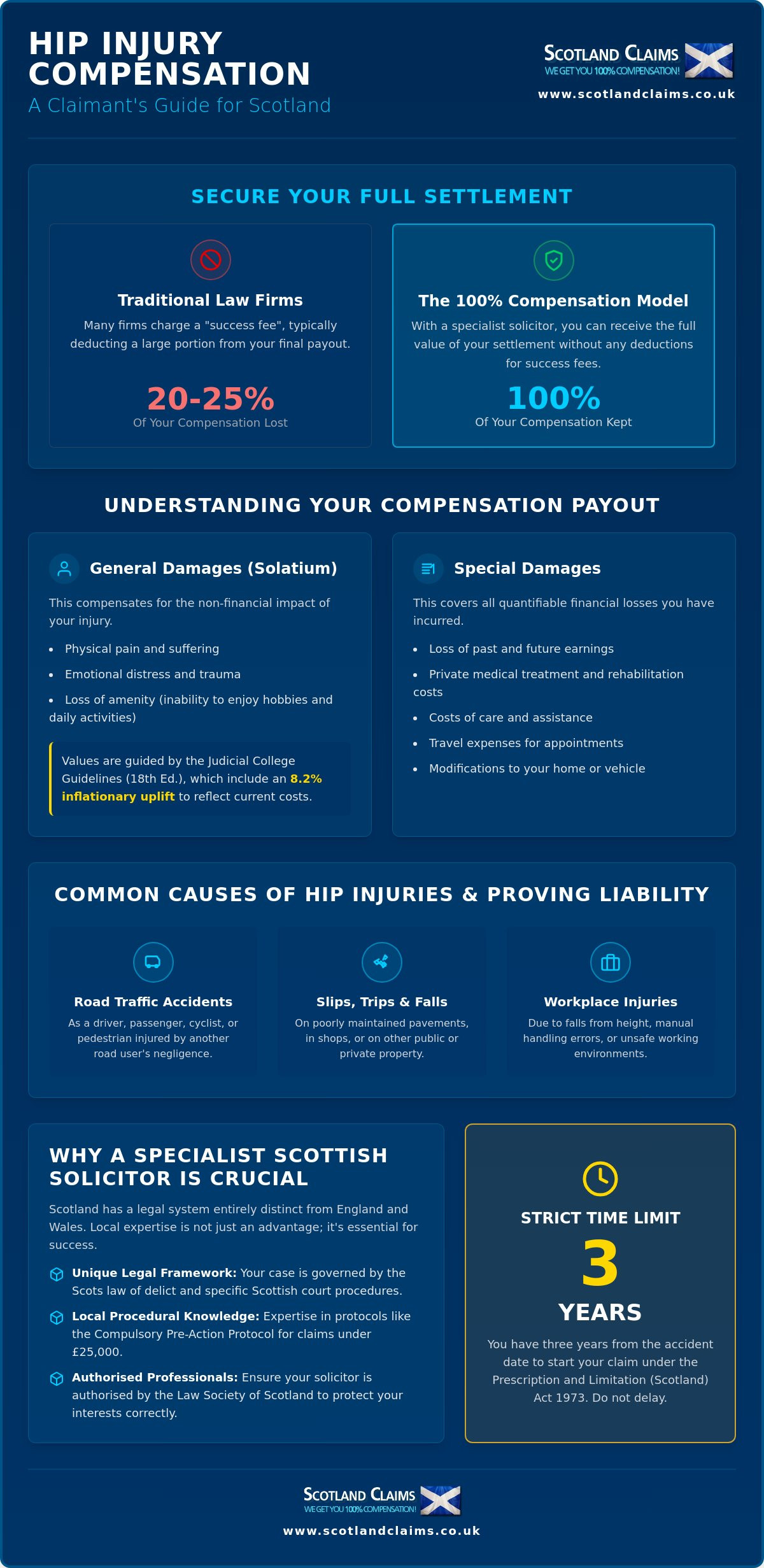
The specific cause of your accident dictates who is legally liable for your hip injury compensation. High-impact collisions frequently lead to road traffic accident claims, where the sheer force of a crash often results in severe pelvis fractures or dislocations. Whether you were a driver, passenger, or pedestrian, the negligent party's insurer is responsible for your recovery costs. We ensure they meet that responsibility in full.
In public spaces, slips or trips on defective pavements are a major contributor to hip fractures, particularly amongst the elderly. Local councils have a statutory duty to maintain public walkways to a safe standard. Similarly, injuries at work often stem from falls from height or lack of training in manual handling. Identifying the correct negligent party is the first step toward a successful claim. It could be a local authority, a private business, or an employer who failed to provide a safe environment. We pinpoint the exact entity responsible to ensure your claim is filed correctly.
Evidence needed to support your claim
Proving liability requires concrete evidence. CCTV footage from nearby buildings or dashcam recordings from vehicles can provide an unbiased account of the incident. You should gather witness statements as soon as possible whilst the details are still fresh; these accounts often prove vital if the at-fault party disputes your version of events. Your medical records act as the definitive proof of your injury. They document the immediate trauma and the long-term prognosis, forming the backbone of your hip injury compensation valuation.
Proving negligence in public places
For pavement claims in Scotland, there is a specific "tripping hazard" standard. Generally, a defect must be at least 20mm to 25mm deep to be considered a breach of duty by the council. If you fall in a supermarket, gym, or shopping centre, you must report the incident in their accident book immediately. This creates a formal record that the event occurred. Always take photographs of the defect, using a coin or ruler for scale, before the area is repaired. This visual proof makes it much harder for the negligent party to deny the hazard existed.
If you have been injured due to someone else's negligence, you can start your claim online to secure the settlement you deserve.
Starting your journey toward financial recovery should be straightforward. We provide a 24-hour freephone helpline designed to give you immediate access to expert guidance when you need it most. During this first contact, we perform a rapid assessment of your situation to determine the viability of your case. If your claim has merit, Scotland Claims Injury Lawyers manages the seamless transition to a qualified injury lawyer in Scotland. This specialist will take over the legal heavy lifting, allowing you to focus entirely on your physical rehabilitation and recovery.
The path from your initial call to receiving a settlement cheque follows a logical, methodical sequence. First, we gather the evidence discussed in previous sections, such as dashcam footage or witness details. Next, we arrange a professional medical assessment to quantify your hip injury compensation. Once we have the full picture of your losses, your solicitor enters robust negotiations with the at-fault party's insurers. Our final promise remains unchanged: you will receive 100% of your compensation with zero success fees deducted. We ensure the financial recovery process is as efficient as the medical one.
The initial consultation: what to expect
Your first conversation is a completely no-obligation chat. We use this time to understand the specific mechanics of your accident and the severity of your symptoms. The solicitor will ask clear, direct questions about the location of the incident, any witnesses present, and the medical treatment you've received so far. We also use this time to clarify the "No Win, No Fee" agreement terms. You'll finish the call with a transparent understanding of how your claim will proceed and the total financial protection Scotland Claims Injury Lawyers offers.
Timeline of a hip injury claim
The duration of a claim depends on the complexity of the injury and whether the defendant admits liability. Straightforward cases where the other party accepts fault quickly can often be resolved within six to nine months. However, serious injuries involving long-term care or disputed liability may take longer to reach a conclusion. The Scottish Compulsory Pre-Action Protocol provides a structured timeframe for these negotiations, ensuring the process moves with necessary speed whilst maintaining legal rigour.
It's vital that you don't rush into a premature settlement. Insurers often make "low-ball" offers early in the process before the full long-term impact of a hip injury is known. Accepting an early payout might leave you under-compensated for future medical needs or lost earnings. We ensure the process moves at a pace that protects the full value of your hip injury compensation, resulting in a settlement that covers your needs for the rest of your life. Our priority is your long-term security, not a quick, diminished result.
Your path to recovery doesn't have to be complicated or costly. You now understand how the latest legal guidelines protect your settlement value and why our zero success fee model is the fairest choice for victims in Scotland. We've established that evidence is the key to proving liability and that local expertise is non-negotiable when navigating Scots law.
Since 2006, Kerr Brown Solicitors has operated with a clear mission to put clients first. We are fully regulated by the Law Society of Scotland; this ensures your claim is handled with the highest professional standards. Our 100% Compensation Guarantee means that the hip injury compensation awarded to you stays with you. Don't let a negligent party's mistake or a law firm's success fee dictate your financial future.
Start your 100% compensation claim online today.
You have the strength to recover, and we have the expertise to ensure you do so with your full settlement intact.
How much compensation will I get for a broken hip in Scotland?
The amount of hip injury compensation you receive is determined by the severity of the injury and the length of your recovery. Under the 18th Edition Judicial College Guidelines, settlements are categorised by the level of permanent disability and the need for future surgery. For a broken hip, your award will also include Special Damages to cover lost wages and private medical costs. A specialist assessment ensures your payout reflects the true cost of your trauma.
Can I claim for a hip injury if I was partially at fault?
Yes, you can still pursue a claim even if you were partially responsible for the incident. This is known as contributory negligence. Your final settlement will be reduced by a percentage that reflects your level of fault. For example, if you are found 20% responsible, you will still receive 80% of the total claim value. We fight to ensure your level of responsibility is assessed fairly and not exaggerated by insurers.
How long does a hip injury compensation claim take to settle?
Straightforward claims typically settle within six to nine months once liability is admitted. However, complex cases involving serious fractures or long-term mobility issues can take longer to resolve. It is important not to rush the process; we must wait until your medical prognosis is clear to ensure you receive the full value of your claim. Rushing often leads to accepting a lower offer that doesn't cover future needs.
Is there a time limit for making a hip injury claim in Scotland?
You generally have three years from the date of your accident to initiate a legal claim in Scotland. This deadline is set by the Prescription and Limitation (Scotland) Act 1973. If you don't start the process within this window, you will likely lose your right to seek compensation forever. There are very few exceptions to this rule, so it is vital to seek expert legal advice as soon as you are medically able.
Will I have to go to court for my hip injury claim?
It is highly unlikely that you will have to step foot in a courtroom. The vast majority of personal injury cases in Scotland settle through negotiations between your solicitor and the at-fault party's insurance company. Court proceedings are usually a last resort used only if the insurer refuses to offer a fair settlement. If your case does go to court, your specialist solicitor will handle all the complex legal requirements on your behalf.
Can I claim for a hip injury caused by a slip in a supermarket?
You can claim compensation if the supermarket failed in its duty of care to keep you safe. This includes incidents like slipping on a spilled liquid that wasn't cleaned or tripping over abandoned stock in an aisle. To succeed, you should ensure the fall was recorded in the store's accident book and take photographs of the hazard. This evidence proves the store was negligent in maintaining a safe environment for shoppers.
Do I need a medical exam to claim for a hip injury?
A medical examination is an essential requirement for every personal injury claim. We arrange for an independent doctor to assess your hip and provide a detailed report on the extent of your injuries. This report acts as the primary evidence used to value your claim. Without it, there is no professional proof of your pain and suffering, making it impossible to secure the full hip injury compensation you deserve.
Why should I choose a Scottish solicitor over a UK-wide firm?
You should choose a Scottish solicitor because our legal system, court procedures, and terminology are entirely different from those in England and Wales. UK-wide firms often lack the specific knowledge of the Scottish Compulsory Pre-Action Protocol or the unique ways our courts assess damages. Local expertise ensures your claim is handled according to Scots law, preventing procedural errors that could delay your payout or result in a lower settlement.