
Most people assume that winning a legal settlement means losing a significant chunk of your payout to success fees. In Scotland, an ankle injury claim should restore your finances, not fund a law firm's profit margin. You are likely already dealing with the daily frustration of reduced mobility and the mounting stress of lost earnings whilst you are unable to drive or walk. It is a difficult position to be in, especially when the fear of hidden legal costs makes you hesitant to seek the justice you deserve.
This 2026 guide explains exactly how to secure the full value of ankle injury claims scotland without losing a single penny of your settlement to legal fees. You will discover the current compensation brackets for your specific injury, from minor sprains to severe fractures requiring surgery. We also preview how to access expert representation under Scots Law that guarantees you retain 100% of your award. We provide a clear path to a quick assessment of your claim's validity so you can focus on your recovery instead of your financial situation.
- Learn how to keep every penny of your settlement with a zero success fee model that recovers legal costs from the opponent's insurer.
- Identify the specific compensation brackets for your injury based on the 2026 Judicial College Guidelines and your unique financial losses.
- Discover how to establish liability and prove a breach of duty for ankle injury claims scotland following a slip, trip, or workplace accident.
- Understand the Scottish legal process, including the "Triennium" rule and the vital evidence required to secure a successful outcome.
An ankle injury claim is a formal legal process designed to recover damages for your physical and financial losses. You aren't just seeking a payout; you're seeking accountability. In Scotland, the legal system aims to achieve "restitutio in integrum," which means returning you to the financial position you were in before the accident. This covers everything from the physical pain you've endured to the out-of-pocket expenses you've incurred whilst recovering.
Success depends on proving liability. Under the Scots law of delict, you must establish that a third party owed you a duty of care and breached that duty through negligence. This breach is the foundation of all ankle injury claims scotland. Whether your injury resulted from a road traffic accident, a workplace incident, or a trip on a poorly maintained public pavement, the person or organisation at fault is legally responsible for the consequences of their actions.
What Constitutes a Valid Ankle Claim?
To move forward with a claim, your case must meet specific legal standards. First, timing is critical. You generally have three years from the date of the accident to initiate proceedings. If you miss this window, your right to claim is usually lost. Second, you must be able to prove that someone else was at fault. This could be an employer who ignored safety protocols or a driver who failed to stop. Finally, medical evidence is non-negotiable. You must have sought professional medical attention at a hospital or GP surgery. This creates a contemporary record of your injury, which serves as the primary evidence for your solicitor to build your case.
The Impact of Ankle Injuries on Daily Life
The true cost of an ankle injury often goes far beyond medical bills. Mobility issues can immediately stop you from walking, driving, or performing your job, especially if your role involves manual handling or standing for long periods. This loss of independence often carries a heavy weight. You might find yourself feeling isolated amongst friends or unable to participate in family activities you once enjoyed.
Long-term health risks are also a major factor. Even after the initial swelling subsides, you may be left with post-traumatic arthritis or permanent ligament instability. These conditions require ongoing management and can lead to a permanent reduction in your quality of life. If you want to understand the potential scale of your settlement, you can use a personal injury compensation calculator to see how these factors influence the final award. We focus on ensuring every aspect of your suffering is accounted for so you receive the maximum possible settlement.
Establishing who is at fault is the first step in any successful claim. Most injuries occur because a third party failed to maintain a safe environment. In Scotland, this usually involves a breach of statutory duty or common law negligence. Whether you were walking down a high street or working in a warehouse, the cause of your injury dictates the legal path we take. You don't have to guess who is responsible; our role is to identify the negligent party and hold them to account.
Road traffic accidents often lead to some of the most severe ankle injury claims scotland. A side-impact collision can crush the ankle against the car door, whilst a sudden brake can cause the foot to twist violently in the footwell. In these cases, the other driver's insurance company is typically the target for compensation. Similarly, spillages in supermarkets or shopping centres that aren't cleaned or cordoned off within a reasonable time create clear liability for the business owner. They have a duty to ensure that customers can shop without the risk of a life-altering fall.
Slips and Trips in Public Spaces
Scottish local authorities have a legal duty to maintain public walkways in a reasonably safe condition. Potholes, loose paving slabs, and significant height differences between stones are common culprits. Many councils follow a specific inspection regime, but if they fail to repair a known defect, they are liable. If you've fallen, you should document the scene immediately. Take photographs of the defect with a ruler or a coin for scale to show the depth or height. This evidence is vital for Slip or Trip Claims against a council or private landowner. Even if you think the injury is minor, consult NHS guidance on sprains to ensure you haven't sustained hidden ligament damage.
Ankle Injuries at the Workplace
Your employer is responsible for your safety at work. This includes providing appropriate footwear and ensuring floor surfaces are free from hazards like trailing cables or leaked oil. In industrial settings, injuries often happen due to falls from height or manual handling errors where a heavy load causes the ankle to give way. You have the right to seek compensation even whilst you remain employed. Scottish labour laws protect you from unfair treatment or dismissal for exercising your legal right to a safe workplace. If you've been hurt on the job, our Accident at Work Scotland guide provides a deeper look at your specific protections.
If you're ready to see what your claim might be worth, you can use our compensation calculator to get an instant estimate of your potential settlement value.
Calculating the value of ankle injury claims scotland involves looking at two distinct categories of compensation. The first is Solatium, which is the Scottish legal term for pain, suffering, and the loss of quality of life. The second is Special Damages, which covers your quantifiable financial losses. In 2026, Scottish courts rely on the 18th Edition of the Judicial College Guidelines to set these figures. These guidelines ensure consistency across the country, but the specific details of your recovery and medical evidence will determine where your claim sits within the bracket.
It's a common misconception that all ankle injuries result in similar payouts. A simple sprain that heals in months is valued very differently from a pilon fracture that requires permanent metalwork. We focus on the specific impact the injury has had on your lifestyle. If your claim is valued at less than £5,000, it will likely follow the Simple Procedure for claims. This is a streamlined process used by the Scottish Courts and Tribunals Service to resolve smaller disputes efficiently.
2026 Compensation Brackets for Ankle Injuries
The severity of your injury dictates the starting point for your Solatium award. Based on current 2026 valuations, the brackets are as follows:
- Modest injuries: Minor fractures or sprains with a full recovery typically expected within a year can see awards up to £6,710.
- Moderate injuries: Displaced fractures requiring surgical fixation or ligament damage that leaves you with ongoing stiffness usually range from £16,770 to £32,450.
- Severe injuries: Complex breaks resulting in permanent deformity, chronic pain, or a significantly increased risk of osteoarthritis are valued between £38,210 and £61,090.
- Very Severe injuries: The most catastrophic injuries leading to a total loss of mobility or potential amputation can reach up to £85,070.
Calculating Your Total Financial Recovery
Your physical injury is only half the story. We work to ensure your settlement covers every penny of your financial loss. If you've been unable to work, we recover your lost wages, including any missed overtime or bonuses. You can also claim for the cost of private physiotherapy to speed up your recovery, as well as travel expenses to and from medical appointments. Even the time your family spent caring for you whilst you were immobile can be included in the final figure. To get an immediate, personalized estimate of what you could receive, use our Compensation Calculator. We ensure you retain 100% of the award, so the figure you see is the figure you keep.
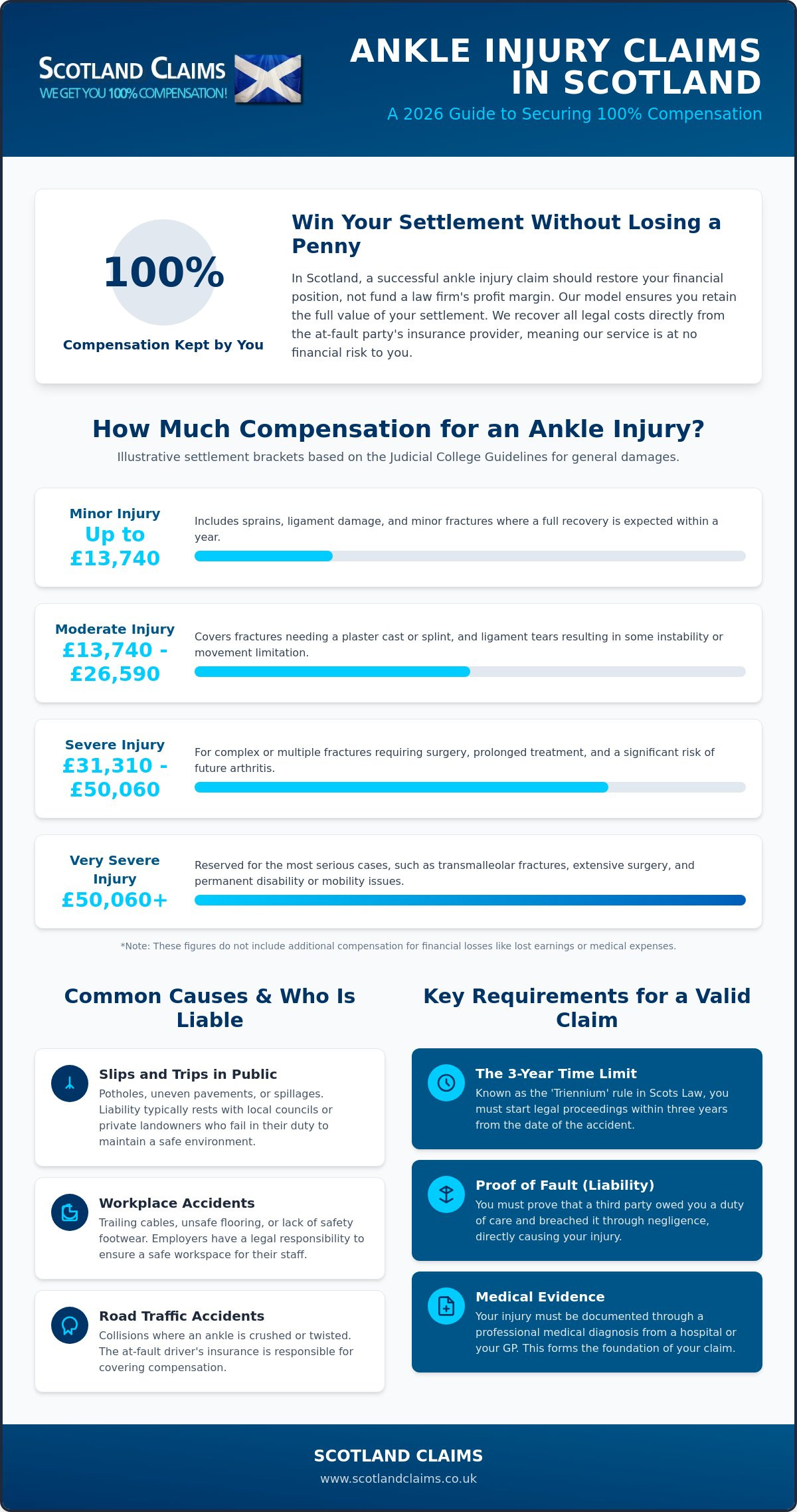
Timing is everything in the Scottish legal system. You are governed by the "Triennium" rule. This means you have exactly three years from the date of your accident to raise a court action. If you wait too long, your claim becomes "time-barred". You lose the right to seek damages entirely. Initiating ankle injury claims scotland early allows your solicitor to secure fresh evidence whilst the details are still clear. We act fast to ensure your rights are protected from the very start.
Evidence is the bedrock of your case. We look for specific items to prove liability and ensure the at-fault party cannot deny responsibility. This often includes:
- CCTV footage: Most public and commercial premises delete footage within 30 days; we move quickly to preserve it.
- Witness statements: Independent accounts from people who saw the accident provide vital corroboration for your version of events.
- Police reports: These are essential for road traffic accidents to establish the official record of negligence.
Once liability is established, we instruct an independent medical expert. They don't just confirm you're hurt; they validate the exact severity of your injury. Their report determines which compensation bracket your claim falls into. This prevents insurance companies from offering a settlement that undervalues your long-term needs. Navigating the Sheriff Court or the Court of Session requires this level of specialist preparation.
The Importance of Immediate Medical Evidence
Visiting a GP or A&E immediately after your accident is a legal necessity. Your medical records serve as the foundation for your compensation valuation. They provide a contemporaneous account of your pain, mobility issues, and required treatment. Medical causation is the legal link that proves your specific injury was directly caused by the accident and not a pre-existing condition. Without this link, insurers will attempt to devalue your settlement by claiming your injury happened elsewhere.
Scots Law vs English Law: Why Local Expertise Matters
The Scottish legal system is entirely distinct from the system in England and Wales. We use different court procedures and settlements are negotiated under a unique set of rules. Your solicitor must be authorised by the Law Society of Scotland to ensure they have the specialist knowledge required. Using an English firm for a Scottish accident often leads to delays and lower settlements. Our team of Injury Lawyers Scotland understands these local complexities intimately. We focus on Scottish results for Scottish claimants.
If you are worried about the three-year deadline or need help gathering evidence, speak with our Scottish legal experts today for a definitive assessment of your claim.
Traditional legal firms often hide a significant catch in their "no win no fee" agreements. They deduct a success fee that can reach up to 20% of your final settlement. When pursuing ankle injury claims scotland, this means a large portion of your award for physical suffering and financial loss never reaches you. This deduction often comes as a shock to claimants who expect the "no win no fee" label to mean they retain the entirety of their compensation. We find this practice unacceptable for someone already dealing with the stress of a life-altering injury and the loss of mobility.
Scotland Claims Injury Lawyers operates on a different principle. We recover our legal fees directly from the at-fault insurance company instead of taking a cut from your award. This approach is designed to restore your quality of life without the added burden of legal expenses eating into your recovery funds. It makes a massive difference to your final payout. On a £10,000 claim, this model puts an extra £2,000 in your pocket compared to others. That money belongs to you to support your long-term recovery and bridge the gap created by lost earnings.
Financial risk shouldn't be a barrier to seeking justice. Our true No Win No Fee arrangement means you pay nothing if your claim is unsuccessful. There are no hidden costs or surprise bills at the end of the process. We take on the entire financial risk of the litigation so you can focus on your physiotherapy and returning to work. We believe in total transparency from the first phone call to the final settlement cheque.
The 100% Compensation Guarantee Explained
We've organised our business to prioritise the client's financial integrity above all else. By operating efficiently and focusing on specialist personal injury law, we ensure you keep every penny of your award. Our legal billing is completely transparent; we provide a clear breakdown of the process with no hidden charges or surprise deductions. Scotland Claims Injury Lawyers earns fees from the at-fault party, not from your pocket.
Starting Your Ankle Claim Today
You don't have to navigate the complexities of the Scottish legal system alone. Our 24-hour freephone helpline is available right now for immediate, expert advice on your situation. The no-obligation claim assessment process takes only minutes and provides you with a clear understanding of your rights. Don't let a negligent party leave you out of pocket. Start your 100% compensation claim online now and secure the full value of your settlement today.
Your path to recovery depends on more than just medical treatment. It requires a legal partner who understands the nuances of the Scottish court system and the specific evidence needed to prove liability. Whether you were injured at work or in a public space, the goal remains the same: full financial restoration. You now know the strict time limits involved and the vital importance of contemporaneous medical records. Now is the time to act on that knowledge.
Handling ankle injury claims scotland should be a transparent process where your needs come first. We are regulated by the Law Society of Scotland and back every case with our 100% Compensation Guarantee. You can reach our expert team for immediate advice through our 24-hour freephone support on 0800 611 8132. We take on the entire financial risk of the process so you can focus on getting back on your feet.
Start your ankle injury claim and keep 100% of your compensation. You've already endured the pain of the accident; you don't have to endure the stress of unfair legal fees. We are ready to help you move forward with the confidence and financial security you deserve.
Can I claim for an ankle injury if I was partially at fault?
Yes, you can still pursue a claim through a process known as contributory negligence. If you were partially responsible, the court assigns a percentage of fault to each party. Your final compensation is then reduced by your percentage of responsibility. We work to minimise your liability to ensure you receive the highest possible settlement for your injury.
How long does an ankle injury compensation claim take in Scotland?
Most straightforward claims are resolved within 6 to 12 months. If the at-fault party disputes liability or your injury is complex, the process can take longer. We focus on moving your case through the Scottish legal system efficiently to avoid unnecessary delays. Our goal is to secure your payout as soon as your medical recovery allows for a final valuation.
What happens if my ankle injury happened at work in Scotland?
You have a legal right to seek compensation if your employer failed to maintain a safe working environment. Scottish law protects you from being fired or treated unfairly for making a claim. Your employer's liability insurance covers the cost of your settlement, so the money does not come directly out of the company's pocket. We manage all negotiations with the insurers to protect your professional relationships.
Do I have to go to court for an ankle injury claim?
It is highly unlikely that you will need to appear in court. Over 90% of ankle injury claims scotland are settled through negotiations with the insurance company before a hearing is necessary. We prepare every case with the rigour required for a court appearance, which often forces insurers to offer a fair settlement much earlier in the process.
Is there a difference between a sprain and a fracture for compensation?
Yes, the medical classification of your injury directly dictates your compensation bracket. A fracture that requires surgical pins or leads to permanent stiffness is valued higher than a soft tissue sprain. However, both injuries are valid grounds for a claim if they were caused by negligence. We use independent medical experts to ensure your specific injury is categorised correctly for the maximum payout.
Can I claim for an ankle injury on behalf of a child?
Yes, you can act as a "representative" for a child under the age of 16. In Scotland, the standard three-year time limit does not start until the child reaches their 16th birthday. This gives families more time to assess the long-term impact of an injury on a child's development. Any compensation awarded is typically held in a secure account until the child reaches adulthood.
What if the accident happened more than three years ago?
Generally, you cannot claim if more than three years have passed since the date of the accident. This is known as the Triennium rule in Scots Law. There are very few exceptions to this deadline, such as injuries where the symptoms only became apparent much later. It is vital to seek a legal assessment as soon as possible to ensure you don't lose your right to claim.
How do you provide 100% compensation when other firms do not?
We recover our legal costs directly from the at-fault party's insurance company rather than taking a cut from your settlement. Many traditional firms deduct a success fee of up to 20% to increase their own profits. We believe the full value of the award belongs to you to cover your recovery and lost earnings. Our business model is designed to ensure you keep every penny of your compensation.