Act Now: Occupational Asthma Evidence, Rights and Claims in Scotland

Occupational asthma is asthma triggered by something you breathe in at work, and the clearest warning sign is breathing that improves on days off or during holidays. If that pattern sounds familiar, get a GP or occupational health review promptly, start a symptom and peak flow diary today, and tell your employer in writing. In Scotland, benefits and legal support are both available, but early evidence gathering makes every later step easier.
TL;DR:
- Asking whether symptoms improve on days off or holidays can be a more sensitive clue than a single test when suspecting occupational asthma.
- Employers must assess risks, remove or substitute triggers, and rely on proper ventilation rather than just providing personal protective equipment.
- Early removal from exposure within 12 months of initial symptoms significantly improves the chances of long-term recovery.
- Maintaining detailed peak flow diaries, medical records, and employer correspondence from the onset is crucial for a successful claim.
- Applying for industrial injuries benefits has a 10-year time limit from the last day worked in the relevant occupation, making prompt action vital.
Scotland Claims Injury Lawyers
Discuss Your Workplace Injury Claim
Scotland Claims Injury Lawyers connects people in Scotland with specialist injury lawyers for claims involving workplace injuries.
Get help with your claimTable of Contents
What is occupational asthma and how does it differ from other asthma?
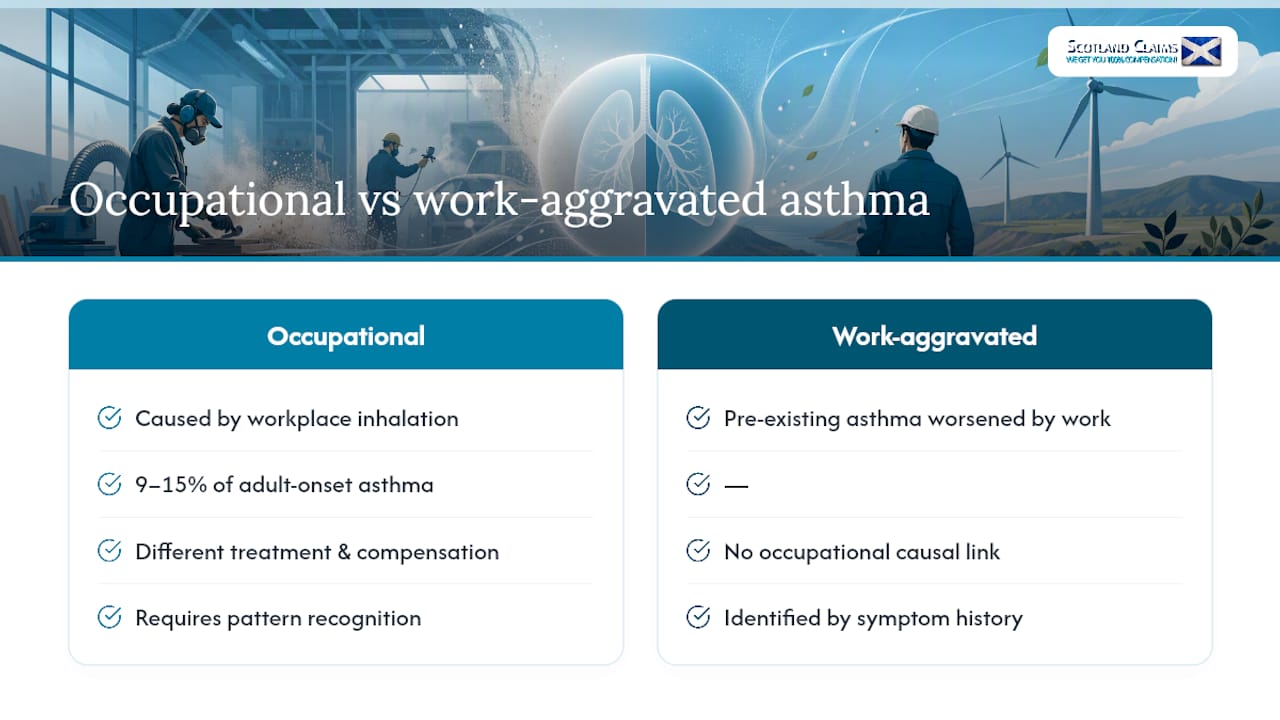
Occupational asthma is asthma caused directly by inhaling a substance at work, distinct from “work-aggravated asthma”, where someone with pre-existing asthma finds their symptoms worsened by dusty or fume-laden conditions but the underlying disease originated elsewhere. The distinction matters clinically and legally, because the causal link changes what treatment and compensation routes are available.
The scale is bigger than most people assume. Occupational causes account for an estimated 9% to 15% of adult-onset asthma cases, which means a significant share of adults diagnosed with asthma after childhood may have a workplace trigger nobody has identified yet.
Normal spirometry on a random clinic visit does not rule this out. Lung function often looks fine hours after leaving the workplace, which is exactly why clinicians rely on pattern recognition rather than a single test. The best screening question a GP can ask is not “does it get worse at work?” but whether symptoms improve on days away from work or on holiday, a more sensitive marker than most patients expect.
What causes occupational asthma and who is most at risk?
Certain substances, known as asthmagens, are recognised triggers, and HSE maintains a working list of them alongside control guidance for employers. The commonest culprits include:
- Flour and grain dust (bakeries, mills)
- Isocyanates, found in spray paints and some adhesives
- Wood dust, particularly hardwoods
- Latex proteins, mainly in healthcare gloves
- Metalworking fluids and coolants
- Laboratory animal proteins
- Cleaning agents, including certain disinfectants
- Glues, resins and other bonding agents
In Scotland, this places bakers, joiners and furniture makers, vehicle spray painters, healthcare and laboratory staff, and engineering or metalworking employees among the higher-risk groups. If you suspect a substance at your workplace, ask your employer for the COSHH assessment covering it. Personal protective equipment is often the first thing offered, but it sits at the bottom of the control hierarchy. Removing or substituting the substance, or containing it with proper ventilation, does far more to prevent sensitisation than a mask handed out after the fact.
How is occupational asthma diagnosed?
Diagnosis usually starts with your GP, who should refer you to an occupational respiratory service or occupational physician once a workplace link is suspected. From there, the pathway typically follows this order:
- Initial history and basic spirometry at the GP or hospital respiratory clinic.
- Serial peak flow monitoring, the mainstay of objective diagnosis. Guidance recommends at least four readings a day over several weeks, covering both working periods and time away, such as weekends or holidays.
- Skin-prick testing or specific IgE blood tests where a specific allergen, such as latex or flour, is suspected.
- Specific inhalation challenge testing, the gold standard, though access to these specialist facilities is limited across the UK, which is precisely why peak flow diaries carry so much diagnostic weight in practice.
Pro Tip: Log every peak flow reading with the time, whether you were at work or off, and any medication taken. A messy diary is hard to interpret months later; a consistent one can be the single most persuasive piece of evidence a specialist, or later a solicitor, ever sees.
Keep copies of any occupational health letters, workplace risk assessments, and correspondence with your employer. You will want them again.
What are employers’ legal duties on workplace asthma prevention?
Employers carry clear statutory duties once asthmagens are present in a workplace. Under COSHH, they must assess the risk, then work through a hierarchy of controls: eliminate the substance where possible, substitute it with something safer, use engineering controls such as extraction and ventilation, and only then rely on PPE, backed by proper training.
Where occupational asthma is diagnosed, employers must report it to HSE under RIDDOR, a legal reporting duty, not an optional courtesy. Health surveillance should also be running wherever exposure risk exists, and typically includes:
If your employer has never mentioned health surveillance despite obvious dust, fume or chemical exposure, that gap itself is worth flagging, both to occupational health and, if things don’t improve, in writing to management. Our guide to RIDDOR reporting duties in Scotland sets out the 15 day rule employers must follow once a case is confirmed.
What is the outlook after an occupational asthma diagnosis?
Timing drives everything here. Removing someone from exposure within around 12 months of first symptoms is linked to meaningfully better long-term outcomes than delayed removal, so the period between “I think this might be work-related” and “I’ve had it confirmed” matters more than it might feel like at the time.
Recovery varies. Some people see symptoms settle substantially once away from the trigger; others are left with persistent, if milder, asthma even after the exposure stops. Waiting it out rarely helps.
Work options after diagnosis usually include redeployment to a role without the trigger substance, or reasonable workplace adjustments, such as improved ventilation or task changes. Depending on severity and duration, occupational asthma may also fall within disability protections under the Equality Act, which can strengthen a case for adjustments rather than dismissal.
Occupational asthma benefits and legal claims in Scotland
Industrial Injuries Disablement Benefit (IIDB) can apply to occupational asthma, but eligibility and award levels depend on individual assessment, so it is worth applying even if you are unsure. One detail catches people out repeatedly: there is a general 10-year time limit for making an IIDB claim, running from the last date you worked in the relevant occupation, with limited statutory exceptions. Miss that window and the benefit route can close, even where the medical case is strong.
The same urgency applies to compensation claims. Preserve your medical records, health surveillance logs, peak flow diaries and any employer correspondence from day one; these are exactly what solicitors and assessors rely on later. Our detailed breakdown of accident at work claim time limits in Scotland covers how limitation periods apply in practice, and it’s worth reading well before any deadline is close.
How can a Scotland-based solicitor help with an occupational asthma claim?
A solicitor’s first job is assessing whether your case has merit, then gathering the evidence that supports it: medical records, peak flow logs, employer risk assessments, and expert opinion linking your diagnosis to your job. They liaise directly with occupational physicians and respiratory specialists so you’re not left interpreting technical reports alone.
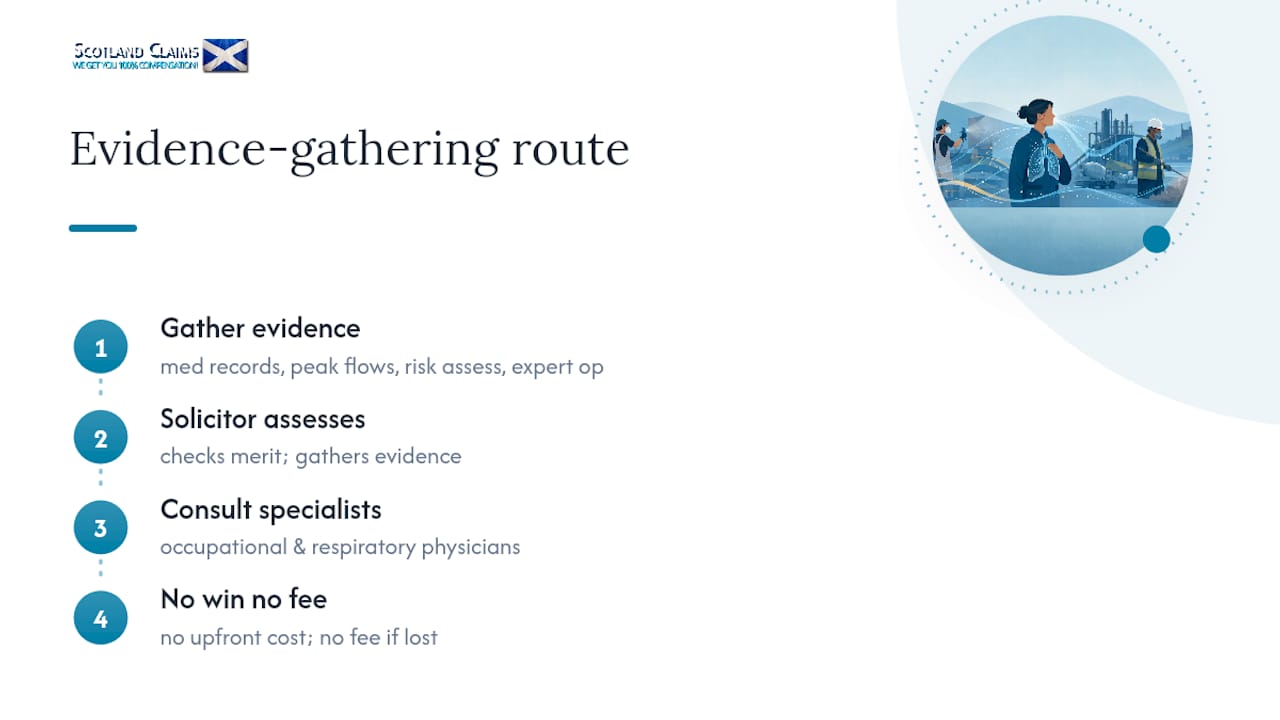
No win no fee removes the financial barrier that stops many people even asking the question. It means you pay nothing upfront, and if the claim doesn’t succeed, you owe nothing. For an initial enquiry, gather your diagnosis letters, peak flow diary, any occupational health correspondence and details of your employer’s control measures, or lack of them. Our overview of injury at work compensation in Scotland explains how liability is typically established in workplace illness cases.
Why acting early matters more than most people realise
The medical evidence and the legal evidence point the same way: delay costs you. Staying in a role with the trigger substance while you “wait and see” can turn a recoverable condition into a permanent one, and a thin paper trail makes a strong claim look weak. Start the diary the day you notice a pattern, not the day a specialist confirms it.
— Roger
Get help with an occupational asthma claim in Scotland
If workplace exposure has damaged your breathing, you may be able to claim compensation without losing any of your awarded amount. Many solicitors charge a success fee that reduces the claimant’s compensation; some offer arrangements where claimants keep all of their awarded settlement. Our injury at work claims service covers occupational illness cases including work-related asthma, assessed under a genuine no win no fee arrangement, meaning nothing to pay upfront and nothing owed if the claim doesn’t succeed.
Before you get in touch, gather your diagnosis letters, peak flow diary and any employer correspondence. You can also check the no win no fee terms before requesting a free, no-obligation callback to talk through your situation.
This article is general information, not a substitute for advice from a qualified doctor. Consult a qualified healthcare professional about your own circumstances before acting on anything here.
Sources
FAQ
How much compensation can you get for occupational asthma?
Compensation depends on severity, impact on earnings and long-term prognosis, so figures vary case by case; a solicitor can give a realistic estimate once your medical evidence is reviewed, and some firms ensure you keep 100% of whatever is awarded.
What is the difference between asthma and occupational asthma?
Ordinary asthma can have many triggers unrelated to work, while occupational asthma is caused directly by a substance inhaled in the workplace, and typically improves when the person is away from that environment.
Is occupational asthma a disability?
It can be, depending on severity and duration of symptoms; where the impact is substantial and long-term, it may fall under the Equality Act’s disability protections, entitling the worker to reasonable adjustments.
How is occupational asthma diagnosed?
Diagnosis usually combines a GP assessment, specialist referral, and serial peak flow monitoring with at least four readings daily, sometimes supported by allergy testing or specialist inhalation challenge where available.
Recommended