Why legal support matters for injured workers in Scotland

Legal claims for workplace injuries in Scotland have surged following recent reforms, yet many injured workers still believe they can navigate complex compensation processes alone. This misconception often leads to denied claims, undervalued settlements, or unexpected costs. The Scottish legal landscape has evolved significantly, with new protections and specialised courts reshaping how personal injury cases proceed. Understanding why expert legal support has become essential can mean the difference between securing fair compensation and walking away empty handed.
Table of Contents
Key takeaways
| Point |
Details |
| Legal expertise navigates complex laws |
Scottish health and safety regulations require specialised knowledge to identify breaches and build strong cases. |
| QOCS reshapes financial risks |
Qualified One-way Costs Shifting protects claimants from paying defendants’ costs in most scenarios. |
| ASPIC streamlines claims |
The All-Scotland Sheriff Personal Injury Court handles thousands of cases annually with specialised expertise. |
| Legal support maximises compensation |
Professional representation increases success rates and ensures accurate claim valuations. |
| No win no fee reduces risk |
Access to legal services without upfront costs makes justice accessible for all injured workers. |
Understanding health and safety laws in Scotland
Scottish workplace safety legislation creates specific duties for employers to prevent injuries and maintain safe working environments. These laws differ in important ways from regulations elsewhere in the UK, requiring solicitors with local expertise to identify breaches effectively. Common violations include inadequate risk assessments, faulty equipment maintenance, and insufficient employee training.
Employers must comply with the Health and Safety at Work Act 1974 alongside Scottish-specific regulations. When these duties are breached and workers suffer injuries, legal professionals can pinpoint exactly where negligence occurred. This might involve examining workplace inspection records, maintenance logs, or training documentation that injured workers would struggle to obtain independently.
Key elements legal experts assess include:
- Employer compliance with risk assessment requirements
- Proper maintenance and inspection of workplace equipment
- Adequate training provision for hazardous tasks
- Implementation of appropriate safety measures
- Documentation of safety procedures and incident reporting
Experienced solicitors know which evidence proves employer negligence most effectively. They understand procedural requirements and strict deadlines that, if missed, can invalidate otherwise valid claims. For instance, workers who sustained back injuries or knee injuries at work need legal professionals who can connect medical evidence to specific safety breaches.
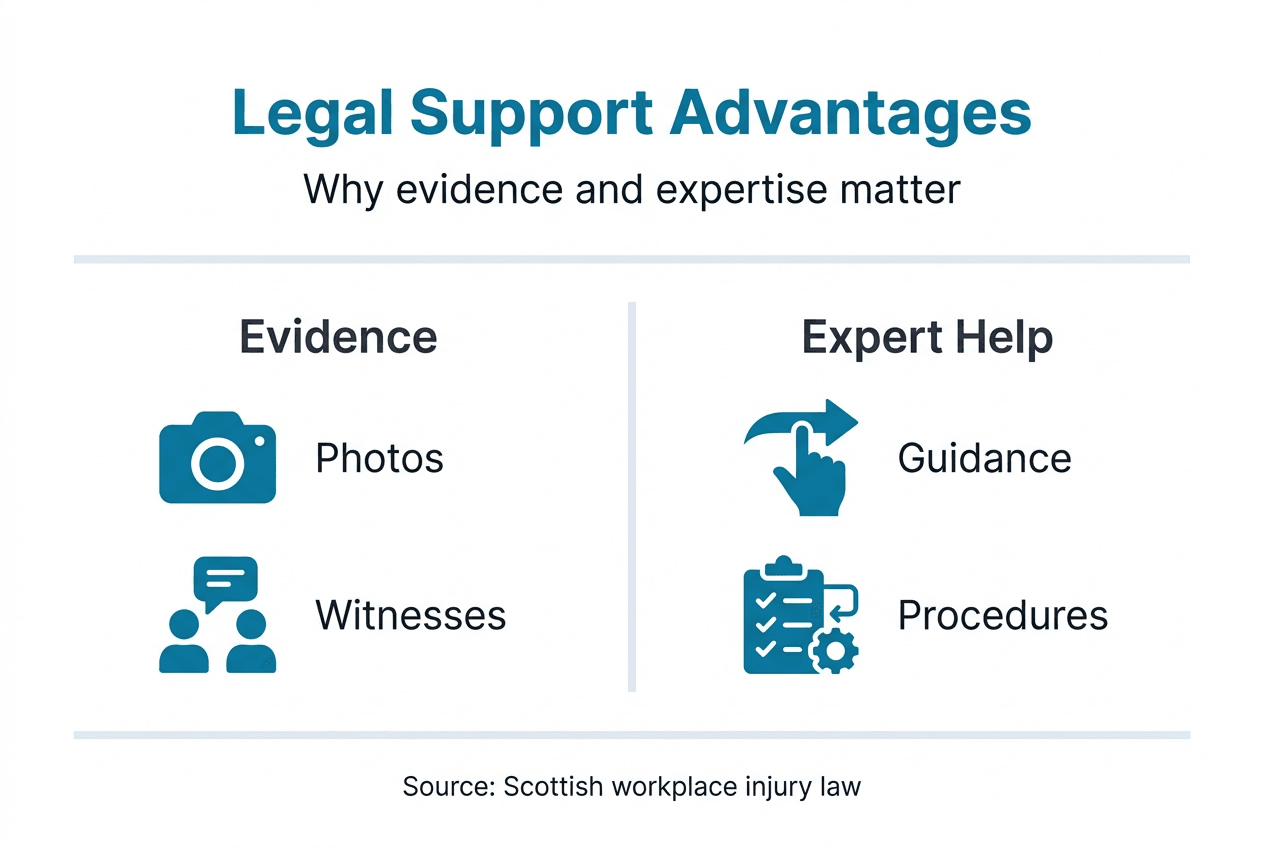
Pro tip: Document everything immediately after a workplace injury, including photographs, witness details, and incident reports, as this evidence becomes crucial when your solicitor builds your case.
Impact of qualified one-way costs shifting (QOCS) on claims
The introduction of QOCS fundamentally changed the financial landscape for personal injury claimants in Scotland. This protection means injured workers typically avoid paying defendants’ legal costs even if their claim fails. The reform aimed to improve access to justice by removing the financial deterrent that previously stopped many legitimate claims.
Following QOCS implementation, litigation volumes increased substantially, with projections showing 11,575 personal injury cases in 2025/26. This represents a significant rise in both meritorious claims and, inevitably, some less robust cases. The protection encourages injured workers to pursue rightful compensation without fear of crippling legal bills.
However, QOCS contains important exceptions where costs may still be awarded against claimants:
- Cases dismissed as fundamentally lacking in merit
- Claims found to be fraudulent or dishonest
- Situations where claimants behave unreasonably during proceedings
- Certain procedural failures or non-compliance with court orders
Legal expertise becomes vital in navigating these exceptions. Solicitors experienced in Scottish injury law assess claim strength before proceeding, ensuring cases have solid foundations. They prepare robust evidence and manage proceedings professionally to avoid behaviours that might trigger cost penalties.
“The rise in litigation reflects both increased access to justice and the need for legal professionals to filter strong claims from weak ones, protecting clients from potential cost consequences whilst maximising legitimate compensation opportunities.”
For workers pursuing injury at work claims, understanding QOCS protections and limitations requires professional guidance. Solicitors structure cases to maintain cost protections whilst building the strongest possible evidence for successful outcomes.
The role and benefits of the All-Scotland Sheriff Personal Injury Court (ASPIC)
ASPIC revolutionised how Scotland handles personal injury litigation by centralising cases and providing specialised judicial expertise. Established to improve efficiency and consistency, this court manages the vast majority of personal injury claims across Scotland. In 2024/25 alone, 6,893 cases were brought at ASPIC, demonstrating its central role in the Scottish legal system.
The court’s specialised nature offers distinct advantages. Sheriffs handling ASPIC cases develop deep expertise in personal injury law, leading to more informed decisions and consistent application of legal principles. This specialisation benefits injured workers by ensuring their cases are heard by judges who understand the nuances of workplace injury claims.
| ASPIC Feature |
Benefit for Claimants |
| Centralised jurisdiction |
Consistent standards across Scotland |
| Specialised sheriffs |
Expert judicial understanding of injury law |
| Streamlined procedures |
Faster case resolution compared to traditional courts |
| Standardised processes |
Predictable timelines and requirements |
| Remote hearings available |
Reduced travel burden for injured workers |
Legal representation proves particularly valuable in ASPIC proceedings. Experienced solicitors familiar with ASPIC procedures prepare cases according to court expectations, present evidence effectively, and navigate the specific rules governing these specialised hearings. They understand which documentation sheriffs require, how to structure written submissions, and what arguments resonate in this particular forum.
Pro tip: Solicitors who regularly appear at ASPIC develop relationships with court staff and understand local practices, giving your claim procedural advantages that self-represented claimants cannot access.
The court’s efficiency means cases progress more quickly than in traditional sheriff courts. For injured workers facing financial pressures, faster resolution delivers compensation sooner, helping cover medical costs, lost wages, and rehabilitation expenses without prolonged uncertainty.

Practical advantages of legal support for injured workers
Professional legal representation delivers tangible benefits throughout the claims process. Solicitors gather compelling evidence of employer negligence, from workplace inspection failures to inadequate safety training records. They know exactly what documentation proves liability and how to obtain it through formal disclosure procedures that individual claimants cannot access.
Calculating accurate compensation values requires specialist knowledge. Claims must account for immediate medical costs, ongoing treatment needs, lost earnings, reduced future earning capacity, and pain and suffering. Solicitors use established legal frameworks and precedent cases to ensure nothing gets overlooked. Underestimating claim values costs injured workers thousands in rightful compensation.
Legal professionals handle all procedural complexities:
- Drafting and filing court documents meeting technical requirements
- Managing strict deadlines for responses and submissions
- Communicating with insurers and opposing solicitors
- Negotiating settlements from positions of legal strength
- Representing clients at court hearings and settlement discussions
This comprehensive support removes emotional and administrative burdens from injured workers already dealing with recovery challenges. You focus on healing whilst your solicitor manages the legal battle.
| Aspect |
Without Legal Support |
With Legal Support |
| Evidence gathering |
Limited access to employer records |
Formal disclosure procedures compel evidence production |
| Claim valuation |
Risk of underestimation |
Accurate calculation using legal precedents |
| Procedural compliance |
High risk of missed deadlines |
Professional management of all requirements |
| Negotiation position |
Weak against experienced insurers |
Level playing field with legal expertise |
| Success likelihood |
Significantly lower |
Substantially higher with proper representation |
Qualified legal assistance increases chances of fair compensation whilst reducing the likelihood of losing cases due to procedural errors or underestimated claims. Insurers employ experienced lawyers to minimise payouts. Facing them without equivalent expertise puts you at a severe disadvantage.
Pro tip: Initial free consultations let you understand your claim’s strength and potential value before committing to anything, making it risk free to explore your options with professional guidance.
How Scotland Claims can support your injury claim
Scotland Claims connects injured workers with specialist solicitors who understand Scottish workplace injury law intimately. Their no win no fee arrangement eliminates financial barriers, ensuring you pay nothing upfront and retain 100% of your compensation if successful. This risk free approach makes expert legal support accessible regardless of your financial situation.
Their experienced legal team specialises in ASPIC procedures and Scottish health and safety regulations, bringing the local expertise essential for successful claims. They handle everything from initial case assessment through to final settlement, managing communications with insurers and opposing solicitors whilst you focus on recovery. Free consultations provide transparent assessments of claim strength and potential compensation values using their compensation calculator, helping you make informed decisions without pressure or cost.
Frequently asked questions
Can I claim compensation without a lawyer in Scotland?
Yes, you legally can pursue a claim independently, but complex Scottish regulations and strict procedural requirements make success challenging without legal expertise. Missteps in evidence gathering, claim valuation, or court filings may result in denied claims or significantly reduced settlements. Legal support dramatically increases your chances of securing fair compensation whilst avoiding costly procedural errors.
What is qualified one-way costs shifting (QOCS)?
QOCS means claimants typically do not pay defenders’ legal costs if their claim fails, removing the main financial risk that previously deterred legitimate claims. However, important exceptions exist where costs may still be awarded, particularly for fraudulent claims or unreasonable conduct during proceedings. Professional legal advice helps you understand how QOCS protections apply to your specific situation and ensures you maintain those protections throughout your case.
How long do I have to make a workplace injury claim in Scotland?
You generally have three years from the injury date or from when you first knew the injury was caused by your employer’s negligence. Missing this limitation period usually means losing your right to claim permanently. Consulting a solicitor promptly ensures you meet all deadlines whilst evidence remains fresh and witnesses’ memories are clear.
How can I find a solicitor experienced in Scottish workplace injury claims?
Look for solicitors with demonstrated expertise in Scottish health and safety law and regular experience with ASPIC procedures. Seek firms offering free initial consultations to assess your claim without financial commitment. Check their track record with workplace injury cases specifically, as this specialisation ensures they understand the nuances of employer liability and compensation calculation in Scottish law.
What compensation can I claim for a workplace injury?
Compensation covers general damages for pain, suffering, and loss of amenity, plus special damages for financial losses including medical costs, lost earnings, travel expenses, and future care needs. The exact amount depends on injury severity, impact on your life and work, and financial losses incurred. Solicitors use legal precedents and medical evidence to calculate accurate values, often securing substantially higher compensation than injured workers estimate independently.
Recommended