Employers: 1:6 Training Ratio, MAC/RAPP for Manual Handling in Scotland
Employers in Scotland must avoid hazardous manual handling where reasonably practicable, and where it cannot be avoided, must carry out a suitable and sufficient risk assessment and reduce the risk of injury as far as reasonably practicable. This duty comes from the Manual Handling Operations Regulations 1992, applies across Scotland the same as the rest of the UK, and is backed by practical tools from the HSE and the Scottish Manual Handling Passport Scheme.
TL;DR:
- Most Scottish workplaces should prioritize avoiding manual handling tasks through redesign or automation before considering assessment or training.
- Deploy task-specific assessments that evaluate the task, load, environment, and individual capabilities, and revisit them whenever there are changes or incidents.
- Employ the Scottish Manual Handling Passport Scheme for role-specific training, with clear records and sign-offs, to demonstrate competence during inspections.
- Keep detailed and recent documentation of risk assessments, training, and review triggers; outdated or generic evaluations increase the likelihood of enforcement action.
- Employers and employees share responsibility for reporting changes, adhering to safe practices, and ensuring assessments reflect real working conditions to avoid injury and legal penalties.
Scotland Claims Injury Lawyers
Injured At Work? Know Your Options
If manual handling caused an injury, Scotland Claims connects you with specialist injury lawyers to discuss a potential compensation claim.
Explore your claim optionsTable of Contents
What are the manual handling regulations in Scotland? Quick compliance checklist
The Manual Handling Operations Regulations 1992 apply identically in Scotland, England and Wales, and they set out a clear hierarchy of duties rather than a single rule to tick off. Get the sequence right and most of the compliance burden looks after itself.
Start with avoidance. If a task can be redesigned, mechanised, or removed from a person’s job altogether, that beats any amount of careful lifting technique. A pallet truck, a hoist, or simply rearranging a stockroom so nothing heavy sits above shoulder height often does more for safety than a training session ever will.
Where handling genuinely cannot be avoided, the law requires a written, task-specific assessment rather than a generic policy statement copied from a template. Regulation 4 is explicit about this: employers must look at the task, the load, the working environment, and the individual doing the lifting.
Here’s the practical checklist most Scottish workplaces should be running through right now:
- Avoid hazardous manual handling wherever a mechanical aid, redesign, or automation genuinely removes the risk.
- Assess every task that remains, using the Schedule 1 factors and recording the outcome in writing.
- Reduce residual risk with equipment, team lifting, task rotation, or better workplace layout.
- Train staff to the specific tasks they perform, not a one-size-fits-all induction video.
- Review assessments on a set trigger, such as a change in task, equipment, workforce, or after an incident.
None of this needs to be complicated. It needs to be documented, specific to the job, and revisited when something changes.
How do you carry out a suitable and sufficient manual handling risk assessment?
“Suitable and sufficient” is a legal phrase, not a marketing one, and HSE guidance is blunt about what it rules out: a tick-box form filled in once and filed away does not meet the standard. An assessment has to genuinely engage with four factors set out in Schedule 1 of the Regulations: the task (twisting, stooping, repetition), the load (weight, shape, stability, whether it is a person or animal), the working environment (space, flooring, lighting, temperature), and individual capability (strength, health conditions, pregnancy, experience).
HSE built two practical tools precisely so employers do not have to start from a blank page:
- Initial filters. HSE’s basic guideline weights and postural checklists let you quickly screen out low-risk tasks that clearly fall within safe limits.
- Manual handling assessment charts (MAC tool). For lifting, carrying, and team handling tasks that fail the initial filter, the MAC tool scores factors like load weight, twisting, and posture to flag which tasks need priority action.
- RAPP tool. Where the task involves pushing or pulling rather than lifting, the Risk Assessment of Pushing and Pulling tool applies the same logic to that different set of forces.
- Full assessment. Anything that scores high on MAC or RAPP, or that clearly cannot be resolved by a quick fix, warrants a full written assessment with named controls and an owner responsible for delivering them.
Involve the people actually doing the lifting. Workers usually know exactly which part of a task causes strain long before an assessment form does, and their input tends to surface risks that a desk-based review misses entirely.
Pro Tip: Prioritise your MAC or RAPP scores by colour band (green, amber, red) and tackle red-band tasks first. Trying to fix everything at once usually means nothing gets fixed properly.
Training and competence: what does the Scottish Manual Handling Passport Scheme require?
Generic manual handling training, the kind delivered once at induction and never revisited, tends to produce workers who can recite the theory but still lift badly under pressure. The Scottish Manual Handling Passport Scheme takes a different approach: modular, role-specific training that matches the technique taught to the actual tasks a worker performs.
SMHPS also sets recommended trainer:trainee ratios for practical sessions, and they’re tighter than many employers expect: SMHPS sets recommended trainer:trainee ratios for practical sessions. The ratios are tighter for people-handling than for load-handling to ensure closer supervision and safe practice… That reflects how much closer supervision is needed when someone is learning to move another person safely rather than a box.
Competence isn’t proven by attendance alone. Employers should keep:
- Induction records showing what training each worker received and when.
- Attendance logs for refresher sessions, tied to specific tasks or equipment.
- Assessor sign-off confirming a worker demonstrated safe technique, not just sat through a presentation.
SMHPS is not a legal requirement in itself, but it functions as a recognised benchmark in Scotland, and employers who can point to it during an inspection are in a noticeably stronger position than those relying on a single generic course.
What records should employers keep, and when must assessments be reviewed?
Inspectors don’t ask for a philosophy of safety. They ask for paper, and specific paper at that: the most recent risk assessments, any MAC or RAPP scoring sheets, training attendance records, assessor sign-offs, and evidence that assessments were actually reviewed after something changed.
Review triggers matter more than a fixed calendar date. An assessment should be revisited when:
- The task, load, equipment, or work environment changes in any material way.
- A near-miss or injury occurs during that task.
- New staff take on the role, particularly if they have different physical capability or experience.
- A reasonable period has passed without review, even if nothing obviously changed.
Enforcement in Scotland can mean improvement notices, prohibition notices stopping a task until it’s fixed, or prosecution for serious or repeated breaches. Employers who keep proactive, dated records rarely end up in that territory. It’s the ones with a single undated assessment from years ago who attract the harder scrutiny, and rightly so.
If a manual handling injury occurs, what should employers and workers do?
Reportable injuries under RIDDOR must be notified to the relevant enforcing authority, with over-seven-day incapacitation injuries reported within 15 days and specified serious injuries reported without delay. Getting this timing wrong is itself a compliance failure, separate from the injury.
Immediately after an incident, preserve the evidence that will matter later:
- Photograph the task, equipment, and environment before anything is moved or repaired.
- Record witness accounts while memories are fresh, not weeks later.
- Pull the relevant risk assessment and check whether it was current and specific to that task.
- Note near-misses on the same task in the preceding months.
For the injured worker, the practical question is usually simpler: was the employer’s assessment adequate, and were the controls it promised actually in place? If a workplace accident happened because a task was never properly assessed, or because promised controls were never delivered, that gap is often the basis of a valid claim, and a lawyer for a work accident in Scotland can advise on whether it stands up. Injured workers should seek a free case review early, before evidence disappears or memories fade.
What counts as manual handling and what counts as a ‘load’?
Manual handling under the Regulations means any transporting or supporting of a load by hand or bodily force, including lifting, putting down, pushing, pulling, carrying, or moving it. That definition is wider than most people assume.
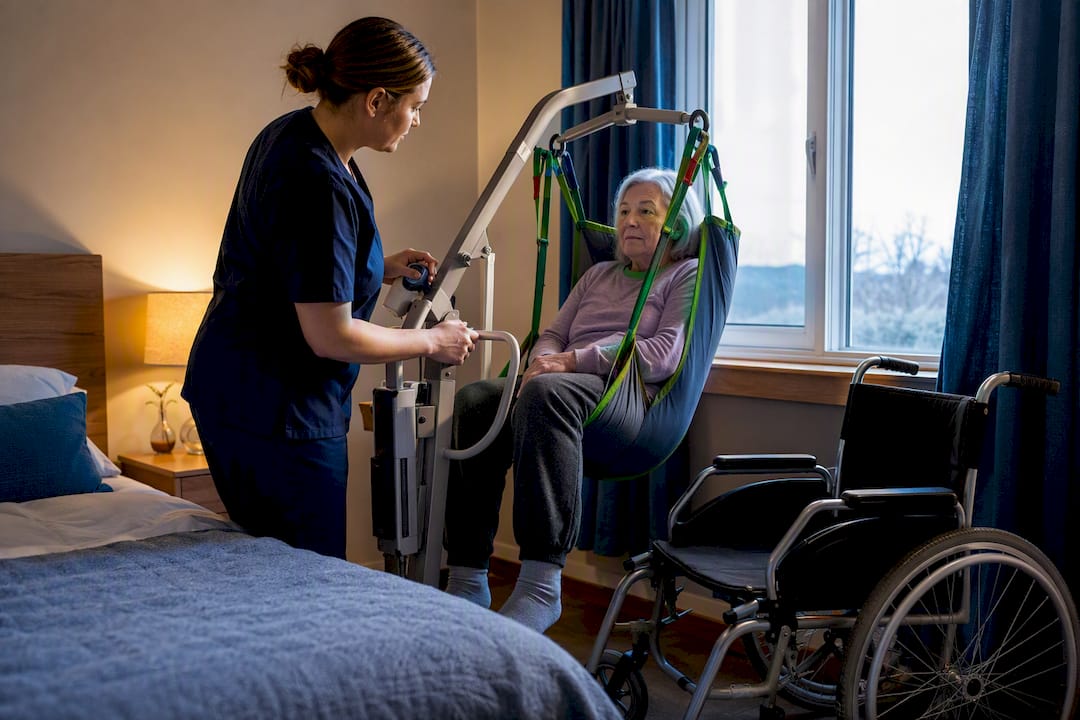
A ‘load’ is not restricted to boxes and equipment. The Regulations explicitly include a person or an animal within the definition of a load, which is precisely why care work, healthcare, and veterinary settings carry some of the highest manual handling risk in the country. Moving a patient from a bed to a wheelchair is manual handling in exactly the same legal sense as shifting a pallet in a warehouse, and it often carries higher risk because the load can move unpredictably, cannot always cooperate, and varies in weight and mobility from one occasion to the next.
This is why NHS Scotland has built manual handling policy specifically around people-handling rather than simply adopting generic industrial guidance. Hoists, slide sheets, and two-person handling protocols exist because a human load behaves nothing like a crate, and the Schedule 1 factors (task, load, environment, individual capability) have to be applied with that difference in mind.
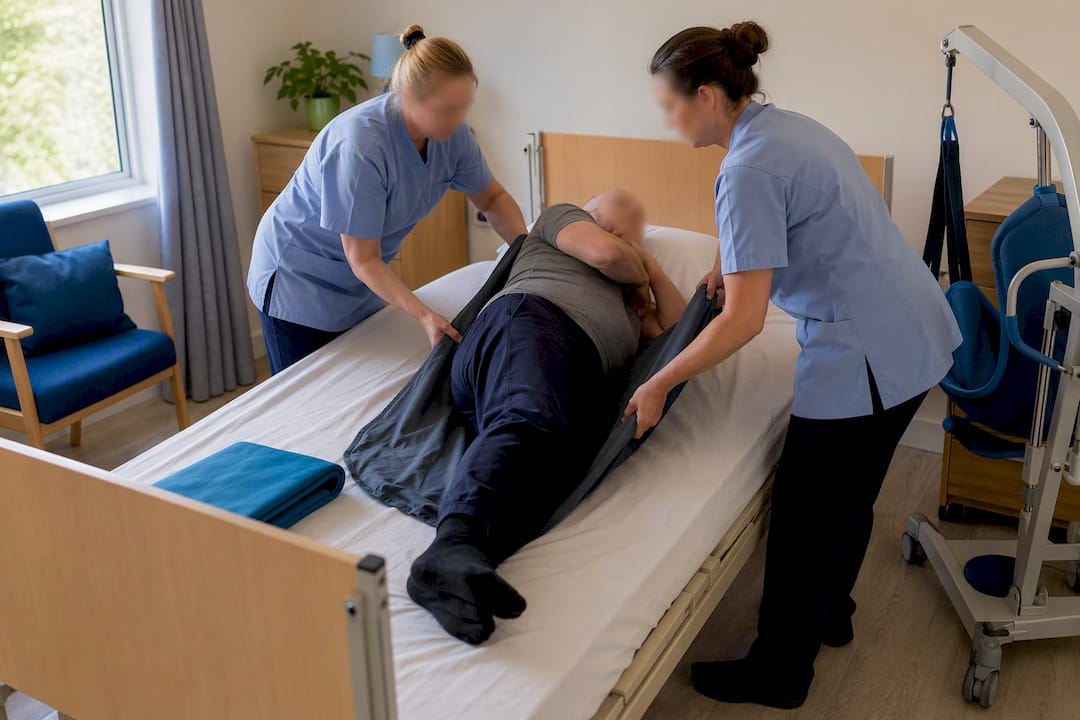
Employers outside healthcare shouldn’t assume this definition doesn’t touch them. Retail, hospitality, and leisure businesses that occasionally move customers, whether assisting someone who has fallen or supporting an intoxicated patron, are handling a load in the same legal sense, and the same duty to assess and reduce risk applies.
How do the Manual Handling Regulations sit alongside wider health and safety law?
The Manual Handling Operations Regulations 1992 don’t operate in isolation. They sit underneath the broader duty set out in the Management of Health and Safety at Work Regulations, which requires every employer to carry out a general risk assessment across the workplace. Where that general assessment identifies manual handling as a hazard, the more specific Manual Handling Regulations then take over and set out exactly what “assess and reduce” has to look like for that particular risk.
Think of it as two layers. The Management Regulations ask the broad question: what could go wrong here? The Manual Handling Regulations answer the follow-up question for one specific hazard: given that lifting or carrying is a risk, what precisely must you do about it? HSE’s L23 guidance exists to bridge that gap, translating the legal text into practical steps, checklists, and worked examples employers can actually apply.
This layered structure matters practically because it means a general risk assessment that never drills down into specific manual handling tasks is not sufficient on its own. An employer who has a broad workplace risk assessment but no task-specific manual handling assessment has only completed half the job. Inspectors and courts treat the two duties as complementary, not interchangeable, and a defence built on the general assessment alone tends not to hold up when a manual handling injury is investigated.
Are there Scotland-specific rules or is this the same as the rest of the UK?
The Manual Handling Operations Regulations 1992 are UK-wide legislation, and the statutory duty is identical whether a workplace sits in Glasgow, Cardiff, or Leeds. There is no separate Scottish statute rewriting the core obligations.
What does differ is the practical guidance framework layered on top. The Scottish Manual Handling Passport Scheme was developed specifically for Scottish employers, largely driven by health and social care needs, and it has become the de facto benchmark north of the border in a way that has no direct equivalent elsewhere in the UK. Employers who adopt it aren’t complying with a separate law; they’re demonstrating good practice against a scheme that Scottish inspectors and sector bodies recognise and expect to see referenced.
Enforcement in Scotland also runs through a slightly different institutional landscape. Workplace health and safety enforcement is generally handled by HSE inspectors and local authority environmental health officers, consistent with the rest of Great Britain, but any prosecution arising from a serious manual handling failure goes through the Scottish criminal courts under Scots law procedure, via the Crown Office and Procurator Fiscal Service, rather than the English court system. That’s a real practical difference even though the underlying safety duty is the same.
For most employers, the sensible approach is straightforward: treat the statutory duty as UK-wide and non-negotiable, but adopt SMHPS as the Scottish standard for training and competence evidence, because it’s what local inspectors and industry bodies will measure you against in practice.
What does compliance look like in a real Scottish workplace?
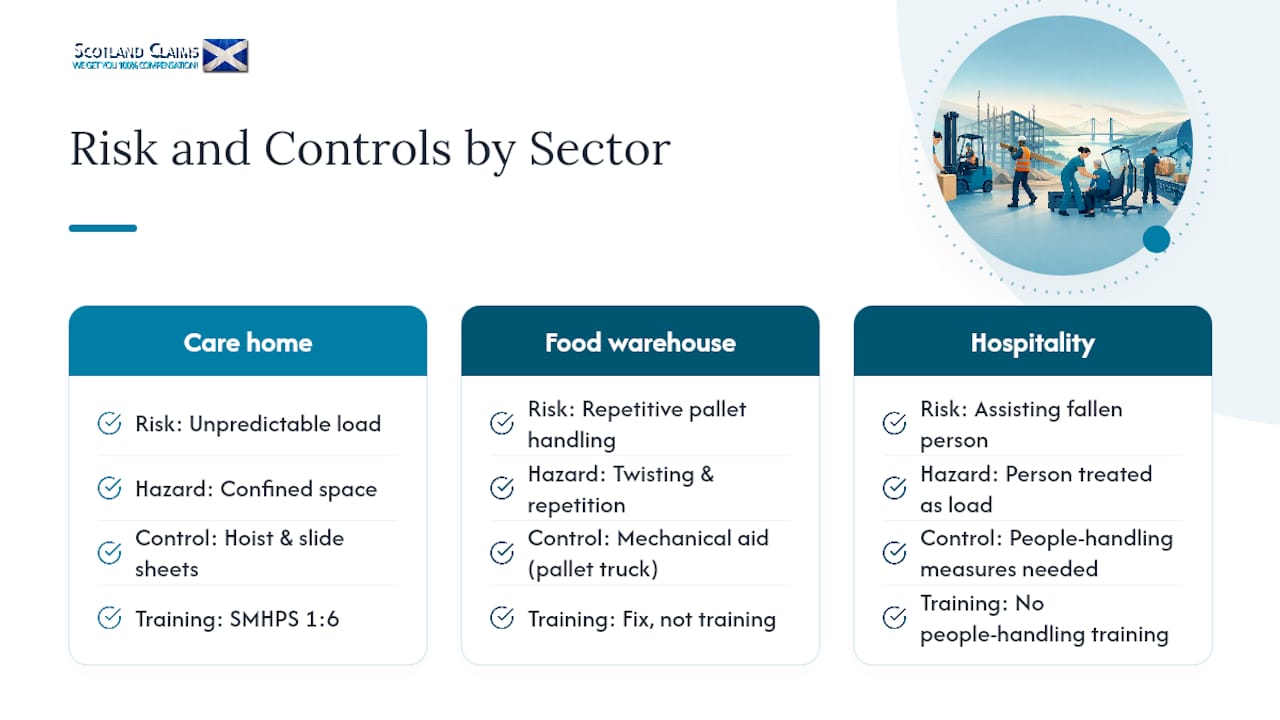
A care home in Edinburgh moving a resident with reduced mobility from bed to chair faces a textbook Schedule 1 scenario: an unpredictable load, a confined bathroom or bedroom environment, and staff whose physical capability varies by shift. Getting this right means hoists sized to the task, slide sheets for lateral transfers, and SMHPS-style people-handling training delivered at the tighter 1:6 ratio, not a generic course borrowed from a warehouse setting.
A food distribution warehouse near Glasgow tells a different story. Pallets of stock moved by hand rather than pallet truck, repeated across a shift, are precisely the kind of task the MAC tool is built to score, flagging twisting and repetition as the dominant risk factors rather than raw weight alone. The fix there is rarely more training; it’s usually a mechanical aid that removes the manual element entirely.
A small hospitality business in Aberdeen assisting an elderly customer who has fallen illustrates how far the definition of ‘load’ stretches. Staff never trained for people-handling, applying warehouse-style lifting instinct to a person, is exactly the mismatch that leads to injury, both to the customer and to the staff member attempting the lift.
Three different sectors, three different risk profiles, but the same underlying legal test applies to all of them: was the task properly assessed, and was the control proportionate to what Schedule 1 actually identified?
What are employees’ responsibilities under manual handling law?
Manual handling duties aren’t one-directional. Employees have a legal obligation to follow the training and systems their employer provides, use equipment properly, and report anything that looks unsafe rather than working around it.
That includes reporting a task that has changed since it was last assessed. If a load has got heavier, an aisle has got narrower, or new equipment has arrived without instruction, flagging it is part of the worker’s duty, not just a courtesy. Employees are also expected to use provided aids such as hoists, trolleys, or slide sheets rather than reverting to manual technique because it feels faster.
Where an employer has genuinely provided suitable training, equipment, and a proper assessment, and an employee ignores it, that can affect how liability is viewed later. It rarely removes the employer’s underlying duty to have assessed and controlled the risk in the first place, but it does matter to how a claim or investigation unfolds. Workers who spot a gap between what an assessment says should happen and what’s actually happening on the floor are usually the first line of defence against an incident, well before an inspector ever gets involved.
Who enforces manual handling law in Scotland, and what are the penalties?
Enforcement in Scotland sits primarily with HSE inspectors and local authority environmental health officers, depending on the sector, mirroring the enforcement split used across Great Britain. Inspectors have the power to issue an improvement notice requiring specific changes within a set timeframe, or a prohibition notice stopping a dangerous task immediately until it’s fixed.
Serious or repeated breaches can escalate to prosecution. Because Scotland operates under Scots law, any criminal case runs through the Crown Office and Procurator Fiscal Service and the Scottish court system rather than the English equivalent, though the underlying health and safety offence being prosecuted is the same UK-wide legislation.
The practical penalty employers should worry about most isn’t always the fine. It’s the cost of a stopped production line under a prohibition notice, the reputational damage to a public prosecution, and the near certainty that a poorly documented manual handling failure will also surface as grounds for an injury at work compensation claim from the affected worker. Regulatory exposure and civil claim exposure tend to arrive together, not separately, which is exactly why proactive assessment and record-keeping pays for itself well before an inspector ever calls.
Practical perspective: three mistakes employers keep making
The same three failures turn up again and again: a generic risk assessment copied across unrelated tasks, training delivered once at induction and never refreshed, and assessments left untouched for years despite the workplace changing around them. None of these need expensive fixes. Task-specific MAC scoring, SMHPS-style role training at proper ratios, and a simple review trigger tied to change or incident close most of the gap, and they cost far less than the inspection or claim that follows when they’re ignored.
— Roger
Injured by unsafe manual handling? How Scotland Claims Injury Lawyers can help
If a manual handling failure at work has left you injured, whether that’s a back injury from unsafe lifting or a strain caused by an assessment that was never properly done, Scotland Claims Injury Lawyers offers something most big-brand solicitors don’t: a success fee capped at 18% including VAT, agreed in writing. There’s no upfront cost either way, win or lose, under our no win no fee approach.
Getting a free case review costs nothing and takes minutes. Use the compensation calculator to get an early estimate of what your workplace injury claim could be worth, or explore no win no fee claims in Scotland to see exactly how the process works before you commit to anything.
Sources
Consult HSE’s L23 guidance, the MAC tool, the RAPP tool, and SMHPS guidance directly for the full legal and practical detail.
This article is general information, not a substitute for advice from a qualified lawyer. Consult a qualified legal professional about your own circumstances before acting on anything here.
FAQ
What is the legal requirement for manual handling?
Employers must avoid hazardous manual handling where reasonably practicable, and where it cannot be avoided, must carry out a suitable and sufficient risk assessment and reduce the risk of injury as far as reasonably practicable under the Manual Handling Operations Regulations 1992.
Is manual handling training required every 3 years?
The Regulations don’t set a fixed three-year cycle; instead, assessments and training must be reviewed when the task, load, environment, or individual capability changes, or after an incident, whichever comes first.
What are the key requirements of manual handling risk assessment?
A suitable and sufficient assessment must consider the task, the load (including a person or animal), the working environment, and the individual’s capability, using tools like MAC or RAPP to prioritise higher-risk tasks.
What are the safe steps for manual handling?
Safe practice generally covers planning the lift, assessing the load, adopting a stable position, keeping the load close to the body, avoiding twisting, and using mechanical aids or team lifting wherever the initial assessment flags risk.
Do employees have manual handling duties too?
Yes, employees must follow the training and equipment provided, use aids correctly, and report changed tasks or unsafe conditions to their employer promptly.
Recommended