How to assess workplace injury severity in Scotland

TL;DR:
- Assessing workplace injury severity influences legal registration, compensation eligibility, and benefits in Scotland.
- Proper documentation, clear medical communication, and follow-up diagnostics are essential for accurate claims.
Assessing workplace injury severity is the process of evaluating the extent and impact of a work-related injury using medical, legal, and regulatory criteria to determine your rights and potential compensation. In Scotland, knowing how to assess workplace injury severity is not just a clinical exercise. It directly shapes whether your injury is legally recordable, how much compensation you may receive, and what benefits you can access. The Injury Severity Score (ISS), Maximum Medical Improvement (MMI), and the legal “contributing factor” test are the three frameworks that matter most to your claim.
What medical and legal criteria define injury severity in the workplace?
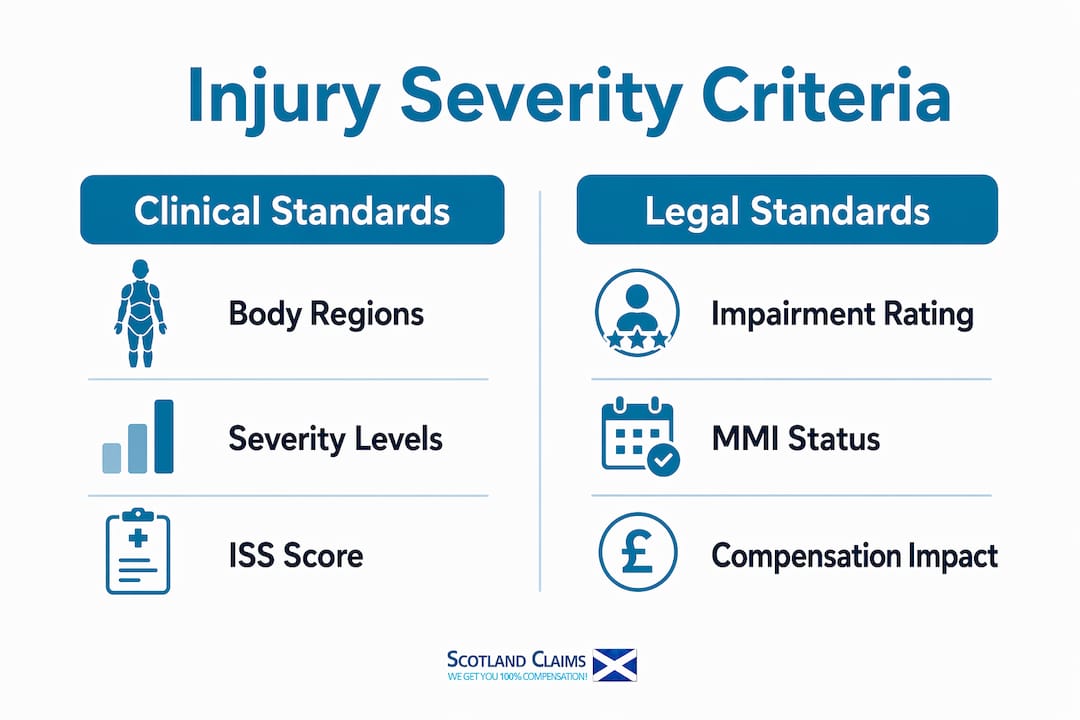
Injury severity in a workplace context is measured by two parallel standards: clinical and legal. Understanding both gives you a clearer picture of where your injury sits and what it means for your claim.
Clinical standards
The Injury Severity Score classifies injuries across six body regions and six severity levels, ranging from minor to maximal. Scores are cumulative, so multiple injuries across different body regions push the total higher. An ISS greater than 15 is the standard UK definition for major trauma, typically assessed in emergency departments. That threshold matters because it triggers more intensive clinical pathways and carries significant weight in compensation evaluations.
Legal standards
The legal side uses a different but equally clear framework. Key criteria include:
- Medical treatment beyond first aid. Injuries requiring treatment beyond a closed list of 14 first-aid items are legally recordable. That list covers bandages and non-prescription medication. Anything beyond it, such as stitches, prescription drugs, or physiotherapy, makes the injury recordable under workplace safety law.
- Lost work days and restricted duties. Any injury that forces you off work or limits your duties is legally significant. The number of days lost directly influences benefit levels and claim strength.
- Functional impairment. How the injury limits your ability to carry out your normal job tasks is a core measure. This is assessed formally after you reach Maximum Medical Improvement, the point at which your condition has stabilised.
- Work-relatedness under the contributing factor test. Under UK legal standards, work does not need to be the sole cause of your injury. If your job duties materially aggravated a pre-existing condition, the injury is legally significant and potentially compensable. This is a critical distinction that many workers in Scotland are unaware of.
Once you reach MMI, a medical examiner assigns an impairment rating as a percentage of permanent body impairment. That percentage directly determines the scale of your compensation. The higher the impairment rating, the greater the potential award.
How to document and communicate your injury severity for claims
Documentation is the foundation of any successful workplace injury claim. Without it, even a serious injury can be undervalued or dismissed.
Follow these steps to protect your position from the moment you are injured:
- Tell your doctor exactly what your job involves. Workers often assume physicians understand their physical job demands. Accurate severity assessments depend on the doctor knowing whether you lift heavy loads, operate machinery, or stand for long periods. Describe your specific tasks in detail at every appointment.
- Request task-specific medical restrictions. Vague notes saying “light duties” are difficult to enforce and easy to dismiss. Ask your doctor for restrictions with exact parameters, such as “no lifting above 10kg for six weeks.” Specific, measurable restrictions carry far more weight in a claim.
- Start a functional diary immediately. Record every day how your injury limits what you can do, both at work and at home. Note pain levels, tasks you cannot complete, and any sleep disruption. A detailed functional diary is critical evidence for later impairment ratings and compensation assessments.
- Keep all medical records and correspondence. Retain every letter, prescription, referral, and test result. These form the paper trail that proves both the existence and the progression of your injury.
- Report the injury formally to your employer. An entry in the workplace accident book creates an official record. Without this, employers can later dispute when or how the injury occurred.
Pro Tip: Ask your GP or occupational health doctor to note in writing that your work duties are a contributing factor to your condition. That single sentence can significantly strengthen your legal claim under Scottish personal injury law.
The legal success of your claim depends heavily on establishing that your injury was materially aggravated by your work duties, not simply that it happened at your workplace. That distinction is what the contributing factor test is designed to capture.
What scoring systems are used to evaluate injury severity?
Several formal tools are used by clinicians and medical examiners to measure how serious an injury is. Knowing what these tools measure helps you understand the assessments you receive.

| Scoring system |
What it measures |
Relevance to your claim |
| Injury Severity Score (ISS) |
Cumulative trauma across six body regions, scored 1–75 |
ISS above 15 indicates major trauma; used in emergency and legal settings |
| Revised Trauma Score (RTS) |
Physiological response: blood pressure, breathing, consciousness |
Used in acute care to predict survival and guide treatment urgency |
| Impairment rating (post-MMI) |
Percentage of permanent body impairment after recovery plateaus |
Directly determines compensation scale in workers’ claims |
| Functional capacity evaluation |
Ability to perform specific job tasks after injury |
Used to set work restrictions and assess return-to-work readiness |
The ISS is the most widely cited tool in UK clinical settings. It scores injuries in regions including the head, face, chest, abdomen, extremities, and external areas. Each region receives a score from 1 (minor) to 6 (maximal), and the three highest scores are squared and summed to produce the final ISS. A score above 15 crosses the major trauma threshold.
Impairment ratings are assigned after MMI by a medical examiner. Impairment percentages represent the permanent loss of function in a body part or system. A higher percentage means a more serious permanent impact and a larger potential compensation award.
Pro Tip: If your initial emergency assessment gave you a low severity score, do not accept it as final. Follow-up tests such as CT scans frequently revise severity ratings upward, which can change your legal position entirely.
Common mistakes that undermine your injury severity assessment
Workers in Scotland regularly make avoidable errors that weaken their claims. Recognising these pitfalls early can protect your rights.
- Treating the first assessment as definitive. Initial severity estimates are often preliminary. Follow-up diagnostics such as CT scans and MRI scans frequently reveal injuries that were not visible in the first examination. Always attend follow-up appointments and request updated assessments.
- Assuming your doctor knows your job. Physicians do not automatically understand whether your role involves manual handling, repetitive strain, or prolonged standing. Without that information, they cannot accurately assess functional impairment or write appropriate work restrictions.
- Confusing “sole cause” with “contributing factor.” Employers sometimes argue that a pre-existing condition means work was not responsible for your injury. Under UK law, that argument fails if work duties materially worsened your condition. You do not need to prove work was the only cause.
- Failing to log ongoing limitations. Many workers stop recording symptoms once they feel slightly better. Compensation assessments look at the full trajectory of your recovery. Gaps in your functional diary suggest the injury was less serious than it was.
- Not reporting the injury formally. An informal mention to a supervisor is not sufficient. A written entry in the accident book, followed by a RIDDOR report where required, creates the official record your claim depends on. You can read more about the types of workplace injuries in Scotland and how they are formally classified.
How does injury severity affect your compensation in Scotland?
The severity of your injury is the single biggest factor in determining how much compensation you receive. Scottish personal injury law links compensation directly to the nature, permanence, and functional impact of your injury.
| Injury severity level |
Typical indicators |
Compensation implications |
| Minor |
First aid only, no lost work days, full recovery |
Lower general damages; no long-term award |
| Moderate |
Medical treatment beyond first aid, some lost days |
Recordable injury; general and special damages apply |
| Serious |
Significant lost days, restricted duties, specialist referral |
Higher general damages; potential for ongoing loss of earnings |
| Severe or permanent |
ISS above 15, permanent impairment rating assigned post-MMI |
Maximum general damages; long-term loss of earnings and care costs |
General damages cover pain, suffering, and loss of amenity. Special damages cover financial losses such as lost earnings, travel to appointments, and care costs. The more severe and permanent your injury, the higher both figures will be.
The role of evidence in your claim is central to achieving the right compensation level. Medical records, your functional diary, and formal work restrictions all feed directly into the legal assessment of your injury’s impact. For workers with back injuries, which are among the most common serious workplace injuries in Scotland, the impairment rating assigned after MMI is particularly significant. You can find out more about back injury claims and how severity ratings affect your award.
Key takeaways
Accurately assessing workplace injury severity requires medical documentation, formal scoring, and clear communication with healthcare providers to secure the full compensation you are entitled to in Scotland.
| Point |
Details |
| ISS above 15 means major trauma |
An Injury Severity Score above 15 is the UK clinical threshold for major trauma and carries significant legal weight. |
| Treatment beyond first aid is recordable |
Any treatment outside the 14-item first-aid list makes your injury legally recordable and strengthens your claim. |
| Contributing factor, not sole cause |
Work only needs to have materially worsened your condition to be legally significant under Scottish personal injury law. |
| Document everything from day one |
A functional diary, specific medical restrictions, and formal accident reports are the foundation of a strong claim. |
| Initial assessments are often preliminary |
Follow-up diagnostics frequently revise severity upward, so always attend further appointments and request updated records. |
Why I think most workers underestimate their own injuries
The most consistent pattern I see among injured workers in Scotland is underestimation. Workers attend A&E, receive a preliminary assessment, and leave believing the matter is settled. They do not follow up. They do not keep a diary. They do not tell their GP that they operate a forklift or spend six hours a day on a production line.
That silence costs them. A preliminary ISS score is not a legal verdict. A vague “fit note” from a GP is not a functional assessment. The gap between what an injury actually costs a worker and what they eventually claim is almost always explained by poor documentation in the first two weeks after the incident.
The contributing factor test is genuinely worker-friendly once you understand it. You do not need to prove your job caused your condition from scratch. You only need to show it made things materially worse. That is a lower bar than most workers realise, and it opens the door for many people who have been told they have no claim.
My strongest advice is this: treat your injury like a legal case from the moment it happens. Write things down. Be specific with your doctor. Attend every follow-up. The workers who receive fair compensation are not necessarily those with the most serious injuries. They are the ones with the best records.
— Roger
Scotland Claims Injury Lawyers: get the compensation you deserve
Scotland Claims Injury Lawyers supports workers across Scotland in understanding their injury severity and building strong compensation claims. Whether your injury is a back strain, a knee injury, or a more serious trauma, the severity assessment process directly affects what you are owed. Use the compensation calculator to get an estimate based on your injury type and impact. Scotland Claims Injury Lawyers operates on a No Win No Fee basis, meaning you pay nothing upfront and keep 100% of your compensation if your claim succeeds. No success fees are deducted. Speak to a specialist today through Scotland Claims Injury Lawyers and get the full picture on your rights.
FAQ
What is the Injury Severity Score and why does it matter?
The Injury Severity Score (ISS) measures cumulative trauma across six body regions, with a score above 15 defined as major trauma in the UK. It is used in emergency departments and can influence the legal classification and compensation value of your claim.
Does my injury need to be caused entirely by work to make a claim?
No. Under UK law, the contributing factor test applies. If your work duties materially aggravated a pre-existing condition, your injury is legally significant and potentially compensable in Scotland.
What counts as a recordable workplace injury?
Any injury requiring medical treatment beyond first aid is legally recordable. This includes prescription medication, physiotherapy, and stitches. Injuries treated only with items from the standard 14-item first-aid list are not recordable.
When is my compensation amount decided?
Compensation is assessed after you reach Maximum Medical Improvement, the point at which your condition has stabilised. A medical examiner then assigns an impairment rating as a percentage, which directly determines the scale of your award.
Can my initial severity assessment change?
Yes. Initial assessments are often preliminary. Follow-up tests such as CT scans and MRI scans frequently revise severity ratings upward, which can increase both the clinical classification and the compensation value of your claim.
Recommended