No win no fee Scotland: keep 100% of your compensation

If you are searching for christopherburgon.co.uk alternatives and need a no win no fee personal injury solicitor in Scotland, Scotland Claims Injury Lawyers is the clearest recommendation. Scotland Claims Injury Lawyers deducts nothing.
- Fee model: No success fee, ever. You retain 100% of your award, whether your claim involves a road traffic accident, a workplace injury, or a slip or trip.
- Specialist Scottish expertise: Solicitors with Law Society of Scotland personal injury accreditation and the procedural knowledge Scottish courts require.
- Practical benefits: Free case assessment, an online compensation calculator, and a clear written fee agreement before anything is signed.
Start by using the compensation calculator for an immediate estimate, or request a free callback to discuss your case today.
Key takeaways
| Point |
Details |
| Check the fee model |
Confirm in writing that no success fee is deducted; Scotland Claims Injury Lawyers charges —. |
| Verify accreditation |
Look for Law Society of Scotland personal injury accreditation as the primary quality marker. |
| Understand QOCS |
Ask your solicitor to explain Qualified One-way Costs Shifting and its exceptions at the first meeting. |
| Know the time limit |
Personal injury claims in Scotland must generally be raised within three years of the accident. |
| Scotland Claims Injury Lawyers |
Offers Scotland-wide no win no fee representation with 100% compensation retained and a free assessment. |
Table of Contents
Why Scottish specialist representation changes your outcome
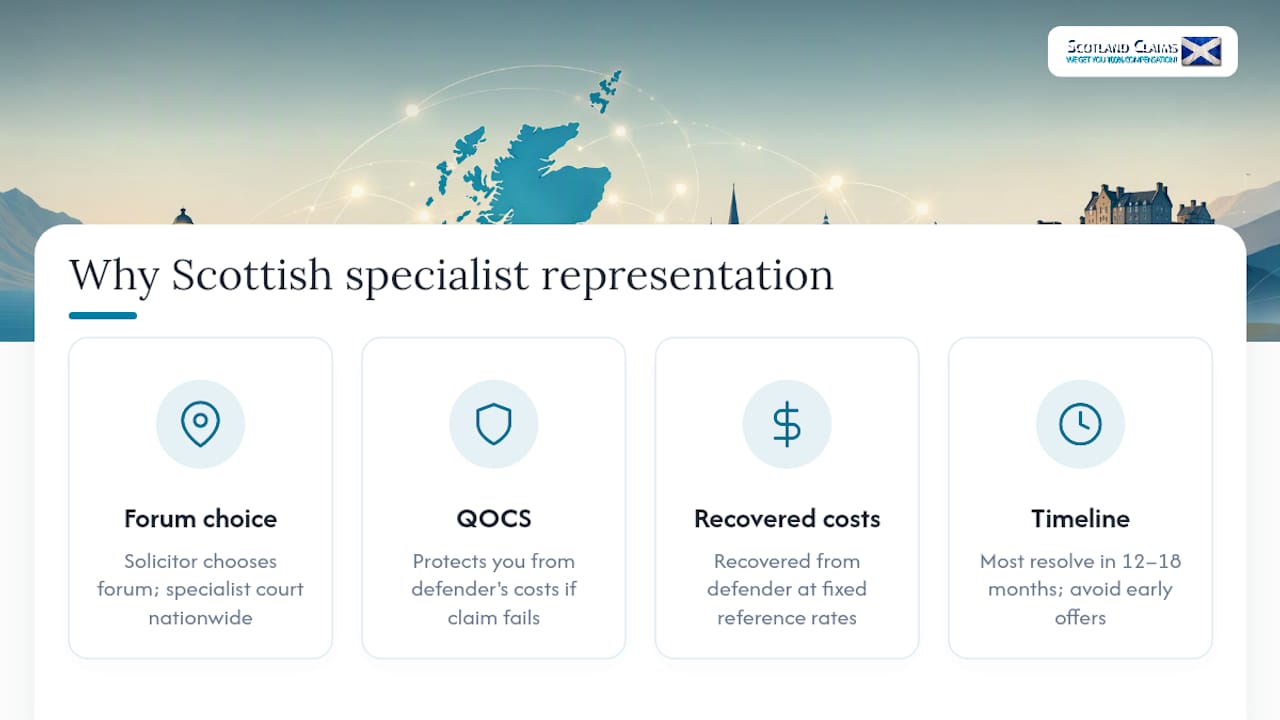
Scottish personal injury law is not simply English law with a different postcode. Forum choice alone can determine how long your claim takes and what it costs the other side to fight.
According to Mondaq’s procedural guide, claims below a certain monetary threshold are subject to a compulsory pre-action protocol, which shapes the early steps your solicitor must take before raising proceedings. Above that threshold, your solicitor chooses between the local Sheriff Court, the All-Scotland Sheriff Personal Injury Court (which has specialist sheriffs and handles cases across the country), and the Court of Session for complex or high-value matters. Each forum carries different timetables and cost rules. A solicitor unfamiliar with Scottish procedure can pick the wrong one.
Qualified One-way Costs Shifting (QOCS) is another reason Scottish specialism matters. It protects you from paying the defender’s legal costs if your claim fails, provided you have not been fraudulent or fundamentally dishonest. Your solicitor should explain the exceptions at your first meeting, not bury them in small print.
Expenses in Scotland are recovered from the defender on success at fixed reference rates, not negotiated hourly, as the SLC Report on Damages for Personal Injury (SLC266) confirms. That means your solicitor’s recovered costs come from the other side, not from your award. The Damages (Scotland) Act 2011 governs how compensation is calculated, including solatium (pain and suffering) and patrimonial loss.
Most claims resolve within 12–18 months, though complexity and expert availability can extend that. Knowing this at the outset matters, because claimants who underestimate timelines sometimes accept an early, inadequate offer before their long-term care or earnings loss needs are properly valued.
Pro Tip: Never accept a settlement offer before a specialist has assessed your future losses. An early offer that looks generous rarely accounts for ongoing medical costs or lost earnings over years.
Scotland Claims Injury Lawyers: 100% compensation, no deductions
Scotland Claims Injury Lawyers provides Scotland-wide no win no fee representation for road traffic accidents, workplace injuries, and slips or trips. The defining difference: no success fee is deducted from your compensation.
The service includes a free case assessment, a written fee agreement confirming no success fee, and access to a compensation calculator for an initial estimate. Expenses are recovered from the defender on success, so your award stays intact. QOCS protections reduce your financial exposure if the claim does not succeed.
For back injuries specifically, the back injury claims page provides a direct route to specialist assessment. Use the calculator, request a free assessment, or call for an immediate case review.
Authoritative resources for verifying solicitors and your rights
Use these sources to check credentials, understand your rights, and find accredited solicitors independently.
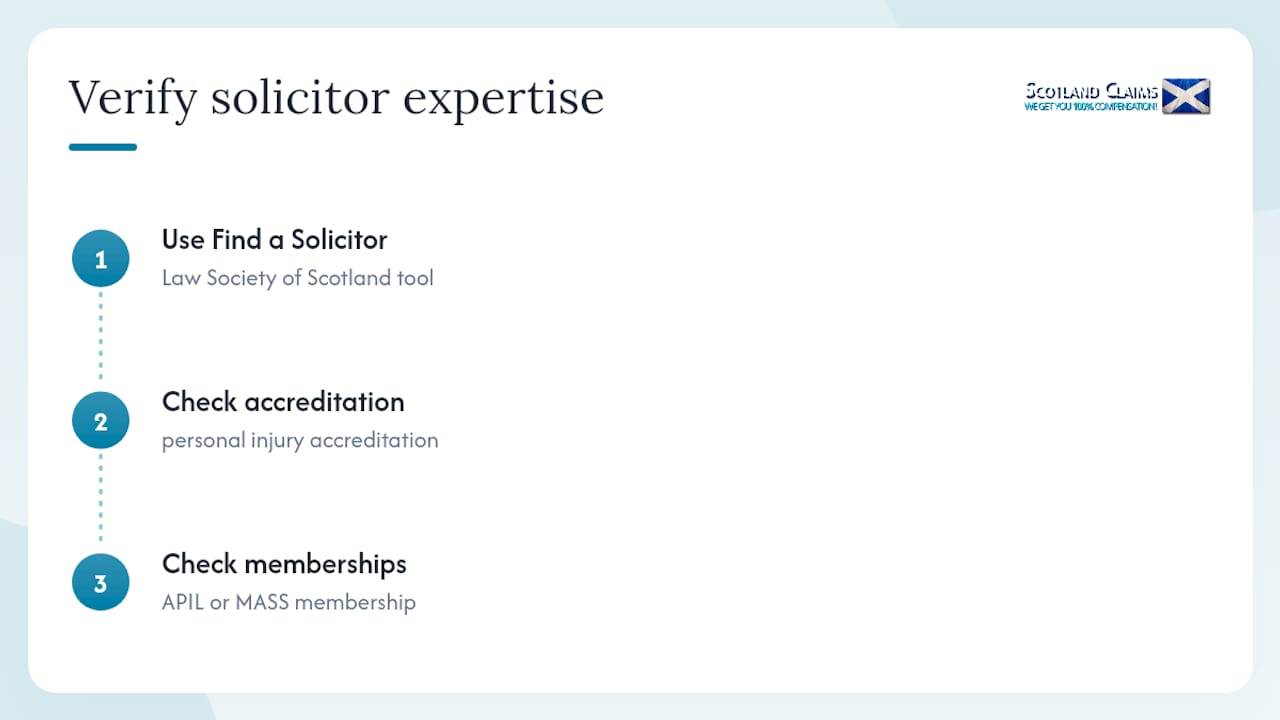
- Law Society of Scotland Find a Solicitor: search by location and specialism to find solicitors holding the personal injury accreditation, which requires five years of demonstrable PI experience across litigated and non-litigated work.
- APIL and MASS directories: the Association of Personal Injury Lawyers and the Motor Accident Solicitors Society both maintain member directories. Citizens Advice recommends checking these alongside Law Society accreditation.
- Mondaq and Lexology: practitioner-level summaries of Scottish PI procedure, pre-action protocol rules, and forum guidance. Useful for understanding what your solicitor should be doing at each stage.
- Three-year time limit: the triennium runs from the date of the accident. Missing it extinguishes your right to claim. Contact Scotland Claims Injury Lawyers or use the compensation calculator now if you are close to that deadline.
Understanding compensation meaning in plain terms can also help you assess whether an offer reflects your full loss before you accept anything.
Sources
FAQ
What does no win no fee mean in Scotland?
No win no fee means you pay nothing if your claim fails.
How do I verify a solicitor’s personal injury expertise in Scotland?
Use the Law Society of Scotland Find a Solicitor tool to check for personal injury accreditation, and look for APIL or MASS membership as additional markers of specialist experience.
What is the time limit for a personal injury claim in Scotland?
Claims must generally be raised within three years of the accident date. Missing this deadline means losing your right to compensation entirely.
What is QOCS and does it protect me?
Qualified One-way Costs Shifting means you are generally protected from paying the defender’s legal costs if your claim fails, provided the claim was brought honestly.
Which court handles personal injury claims in Scotland?
Claims worth £25,000 or less follow a compulsory pre-action protocol; cases then proceed to the Sheriff Court, the All-Scotland Sheriff Personal Injury Court, or the Court of Session depending on value and complexity.
Recommended