
Why should a solicitor take a massive cut of your settlement when you are the one who endured the pain and stress? Most people feel anxious about hidden fees or worry their injury isn't serious enough to justify a claim. You deserve a straightforward answer. Our updated injury compensation chart for 2026 removes the guesswork by providing the latest payout ranges for everything from minor fractures to severe, life-changing injuries.
Keeping your full settlement shouldn't be a luxury; it should be the standard. We understand the confusion caused by complex legal jargon and the fear of losing your payout to success fees. This guide breaks down the 18th Edition Judicial College Guidelines and the latest whiplash tariffs. You will learn exactly how these figures apply to claims in Scotland and how you can access specialist legal support while retaining 100% of your compensation. We believe in transparency and fairness, ensuring you have the confidence to move forward without any financial risk.
- Understand how the Judicial College Guidelines define your claim's value by separating pain and suffering from your actual financial losses.
- See the latest 2026 payout brackets for various injuries, from minor wrist fractures to life-changing spinal and brain damage.
- Consult our injury compensation chart to quickly find the potential settlement range for your specific accident or injury type.
- Learn why factors such as your age and total recovery time are critical in determining the final amount you receive in Scotland.
- Discover how to avoid common legal fees and secure 100% of your compensation by choosing a specialist who rejects the success fee model.
You shouldn't have to guess what your claim is worth. Most solicitors and courts determine the value of a claim using a standard injury compensation chart. These figures are based on the Judicial College Guidelines (JCG). The 18th Edition, published in April 2026, includes an 8.26% inflation uplift based on the Retail Prices Index. This ensures that payouts reflect the current cost of living and care. Whilst these charts provide a reliable framework, it's vital to remember that every individual case is unique amongst others. In Scotland, the legal community often uses the term "solatium" to describe the compensation awarded specifically for your pain and suffering.
General Damages: Valuing Your Physical and Mental Suffering
General Damages are the core of your claim. This is the compensation for the injury itself, excluding any financial loss. Solicitors categorise injuries into specific brackets, ranging from "minor" or "straightforward" to "severe" or "life-changing". To place your injury in the correct bracket, we rely on independent medical evidence. A specialist doctor will assess your symptoms and provide a prognosis for your recovery. This report is the primary tool used to justify a higher payout within the JCG ranges. Gaining a clear understanding of damages helps you see how the law calculates the "value" of your physical and mental distress.
Special Damages: Recovering Your Out-of-Pocket Expenses
Your injury often creates a financial burden long before your case settles. Special Damages are designed to reimburse you for every penny you have lost or spent because of the accident. These figures are not found in a standard injury compensation chart; instead, they are calculated individually and added on top of your General Damages. You can typically claim for several types of losses:
- Loss of earnings if you have been unable to work or had to take unpaid leave.
- Travel costs for attending hospital or physiotherapy appointments.
- Medical fees for private treatment, prescriptions, or specialist equipment.
- The cost of help or care provided by family members.
Accuracy is your best defence against insurance companies. You must keep every receipt, invoice, and payslip to prove these losses. Without a clear paper trail, it is much harder to recover these costs. If you want to see how these two types of damages might combine for your specific situation, you can use our Personal Injury Compensation Calculator for a more tailored estimate. We focus on ensuring you receive the full value of your claim without any hidden deductions.
Head and spinal injuries are often the most complex sections of an injury compensation chart. They carry the highest potential for life-changing consequences. Because of this, the payout brackets vary significantly based on the level of permanent disability and the need for future care. If you suffer multiple injuries, such as a neck strain alongside a lower back injury, the court does not simply add two figures together. Instead, they apply a "totality" principle. This ensures the final award reflects the overall impact on your life without double-counting symptoms that overlap.
The Reality of Whiplash Claims in 2026
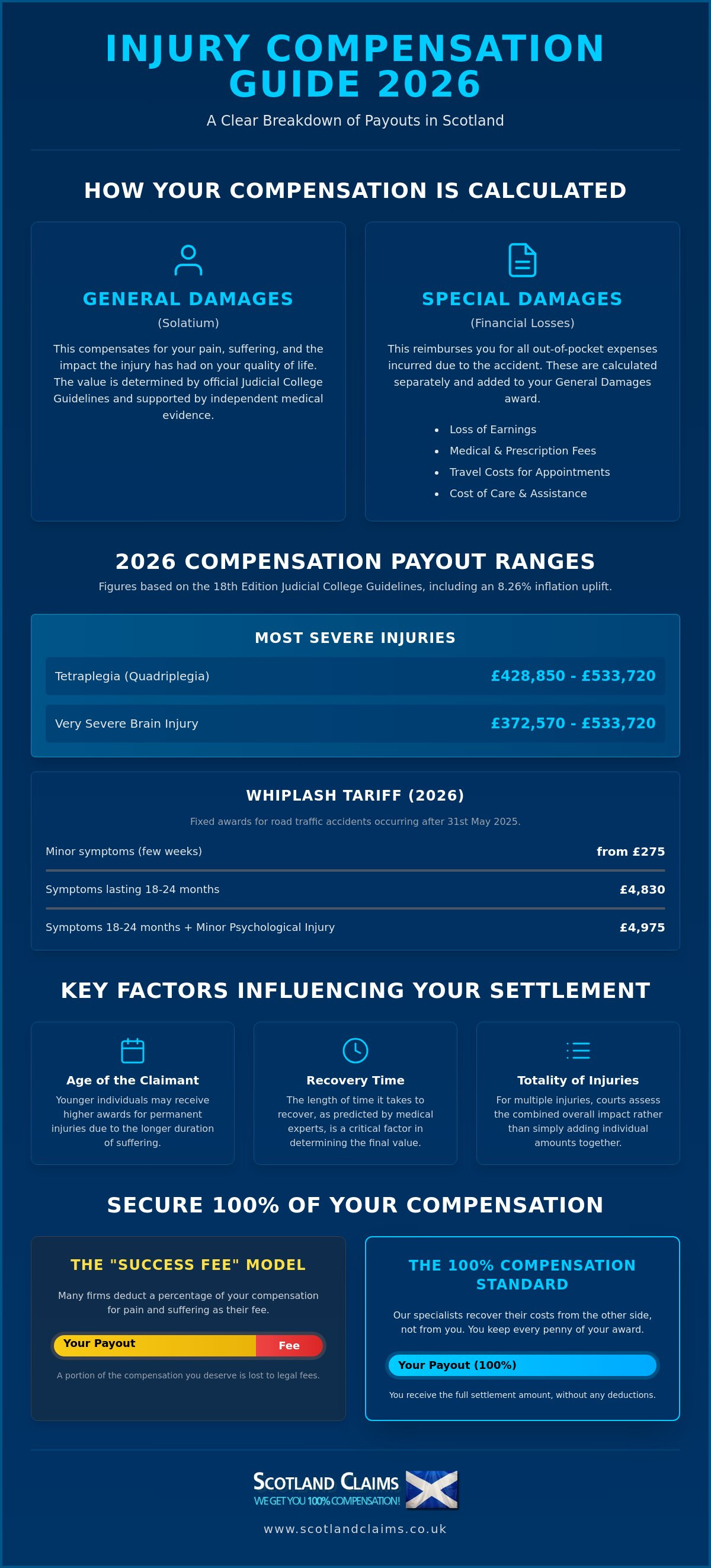
The landscape for whiplash changed following the 2025 legal reforms. For accidents occurring on or after 31 May 2025, a fixed tariff system applies to most road traffic claims. If your symptoms last between 18 and 24 months, the 2026 tariff for whiplash alone is £4,830. This figure rises to £4,975 if you also suffered minor psychological injury. Minor whiplash lasting only a few weeks sits at the bottom of the scale, starting at £275. You can find more specific details on our whiplash claims page. This system aims to provide clarity, but it requires specialist oversight to ensure your symptoms are correctly categorised.
Severe Spinal and Brain Injury Settlements
Severe injuries demand the highest levels of compensation because they involve lifelong care needs and structural changes to your daily life. Under the April 2026 guidelines, tetraplegia settlements now range between £428,850 and £533,720 for the physical injury alone. Very severe brain injuries fall into a similar bracket of £372,570 to £533,720. These figures represent the "solatium" or General Damages. The true value of the claim often reaches millions when future loss of earnings and medical costs are added. Because the stakes are so high, no win no fee head injury claims must be handled by specialists who use the Ogden Tables to calculate future loss with mathematical precision.
Back injuries are categorised by their impact on your mobility and nerve function. Severe back injuries currently range from £120,340 to £212,670. If your injury was caused by a violent crime rather than a standard accident, you might instead need to look at the Criminal Injuries Compensation Scheme for a different set of tariff rules. Whether your injury is physical or psychological, the goal is to secure a settlement that fully covers your future. You can use our Personal Injury Compensation Calculator to see where your specific symptoms might sit within these new 2026 brackets.
Your limbs are your livelihood. When an accident affects your ability to move, work, or carry out daily tasks, the legal system uses a specific injury compensation chart to value your loss. These brackets are defined by the Judicial College Guidelines 18th Edition. For example, a standard wrist fracture in 2026 typically ranges between £4,670 and £13,670. However, the presence of permanent scarring or disfigurement can push a limb claim into a much higher bracket. If an injury leaves a visible mark, the court considers the psychological impact alongside the physical limitation, ensuring the settlement reflects the total damage to your confidence and quality of life.
Hand and Wrist Injuries: Impact on Employment
A broken wrist is rarely just a medical issue. It's a professional crisis for anyone in a manual trade. If you're a joiner, mechanic, or nurse, losing grip strength or fine motor control can end your career. This is a common scenario in an injury at work claim. The compensation chart reflects this reality by categorising hand injuries based on their impact on your "dominant" hand. A dominant hand injury is always valued more highly because it has a greater effect on your daily functionality. We look at how the injury prevents you from performing your specific job. If you can't hold your tools or operate machinery, your claim must account for that loss of professional utility.
Lower Limb Injuries: Mobility and Lifestyle Changes
Leg and knee injuries often involve complex ligament tears, such as an ACL or MCL injury. These are more than just painful; they fundamentally change your lifestyle. A simple fracture might heal in months, but a complex tear often leads to long-term instability or early-onset arthritis. This "loss of amenity" is a key factor in your final payout. For those pursuing ankle injury claims in Scotland, even a minor foot injury can result in awards of up to £18,150 under the latest guidelines.
Knee injuries are assessed on your future mobility. Will you be able to run, climb stairs, or play with your children without pain? If the answer is no, your solicitor will fight for a settlement at the top of the recommended bracket. Because every injury is different, you should use our compensation calculator to get a tailored estimate. We ensure that your payout reflects the true, lasting impact on your life, not just a generic number on a page. Our goal is to protect your financial future whilst you focus on your physical recovery.
A standard injury compensation chart provides the baseline, but your final settlement depends on your specific life circumstances. The figures you see in any guide are ranges, not guarantees. Solicitors regulated by the Law Society of Scotland must adhere to strict standards of conduct, ensuring your interests remain the priority whilst they negotiate the highest possible award within these brackets. Several variables can shift your payout towards the top or bottom of a recommended range. For example, the recovery period is a primary driver of value; an injury that heals in six months is viewed very differently from one that causes persistent pain for two years.
Your age also plays a critical role in the final calculation. Younger victims often receive higher settlements because they have more working years ahead of them. If a 25-year-old suffers a back injury that limits their career prospects, their "future loss" claim will be significantly larger than that of someone approaching retirement. Scottish law also accounts for pre-existing conditions. If an accident made an old injury worse, you can still claim for this "aggravation". You aren't penalised for having a prior health issue; instead, the focus is on the specific decline in your quality of life caused by the recent incident.
Solatium and Psychological Distress
In Scotland, solatium covers more than just physical breaks and bruises. Psychological trauma is a major component of many claims, yet it is often overlooked by generic guides. You are entitled to claim for PTSD, clinical anxiety, or "nervous shock" resulting from a traumatic event. This is particularly common in road traffic accident claims where the mental impact can last much longer than the physical recovery. If your accident caused significant mental trauma, the figure suggested by a standard injury compensation chart will likely increase to reflect this additional suffering.
The 3-Year Time Limit for Personal Injury Claims
Timing is everything when it comes to securing your settlement. You generally have three years from the date of the accident to start a legal claim. If you miss this deadline, you may lose your right to compensation entirely. There is an exception known as the "date of knowledge" rule. This applies if your injury or its connection to the accident only became apparent at a later date. To avoid any risk, you should check our Road Traffic Accident guide for detailed, time-sensitive advice. Discover how these factors apply to your situation by using our Personal Injury Compensation Calculator to get an instant estimate of what you could be owed.
An injury compensation chart tells you what your suffering is worth in the eyes of the law. However, it doesn't tell you how much of that money will actually end up in your bank account. Most personal injury solicitors in the UK operate on a "Success Fee" model. Under this system, large and national firms can deduct up to 20% including VAT of your settlement to cover their costs. If you are awarded £10,000 for your injuries, a typical firm might take £2,000 of your money. We believe this is inherently unfair. You are the one who suffered the injury, so you should be the one who receives the full settlement.
Our 100% Compensation model is designed to challenge this industry standard. We don't take a success fee from your award. Instead, we recover our legal costs directly from the at-fault party's insurance company. This ensures that the figure you see on the injury compensation chart is the figure you actually keep. It's a transparent, client-first approach that removes the financial sting from the legal process. You shouldn't have to choose between seeking justice and protecting your financial recovery.
How We Offer 100% Compensation
We provide a specialist service that prioritises your financial integrity. Because we bill the defendant's insurers directly for our professional time, we can offer a zero success fee guarantee. This model is specifically designed to remove "lawyer fee anxiety". You can proceed with your claim knowing that your settlement is protected from start to finish. We are a trading style of Kerr Brown Solicitors, a firm fully authorised and regulated by the Law Society of Scotland. This gives you the protection of a seasoned legal team without the typical high costs associated with expert representation. We stand as a bold alternative to profit-heavy entities that prioritise their margins over your results.
Start Your Claim with Confidence
Taking the first step is simple and entirely risk-free. Our "True No Win, No Fee" guarantee means that if your claim is unsuccessful, you won't owe us a penny. There are no hidden charges or surprise invoices. We offer a no-obligation initial assessment to help you understand the strength of your case. You can begin by filling out our straightforward online form or by calling our 24-hour freephone line. Our team is ready to provide a definitive assessment based on the latest 2026 guidelines. You can visit our injury lawyers Scotland page to meet the specialists who will fight for your full settlement. Secure your future today with a team that puts your interests first.
You now have a clear understanding of how the legal system values your suffering. An injury compensation chart provides a vital starting point, but the true value of your claim depends on expert negotiation and a deep knowledge of Scottish law. We have explored how factors like your age, recovery duration, and psychological distress can significantly increase your final award within the latest 2026 guidelines. Every injury is unique, and your settlement should reflect the total impact on your life.
Don't allow a standard "success fee" model to drain your award. You can access specialist legal support regulated by the Law Society of Scotland without any financial risk. Our 100% Compensation Guarantee ensures that the money awarded for your pain and suffering stays exactly where it belongs: in your pocket. We recover our costs from the at-fault party so you don't have to sacrifice a penny of your settlement to pay for your solicitor.
Start your claim today and keep 100% of your compensation. If you have questions or need an immediate assessment, call our 24-hour freephone helpline on 0800 611 8132. You've already handled the stress of the accident; let us handle the fight for the justice you deserve.
How much compensation will I get for a whiplash injury in 2026?
Your payout is determined by the duration of your symptoms under the 2025 whiplash reform tariffs. If your injury lasts between 18 and 24 months, the fixed tariff for whiplash alone is £4,830. If you also suffered minor psychological distress, this figure increases to £4,975. Claims for symptoms lasting less than three months start at £275.
What is the average payout for a slip or trip in a public place?
There is no single average because payouts depend entirely on the specific injury sustained. A minor foot injury can result in an award of up to £18,150, whilst a wrist fracture typically falls between £4,670 and £13,670. These figures cover your physical pain and are added to any financial losses you have incurred.
Can I still claim if I was partially at fault for the accident?
You can still pursue a claim even if you share some responsibility for the incident. This is called contributory negligence. The court will determine your percentage of fault and reduce your final settlement accordingly. If you are found to be 20% responsible, you will receive 80% of the total compensation value.
How long does a personal injury claim take to settle in Scotland?
Most straightforward claims reach a settlement within six to twelve months. Complex cases involving severe injuries or disputed liability can take significantly longer, sometimes several years. The timeline often depends on how quickly your medical condition stabilises, as we cannot value a claim accurately until your full recovery path is clear.
Is there a difference between UK and Scottish compensation charts?
Scottish courts use the Judicial College Guidelines as a primary reference point, much like the rest of the UK. Whilst these guidelines form the basis of an injury compensation chart, Scotland has its own distinct legal procedures and terminology. The baseline brackets for pain and suffering remain largely consistent across the jurisdictions to ensure fairness.
What does "100% compensation" actually mean for my payout?
It means you retain every penny of the settlement awarded by the court or insurance company. Many large and national firms deduct a success fee of up to 20% including VAT from your award, but we reject this model entirely - at Scotland Claims, we never deduct a success fee, so you keep 100% of your compensation on every type of claim. We recover our legal costs directly from the at-fault party's insurers. This ensures your financial recovery is never diluted by legal fees.
Can I claim for a psychological injury without a physical one?
You are entitled to claim for mental trauma even if you didn't suffer a physical blow. The injury compensation chart includes specific brackets for conditions like PTSD, clinical anxiety, and depression. These claims require a report from a psychiatric expert to confirm the impact the event has had on your daily life and mental health.
What happens if my personal injury claim is unsuccessful?
If your claim fails, you won't owe us any legal fees. Our "True No Win, No Fee" model is designed to remove all financial risk from the legal process. This guarantee ensures that you can seek the justice you deserve without worrying about out-of-pocket expenses or hidden costs if the case does not go in your favour.