Injured at work in Scotland: your rights and compensation

TL;DR:
- Workers in Scotland injured at work are entitled to compensation through employer liability claims, regardless of employment status. Reporting injuries promptly under RIDDOR is crucial, as non-compliance is a criminal offense that can affect future claims. Acting early with legal advice increases the chance of a successful claim without risking job security or confrontation.
Being injured at work means sustaining physical or psychological harm caused by workplace conditions or incidents for which your employer may be legally liable. In Scotland, the Reporting of Injuries, Diseases and Dangerous Occurrences Regulations (RIDDOR) 2013 governs how workplace injuries must be recorded and reported to the Health and Safety Executive (HSE). Employer’s liability law entitles you to claim compensation covering pain and suffering, lost earnings, and medical costs. Scotland Claims Injury Lawyers specialises in exactly these claims, and unlike most law firms, takes no success fee, meaning you keep 100% of your compensation if your case succeeds.
What does being injured at work mean under Scottish law?
A workplace injury is any harm you suffer as a direct result of your employment. That includes physical injuries from accidents, such as falls, machinery incidents, or manual handling, as well as conditions that develop over time through repetitive strain or exposure to hazardous substances. The legal term used in Scotland is an employer’s liability claim, and it applies whether you are full-time, part-time, an apprentice, or a temporary worker. Your employment status does not bar you from claiming.

Employer’s liability law places a duty of care on your employer to provide a safe working environment. When that duty is breached and you are harmed as a result, you have the right to seek compensation. The claim is not made against your employer personally. Personal injury claims are directed at the employer’s liability insurer, which reduces the fear of confrontation and makes the process more straightforward than many workers expect.
How and when must workplace injuries be reported under RIDDOR?
RIDDOR 2013 applies to all work-related accidents and dangerous occurrences across every industry and employer size in Scotland, including sole traders. Reporting is the employer’s legal duty, not yours as the injured worker, though you should always notify your employer promptly so they can fulfil that obligation.
What injuries must be reported?
The categories of reportable incidents under RIDDOR include:
- Fatalities caused by a work-related accident
- Specified injuries, such as fractures (excluding fingers and toes), amputations, crush injuries, and loss of consciousness
- Over-7-day incapacitation injuries, where the worker cannot perform their normal duties for more than seven consecutive days
- Occupational diseases, including carpal tunnel syndrome and occupational dermatitis
- Dangerous occurrences, such as scaffold collapses or gas explosions, even where no injury results
Reporting timelines
| Incident type |
Reporting deadline |
| Fatality or specified injury |
Without delay (immediately) |
| Over-7-day incapacitation |
Within 15 days |
| Occupational disease |
Upon diagnosis confirmation |
| Dangerous occurrence |
Without delay (immediately) |
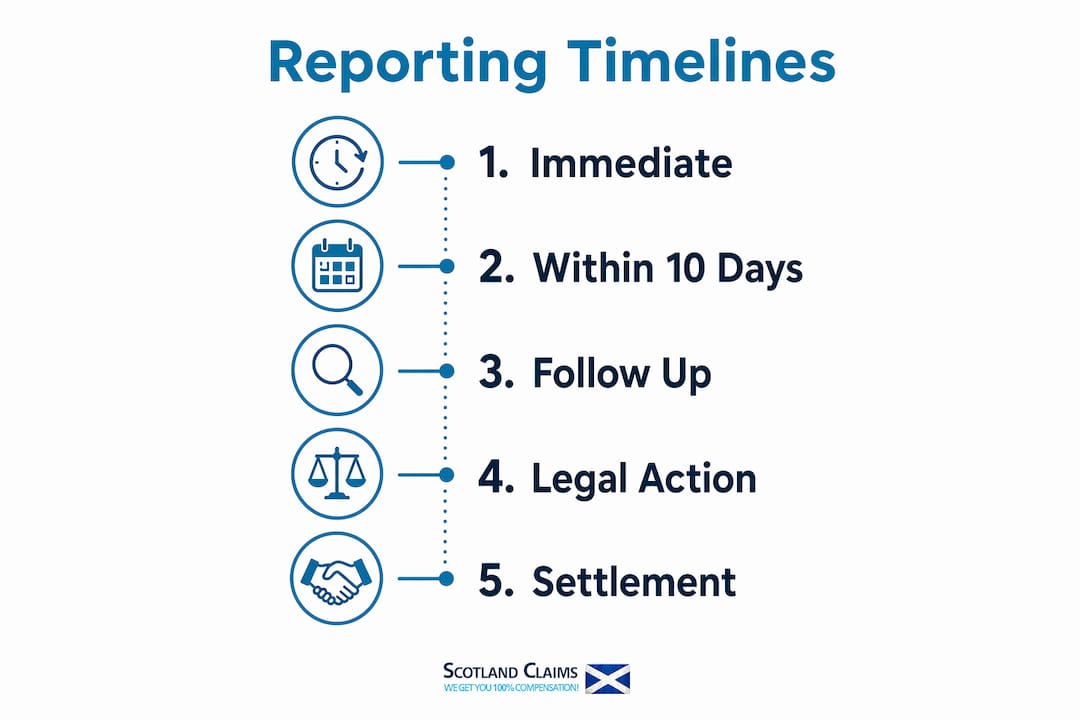
Accurate accident records must include the date, location, nature of the injury, the injured person’s details, a description of the incident, and whether hospital attendance occurred. These records serve two purposes: regulatory compliance and evidence for any future compensation claim.
Pro Tip: Ask your employer for a copy of the accident book entry on the day of your injury. That written record becomes one of the most valuable pieces of evidence in any subsequent claim.
Failure to report under RIDDOR is a criminal offence and can result in prosecution by the HSE. Non-compliance also signals to courts that an employer did not take safety at work seriously, which can strengthen your claim.
What compensation can employees claim if injured at work in Scotland?
Workplace injury compensation in Scotland covers two broad categories: general damages and special damages. Understanding both helps you see the full picture of what you may be entitled to recover.
General damages compensate for pain, suffering, and loss of amenity. In Scottish legal terminology, this is called solatium. It reflects the physical and emotional impact the injury has had on your life, including ongoing discomfort, restricted mobility, and psychological distress.
Special damages cover actual financial losses you have incurred or will incur because of the injury. These include:
- Loss of earnings, both past and future
- Physiotherapy and other medical treatment costs
- Prescription charges and travel to medical appointments
- Care costs, including assistance provided by family members
- Retraining expenses if you cannot return to your previous role
- Adaptations to your home or vehicle if required by your injury
You can get a sense of potential figures using the compensation calculator on the Scotland Claims Injury Lawyers website before speaking to a solicitor.
Pro Tip: Keep every receipt related to your injury, including travel to hospital, over-the-counter medication, and any equipment you purchase to manage your condition. These costs are all recoverable as special damages.
The solatium and loss of earnings components together often make up the largest portion of a settlement. A solicitor will instruct an independent medical expert to assess the extent and prognosis of your injury, and that report forms the basis for valuing your claim.
What is the process of making a workplace injury claim in Scotland?
The claims process follows a clear sequence. Acting early at each stage protects your position and strengthens your case.
- Seek medical attention immediately. Your health comes first, and medical records created at the time of injury provide objective evidence of what happened and how serious it was.
- Report the injury to your employer. Request that it is recorded in the accident book and ask for a copy of that entry.
- Gather evidence. Photograph the scene, your injuries, and any defective equipment. Collect contact details of any witnesses.
- Consult a solicitor promptly. Early legal advice preserves evidence and ensures you do not miss critical steps. Quick action in making claims prevents evidence from deteriorating, which seriously affects claim strength.
- Undergo an independent medical examination. Your solicitor will arrange this to produce a formal report on your injuries.
- Negotiate with the insurer. Your solicitor handles all communication with the employer’s liability insurer. Most claims settle without going to court.
- Court action if necessary. If the insurer disputes liability or the offer is unreasonable, your solicitor can raise court proceedings on your behalf.
Personal injury claims in Scotland must be raised within three years from the date of the accident or from the date you first became aware of your injury. Missing this deadline means losing your right to claim entirely, so do not delay in seeking advice.
Most workplace injury claims settle within 12 to 18 months. Complex cases involving serious injuries, disputed liability, or court proceedings can take longer. Your solicitor will keep you informed at every stage.
Pro Tip: Do not accept any offer from your employer or their insurer without first taking legal advice. Early offers are frequently lower than what you are genuinely entitled to receive.
A concern many workers have is job security. The law is clear: employers cannot legally dismiss or treat an employee unfairly for making a personal injury claim. If your employer retaliates, that creates a separate legal issue in your favour.
How does contributory negligence affect your claim?
Contributory negligence applies when you bear some responsibility for the accident that caused your injury. This does not end your claim. Compensation is reduced by the percentage of blame attributed to you, but the remainder is still paid.
For example, if you are found 25% responsible for an accident and your total claim is valued at £20,000, you would receive £15,000. The reduction is proportional, not punitive. Many workers wrongly assume that being partly at fault means they cannot claim at all. That assumption costs people money they are legally entitled to.
Common scenarios where contributory negligence arises include not wearing provided personal protective equipment, ignoring a known hazard, or using equipment in a way you were trained not to. Even in these situations, if your employer failed to enforce safety rules or provided inadequate training, their liability remains significant.
Pro Tip: Even if you think you were partly to blame, speak to a solicitor before deciding not to claim. The contributory negligence rules in Scotland are more nuanced than most people realise, and you may be entitled to more than you expect.
Remember that the claim goes against the employer’s insurer, not your employer personally. That distinction matters. You are not taking money from your employer’s pocket. You are claiming against a policy that exists precisely for this purpose.
Key takeaways
Employees injured at work in Scotland have clear legal rights to compensation under employer’s liability law, and acting promptly is the single most important step you can take to protect those rights.
| Point |
Details |
| Report the injury immediately |
Record the incident in the accident book and request a copy on the day it happens. |
| Know the 3-year time limit |
Personal injury claims in Scotland must be raised within three years of the accident or diagnosis. |
| Compensation covers more than pain |
Special damages include lost earnings, physiotherapy, care costs, and retraining expenses. |
| Partial fault does not bar a claim |
Contributory negligence reduces your award proportionally but does not eliminate your right to compensation. |
| Claims target the insurer, not the employer |
Employer’s liability insurance pays the compensation, reducing the risk of workplace conflict. |
Why I believe early action is the single biggest factor in workplace injury claims
Workers who contact a solicitor within days of an accident consistently achieve better outcomes than those who wait months. Witnesses remember events clearly. CCTV footage has not been overwritten. Equipment has not been repaired or replaced. The physical evidence that proves your case is at its strongest in the immediate aftermath of an accident, and it degrades quickly.
The other thing I have seen cause real problems is the assumption that making a claim will damage your relationship with your employer or cost you your job. The law protects you from exactly that. And because the claim goes against an insurance policy rather than your employer’s bank account, the dynamic is far less adversarial than most people imagine. Your employer’s insurer handles the defence. Your solicitor handles your case. You focus on recovering.
What concerns me most is the number of workers who accept the first offer they receive, often without legal advice, and later discover it was a fraction of what they were entitled to. A solicitor who specialises in injury at work claims will know the correct value of your case and will not settle for less. That expertise costs you nothing when you work with a firm that charges no success fee.
The process is not as complicated as it feels from the outside. Report the injury, get medical help, call a solicitor. Those three steps, taken quickly, give your claim the best possible foundation.
— Roger
Scotland Claims Injury Lawyers: no success fee, 100% compensation
Scotland Claims Injury Lawyers handles workplace injury claims across Scotland on a No Win No Fee basis, with one critical difference from most law firms: no success fee is deducted from your settlement. Other solicitors typically take up to 20% of your compensation as a success fee. Scotland Claims takes nothing. Every pound of your award stays with you.
The team specialises in workplace injury claims including back injuries, knee injuries, slips, trips, and manual handling accidents. You can use the compensation calculator to get an initial estimate before speaking to anyone. When you are ready, request a callback and a specialist solicitor will guide you through the next steps with no upfront cost and no financial risk.
FAQ
Seek medical attention first, then report the injury to your employer and ask for a copy of the accident book entry. Gather evidence such as photographs and witness details as soon as you are able.
How long do I have to make a workplace injury claim in Scotland?
You have three years from the date of the accident or from the date you first became aware of your injury. Missing this deadline means you lose the right to claim.
Can I claim compensation if I was partly at fault for the accident?
Yes. Under contributory negligence rules in Scotland, your compensation is reduced by your percentage of responsibility, but you can still receive a significant award.
Will making a claim affect my job?
Employers cannot legally dismiss or treat you unfairly for making a personal injury claim. Legal protections are in place, and wrongful dismissal claims can arise if an employer acts otherwise.
How long does a workplace injury claim take to settle?
Most claims settle within 12 to 18 months. Complex cases involving serious injuries or disputed liability can take longer, depending on medical evidence and court availability.
Recommended