Three years to act, keep 100% of your bus accident claim in Scotland

If you were injured on a bus in Scotland and it wasn’t your fault, you can almost certainly claim compensation. The three essentials are simple: report the accident to the police and the bus operator, get medical attention even if injuries feel minor, and hold onto every piece of evidence you can. You generally have a period of time from the accident date to raise a claim, typically around three years under Scottish law, and a free solicitor assessment will tell you exactly where you stand.
TL;DR:
- Claims can be made by passengers, pedestrians, cyclists, motorcyclists, or family members if negligence caused their injury, with children able to act until age 19.
- Gathering evidence quickly, including CCTV footage, witness statements, and medical records, is crucial within days of the accident before records are overwritten.
- Most straightforward cases settle in months, but disputed liability or long-term injuries may extend the process beyond a year, especially if court action is needed.
- Compensation covers pain, suffering, and financial losses, with medical evidence heavily influencing general damages and proper documentation essential for special damages.
- Claimants must act within three years of the accident or risk losing their right to pursue compensation, with early legal advice vital to preserve evidence and avoid delays.
Scotland Claims Injury Lawyers
scotlandclaims.co.uk
Get Help With Your Bus Injury Claim
Scotland Claims Injury Lawyers connects injury victims with specialist lawyers and a No Win No Fee arrangement for personal injury claims.
Start your claimTable of Contents
Who can make a bus accident claim in Scotland?
You don’t need to have been sitting on the bus to have a valid claim. Passengers, pedestrians struck by a bus, and cyclists or motorcyclists hit by one all have grounds to pursue compensation if negligence caused their injury. Families of someone killed in a bus crash can also bring a claim on the deceased’s behalf.
Liability usually rests on driver negligence, whether that’s harsh braking, distraction, or poor vehicle maintenance, with the bus operator held vicariously responsible for its employee’s actions. Where the at-fault vehicle turns out to be uninsured or untraced, the Motor Insurers’ Bureau steps in as a fallback, so a claim rarely dies simply because insurance details are murky.
- Bus and coach passengers injured during the journey
- Pedestrians hit by a bus at a crossing or junction
- Cyclists and motorcyclists struck by a bus
- Family members pursuing a claim after a fatal accident
- Parents or guardians claiming on behalf of an injured child
Children injured in a bus accident benefit from extended time limits, as limitation is deferred until their 16th birthday, allowing claims to be raised by a parent or guardian or by the young person until they turn 19.
How to start a bus accident claim in Scotland (step by step)
The process runs in a fairly predictable sequence, and moving through it quickly protects both your health and your case.
- Get safe and get checked. Call emergency services if anyone needs urgent care, then seek medical attention yourself, even for injuries that seem minor at the time.
- Gather details at the scene. Note the bus operator’s name, the vehicle registration and route number, and the contact details of any witnesses.
- Request a free claim assessment. A specialist solicitor reviews the circumstances and tells you honestly whether you have a viable case.
- Let the solicitor investigate. This typically means requesting CCTV footage, the operator’s incident report, and witness statements before the operator’s own retention windows close.
- Negotiate with the insurer. Most claims settle here once liability and the medical evidence are established.
- Go to court if needed. Only a minority of cases reach this stage, usually where liability is disputed or the insurer’s offer undervalues the injury.
Straightforward claims with clear liability can settle in a matter of months. Contested cases involving disputed fault or long-term injuries can take considerably longer, particularly if court proceedings become necessary.
Pro Tip: Contact a solicitor within days, not weeks. Bus operators aren’t required to keep CCTV footage indefinitely, and once it’s overwritten, a key piece of evidence disappears with it.
What evidence should you preserve after a bus accident?
Evidence quality is often what separates a straightforward settlement from a drawn-out dispute. Solicitors handling road crash claims consistently point to photographs, witness statements and medical reports as the backbone of a strong case, a point echoed in official Scottish Government guidance on road crash compensation.
- Photograph the scene, the bus, and your injuries before anything changes, and keep the original image files with their timestamps intact
- Collect names and contact details for any witnesses, and ask for a brief written note of what they saw while it’s fresh in their mind
- Keep every medical record: A&E notes, GP referral letters, physiotherapy reports, and receipts for any private treatment
- Ask your solicitor to request the bus operator’s incident report, vehicle logbooks, CCTV footage and telematics data as early as possible
- Retain payslips, travel receipts and any documents showing financial loss caused by the injury
Operator incident reports and telematics data are particularly time-sensitive. In practice, writing to the operator within days of the accident, before records are routinely overwritten, is often what makes the difference between a solid liability case and a shaky one.
What compensation covers in a bus accident claim
Compensation in a Scottish personal injury claim splits into two categories, and understanding both helps you see why documentation matters so much.
General damages cover pain, suffering and loss of amenity, the physical and emotional toll of the injury itself. Medical evidence drives this figure: a consultant’s report describing the severity, recovery time and any lasting impairment carries far more weight than your own account alone.
Special damages are the financial losses that flow from the accident, and they’re only as strong as the paperwork behind them.
- Loss of earnings, backed by payslips or accountant statements for the self-employed
- Travel costs to medical appointments or alternative transport while unable to drive
- Care and assistance costs, including help from family members during recovery
- Treatment costs such as physiotherapy, private consultations or prescriptions
- Damage to personal property, including phones, clothing or mobility aids
For more serious or long-term injuries, a solicitor may bring in a vocational or rehabilitation expert to assess future earning capacity or ongoing care needs. Read more on how general damages are calculated in personal injury claims.
How long do you have to make a claim in Scotland?
Scots law gives you three years from the date of the accident to raise court proceedings, under section 17 of the Prescription and Limitation (Scotland) Act 1973. Miss that window and your claim is almost always barred, regardless of how strong the underlying evidence is.
There’s a nuance worth knowing: the clock can start from a later “date of knowledge” where the injury or its cause only became apparent after the accident itself. This provision has drawn criticism, and the Scottish Law Commission’s report on prescription and limitation has recommended reforms to make the rule fairer to claimants who couldn’t reasonably have known sooner.
- Standard rule: three years from the accident date
- Date of knowledge: the clock can start later if the injury or its cause wasn’t immediately obvious
- Children: prescription is deferred until their 16th birthday, giving until age 19 to act
- Court discretion exists in limited circumstances, but it’s never guaranteed
If you’re approaching the three-year mark, don’t wait for a “better time” to get advice. Read more on how the time limit works in practice and speak to a solicitor immediately, even a same-day call can be the difference between preserving your claim and losing it entirely.
What does it cost to make a bus accident claim?
Most personal injury solicitors in Scotland work on a no win no fee basis, meaning you pay nothing upfront to have your case assessed and pursued.
Scotland Claims Injury Lawyers takes a different position entirely.
- No upfront costs to have your case reviewed
- No success fee deducted from your settlement if you win
- Free claim assessment before any commitment
- Minor disbursements (such as medical report fees) are typically recovered as part of the claim, not charged to you separately
- Legal aid and claims management companies exist as alternatives, though neither offers the same guarantee of keeping 100% of compensation
Why specialist Scottish solicitors matter
Scots law isn’t the same as the system south of the border, and case law proves it. In Woodhouse v Lochs and Glens (Transport) Ltd, the Court of Session’s Inner House examined the doctrine of res ipsa loquitur, finding the operator liable on the facts. It’s a useful illustration that Scottish courts apply this presumption of negligence carefully, not automatically, which is exactly why local expertise in Court of Session procedure matters when your case is being built.
Scotland Claims Injury Lawyers offers a free claim assessment, a no win no fee guarantee with no success fee deducted, a compensation calculator to help you understand potential value, and a 24-hour callback service so you’re never left waiting for answers.
How do insurers get involved in a bus accident claim?
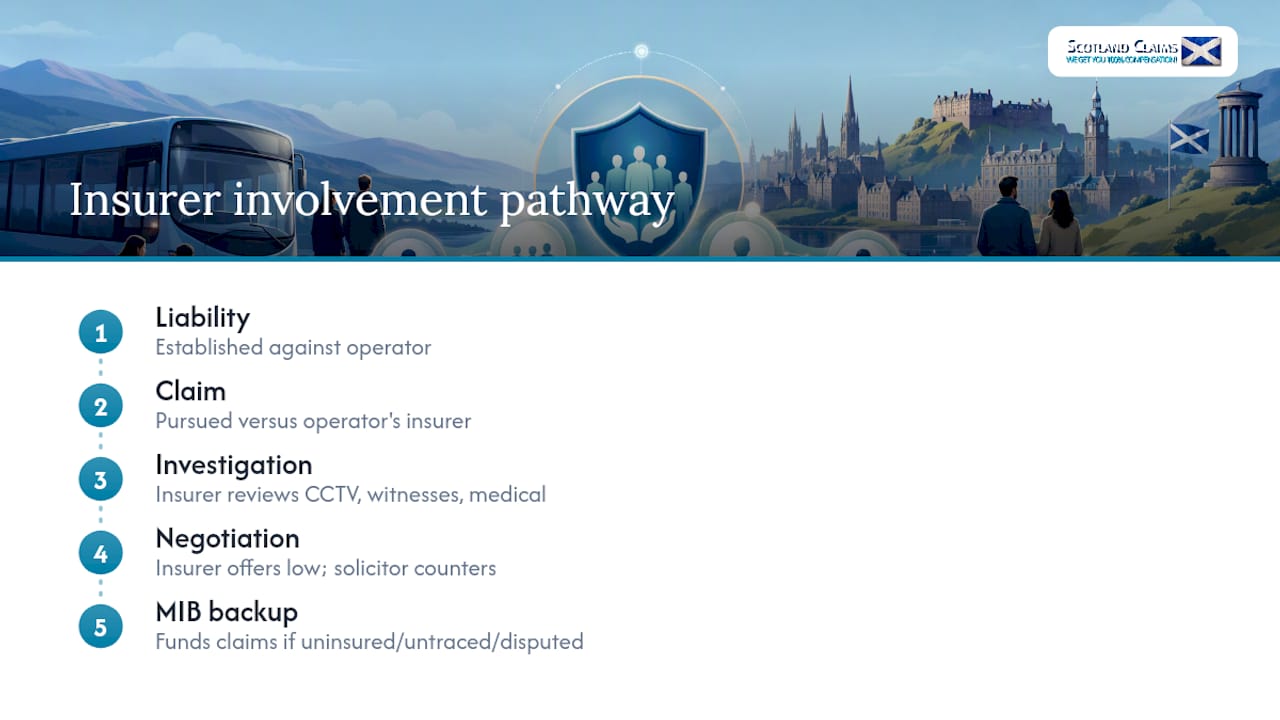
Once liability is established, your claim is pursued against the bus operator’s insurer, not the operator directly. Bus and coach operators in Scotland are required to carry substantial liability insurance, which is what ultimately funds any settlement or court award.
The insurer’s role is to investigate the claim on the operator’s behalf, often instructing their own loss adjusters to review CCTV, witness statements and medical evidence. This is precisely why your solicitor requests the same materials independently: an insurer working solely from the operator’s version of events has an obvious incentive to minimise the payout.
Insurers frequently open negotiations with a lower offer than the claim is worth, expecting some claimants to accept it without challenge. A solicitor experienced in bus accident claims won’t settle prematurely; they’ll counter with medical evidence and a properly evidenced schedule of losses, pushing the offer toward its true value.
Where the driver was uninsured, untraced, or the operator disputes cover, the Motor Insurers’ Bureau can step in to fund a legitimate claim. This safety net matters more than most claimants realise, particularly for accidents involving smaller operators or unregistered vehicles, and it means a claim rarely collapses purely because of an insurance gap on the other side.
How should you deal with the bus company itself?
Bus operators and public transport authorities have their own internal processes for logging incidents, and getting your version on record early matters. Report the accident to the driver or a member of staff at the time if at all possible, and ask for an incident reference number.
Avoid giving a detailed statement to the operator’s representative beyond the basic facts of what happened. Operators sometimes ask accident victims to complete a form on the spot, and while providing your name and a brief description is sensible, detailed commentary on fault or injury severity is best left until you’ve had proper medical assessment and legal advice.
Write to the operator, or have your solicitor do so, requesting that CCTV footage and telematics data be preserved. Many operators only retain footage for a limited period before it’s automatically overwritten, so this request needs to happen within days rather than weeks. Public transport authorities such as regional transport partnerships may also hold relevant data on route safety records or prior incidents involving the same vehicle or driver, which can support a wider pattern-of-negligence argument in more serious cases.
What can delay or complicate a bus accident claim?
Liability disputes are the most common source of delay. If the operator’s insurer disputes fault, perhaps arguing a sudden stop was unavoidable, the claim can stall while both sides gather competing evidence.
Soft-tissue injuries present a particular challenge. Symptoms like whiplash or minor sprains can present mildly at first and worsen over following days, making early medical documentation and a thorough symptom chronology essential to proving the injury genuinely resulted from the accident rather than something unrelated.
Missing or destroyed evidence causes real problems too. If CCTV footage has already been overwritten by the time a solicitor requests it, proving exactly what happened becomes harder and relies more heavily on witness accounts, which can themselves fade or become inconsistent over time.
Multiple defenders can also slow things down, for instance where another vehicle contributed to the bus driver’s actions. Untangling contributory fault between several parties takes longer than a straightforward single-defender case.
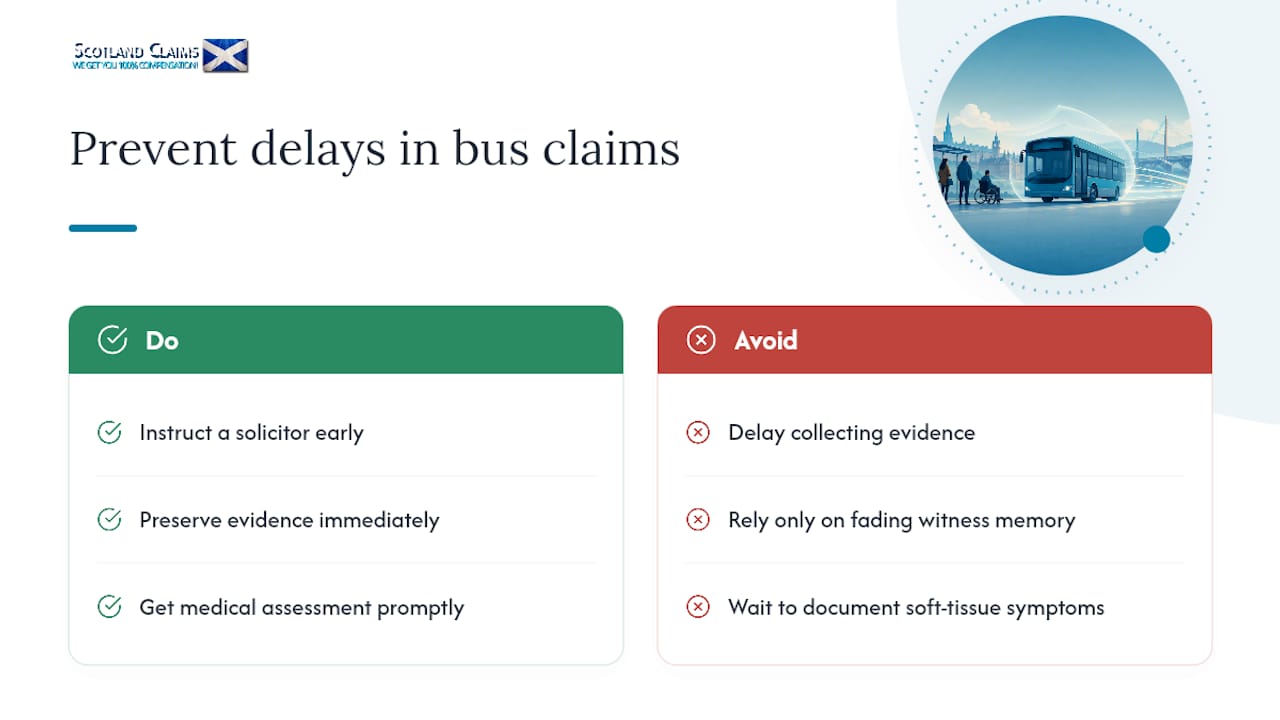
The fix for most of these issues is the same: instruct a solicitor early, preserve evidence immediately, and get medical assessment promptly. Claims that stall usually do so because evidence was lost in the early days, not because the underlying case was weak.
How long does the whole process take?
There’s no single answer, because timescales depend entirely on how contested the claim is. A straightforward case, clear liability, well-documented injury, cooperative insurer, can settle within several months of the initial assessment.
Cases involving disputed liability, more serious or long-term injuries, or the need for expert medical or vocational reports typically take considerably longer, sometimes well over a year, particularly if court proceedings become necessary. The vast majority of claims never reach a courtroom; most resolve through negotiation once both sides have seen the medical evidence and the schedule of losses.
Instructing a solicitor early doesn’t just protect your evidence, it also tends to shorten the overall timeline, because investigation starts while records are still intact rather than after gaps have already appeared.
A word of reassurance
Delaying after a bus accident rarely helps, and it can quietly weaken a claim that would otherwise have been straightforward. Contact a solicitor as soon as you reasonably can, preserve what evidence you have, and let a free assessment tell you where you stand.
— Roger
Start your claim with Scotland Claims Injury Lawyers
Scotland Claims Injury Lawyers does not charge any upfront or success fees for making a claim.
Getting started takes minutes. Fill in the online claim form or request a callback, and a specialist will ask a few straightforward questions: when and where the accident happened, what injuries you sustained, and what evidence you already have, before giving you an honest view on your case. If you’re ready to move, begin your personal injury compensation claim today, or use the compensation calculator to get a sense of potential value before you call.
This article is general information, not a substitute for advice from a qualified lawyer. Consult a qualified legal professional about your own circumstances before acting on anything here.
Sources
FAQ
How much compensation can you get from a bus accident?
There’s no fixed figure. The amount depends on injury severity, medical evidence, and proven financial losses such as lost earnings and treatment costs, which is why a free claim assessment is the only reliable way to get a realistic estimate for your specific case.
What is the average payout for whiplash in Scotland?
Payouts vary widely depending on how long symptoms last and their impact on daily life, so there’s no single average figure that applies fairly across cases. A solicitor reviewing your medical records can give you a realistic range based on comparable settled claims.
What is the hardest injury to prove?
Soft-tissue injuries like whiplash are often the hardest to prove because symptoms can be mild at first and worsen over following days. Thorough medical documentation and a clear chronology of symptoms from the outset make a significant difference to how credible the claim appears.
What happens if a bus gets into an accident?
The operator and driver should report the incident, and passengers or others involved should seek medical attention and gather evidence such as photographs and witness details. If another party’s negligence caused the accident, you can raise a claim against the operator’s insurer within the three-year time limit.
Does Scotland Claims Injury Lawyers charge a success fee?
No.
Recommended