Zero success fee: keep 100% of your compensation

TL;DR:
- A zero success fee arrangement in Scotland ensures claimants keep 100% of their compensation without deductions at settlement. It eliminates both upfront costs and success fee deductions, with the solicitor paid by the defendant’s insurer and often includes optional ATE insurance. Verification requires a clear, written CFA stating zero percent success fee and confirming no VAT or hidden costs apply.
A zero success fee arrangement is defined as a legal agreement where no percentage of your compensation is deducted as a fee when your personal injury claim succeeds. Most large solicitors in Scotland charge a success fee of up to 20% including VAT of your damages, meaning a significant slice of your award disappears before you see it. Scotland Claims Injury Lawyers operates differently. Under a zero success fee model, you retain 100% of your compensation. That is the single most important financial distinction any Scottish claimant can understand before signing a legal agreement.
How does a zero success fee arrangement work?
A zero success fee agreement is a type of Conditional Fee Agreement (CFA), the formal legal instrument that governs no win no fee claims in Scotland. The CFA sets out exactly what you pay, when you pay it, and under what conditions. Under a standard CFA, your solicitor takes a success fee if you win. Under a zero success fee CFA, that deduction simply does not exist.
Here is what the arrangement means in practice:
- No upfront costs. You pay nothing to start your claim. The solicitor carries the financial risk.
- No ongoing legal fees. You are not billed during the claims process, regardless of how long it takes.
- No success fee deduction. When you win, no percentage is taken from your compensation award.
- After the Event (ATE) insurance. This policy covers costs if your claim fails. Some zero success fee agreements include ATE insurance costs, but you are never charged a success fee percentage on top.
The solicitor is paid by the losing party, typically the defendant’s insurer, through a separate costs order. That is how the firm recovers its fees without touching your award. Clear conditional fee agreements must disclose all fees, cancellation deadlines (usually 14 days), and payment protocols before you sign.
Pro Tip: Ask your solicitor to confirm in writing that the success fee percentage is zero and that no VAT applies to any deduction from your compensation. Get this confirmed before you sign anything.

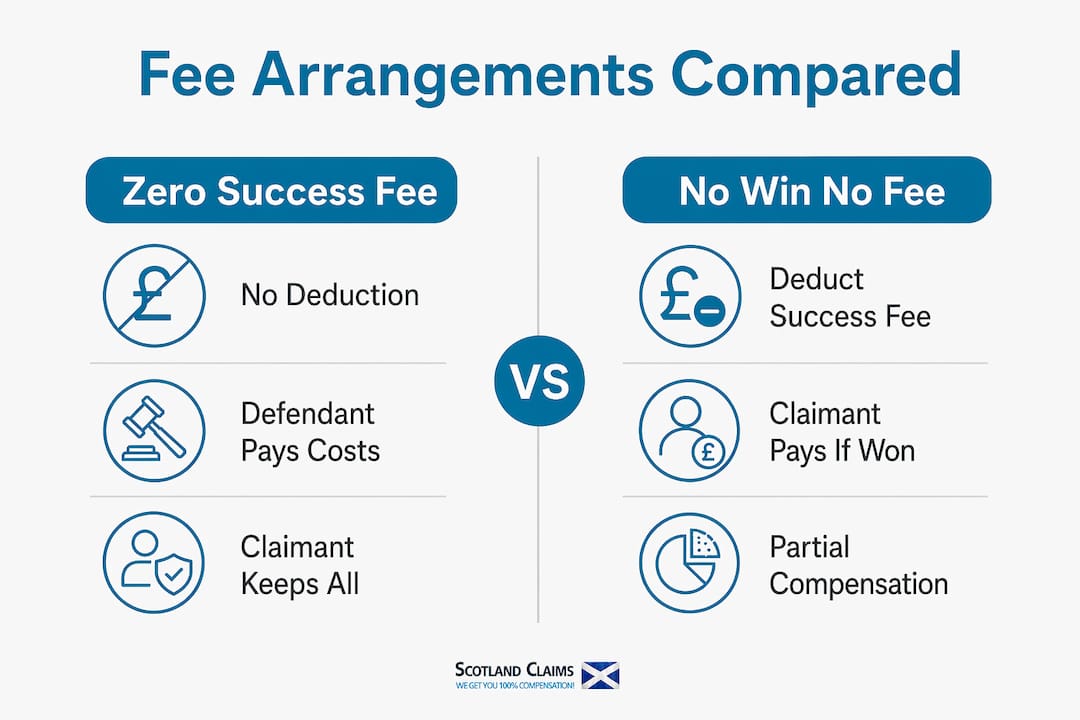
Zero success fee vs no win no fee: what is the difference?
The two terms sound similar but they describe different financial outcomes for you as a claimant. Understanding the gap between them is worth real money.
| Fee arrangement |
Success fee deducted? |
Who pays legal costs? |
Claimant keeps |
| Standard no win no fee |
Yes, up to 20% including VAT |
Defendant pays base costs; claimant pays success fee |
75–100% of award |
| Zero success fee |
No |
Defendant pays all recoverable costs |
100% of award |
| Traditional private fee |
N/A |
Claimant pays regardless of outcome |
Varies |
Typical success fees reach up to 20% including VAT at most large firms in Scotland. On a £10,000 award, that means up to £2,500 goes to your solicitor before you receive a penny. Scotland Claims Injury Lawyers charges zero. The financial difference is immediate and concrete.
Other costs to be aware of under any arrangement include:
- Disbursements. These are third-party costs such as medical reports or court fees. Check whether these are recovered from the defendant or deducted from your award.
- ATE insurance premiums. ATE insurance covers costs if a claim fails; it is typically only payable after a successful outcome. Confirm who bears this cost in your specific agreement.
- VAT on fees. Under a standard success fee arrangement, VAT applies to the fee, further reducing your payout. Under a zero success fee model, this issue does not arise.
The core distinction is this: a standard no win no fee arrangement removes your upfront financial risk but still costs you a percentage of your award. A zero success fee arrangement removes both the upfront risk and the end deduction.
What are the benefits of zero success fee legal representation?
The primary benefit is financial. You receive every pound of your compensation. No percentage is withheld, no VAT is added to a deduction, and no hidden charge appears at settlement. Zero success fee means no deduction from damages, which is the clearest form of affordable legal representation available in Scotland.
Beyond the money, there are practical advantages worth noting:
- Reduced stress at settlement. You know exactly what you will receive. There is no last-minute calculation of what the solicitor takes.
- Shared risk. The solicitor only earns if the claim succeeds. That alignment of interest means your lawyer is motivated to win.
- Access to justice. Claimants who might hesitate due to cost concerns can pursue legitimate claims without financial fear.
- Transparency. A genuine zero success fee provider states the arrangement clearly in the CFA, leaving no room for ambiguity.
One consideration is worth raising honestly. Not every solicitor accepts every case under a zero success fee model. Firms take on risk when they waive the success fee, so they assess claim strength carefully before agreeing. A strong, well-documented claim is more likely to be accepted. This is not a barrier. It is a quality filter that benefits claimants with genuine cases.
Pro Tip: Before instructing any solicitor, ask directly: “What is your success fee percentage?” and “Is VAT included in any deduction from my compensation?” A genuine zero success fee provider will confirm both answers immediately and in writing.
How do you verify a true zero success fee agreement in Scotland?
Verification starts with the Conditional Fee Agreement document itself. Every legitimate CFA must state the success fee percentage explicitly. If that figure is zero, it should appear clearly in the contract. Do not accept verbal assurances alone.
Follow these steps before signing:
- Read the CFA in full. Look for the section that states the success fee percentage. It should read 0%.
- Check for VAT clauses. Confirm that no VAT is applied to any deduction from your compensation.
- Ask about ATE insurance. Confirm whether an ATE premium applies, who pays it, and whether it comes from your award or from the defendant’s costs.
- Request a fee schedule. Ask for a written list of all possible charges, including disbursements, so nothing surprises you at settlement.
- Confirm the cancellation period. CFAs detail cancellation periods, typically 14 days. Know your rights if you change your mind.
- Look for a written guarantee. Scotland Claims Injury Lawyers provides a written commitment that clients receive 100% of their compensation. Ask any prospective solicitor for the same.
Solicitors can negotiate fees, but a zero success fee guarantee removes that negotiation entirely. You should not need to haggle for your full award. If a firm is vague about its success fee percentage, treat that as a warning sign.
Pro Tip: Use the types of compensation available in Scotland as a reference point when reviewing your CFA. Understanding what your claim covers helps you spot any discrepancy between expected and actual payout.
Common misconceptions about zero success fee claims
Several misunderstandings circulate about what zero success fee actually means. Clearing them up protects you from making decisions based on incorrect assumptions.
- “Zero success fee means free legal services.” This is not accurate. It means no percentage of your compensation is taken as a fee. The solicitor is still paid, but by the losing party through a costs order.
- “It only applies if I lose.” The opposite is true. The zero success fee clause applies when you win. It means no deduction is made from your award at the point of settlement.
- “All no win no fee solicitors offer zero success fees.” They do not. Success fees at most large or national firms are commonly up to 20% including VAT under standard no win no fee arrangements. Zero success fee is a specific, distinct offer.
- “There are no other costs whatsoever.” Disbursements such as medical report fees may still apply. Confirm these details in your CFA before signing.
- “Zero success fee and contingency fee options are the same thing.” They are not. A contingency fee arrangement, more common in the United States, involves the lawyer taking a percentage of the final award. Zero success fee explicitly prevents that deduction.
The safest approach is to read every line of your agreement. Experts stress clarity in legal agreements as critical, particularly regarding how fees are calculated and whether VAT applies. If anything is unclear, ask before you sign.
Key takeaways
A zero success fee arrangement is the only legal fee structure in Scotland that guarantees claimants receive 100% of their personal injury compensation with no percentage deducted at settlement.
| Point |
Details |
| Zero success fee defined |
No percentage of your compensation is deducted when your claim succeeds. |
| Standard success fees cost you |
Typical success fees at most large firms reach up to 20% including VAT, reducing your award significantly. |
| CFA verification is critical |
Check your Conditional Fee Agreement explicitly states a 0% success fee before signing. |
| ATE insurance still applies |
After the Event insurance may be payable on success; confirm who bears this cost in writing. |
| Scotland Claims Injury Lawyers guarantees 100% |
The firm commits in writing that clients keep their full compensation award. |
Why zero success fee matters more than most claimants realise
The legal fee conversation tends to happen at the start of a claim, when claimants are focused on whether they have a case at all. By the time settlement arrives, the fee structure feels like a detail from months ago. That is exactly when it hits hardest.
I have seen claimants genuinely surprised at settlement when a firm deducts 20% from an award they had mentally spent. On a £15,000 whiplash settlement, that is £3,000 gone. On a serious workplace injury claim worth £40,000, it is £8,000. These are not abstract figures. They represent real financial consequences for people who were already harmed through no fault of their own.
What strikes me about the zero success fee model is not just the financial saving. It is the signal it sends. A firm willing to waive its success fee entirely is a firm that has structured its business around recovering costs from the defendant, not from the claimant. That alignment matters. It means your solicitor’s financial interest and your financial interest point in exactly the same direction.
My strong advice is this: never assume a no win no fee arrangement means zero success fee. Ask the direct question before you sign. The answer tells you immediately whether the firm is genuinely on your side or simply sharing the risk while still taking a cut of your award.
— Roger
Scotland Claims Injury Lawyers: personal injury claims with no fee deductions
Scotland Claims Injury Lawyers operates exclusively on a zero success fee basis for personal injury claims across Scotland. Claimants pursuing road traffic accidents, workplace injuries, slips, trips, or back and knee injuries pay nothing upfront and receive their full compensation at settlement. No percentage is deducted. No success fee applies. The firm’s injury lawyers in Scotland handle the entire claims process, from initial assessment through to settlement, with the commitment to 100% compensation written into every agreement. For back injury claims or knee injury claims, the same zero success fee guarantee applies. Use the compensation calculator to estimate your potential award before you begin.
FAQ
What is a zero success fee in personal injury claims?
A zero success fee means your solicitor takes no percentage of your compensation when your claim succeeds. You receive 100% of your award with no deduction at settlement.
Is zero success fee the same as no win no fee?
No. Standard no win no fee arrangements at most large firms typically include a success fee of up to 20% including VAT deducted from your compensation. Zero success fee removes that deduction entirely.
Are there any costs at all under a zero success fee agreement?
Disbursements such as medical report fees may apply, and After the Event insurance premiums may be payable on success. Confirm all costs in your Conditional Fee Agreement before signing.
How do I confirm my agreement is truly zero success fee?
Check your Conditional Fee Agreement for an explicit 0% success fee clause. Ask your solicitor to confirm in writing that no VAT applies to any deduction from your compensation.
Does zero success fee apply if I lose my claim?
No. The zero success fee clause applies at the point of a successful settlement. If your claim does not succeed under a no win no fee arrangement, you pay no legal fees at all.
Recommended