
Did you know that a whiplash injury in Glasgow is often worth more than double the same injury in London? While drivers in England are restricted by rigid government tariffs, claiming for whiplash in Scotland 2026 remains governed by a separate legal system that prioritises fair, case-by-case assessments. If you are struggling with persistent neck pain and the stress of lost earnings, you shouldn't have to worry about a solicitor taking a 20% cut of your settlement. We believe that when you are injured through no fault of your own, you deserve the full value of your award.
You might feel confused by conflicting information online or fear that legal fees will swallow your compensation. This is a common concern for many, but the Scottish landscape is much more empowering for the pursuer. Our specialist approach ensures that legal costs are recovered directly from the at-fault insurer; this leaves your award completely untouched. This guide provides a clear roadmap to securing 100% of your compensation while navigating the specific rules that protect your rights in Scotland. You will learn exactly how the Judicial College Guidelines apply to your injury, why the English portal does not affect you, and how to achieve a stress-free recovery without any hidden success fees.
Key Takeaways
- Understand why Scottish law rejects the restrictive English whiplash tariffs, ensuring you receive a fair valuation based on your actual recovery time.
- Discover the exact process for claiming for whiplash in scotland 2026, including the strict three-year window for starting your legal action.
- Learn how the 100% compensation guarantee works by shifting the burden of legal costs onto the at-fault driver’s insurance provider.
- Identify the vital medical evidence needed to prove your injury and secure full payment for both your pain and your lost earnings.
- Gain clarity on your immediate responsibilities after an accident, from exchanging details to fulfilling your duty to report to Police Scotland.
Understanding Whiplash Claims in Scotland: The 2026 Landscape
Whiplash is often dismissed by insurance companies as a minor inconvenience. However, the reality for many Scottish road users is much more severe. It's a soft tissue injury caused by the sudden acceleration-deceleration forces of a collision. These forces whip the head forward and back, straining the tendons and ligaments in the neck. When you are claiming for whiplash in scotland 2026, you need to know that even a "minor" injury can have long-term impacts on your mobility and your ability to work. You aren't just seeking a "bonus"; you are recovering the financial losses and physical comfort that were taken from you.
It's a common misconception that only drivers can seek compensation. In reality, passengers, cyclists, and pedestrians have equal rights to claim if they've been injured by a negligent driver. If you were sitting in the passenger seat or crossing the road when the impact occurred, the law protects you. Every specialist at Scotland Claims Injury Lawyers is committed to ensuring you understand your rights from the very first phone call. You can learn more about your specific rights on our dedicated whiplash compensation page.
The Distinction Between Scottish and English Legal Systems
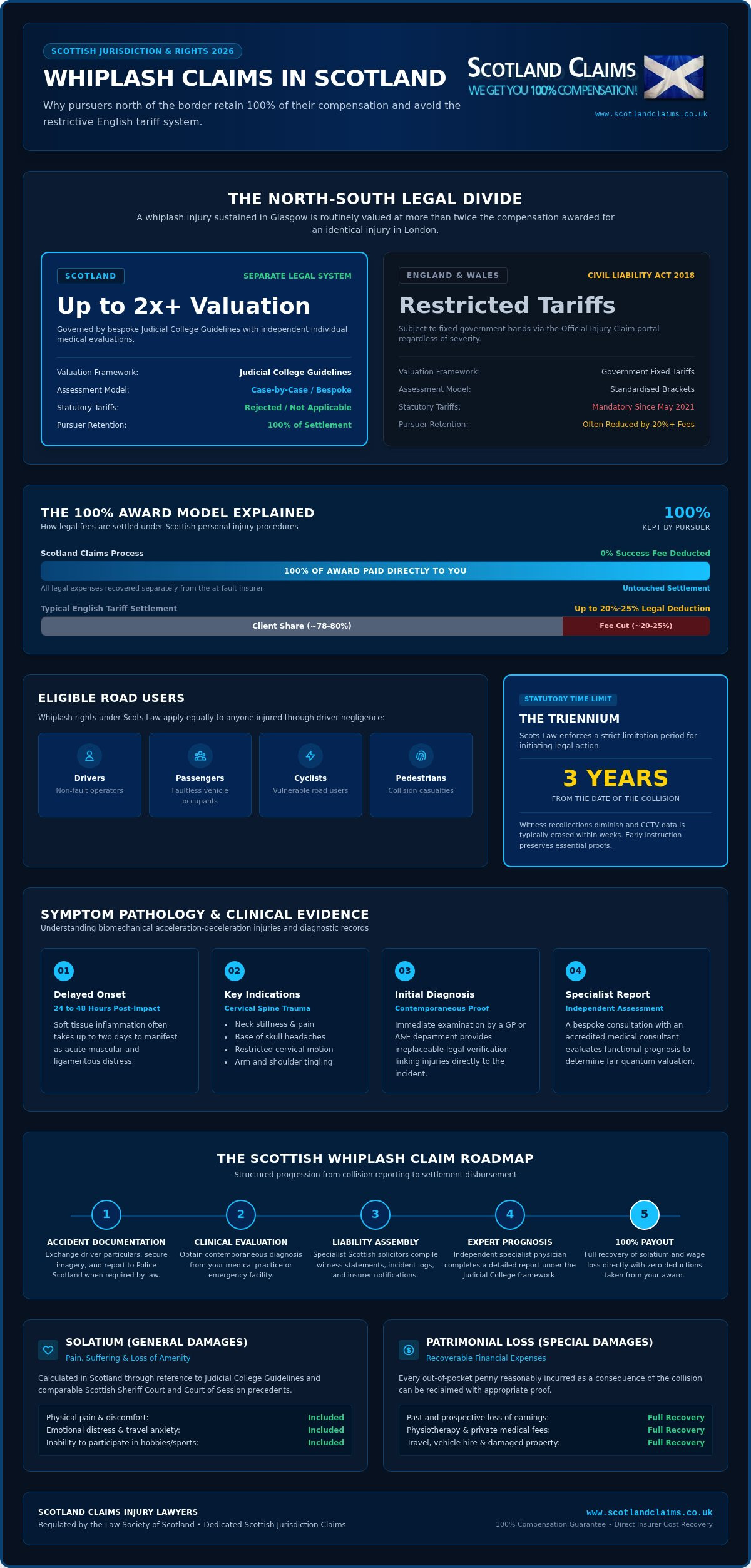
The legal landscape for whiplash changed significantly in 2021, but only for those south of the border. The English "Whiplash Reforms" introduced a rigid tariff system that slashed compensation amounts for minor injuries. These reforms do not apply to the Scottish courts. In Scotland, we maintain a separate legal system where judges use the Judicial College Guidelines to determine the value of a claim based on the unique medical evidence of each case. This often results in significantly higher settlements for Scottish pursuers compared to their English counterparts. Every specialist solicitor at Scotland Claims Injury Lawyers is regulated by the Law Society of Scotland, ensuring your case is handled with the highest standards of professional integrity.
Common Symptoms and When to Seek Medical Attention
Identifying the injury early is vital for both your health and your legal record. You might not feel pain immediately after the accident. This is known as "delayed onset" whiplash, where symptoms appear 24 to 48 hours later as inflammation sets in. You should watch for these signs:
- Persistent neck pain and stiffness.
- Headaches originating at the base of the skull.
- Reduced range of motion in the neck.
- Referred pain or tingling in the shoulders and arms.
You can find detailed clinical information regarding whiplash injury symptoms and diagnosis to help you understand the biomechanical impact of your collision. Seeking a medical diagnosis from your GP or an A&E department immediately creates a contemporaneous record of your injury. This record is the foundation of a successful claim. Without it, insurance companies may argue that your symptoms are unrelated to the accident.
The Legal Process: Proving Your Whiplash Injury
Proving a soft tissue injury requires a methodical approach that prioritises evidence over assertion. When you are claiming for whiplash in scotland 2026, your specialist solicitor acts as your advocate to establish liability. This means proving the other driver was at fault. We don't just rely on your account of the event. We build a robust case file that makes it difficult for insurance companies to dispute the facts of the collision.
A vital part of this process involves gathering medical evidence. Unlike the restrictive Civil Liability Act 2018 whiplash provisions that apply in England and Wales, Scottish law allows for a bespoke assessment of your condition. We arrange an examination with an independent medical expert. They will assess your range of movement and document the severity of your symptoms. This report is the primary tool used to value your claim, ensuring you aren't boxed into a generic compensation bracket.
Timing is also a critical factor. In Scotland, you generally have a three-year period, known as the "triennium," to initiate legal proceedings. This clock starts on the day of the accident. Whilst three years sounds like a long time, evidence can go cold. Witness memories fade and CCTV footage is often overwritten within weeks. Starting the process early ensures the strongest possible foundation for your recovery.
Establishing Liability in Road Traffic Accidents
Establishing fault involves a detailed investigation into the mechanics of the crash. We secure police reports and witness statements to corroborate your version of events. In 2026, technology plays a bigger role than ever. Dashcam footage and urban CCTV are often the deciding factors in disputed cases. We also address "contributory negligence." For instance, if you weren't wearing a seatbelt, a court might reduce your award by a certain percentage. However, this does not stop you from pursuing a claim for the injuries that weren't your fault.
Qualified One-Way Costs Shifting (QOCS) Explained
One of the most significant protections for Scottish pursuers is Qualified One-Way Costs Shifting (QOCS). This rule ensures that if your claim is unsuccessful, you are not held liable for the defender's legal expenses. There are exceptions for fraudulent claims or "manifestly unreasonable" behaviour, but for the vast majority of honest claimants, the financial risk is removed. Under QOCS, whilst you pursue justice, you are generally protected from the financial risk of the opponent’s legal fees. This protection, combined with a "No Win, No Fee" agreement, ensures that justice is accessible to everyone, regardless of their bank balance. If you are ready to see where you stand, you can use our compensation calculator to estimate your potential award.
Calculating Compensation: Why the 100% Model Matters
When you are claiming for whiplash in scotland 2026, understanding how your settlement is calculated is the first step toward full financial recovery. Scottish law divides your award into two distinct categories. This ensures that every aspect of your suffering and financial loss is accounted for. You should never accept a "one size fits all" offer from an insurance company without a full breakdown of these figures. For an initial estimate tailored to your specific situation, you can use our compensation calculator.
Solatium vs. Patrimonial Loss
Solatium is the Scottish legal term for compensation awarded for your physical and psychological distress. It covers the pain you have endured and the "loss of amenity," such as being unable to enjoy your usual hobbies or exercise. Patrimonial loss, on the other hand, covers your tangible financial hits. This includes:
- Lost wages from time off work, including potential bonuses.
- Medical expenses for private treatment or prescriptions.
- Travel costs to and from physiotherapy appointments.
- Costs for "care and assistance" provided by family members.
We also look at the long-term impact. If your neck injury prevents you from returning to a physically demanding job, we factor in future loss of earnings. This comprehensive approach ensures that the settlement reflects the true impact on your life, protecting your financial stability while you focus on your physical recovery.
The Financial Impact: 100% vs. 80% Settlements
The most critical difference between our service and traditional firms is how much money actually reaches your bank account. Many "big-brand" firms operate on a model where they deduct a success fee, often as high as 20%, from your final award. They do this even on straightforward cases. Under the Civil Liability Act 2018, Scottish claims remain exempt from the English tariff caps, meaning your potential award is already higher. We believe you should keep every penny of it.
Consider the math. On a £5,000 settlement for a minor injury, a firm taking a success fee leaves you with only £4,000. With Scotland Claims Injury Lawyers, you receive the full £5,000. We recover our legal costs directly from the at-fault driver’s insurance company through the Scottish cost-recovery system. This is a point of fairness that we refuse to compromise on when you are claiming for whiplash in scotland 2026. Your injury. Your claim. 100% your compensation.
Steps After a Road Accident to Protect Your Claim
The moments following a collision are often chaotic and stressful. However, the actions you take in the immediate aftermath are vital when claiming for whiplash in scotland 2026. Your first priority is always safety. Move your vehicle to a secure location if possible and check all parties for injuries. Once the scene is stable, you must exchange details with the other drivers. Under the Road Traffic Act, you have a legal requirement to report the accident to Police Scotland within 24 hours if you cannot exchange details at the scene or if any person has been injured.
Gathering Vital Evidence at the Scene
A successful claim relies on the quality of your evidence. You shouldn't rely on memory alone. Collect the following details before leaving the area:
- Full names and contact numbers of all drivers involved.
- Vehicle registration marks and make/model of the cars.
- Insurance provider names and policy numbers if available.
- Contact details for any independent witnesses.
Use your smartphone to document the "locus" or the exact location of the crash. Photograph the final positions of the vehicles, any visible damage, skid marks, and the prevailing weather or road conditions. In 2026, digital evidence is more influential than ever. If you have a dashcam, ensure the footage of the impact is saved before it is overwritten. This "silent witness" often provides the undeniable proof needed to settle a liability dispute quickly.
Dealing with Insurance Companies
You may find that the at-fault driver’s insurance company contacts you within days of the accident. They often make "pre-medical" offers. These are lowball settlements designed to close your file before the full extent of your injury is known. You should never accept these offers. Whiplash symptoms can evolve over several weeks, and a premature settlement prevents you from seeking further compensation if your condition worsens.
Your solicitor should handle every piece of correspondence with the defender's insurer. This protects you from being pressured into a settlement that doesn't cover your long-term needs. We ensure that a medical expert assesses your recovery before any figures are discussed. For a deeper look at your rights on the road, visit our Road Traffic Accident Claims: Your Complete Legal Guide.
Contact our specialist team to protect your claim
Choosing a Specialist Scottish Solicitor: The Scotland Claims Advantage
Selecting the right legal partner is the single most important decision you'll make after an accident. When you're claiming for whiplash in scotland 2026, you need a team that understands the nuances of the local court system. Scottish cases are raised in the local Sheriff Court or the specialised All-Scotland Sheriff Personal Injury Court (ASSPIC) in Edinburgh. Navigating these venues requires a deep understanding of Scottish civil procedure that "UK-wide" firms often lack. We provide immediate legal support through our 24-hour freephone helpline, ensuring you aren't left waiting for answers when you're at your most vulnerable.
Our "No Success Fee" model is designed to remove the anxiety that stops many people from seeking justice. We recover our full costs from the at-fault driver’s insurance company. This means we don't need to dip into your settlement to cover our work. From day one, you have the peace of mind that comes with knowing exactly where you stand financially. Scotland Claims Injury Lawyers is committed to recovering the full value of every claim, ensuring our clients aren't penalised for seeking the compensation they deserve.
Regulated Expertise You Can Trust
Transparency isn't just a buzzword for us; it's a regulatory requirement. Scotland Claims Injury Lawyers is a trading style of Kerr Brown Solicitors, a firm established in 2006 with a reputation for unwavering client advocacy. Every case we handle is overseen by a qualified solicitor authorised and regulated by the Law Society of Scotland. Many large, volume-based firms use unqualified "claims handlers" to process files. This often leads to missed details and lower settlements. We believe your recovery is too important to be handled by anyone other than a specialist who understands the law inside out.
How to Start Your 100% Claim Today
We've made the path to justice as low-friction as possible. You don't need to visit an office or navigate complex paperwork to find out if you have a case. Our fast, no-obligation claim assessment process can be started online in minutes for your convenience. Whether you prefer a phone call or a digital inquiry, we provide a definitive, expert assessment of your situation without any upfront costs or hidden risks.
You've already suffered enough through your injury and the stress of a collision. Don't let a profit-heavy law firm take a chunk of what you're owed. Don’t lose 20% of your payout to big-brand law firms. Keep 100% with Scotland Claims Injury Lawyers.
Secure Your Full Recovery Today
The path to physical and financial recovery after a road accident shouldn't be blocked by hidden legal costs or confusing cross-border regulations. You now understand that Scottish law provides a distinct advantage, prioritising your actual needs over rigid government tariffs. By acting quickly to secure evidence and seeking expert medical assessments, you build a case that insurance companies cannot easily ignore.
Choosing a specialist regulated by the Law Society of Scotland ensures your interests are always the priority. When you are claiming for whiplash in scotland 2026, you deserve a partner who fights for every penny of your award. Our 100% compensation guarantee means you never have to sacrifice a portion of your settlement to success fees. We recover our costs from the at-fault party, not from you. If you need immediate reassurance, our 24-hour freephone helpline is available to provide the expert guidance you need right now.
Start your whiplash claim online now and keep 100% of your compensation
Take the first step toward putting this accident behind you. You have the right to a full recovery, and we have the expertise to make it happen without any financial risk.
Frequently Asked Questions
How much compensation can I expect for whiplash in Scotland in 2026?
Your compensation depends on the severity of your injury and the recovery time documented in your medical report. Under the current Judicial College Guidelines, a minor neck injury with a full recovery within three months can reach up to £2,990. If symptoms persist for up to a year, the bracket increases to between £2,990 and £5,310. These figures only cover your physical pain; any lost wages or medical costs are added on top.
How can Scotland Claims offer 100% compensation when others take 20%?
We operate a unique cost-recovery model that prioritises your financial integrity. Unlike many big-brand firms that deduct a 20% success fee from your award, we recover our legal expenses directly from the at-fault driver’s insurance company. This is possible because Scottish law allows solicitors to bill the defender's insurer for the work performed. This ensures that every penny of the settlement goes to you, exactly as it should, without any hidden deductions or surprise costs.
What happens if my whiplash claim is unsuccessful?
If your claim is unsuccessful, you will not owe us a penny for our legal services. We operate on a true "No Win, No Fee" framework designed to remove all financial risk from the pursuer. Additionally, Scottish rules on Qualified One-Way Costs Shifting (QOCS) generally protect honest claimants from having to pay the opponent's legal fees. This ensures that seeking justice remains accessible and entirely risk-free for victims of road accidents across the country.
Can I still claim for whiplash if the accident was partially my fault?
Yes, you can still pursue a claim even if you share some responsibility for the collision. In these cases, a principle called "contributory negligence" applies. This means your total compensation award is reduced by a percentage that reflects your level of fault. For example, if you were found 25% responsible, you would receive 75% of the total claim value. It is still highly beneficial to claim for the portion of the injury that wasn't your fault.
How long do I have to make a whiplash claim in Scotland?
You generally have three years from the date of the accident to initiate legal proceedings in Scotland. This time limit is known as the "triennium." If you were under 16 at the time of the crash, the three-year clock only starts on your 16th birthday. Whilst three years may seem generous, it's vital to begin claiming for whiplash in scotland 2026 as soon as possible to ensure that evidence and witness memories remain fresh.
Do I have to go to court for a whiplash injury claim?
It is very unlikely that you will need to step foot in a courtroom. The vast majority of whiplash claims are settled through direct negotiation between your solicitor and the at-fault driver’s insurance company. We only raise court proceedings if the insurer refuses to accept liability or offers an unfairly low settlement. Even then, most cases settle before reaching a final hearing, meaning the process remains efficient and low-stress for the vast majority of our clients.
Can I claim for whiplash if I was a passenger in the vehicle?
Passengers have a very strong right to claim because they are almost never responsible for the collision. Whether you were in the vehicle that caused the accident or the one that was hit, you can seek 100% compensation for your injuries. Your claim will be made against the insurance policy of whichever driver was at fault. This remains one of the most straightforward types of claiming for whiplash in scotland 2026.
What medical evidence do I need to prove a whiplash injury?
To prove your injury, you need a professional medical report from an independent expert. We arrange this examination for you at no upfront cost. The doctor will assess your symptoms, check your range of motion, and provide a prognosis for your recovery. This report is supplemented by your initial GP or hospital records created immediately after the accident. Together, these documents form the essential evidence needed to value your claim accurately and fairly under Scottish law.