Table of Contents
How a Whiplash Claim Calculator Works 🧮
A whiplash claim calculator is a digital tool designed to estimate the potential compensation you might receive for a whiplash injury sustained in a road traffic accident. Scotland Claims Injury Lawyers has developed resources to help injured parties understand what their claim might be worth before committing to legal representation. The calculator takes into account injury severity, recovery period, and financial losses, then cross-references these against established compensation guidelines used by Scottish courts.
You input information about your accident, the nature of your soft tissue injury, symptom duration, and out-of-pocket expenses. The tool applies the Judicial College Guidelines, which provide structured ranges for general damages across different injury categories. This approach offers transparency: you're seeing what the Scottish legal system typically awards for injuries like yours rather than guessing in the dark.
According to Whiplash Claim Scotland, Compensation Amounts & Guide, minor whiplash injuries recovering within 3 months typically result in £1,000 to £2,500 in compensation. The calculator isn't a guarantee, liability, medical evidence, and individual circumstances all matter, but it removes much uncertainty from the initial assessment phase.
Pro Tip
Scottish whiplash claims operate under different rules than England and Wales. Scotland wasn't affected by the 2021 whiplash reforms, meaning you can claim full compensation without tariff caps. A calculator built for Scotland reflects this advantage.
How Much Compensation for Whiplash: Severity Ranges 💷
Compensation depends primarily on injury severity and recovery duration, based on decades of case law and the Judicial College Guidelines that Scottish courts consult when awarding damages.
Minor Whiplash Injuries
Minor whiplash injuries that resolve with conservative treatment typically result in £1,000 to £2,500 compensation if symptoms clear within three months. This covers pain and suffering during recovery, plus reasonable expenses including physiotherapy, time off work, and transport to medical appointments.
Moderate Whiplash Injuries
If recovery takes between 3 and 12 months, you're entering a different bracket. According to Whiplash Claim Scotland, Compensation Amounts & Guide, moderate whiplash typically results in £2,500 to £5,000 in compensation.
This category accounts for longer-term disruption: ongoing physiotherapy, weeks or months away from work, and persistent symptoms affecting your ability to perform household duties or leisure activities.
Severe or Chronic Whiplash
When symptoms persist beyond 12 months or cause lasting complications, compensation may reach £8,000 to £12,000 or more. Research from the Association of Personal Injury Lawyers indicates one in five whiplash sufferers experience symptoms for more than a year.
These cases typically involve ongoing physiotherapy, potential nerve involvement, chronic pain, or psychological effects like anxiety triggered by the accident.
Key Takeaway
Severe whiplash compensation reflects both immediate suffering and long-term disruption. Symptoms persisting after a year place your claim in a higher valuation bracket.
Understanding General Damages and Special Damages 📋
Compensation breaks down into two distinct categories: general damages and special damages.
General damages cover pain, suffering, and loss of amenity, the subjective experience of your injury. The Judicial College Guidelines primarily address this. Courts recognise you've endured physical pain, emotional distress, and disruption to normal life. General damages don't require receipts; they're assessed based on symptom nature, duration, and how they've affected daily functioning.
Special damages are quantifiable financial losses: physiotherapy costs, prescription charges, transport to medical appointments, lost wages during recovery, and other out-of-pocket expenses directly caused by your injury. Special damages require documentary evidence, invoices, receipts, payslips, medical records proving exactly what you've spent and why it was necessary.
Most whiplash claims include both. A minor injury might have £1,500 in general damages and £300 in special damages (three physiotherapy sessions). A moderate injury might have £3,500 in general damages and £800 in special damages (more physiotherapy, lost earnings, travel costs).
Watch Out
Many claimants forget to track special damages immediately after an accident. Without receipts or records, you'll struggle to claim those costs later. Document everything from day one.
Factors That Influence Your Whiplash Claim Value 🔍
Several factors beyond injury severity affect compensation.
Liability is fundamental. If the other party is clearly at fault, liability is straightforward. Disputed liability doesn't prevent claiming but affects timeline and settlement negotiations.
Medical evidence carries substantial weight. Courts rely on medical reports, diagnostic imaging, and healthcare provider statements. A physiotherapist's detailed assessment of range of motion, pain levels, and functional limitations is far more persuasive than your own account. Imaging (X-rays, MRI scans) strengthens your claim significantly.
Age and occupation matter too. A 25-year-old labourer whose whiplash prevents work for three months has suffered greater loss than a 65-year-old office worker with the same injury.
Impact on daily life is assessed through your testimony and medical records. Can you perform household tasks? Drive? Play sport? The greater the disruption, the higher the general damages.
Pre-existing conditions can complicate matters. If you had previous neck problems, the court must determine what portion of current suffering is attributable to the accident versus pre-existing conditions. This requires clearer medical evidence distinguishing the new injury from old problems.
Time Limits for Personal Injury Claims in Scotland ⏰
In Scotland, you have 3 years from the accident date to make a whiplash claim under the Prescription and Limitation (Scotland) Act 1973. Missing this deadline means losing your right to claim entirely.
Three years passes quickly. Many people delay seeking legal advice whilst focusing on recovery or questioning whether their injury warrants a claim. The clock doesn't stop for uncertainty; it runs from the accident date regardless of when you feel ready to claim.
For children under 16 at the time of the accident, the three-year clock doesn't start until their 16th birthday. A child injured at age 14 has until age 19 to claim. However, parents or guardians should still act promptly because evidence deteriorates and CCTV footage is routinely deleted after 90 days.
Pro Tip
Contact a solicitor within the first few months of your accident. Early action gives you the strongest position for gathering evidence and witness testimony.
The Whiplash Claims Process: From Accident to Settlement ⚖️
Most whiplash claims in Scotland follow a predictable pathway.
Step 1: Report the accident and gather evidence. Contact the police if there are injuries or significant damage. Exchange details with the other driver, name, address, insurance details, vehicle registration. Take photographs of vehicle damage, the accident scene, road conditions, and any visible injuries. Get witness contact information.
Step 2: Seek medical attention. Even if you feel fine initially, see your GP or attend accident and emergency. Whiplash symptoms often develop over hours or days. Keep all medical records, appointment letters, and prescriptions.
Step 3: Contact a solicitor. According to Why claim for whiplash in Scotland: your 2026 guide, most straightforward whiplash claims in Scotland settle within four to nine months. Early legal advice accelerates this process. Scotland Claims Injury Lawyers assesses claims on a No Win No Fee basis, meaning you pay nothing upfront and retain 100% of compensation if successful.
Step 4: Obtain a medical report. Your solicitor arranges an independent medical examination. The doctor assesses current symptoms, reviews medical history, and provides a detailed report on injury, prognosis, and impact on daily functioning. This report is central to your claim's valuation.
Step 5: Submit a claim to the insurer. Your solicitor prepares a formal claim letter detailing your injury, medical evidence, financial losses, and compensation sought. The defendant's insurance company has 30 days to respond.
Step 6: Negotiate a settlement. Most claims settle through negotiation. If the insurer's initial offer is too low, your solicitor will counter-propose. This typically results in agreement within weeks or months.
Step 7: Receive your compensation. Once settlement is agreed, the insurer transfers funds to your solicitor's client account. You receive your compensation minus any legitimate expenses. With Scotland Claims Injury Lawyers, you keep the full amount.
If liability is disputed or symptoms are ongoing, the process can take eighteen months or more.
No Win No Fee Solicitors in Glasgow: What You Need to Know 🏛️
The No Win No Fee arrangement has transformed access to justice for injury claimants. You can pursue a legitimate claim without risking your own money, knowing that if you lose, you pay nothing.
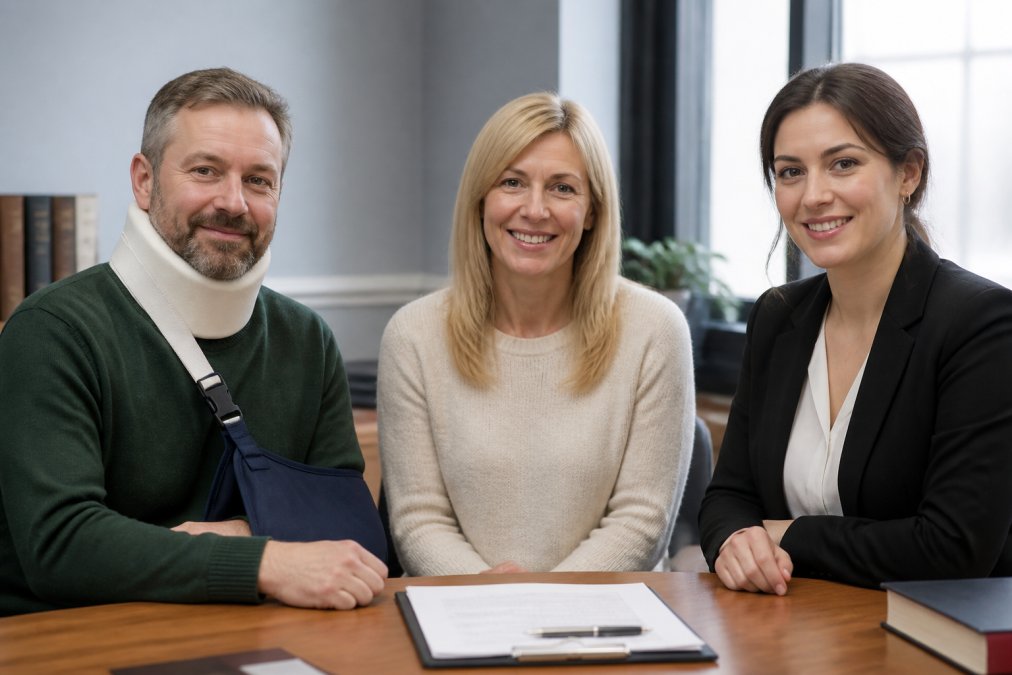
 Professional solicitor in modern Glasgow office reviewing documents with a client across a desk, both examining paperwork and discussing claim details
Scotland Claims Injury Lawyers operates exclusively on this basis. You don't pay upfront legal fees or if your claim is unsuccessful. You only pay if you win, and crucially, you pay nothing to us. We recover our costs from the defendant's insurer as part of the settlement, and you keep 100% of your compensation. This differs fundamentally from competitors who charge a success fee, taking a percentage of your settlement before you see it.
This arrangement removes a major barrier to claiming. Many people with legitimate injuries don't pursue compensation because they can't afford solicitor fees. No Win No Fee changes that equation. Your financial risk is zero.
When you contact a No Win No Fee solicitor, they assess your claim's merits honestly. If they believe you have a reasonable prospect of success, they'll take the case. If they think your claim is weak, they'll tell you directly rather than pursuing an unwinnable case.
Best For
No Win No Fee is ideal for anyone with a legitimate whiplash injury who's uncertain whether claiming is worthwhile. There's no financial downside to getting professional advice.
Why Scottish Whiplash Claims Differ from the Rest of the UK 🏴
Scotland operates under a different legal system from England and Wales, affecting whiplash claims significantly.
In 2021, the UK Government introduced whiplash reforms that dramatically restricted compensation in England and Wales. The reforms introduced a fixed tariff: minor whiplash injuries now receive a maximum of £750 regardless of individual circumstances. Scotland was not affected by these reforms. Scottish whiplash claims continue to be assessed individually using the Judicial College Guidelines, allowing full compensation based on injury severity and impact. This is a substantial advantage for Scottish claimants.
Mike Benner, Chief Executive at the Association of Personal Injury Lawyers, stated: "The reforms to whiplash claims have had a devastating impact on access to justice for injured victims of negligence and failed to reduce the cost of motor premiums as the public were promised they would." This sentiment reflects frustration about the English and Welsh system, which doesn't apply in Scotland.
A Scottish claimant with moderate whiplash recovering over six months might receive £3,500 in compensation. The equivalent claimant in England would receive substantially less under the tariff system. In Scotland, your individual circumstances, recovery period, and functional impact determine your compensation, not an arbitrary cap.
The moments following a road traffic accident are critical. The decisions you make and information you gather will significantly impact any future claim.
 Person at roadside taking photographs of vehicle damage after a road traffic accident, with emergency services visible in the background and overcast Scottish weather
First priority: Safety and medical attention. If anyone is injured, call 999 immediately. Move to a safe location away from traffic. Don't attempt to move anyone with a suspected spinal injury. Seek medical attention even if you feel relatively fine. Whiplash symptoms often develop over hours or days.
Report the accident. Contact the police if there are injuries or significant damage. Get the incident report number for your insurance claim and any subsequent legal claim. The police report provides an independent account valuable if liability is later disputed.
Exchange details. Get the other driver's full name, address, phone number, email, vehicle registration, insurance company name, and policy number. Get passenger details too. Stick to factual statements about what happened; don't admit fault or apologise.
Document the scene. Take photographs of vehicle damage from multiple angles, the accident scene, road conditions, traffic signals, and any visible injuries. Get witness names and contact details. Witness testimony can be crucial if liability is disputed.
Notify your insurer. Contact your car insurance company within the timeframe specified in your policy (usually within 30 days). Provide factual information about the accident without speculating or accepting liability.
Seek medical advice. Visit your GP or accident and emergency department. Describe your symptoms accurately. Keep all medical documentation, appointment letters, prescriptions, and test results. This creates an official record linking your symptoms to the accident.
Contact a solicitor. Within days or weeks of the accident, contact a personal injury solicitor. Early legal advice protects your interests and ensures you understand your rights. Scotland Claims Injury Lawyers offers free initial consultations on a No Win No Fee basis.
Conclusion
Whiplash injuries sustained in road traffic accidents deserve proper compensation. The Scottish legal system recognises this through the Judicial College Guidelines, which allow full assessment of your individual circumstances rather than arbitrary caps. A whiplash claim calculator provides a realistic starting point for understanding what your injury might be worth, but it's not a substitute for professional legal advice.
Scotland Claims Injury Lawyers specialises in helping injured parties in Glasgow and across Scotland pursue compensation on a No Win No Fee basis. You keep 100% of your settlement; we don't charge a success fee like competitors. Our team assesses your claim honestly, gathers the medical evidence needed to support it, and negotiates firmly on your behalf. Get in touch today for a free consultation and impartial advice about your whiplash claim.
===
| Injury Severity |
Recovery Period |
Typical Compensation Range |
Key Factors |
| Minor |
Under 3 months |
£1,000-£2,500 |
Quick recovery, minimal disruption |
| Moderate |
3-12 months |
£2,500-£5,000 |
Ongoing treatment, time off work |
| Severe/Chronic |
12+ months |
£8,000-£12,000+ |
Long-term symptoms, significant impact |
Frequently Asked Questions
How is whiplash compensation calculated in Scotland?
Whiplash compensation is calculated using the Judicial College Guidelines, which set ranges for general damages based on injury severity and recovery period. Special damages cover financial losses like medical costs and lost wages. A whiplash claim calculator estimates your payout by assessing recovery duration, symptom impact, and out-of-pocket expenses. Minor injuries recovering within three months typically attract £1,000 to £2,500, while moderate injuries spanning three to twelve months range from £2,500 to £5,000. Severe cases with lasting symptoms can exceed £8,000. Your solicitor will apply these guidelines to your specific circumstances.
What is the average payout for whiplash in the UK in 2026?
In Scotland, average payouts depend on injury severity. Minor whiplash injuries typically receive £1,000 to £2,500 in compensation. Moderate injuries lasting three to twelve months average £2,500 to £5,000. Severe or chronic whiplash cases can result in £8,000 to £12,000 or more. These figures reflect the Judicial College Guidelines used by Scottish courts. Unlike England and Wales, Scotland was not affected by 2021 whiplash reforms, allowing claimants to receive full compensation without tariff caps. Your actual payout will depend on liability, medical evidence, and your specific recovery timeline.
How long do I have to make a whiplash claim in Scotland?
You have three years from the date of the accident to make a personal injury claim in Scotland under the Prescription and Limitation (Scotland) Act 1973. This deadline is crucial—claims submitted after three years will typically be rejected by the court. Most straightforward whiplash claims settle within four to nine months once submitted. If liability is disputed or your symptoms persist, the process may take eighteen months or longer. Acting quickly helps preserve evidence and ensures your claim progresses smoothly within the time limit.
Do I need a solicitor to claim for whiplash in Glasgow?
Whilst you can pursue a claim independently, legal representation significantly improves your outcome. A solicitor gathers medical evidence, negotiates with insurers, and ensures you receive fair compensation under the Judicial College Guidelines. Many solicitors, including those in Glasgow, operate on a No Win No Fee basis, meaning you pay nothing upfront and retain 100% of your compensation if successful. This removes financial risk and provides expert guidance through a complex process. Having professional support also deters insurers from undervaluing your claim.