The role of expert witnesses in scottish legal claims
TL;DR:
- Expert witnesses in Scottish legal disputes provide independent opinions that assist courts in interpreting complex evidence beyond a layperson’s understanding. Their primary duty is to the court, requiring complete neutrality, disclosure of all relevant information, and adherence to professional standards, with breaches risking exclusion or sanctions. They add value by clarifying technical facts, evaluating damages, and fostering early settlement through joint expert meetings, ultimately influencing case outcomes significantly.
An expert witness is a qualified specialist who provides independent, impartial opinions to help courts interpret complex technical, scientific, or financial evidence that falls beyond the understanding of a layperson. In Scottish legal disputes, the role of expert witnesses is not simply to support one side. Their primary function is to assist the court in reaching a fair and informed verdict. Whether your case involves a personal injury, a workplace accident, or a disputed valuation, expert testimony can be the difference between a successful claim and a failed one.
What are the main duties of expert witnesses?
The overriding duty of an expert witness is to the court, not to the party who instructed or paid them. This principle is codified in the Civil Procedure Rules and reinforced by the Ikarian Reefer principle, which mandates that experts produce independent opinions uninfluenced by the instructing party. That independence is not optional. It is a legal requirement.
Expert witness duties include a specific set of obligations that every appointed specialist must follow:
- Remain neutral and objective. Experts must not act as advocates for the party who instructed them.
- Disclose all relevant information. This includes evidence that may be damaging to the instructing party’s case. Full disclosure is required to maintain credibility and admissibility.
- Limit testimony to their area of expertise. An orthopaedic surgeon cannot offer opinions on psychiatric injury, for example.
- Disclose all material instructions. Under the Civil Procedure Rules, instructions given to an expert are not protected by legal privilege and must be disclosed to the court.
- Acknowledge gaps in knowledge. Experts must communicate any limitations in their experience at the outset, not under cross-examination.
Breaching these duties carries real consequences. A court can disregard expert testimony entirely, impose sanctions, or exclude the expert from proceedings. The Ikarian Reefer standards exist precisely because courts have seen what happens when experts act as hired advocates rather than neutral advisers.
Pro Tip: If you are instructing an expert for your claim, ask them directly whether they have testified in court before and whether they have received formal training on expert witness conduct. An expert who has never been cross-examined may struggle under pressure.

How do expert witnesses differ from lay witnesses?
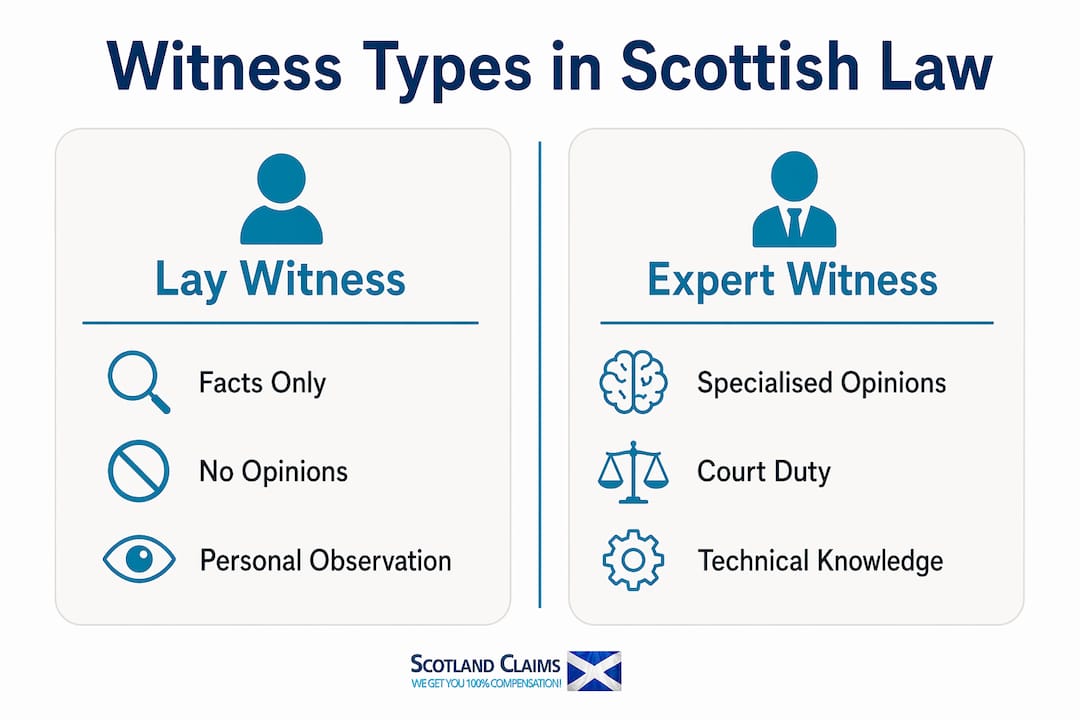
Lay witnesses and expert witnesses serve fundamentally different purposes in court. Understanding the distinction helps you appreciate why expert testimony carries so much weight in complex disputes.
A lay witness testifies only about facts they personally observed. They cannot offer opinions or draw conclusions. A bystander who saw a road traffic accident can describe what they saw. They cannot tell the court whether the road surface was defective or whether the driver’s reaction time was impaired.
An expert witness, by contrast, provides specialised opinions beyond the understanding of laypersons, which helps courts navigate complex evidence. That distinction is critical. In a personal injury claim involving a back injury, a lay witness cannot explain the biomechanical forces involved or the long-term prognosis. A consultant spinal surgeon can.
The table below sets out the key differences clearly.
| Feature |
Lay Witness |
Expert Witness |
| Basis of testimony |
Personal observation of facts |
Specialised knowledge and analysis |
| Can offer opinions |
No |
Yes, within their area of expertise |
| Qualifications required |
None |
Professional credentials and domain expertise |
| Duty to the court |
To tell the truth |
To remain independent and impartial |
| Typical role in injury claims |
Describes the accident scene |
Assesses injury severity, causation, or prognosis |
The practical implication for you as a claimant is straightforward. Lay witnesses support the factual narrative of your case. Expert witnesses give that narrative technical credibility. In Scottish personal injury claims, both matter, but expert testimony frequently determines how damages are quantified.
How do expert witnesses add value in scottish legal disputes?
Expert witnesses add value at every stage of a legal dispute, not just at trial. Their influence begins the moment they are instructed and can shape the entire trajectory of a case.
Expert evidence is integral to personal injury claims and complex technical disputes in Scottish courts. Here is how that value materialises in practice:
- Clarifying technical facts. A medical expert can explain the causal link between an accident and a specific injury, which is often the central dispute in personal injury claims.
- Quantifying damages. Experts assess the financial impact of an injury, including loss of earnings, future care costs, and the effect on quality of life.
- Narrowing disputes in mediation. Expert input in mediation helps narrow disputes through objective data, facilitating early settlements and potentially avoiding full trials.
- Producing joint statements. Before trial, opposing experts often meet to identify agreed points. These joint statements can dramatically reduce the scope of a trial and encourage realistic settlement offers.
- Withstanding voir dire scrutiny. In court, opposing counsel can challenge an expert’s credentials through a process called voir dire. A well-prepared expert who survives credential scrutiny carries far greater weight with the judge.
The role of evidence in injury claims in Scotland is well-established, and expert testimony sits at the centre of that evidentiary framework. A well-prepared expert does not just explain facts. They give the court a framework for understanding what those facts mean.
Pro Tip: Ask your solicitor whether a joint expert meeting has been scheduled before trial. If both sides’ experts have already agreed on key medical findings, your case may settle without ever reaching a courtroom.
What qualifications and standards are required for expert witnesses in scotland?
Not every specialist qualifies as a credible expert witness. Courts in Scotland expect a specific combination of domain expertise, procedural knowledge, and professional conduct. Selecting the wrong expert can undermine an otherwise strong claim.
The following standards apply to expert witnesses operating in Scottish legal proceedings:
- Professional credentials. Experts must hold recognised qualifications in their field. A medical expert in a personal injury case should typically be a consultant with active clinical practice, not a retired generalist.
- Training on legal procedures. Comprehensive training on legal processes and expert witness conduct is required for experts to defend their opinions effectively during cross-examination. Professional bodies such as RICS mandate this for their members acting as expert witnesses.
- Disclosure of conflicts of interest. Any prior relationship with the instructing party, financial interest in the outcome, or professional connection to the opposing side must be declared upfront.
- Thorough and complete reports. Expert reports must cover all relevant information, including evidence that may favour the opposing side. Honest reporting of potentially damaging evidence is required to avoid credibility loss and the risk of testimony exclusion.
- Transparency about limitations. Experts must disclose any limits in their expertise to both the instructing party and the court at the outset. Discovering those limits under cross-examination is far more damaging.
The expert assessment process in claims in Scotland follows these standards closely. Solicitors who regularly handle personal injury claims will have established relationships with credible, court-tested experts. That network matters as much as the expert’s qualifications on paper.
Key takeaways
Expert witnesses are the cornerstone of complex legal disputes in Scotland, providing independent, court-focused opinions that determine how evidence is understood and how damages are assessed.
| Point |
Details |
| Duty to the court |
Experts owe their primary obligation to the court, not the party who instructed them. |
| Impartiality is non-negotiable |
The Ikarian Reefer principle requires independent, uninfluenced opinions or testimony may be disregarded. |
| Expert vs lay witness |
Lay witnesses state facts; expert witnesses provide qualified opinions and technical analysis. |
| Value beyond the courtroom |
Joint expert meetings and mediation input can narrow disputes and encourage early settlement. |
| Qualifications matter |
Credible experts hold professional credentials, disclose conflicts, and have training in legal procedures. |
Why independent experts are the unsung heroes of scottish claims
I have reviewed a great many personal injury cases over the years, and the pattern is consistent. Cases that succeed cleanly almost always have one thing in common: an expert who was genuinely independent and thoroughly prepared.
The mistake I see claimants make most often is assuming that an expert is there to support their version of events. That is not how it works, and it is not how it should work. A good expert who acknowledges weaknesses in your case is far more credible to a judge than one who appears to be advocating for you. Courts notice the difference immediately.
What surprises many people is how much of a case is resolved before it ever reaches a courtroom. When two well-prepared experts from opposing sides meet and produce a joint statement, they often agree on more than either party expected. That agreement narrows the dispute, and a narrower dispute is far easier to settle. I have seen cases that looked destined for a lengthy trial resolve within weeks of a joint expert meeting.
Scottish jurisprudence is also evolving in its expectations of experts. Judges are increasingly willing to scrutinise expert reports for signs of advocacy, and they will say so in their judgements. The standard is rising, and claimants benefit when their solicitors understand that.
— Roger
How Scotlandclaims supports claims that depend on expert evidence
If your claim involves a personal injury in Scotland, the quality of expert evidence will shape your outcome. Scotlandclaims connects you with specialist injury lawyers who work with credible, court-tested experts across medical, engineering, and financial disciplines.
For road traffic accident injuries where you are not at fault, you keep 100% of your compensation. For all claim types - including slips, trips, and workplace accidents - Scotland Claims deducts no success fee whatsoever, meaning you keep 100% of your compensation. Most other large firms charge up to 20% including VAT.
Start with a no win no fee arrangement and pay nothing unless your claim succeeds. Use the compensation calculator to estimate what your claim may be worth before you speak to anyone.
FAQ
What is the primary role of an expert witness in court?
An expert witness provides independent, impartial opinions to help the court understand complex technical, scientific, or financial evidence. Their overriding duty is to the court, not to the party who instructed them.
Can an expert witness be challenged in scottish proceedings?
Yes. Opposing counsel can scrutinise an expert’s credentials and suitability through a process called voir dire before their testimony is accepted. Poor preparation or undisclosed conflicts of interest can result in testimony being excluded.
What is the ikarian reefer principle?
The Ikarian Reefer principle establishes that expert witnesses must produce independent opinions uninfluenced by the instructing party, with their sole duty owed to the court. Breaching this standard can lead to sanctions or disregarded testimony.
How do expert witnesses differ from ordinary witnesses?
Lay witnesses can only testify about facts they personally observed and cannot offer opinions. Expert witnesses provide specialised analysis and qualified opinions within their area of expertise, which is why they are permitted to draw conclusions that lay witnesses cannot.
Do expert witnesses help settle cases before trial?
Yes. Experts often attend pre-trial joint meetings with opposing experts to identify agreed points and produce joint statements. This process frequently narrows the dispute and encourages realistic settlement negotiations, avoiding the need for a full trial.
Recommended