Taxi accident claim Scotland: how to start and protect it

Yes, you can claim compensation for a taxi accident in Scotland if the driver, another motorist, or an operator was at fault. Court action must generally be raised within three years under the Prescription and Limitation (Scotland) Act 1973, so treating the clock as running from day one matters more than most people realise.
Protect your position now:
- Get medical attention and keep every record, even for injuries that feel minor at first.
- Report the incident to police if there’s any dispute, injury, or uninsured driver involved.
- Photograph the scene, the taxi’s registration and operator details, and note witness contacts before memories fade.
- Write down the date, time and how the crash happened while it’s fresh.
- Speak to a specialist solicitor early, particularly if symptoms appeared later, since discoverability can shift your three-year deadline.
Key Takeaways
A taxi accident claim in Scotland must generally be raised within three years, and early evidence collection determines both the strength of liability and the final compensation figure.
| Point |
Details |
| Three-year deadline applies |
Court action must usually start within three years under the Prescription and Limitation (Scotland) Act 1973. |
| Discoverability can shift the clock |
If symptoms appear later, the countdown may start from when you realised the injury was linked to the accident. |
| MIB covers uninsured or untraced drivers |
Claims proceed through the Motor Insurers’ Bureau when the taxi driver lacked valid cover or can’t be found. |
| Contributory negligence reduces, not blocks |
Shared blame lowers compensation proportionately rather than defeating the claim entirely. |
| Scotland Claims Injury Lawyers offers 100% compensation |
No success fee is deducted from your settlement, unlike firms charging up to 20% including VAT. |
Table of Contents
Timeframe and process for notifying the taxi company and insurer about the accident
There’s no fixed statutory deadline for telling a taxi firm or insurer you’ve been injured, but delay works against you in practice. Insurers expect prompt notification, and taxi operators often have their own internal reporting windows, sometimes as short as 24 to 48 hours for driver incident logs.
Notify the taxi operator as soon as reasonably possible, ideally before you leave the scene or on the same day. Ask for the driver’s name, licence badge number, the operator’s name, and their insurance details. Most licensed taxis in Scotland operate under commercial hire and reward insurance, which differs from standard private car cover, so getting the correct policy reference matters.
Once you’ve had initial medical treatment, your solicitor typically sends a letter of claim to the taxi operator and its insurer setting out what happened and the injuries sustained. This starts the formal claims process and puts the insurer on notice to investigate. Insurers usually acknowledge a letter of claim within 21 days and aim to confirm liability within three months under the pre-action protocol used across Scotland, though contested cases run longer.
Waiting weeks or months to report the accident doesn’t bar your claim outright, but it gives an insurer grounds to question your credibility or argue that evidence has degraded. A specialist solicitor can manage this notification on your behalf, which removes the pressure of chasing an insurer while you’re still recovering.
What happens if the taxi was uninsured or the driver can’t be traced?
Every licensed taxi in Scotland must carry valid hire and reward insurance, but gaps happen: a lapsed policy, a driver operating outside their licence conditions, or a hit-and-run where the vehicle is never identified. In these situations, your claim doesn’t disappear. It moves to the Motor Insurers’ Bureau (MIB).
The MIB exists specifically to compensate victims of uninsured or untraced drivers, funded by a levy on the UK’s motor insurance industry. Scottish government guidance confirms that claims can be made through the MIB when the at-fault driver was uninsured, using much the same evidence base as a standard insurer claim: police reports, medical records, and details of the vehicle involved.
Untraced driver claims carry an extra hurdle. Without an identified vehicle or registered keeper, the MIB relies heavily on independent evidence: CCTV, dashcam footage from your own vehicle or a nearby taxi, and witness statements taken quickly after the event. This is where early evidence gathering earns its keep, since an untraced-driver claim built entirely on memory months later is a much harder case to argue.

MIB claims also tend to move more slowly than standard insurer claims because the Bureau investigates from a colder start. A solicitor experienced in these applications knows the documentation the MIB expects and can push the process rather than letting it stall.
Does contributory negligence reduce your compensation?
Contributory negligence can reduce, but rarely eliminates, what you’re awarded. It applies where you bear some responsibility for the accident or for worsening your own injuries, and Scottish courts and insurers reduce compensation by a percentage that reflects your share of the blame.
A common example in taxi cases: a passenger injured in a collision who wasn’t wearing a seatbelt. Even where the taxi driver caused the crash entirely, failing to belt up can see compensation reduced, often by a moderate percentage depending on how much the injury would have been lessened had a belt been worn. Similarly, a pedestrian struck by a taxi while crossing away from a designated crossing point might face a partial reduction if their own actions contributed to the incident.
The key point is that contributory negligence is proportionate, not binary. It’s an insurer’s standard tactic to raise contributory negligence early, sometimes as a negotiating position rather than a genuinely strong argument, so don’t assume an accusation of shared blame means your claim is weak.
This is precisely the kind of dispute where evidence quality decides the outcome. Dashcam footage, CCTV, and witness accounts that show exactly how the accident unfolded can knock down an inflated contributory negligence argument before it gains traction. A solicitor reviewing your case early can usually spot whether an insurer’s contributory negligence claim has real substance or is simply a tactic to shrink your settlement.
What if the taxi driver denies fault?
Disputed liability is common in taxi accident claims, particularly where there’s no independent witness and it comes down to one account against another. The taxi driver, or more often their insurer, may simply deny responsibility outright or argue a different version of events.
Don’t be discouraged if this happens. It’s a standard opening position, not a verdict. Your solicitor will gather corroborating evidence: any CCTV from nearby shops, traffic cameras, dashcam footage from other vehicles, and independent witness statements. Police reports carry particular weight here, so if officers attended the scene, request the reference number and, where relevant, a copy of any collision report.
Medical evidence also helps establish causation even when liability is contested, since the pattern and severity of your injuries can support your account of how the impact occurred. If the insurer continues to deny liability after reviewing the evidence, your solicitor can raise court proceedings. Most disputed cases still settle before reaching a proof hearing once both sides see the strength of the evidence, but knowing that court action remains a genuine option changes the negotiating dynamic considerably.
The personal injury court process in Scotland exists precisely for cases where an insurer won’t move on liability voluntarily. Having a solicitor who’s prepared to litigate, not just negotiate, tends to produce fairer settlement offers even in cases that never actually reach a courtroom.
Common delays in Scotland taxi accident claims and how to avoid them
Taxi accident claims tend to stall for a handful of predictable reasons, and most are avoidable with the right approach from the outset.
Slow evidence gathering is the biggest culprit. CCTV footage from shops, buses, and traffic cameras is often overwritten within 30 days, sometimes sooner. If a solicitor isn’t instructed until weeks after the accident, that footage may already be gone.
Identifying the correct defender causes delay in taxi cases specifically, because liability might sit with the driver personally, the operator, a private hire firm, or a combination, depending on the employment and licensing arrangement. Sorting this out takes time if it isn’t addressed early.
Ongoing medical treatment genuinely justifies some delay, since a claim’s value depends on knowing the full extent of your recovery, or lack of it. Settling too early, before you know whether an injury will resolve fully, risks accepting compensation that undervalues a lasting problem.
Insurer tactics, including slow responses, repeated requests for further information, and lowball early offers, remain a persistent source of delay across the industry. A solicitor who deals with these insurers regularly recognises stalling tactics and knows how to keep a claim moving rather than letting it drift.
How much compensation can you expect for a taxi accident claim?
Compensation in Scotland splits into two categories: general damages for pain, suffering and loss of amenity, and special damages (sometimes called pecuniary loss) for actual financial costs like lost earnings, medical expenses, and travel to appointments.
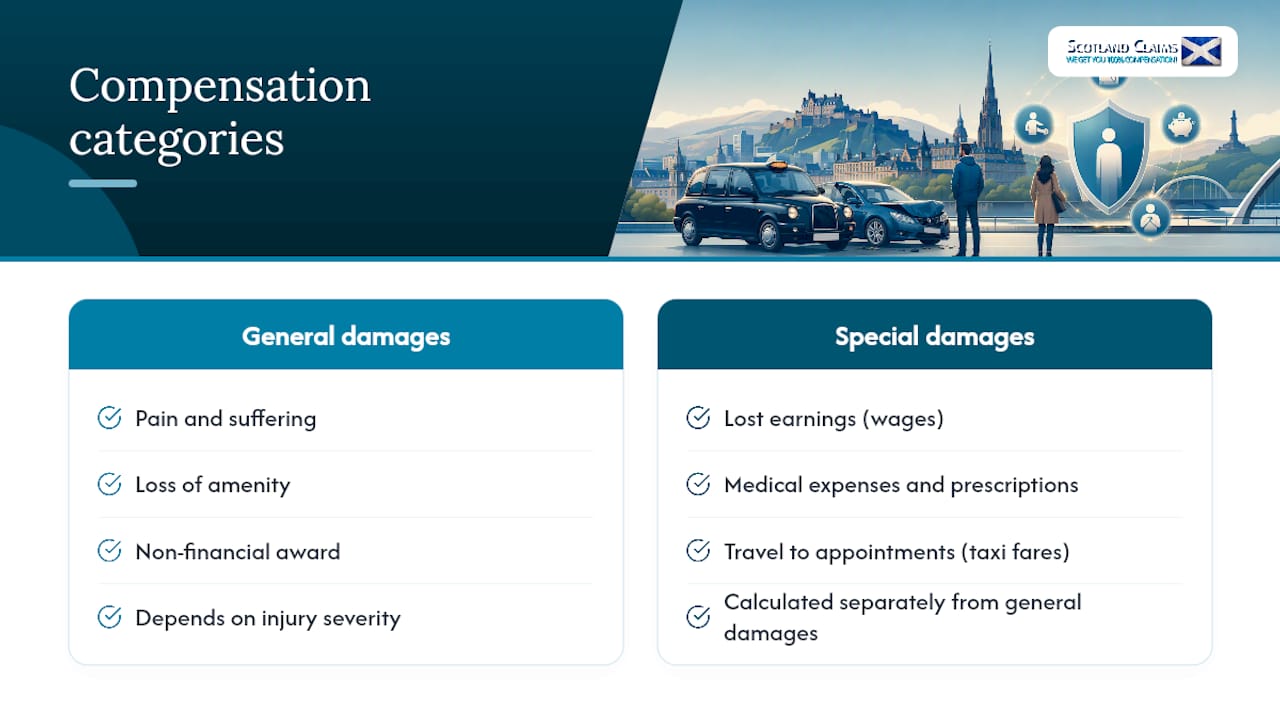
The amount depends entirely on injury severity and how long recovery takes. A straightforward whiplash injury that resolves within a few months typically attracts a lower award than a fracture requiring surgery or an injury with lasting effects on mobility or work capacity. Special damages are calculated separately and can include taxi fares to medical appointments, prescription costs, and any wages lost while unable to work, all of which need receipts or payslips to evidence properly.
There’s no single “typical” figure for a taxi accident claim because injuries vary so widely between a minor soft-tissue injury and a serious fracture. What determines your award is medical evidence of the injury’s severity, its impact on daily life, and documented financial losses, not the fact that a taxi was involved rather than another type of vehicle. This is why building a proper evidence file, medical records, receipts, and a diary of how the injury affected you, matters more to your final settlement than almost anything else.
Why timing and local knowledge matter in Scottish claims
Scotland’s three-year limitation period isn’t a formality. I’ve seen how the discoverability rules under the 1984 Act genuinely change when that clock starts for symptoms that surface later, but relying on that exception is a gamble, not a plan. Get advice early.
Start your taxi accident claim with a Scotland-focused solicitor
Scotland Claims Injury Lawyers handles road traffic injury claims, including taxi accidents, for passengers, drivers and pedestrians hurt through someone else’s fault. Where most big-name firms take up to 20% of your settlement including VAT as a success fee, we don’t take a penny from your compensation. You get 100% of what you’re awarded, with no upfront costs and nothing to pay if the claim doesn’t succeed.
That structure matters most in a taxi claim, where liability can sit with the driver, the operator, or an insurer, and working out who to pursue takes real Scottish legal experience. Our free assessment reviews your accident details and gives you a clear answer on whether you have a claim worth pursuing, with no obligation attached. If you’d rather see a likely figure first, try our compensation calculator before you call.
This article is general information, not a substitute for advice from a qualified lawyer. Consult a qualified legal professional about your own circumstances before acting on anything here.
Sources
FAQ
Can I claim if I was a passenger in the taxi that crashed?
Yes. Passengers injured in a taxi accident can usually claim against the taxi driver, the operator, or their insurer, regardless of who caused the crash.
How long do I have to make a taxi accident claim in Scotland?
You generally have three years from the date of the accident under the Prescription and Limitation (Scotland) Act 1973, though discoverability rules can adjust this if injuries emerged later.
What if the taxi driver was uninsured?
Your claim proceeds through the Motor Insurers’ Bureau, which compensates victims of uninsured or untraced drivers using similar evidence to a standard claim.
Will I lose money if I don’t win my claim?
Not with Scotland Claims Injury Lawyers. We work on a No Win No Fee basis, so there’s nothing to pay if your claim is unsuccessful, and you keep 100% of your compensation if it succeeds.
Does it matter if I wasn’t wearing a seatbelt?
It can. A failure to wear a seatbelt may lead to a finding of contributory negligence, reducing your compensation by a percentage rather than eliminating the claim.
Recommended