20%/10%/2.5% and a no fee option for solicitor deductions in Scotland

Under a success-fee agreement, the only solicitor charge you can face is the success fee itself, capped at 20% of the first £100,000, 10% up to £500,000, and 2.5% above that, inclusive of VAT. Outlays such as medical reports, court dues and expert fees cannot be charged to you under section 6(2) of the 2018 Act, except insurance premiums. Solicitor advocate fees are normally treated as outlays too, so they typically don’t touch your damages at all.
TL;DR:
- Success fees are capped at 20% for the first £100,000, 10% for amounts between £100,000 and £500,000, and 2.5% above that, all inclusive of VAT.
- Outlays like medical reports, court dues, and expert fees are not charged to clients, except for after-the-event insurance premiums, and solicitor advocate fees are typically recovered from the defender.
- Deductions from your settlement follow a specific order: judicial expenses first, success fee second, ATE premiums third, and benefits or NHS charges last; errors usually involve charges outside the permitted caps or outlays charged directly to claimants.
- Solicitor advocate fees are generally recovered from the opposing insurer as expenses, not deducted from claimants’ damages, and must be entered as outlays in court accounts.
- Understanding the funding model and asking your solicitor for detailed, written breakdowns can help prevent incorrect deductions and ensure transparency.
Scotland Claims Injury Lawyers
scotlandclaims.co.uk
Keep More Of Your Compensation
Scotland Claims Injury Lawyers connects people in Scotland with specialist injury lawyers through a No Win No Fee arrangement.
Explore your claim optionsTable of Contents
Which charges may lawfully be deducted from your award
The law is specific here, and it works in bands rather than one flat percentage. Under the Success Fee Agreements (Scotland) Regulations 2020, personal injury success fees are capped at:
- 20% on the first £100,000 of damages recovered
- 10% on the portion between £100,000 and £500,000
- 2.5% on anything above £500,000
Each cap is inclusive of VAT, so your solicitor cannot add VAT on top of the percentage quoted to you.
Outlays sit outside this. Section 6(2) of the 2018 Act makes the solicitor’s firm liable for outlays in a personal injury success-fee agreement, not the client, with one exception: after-the-event (ATE) insurance premiums, which can still be deducted. Employment tribunal claims and other civil matters carry different capped bands under the same regulatory framework, so a percentage quoted for a workplace grievance won’t match the personal injury figure above. Anyone checking their own paperwork should treat the banded structure as cumulative, not a single number applied to the whole sum.
How solicitor advocate fees are treated in judicial accounts of expenses
Solicitor advocate fees are usually recovered from the losing side’s insurer, not deducted from your compensation. The Auditor of the Court of Session has directly addressed this point.
Fees claimed in respect of work carried out by solicitor advocates should be entered as outlays in judicial accounts of expenses.
That single sentence changes how a lot of claimants read their paperwork. Practically, it means:
- Solicitor advocate fees appear as an outlay line, not as part of the solicitor’s own professional charge.
- The Act of Sederunt (Fees of Solicitors in the Sheriff Appeal Court) 2015 allows reasonable advocate and solicitor advocate fees to be taxed and recovered as outlays.
- Those sums are normally recovered from the defender as part of judicial expenses, not carved out of your damages.
The catch is that “reasonable” is doing real work in that sentence. The Auditor scrutinises time records for advocacy work billed in quarter-hour blocks, and fees can be disallowed where a solicitor merely sat behind counsel rather than doing substantive work, according to Scottish Legal Aid Board guidance.
How deductions appear on your settlement and the order of deductions
Money doesn’t leave your award in one lump. It follows a sequence, and understanding that order helps you sanity-check the final cheque.
- Judicial expenses first. These are recovered from the defender’s insurer, covering court fees, solicitor advocate outlays, and most professional costs.
- Success fee, if applicable. Only deducted where you signed a success-fee agreement, and capped as set out above.
- ATE premium, if one was taken out. This is the sole outlay a claimant can be charged under section 6(2).
- Benefit recoveries and NHS charges. Handled separately by the Compensation Recovery Unit and settled before the final payment reaches you.
Compare that with an insurer-funded pre-action protocol case, where the insurer pays the solicitor directly and the claimant keeps the full £80,000. That contrast is exactly why some firms can promise you keep everything and others cannot; it depends entirely on which funding model applies to your claim, not on how good the solicitor is.
What to ask your solicitor and what written documents to demand
Before you sign anything, ask these questions and get the answers in writing:
- Is this a success-fee agreement, or is my solicitor paid by the other side’s insurer?
- What percentage applies, and is that figure inclusive of VAT?
- Will any outlays be charged to me directly?
- Is there an ATE insurance premium, and how and when is it deducted?
A written success-fee agreement is a statutory requirement, not an optional courtesy, and early disclosure of fees and outlays protects both sides from disputes later.
Pro Tip: Request a full cash account before you accept the final cheque, and insist your solicitor walks you through every deduction line by line. If a figure doesn’t match what you were told at the outset, ask for it in writing before you sign off.
If something looks wrong: how to check the law and where to complain
Don’t take a deduction on trust if the numbers don’t add up. Start with the primary sources:
- legislation.gov.uk for the 2018 Act and SSI 2020/110, which set the caps and the outlay prohibition.
- The Act of Sederunt governing sheriff and appeal court fees, for how accounts of expenses are structured.
- ScotCourts for procedural guidance on taxation and appeals.
If a deduction still looks wrong, you can ask for a cash account, request taxation of expenses through the Auditor, or raise a complaint with the Scottish Legal Complaints Commission, the statutory body for grievances against solicitors. Independent legal advice is worth seeking if the sums involved are significant.
Publisher perspective: how Scotland Claims Injury Lawyers approaches fees and client protection
That approach doesn’t remove the value of asking the questions above; it just changes the answer you should expect to hear.
Act of Sederunt rules for sheriff and appeal courts explained
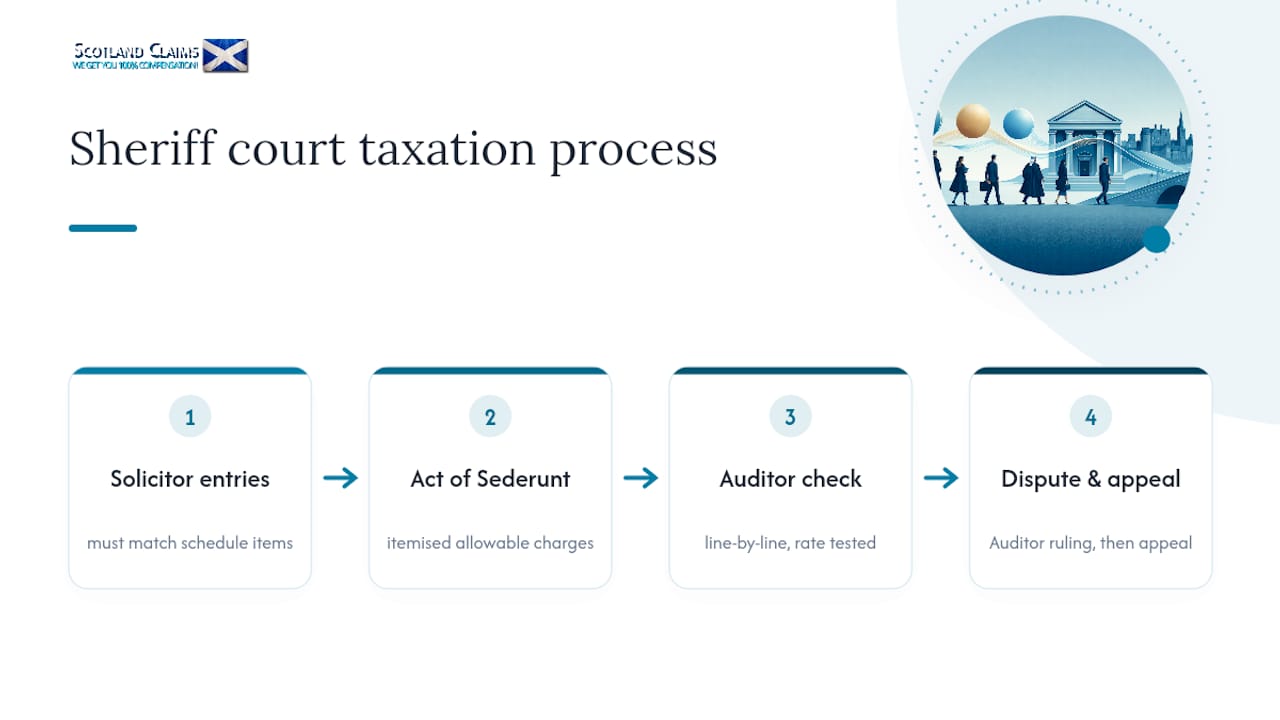
Accounts of expenses in Scotland are taxed against detailed fee schedules set out in successive Acts of Sederunt, not against whatever a solicitor decides to charge. The 2015 Act of Sederunt governs fees in the Sheriff Appeal Court specifically, while related instruments cover the sheriff court and Court of Session.
These schedules itemise exactly what can be claimed: instruction fees, correspondence, attendance at hearings, copying costs, and fees for instructing counsel or a solicitor advocate. The 2014 amendment to the sheriff court fee schedule shows how granular this gets, right down to per-page copying charges and travel time for attending court.
When a case goes to taxation, the Auditor checks the account line by line against these schedules. A solicitor can’t simply invoice a round figure; every entry has to correspond to an allowable item, priced at the rate the Act of Sederunt permits. This is what stops judicial expenses becoming a blank cheque against the losing party, and it’s also why solicitor advocate fees, discussed earlier, get folded into this same taxed framework as outlays rather than professional fees.
For claimants, the practical upshot is that most of the fee detail in your case gets fought out between solicitors and the Auditor, well away from your own settlement cheque. Where a dispute arises over whether an item was reasonably incurred, either side can ask the Auditor to rule, and that ruling can itself be appealed within the court structure.
Allowable and non-allowable deductions under Scottish law
Split the picture into two columns and it becomes far easier to check your own paperwork.
Allowable deductions from your damages under a success-fee agreement:
| Deduction |
Basis |
| Success fee |
Capped at 20% / 10% / 2.5% by band, inclusive of VAT |
| ATE insurance premium |
Explicitly excepted under section 6(2) |
Non-allowable deductions (must not be charged to you):
| Item |
Why it’s excluded |
| Medical report fees |
Classed as an outlay under section 6(2) |
| Court dues and filing fees |
Classed as an outlay |
| Solicitor advocate fees |
Normally treated as an outlay, recoverable from the defender |
| Expert witness fees |
Classed as an outlay |
| VAT charged separately on top of the capped percentage |
The cap is inclusive of VAT by law |
The distinction that trips people up most is the difference between a “success fee” and an “outlay”. A success fee is the solicitor’s own reward for winning, and it’s the one thing the law allows coming from your damages, within the capped bands. An outlay is a third-party cost the solicitor’s firm has already paid on your behalf, and the 2018 Act makes the firm absorb that cost rather than pass it back to you. If your final statement shows a deduction labelled as anything other than the success fee or an ATE premium, that’s the moment to ask questions.
How solicitor deductions affect your net settlement
The gap between your headline award and what lands in your bank account comes down almost entirely to which funding model applies. Two claimants awarded identical £60,000 settlements can walk away with very different net figures.
Under an insurer-funded pre-action protocol claim, the losing side’s insurer pays the claimant’s solicitor directly, and the claimant keeps the full £60,000. Neither model is unlawful, and neither is automatically better; it depends on which route your solicitor uses and, sometimes, on the value and complexity of your claim.
What should worry you is a deduction that doesn’t fit either model, such as an outlay charged directly to you outside the ATE exception, or a success fee calculated above the statutory cap. Those are the errors worth challenging, and they’re rarer than claimants often assume, precisely because the 2018 Act was designed to close that gap. Where a claimant does end up worse off than expected, it’s usually because nobody explained at the outset which funding model was in play, not because the solicitor broke any rule.
How deductions differ across personal injury and other claim types
Personal injury claims sit under their own capped regime, and that matters because other areas of Scottish civil law use different bands entirely. The same Success Fee Agreements (Scotland) Regulations 2020 that set the 20% / 10% / 2.5% structure for personal injury also set separate, generally lower caps for other types of civil litigation and for employment tribunal claims.
Commercial disputes, for instance, don’t carry the same outlay protection that section 6(2) gives personal injury claimants. A business pursuing a commercial claim under a success-fee agreement may still be liable for outlays such as expert accountancy reports or specialist valuation fees, because the statutory shield in the 2018 Act is aimed squarely at personal injury and a small number of other protected claim types.
That’s a meaningful distinction if you’ve seen success-fee terms quoted for a friend’s commercial dispute and assumed the same rules apply to your road traffic accident claim. They don’t. If you’re pursuing a personal injury claim in Scotland, whether that’s a road traffic accident, a workplace injury, or a slip or trip. The outlay protection under section 6(2) applies to you specifically, and any solicitor asking you to cover outlays directly outside the ATE exception is stepping outside what the Act permits for your type of claim.
Examples showing typical deduction scenarios
A few short scenarios show how the rules play out in practice.
Scenario one: straightforward whiplash claim, £8,000 award. Handled under the insurer-funded protocol, the claimant’s solicitor is paid by the at-fault driver’s insurer. The claimant receives the full £8,000, minus nothing.
Scenario two: workplace accident claim, £120,000 award, success-fee agreement. The success fee is capped at £20,000 (20% of £100,000) plus £2,000 (10% of the remaining £20,000), totalling £22,000. An ATE premium of a few hundred pounds may also apply. The claimant nets roughly £97,500 to £98,000 depending on the exact premium.
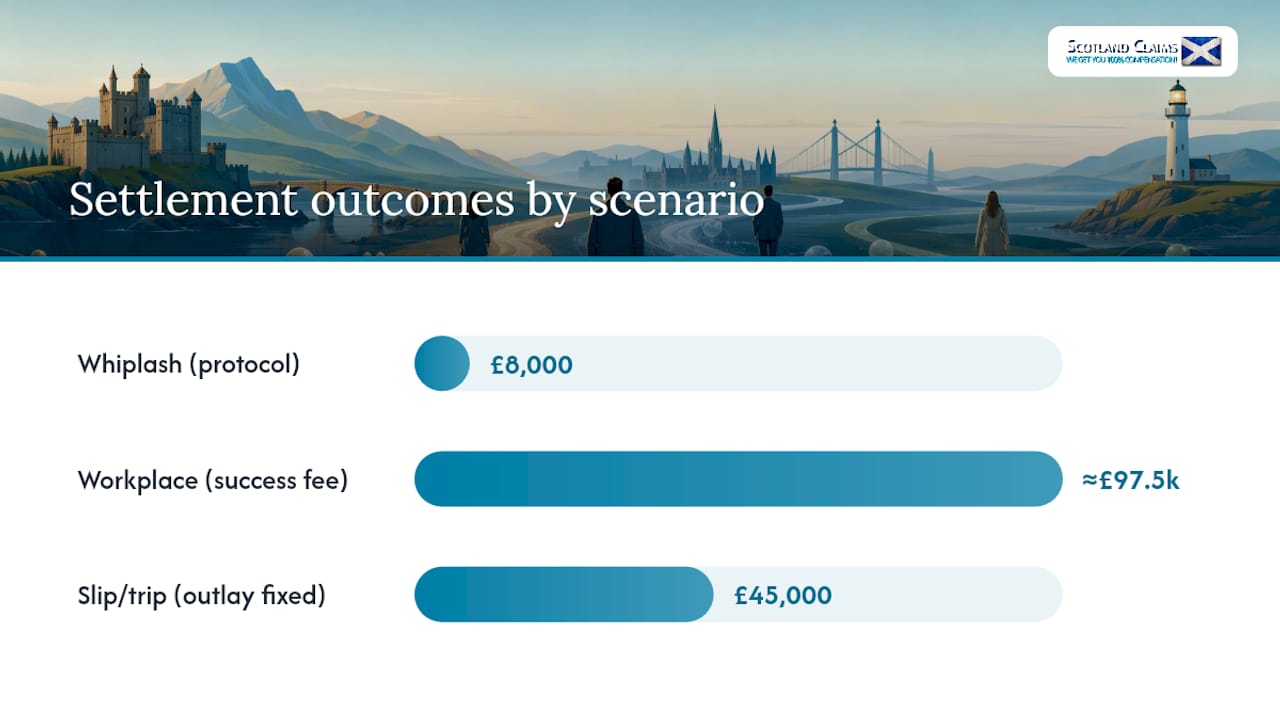
Scenario three: slip and trip claim, £45,000 award, disputed solicitor advocate fee. The solicitor advocate’s fee was initially billed to the claimant in error. On review, it was correctly reclassified as an outlay and recovered from the defender’s insurer as part of judicial expenses instead, in line with the Auditor’s guidance. The claimant’s net settlement was unaffected once corrected.
These scenarios aren’t hypothetical outliers. They map onto the three most common situations claimants raise: full compensation retained, a capped success fee correctly applied, and an outlay wrongly charged that gets fixed once someone asks the right question.
Timeframe for deduction processing and finalisation
Deductions aren’t calculated until settlement is agreed or a court awards damages, so nothing comes off your award while the claim is still being negotiated. Once a settlement figure is reached, most straightforward personal injury cases see funds processed and deductions applied within a few weeks, though this varies with how quickly the paying insurer releases funds and whether any judicial taxation of expenses is required.
Cases that go through formal taxation of expenses, where the Auditor has to rule on disputed items, take longer, sometimes adding several weeks while accounts are checked line by line against the Act of Sederunt schedules. Straightforward cases settled by agreement, with no dispute over solicitor advocate fees or outlays, tend to move faster because there’s nothing for the Auditor to review.
Ask your solicitor for an estimated timeframe once settlement is agreed, and request the cash account as soon as it’s available rather than waiting for the final cheque to arrive unexplained.
Author’s perspective: what claimants usually misunderstand
The confusion I see most often is claimants mixing up judicial expenses (paid by the defender) with a success fee (deducted from their own damages). They’re not the same thing, and mistaking one for the other leads people to expect deductions that never happen, or to miss ones that should be queried.
Three protections worth remembering: your success fee, if any, is capped by law; your outlays cannot be charged to you except an ATE premium; and solicitor advocate fees are normally an outlay, not a personal charge.
— Roger
How Scotland Claims Injury Lawyers can help: free assessment, no fee if you lose
If you’ve read this far wondering whether your own settlement was calculated correctly, or you haven’t started a claim yet and want to avoid the confusion altogether, Scotland Claims Injury Lawyers offers a genuinely different starting point.
There’s no success fee to calculate, no cap to check against, and no cash account line to query because there’s no deduction from your damages in the first place. A free case assessment and a compensation calculator let you see what your claim might be worth before you commit to anything, and the no win no fee guarantee means you pay nothing if the claim doesn’t succeed. If you’ve suffered a personal injury in Scotland through someone else’s fault, request a callback and find out where you stand.
This article is general information, not a substitute for advice from a qualified lawyer. Consult a qualified legal professional about your own circumstances before acting on anything here.
Sources
FAQ
What are the fees for a solicitor in Scotland on a personal injury claim?
Under a success-fee agreement, the only fee you can be charged is the success fee itself, capped at 20% of the first £100,000, 10% up to £500,000, and 2.5% above that, inclusive of VAT. Outlays cannot be charged to you separately, aside from an ATE insurance premium.
How can I reduce my solicitor’s fees on a claim?
You can’t negotiate below the statutory cap, but you can choose a firm that operates under a no-fee-if-you-lose model with no success fee at all, or one funded through the insurer-paid pre-action protocol, which means no deduction from your damages either way.
How much do solicitors charge per hour in Scotland?
Hourly rates vary by firm and are usually set out in the initial client agreement rather than fixed by statute, though court work is taxed against the fee schedules in the relevant Act of Sederunt regardless of the hourly rate quoted.
What is normal for solicitors’ fees on a personal injury award?
For a claim under a success-fee agreement, a success fee near the statutory cap for the relevant band is normal.
Are solicitor advocate fees ever charged to the client directly?
Rarely, and generally by error. The Auditor of the Court of Session treats these fees as outlays recoverable from the defender, not as a personal charge against the claimant’s damages.
Recommended