
Table of Contents
Last Updated: August 2, 2026
Slip and Trip Claims vs Road Traffic Accidents: What's the Difference?
Understanding the distinction between slip and trip injury claims Glasgow vs road traffic accidents is crucial for anyone considering a personal injury compensation claim in Scotland. The legal pathways diverge significantly in terms of liability, evidence requirements, and settlement timescales. Misunderstanding which type of claim you have can delay your compensation by months.
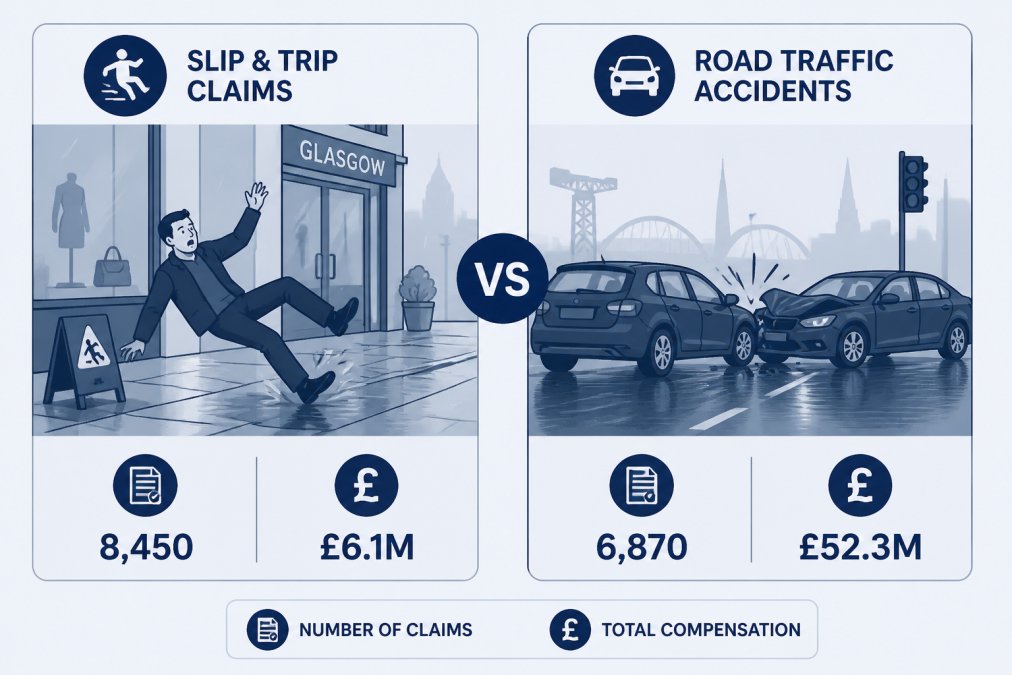 Side-by-side comparison of slip and trip claims Glasgow
The fundamental difference lies in how liability is established. Slip and trip claims typically involve accidents on someone else's property where the property owner or occupier failed in their duty of care. Road traffic accidents centre on breaches of the Road Traffic Act 1988 and the duties owed by drivers and pedestrians to one another on public highways. Both require proof of negligence, but the evidence and legal frameworks differ markedly.
How Liability Differs Between Claim Types
In slip and trip cases, you must demonstrate that the property occupier knew, or ought reasonably to have known, about the hazard that caused your accident. This is called "occupiers liability", governed primarily by the Occupiers' Liability (Scotland) Act 1960. If a supermarket failed to clean up spilled liquid, or a landlord left a loose stair carpet unrepaired, liability can be established.
Road traffic accident claims follow a different legal route. Liability rests on breach of the duty of care owed by road users. Did the other driver exceed the speed limit? Fail to stop at a red light? Drive whilst distracted? These are breaches of the Road Traffic Act 1988 and the Highway Code. Traffic laws create objective rules, but proving the other party breached them requires solid evidence: witness statements, CCTV, or police reports.
Pro Tip
Slip and trip claims often succeed on circumstantial evidence alone, whereas road traffic accident claims almost always require direct proof of the other driver's actions or omissions.
Why Claim Complexity Varies
Slip and trip claims are paradoxically harder to prove despite being more common. Proving what the occupier "ought to have known" is subjective. Courts ask: how long had the hazard been there? Could the occupier have discovered it with reasonable inspection routines?
Road traffic accident claims are often more straightforward because the law is codified. However, liability can still be contested if both parties were partially at fault. A pedestrian stepping into traffic might be found partially responsible, reducing compensation by their percentage of fault.
Slip and trip claims frequently settle within 6-12 months because occupiers' liability insurance is well-established. Road traffic accident claims can take 12-24 months, particularly if injuries are serious or liability is disputed.
Understanding Personal Injury Compensation Claims in Glasgow
Personal injury claims in Glasgow fall into several categories, but slip and trip claims and road traffic accidents represent the two largest segments. A personal injury claim is a legal action seeking financial compensation for harm caused by someone else's negligence or breach of duty.
The foundation of any personal injury claim is negligence. You must prove four elements: duty of care (the defendant owed you a legal duty), breach (they failed in that duty), causation (the breach caused your injury), and loss (you suffered quantifiable harm).
What Constitutes a Valid Claim
A valid personal injury claim requires more than simply having been injured. You must demonstrate that someone else's wrongful act or omission caused your injury, and that you've suffered measurable loss: medical expenses, lost wages, pain and suffering, or reduced quality of life.
For slip and trip claims in Glasgow, validity depends on whether the property owner or occupier had a duty toward you. If you slipped on a public pavement, Glasgow City Council may be liable if they failed to maintain the surface or salt it during winter. If you fell in a shop, the shop owner is liable if they failed to keep the premises reasonably safe. If you tripped in a workplace, your employer is liable under the Health and Safety at Work etc. Act 1974.
For road traffic accidents, validity is clearer: if you were injured due to another road user's breach of traffic law or failure to exercise reasonable care, you have a valid claim.
Key Takeaway
The critical threshold for validity is simple: did someone owe you a duty of care, did they breach it, and did that breach injure you? If yes to all three, you have grounds for a claim.
Negligence and Duty of Care Explained
Negligence is the legal concept underpinning personal injury law in Scotland. It requires proof that the defendant owed you a duty of care, breached that duty, and caused you loss.
In slip and trip cases, the duty of care arises from the Occupiers' Liability (Scotland) Act 1960. An occupier of premises owes a duty to visitors to take reasonable care to ensure the premises are safe. This duty extends to natural hazards (icy pavements) and artificial hazards (broken floorboards, poor lighting). The standard is "reasonable care", not absolute safety.
In road traffic accidents, the duty of care arises from common law and statute. Every road user owes other road users a duty to exercise reasonable care. This means obeying traffic laws, maintaining control of your vehicle, and watching for pedestrians.
Public Liability Claims in Glasgow: Slip and Trip Accidents
Public liability claims in Glasgow account for thousands of claims annually. These are claims brought by members of the public against property owners, occupiers, or businesses for injuries sustained on their premises. Slip and trip accidents represent the largest category of public liability claims in Scotland.
Public liability insurance is mandatory for most businesses in Glasgow. When a customer slips on a wet floor or trips on a loose carpet, they can claim against the business's public liability insurer.
Common Slip and Trip Scenarios
Slip and trip accidents in Glasgow occur in predictable contexts: supermarkets and shops (spillages, poor lighting), restaurants and cafés (wet floors), offices (trailing cables, loose carpets), public pavements (ice, potholes), leisure facilities (wet changing rooms), and workplaces (machinery hazards, wet floors).
In Glasgow's climate, winter slip and trip claims spike November through March due to ice and snow. A minor slip might settle for a certain amount. A serious fall causing a fractured hip or head injury can settle for a higher amount, depending on age and ongoing care needs.
Proving Occupier's Liability
Proving occupier's liability requires establishing three things: the hazard existed, the occupier knew or ought to have known about it, and the occupier failed to take reasonable steps to make it safe or warn of it.
Evidence is critical. Gather photographs or video of the hazard taken immediately after the accident, witness statements from anyone who saw the accident, CCTV footage from the property, the accident report book completed at the premises, medical evidence documenting your injuries, and proof of the hazard's duration.
A common mistake is failing to report the accident formally at the time. Always report accidents immediately and request contact details of any witnesses.
Road Traffic Accidents: Claim Process and Liability
Road traffic accidents represent the second-largest category of personal injury claims in Scotland. Unlike slip and trip claims, which depend on property conditions, road traffic accident claims centre on the conduct of drivers, cyclists, and pedestrians on public roads.
The claims process for road traffic accidents is more standardised than for slip and trip claims, partly because insurance is compulsory and partly because traffic law is codified.
Third-Party Liability in RTAs
In a road traffic accident, liability typically rests with the "third party", the other road user whose actions caused the accident. If you were hit by another car, that driver is the third party. Their insurance company is responsible for compensating you. Obtaining the other driver's insurance details at the scene is critical.
Third-party liability is established by proving the other road user breached the Road Traffic Act 1988 or the Highway Code. Common breaches include exceeding the speed limit, failing to stop at traffic lights, driving whilst unfit, failing to maintain control, failing to keep a proper lookout, and driving whilst using a mobile phone.
If the other driver was clearly in breach, liability is straightforward. However, if both vehicles were moving, liability can be shared. Scotland applies the principle of "contributory negligence", meaning your compensation can be reduced if you were partly at fault.
Watch Out
A critical pitfall: admitting fault at the scene of a road traffic accident, even in passing, can be used against you later. Never admit liability. Exchange details, contact the police if there are injuries, and inform Scotland Claims Injury Lawyers immediately.
Insurance and Settlement Timescales
All vehicles on UK roads must carry third-party motor insurance. When you claim for a road traffic accident, you claim against the other driver's insurance company.
The claims process typically follows this timeline: notification within 30 days, investigation over 4-8 weeks, liability admission within 8-12 weeks, valuation within 12-24 weeks, and settlement within 24-52 weeks. Straightforward claims with clear liability and minor injuries can settle within 3-6 months. Complex claims involving serious injuries or disputed liability can take 18-24 months or longer.
If the third party is uninsured or untraced, you may be able to claim through the Motor Insurers' Bureau (MIB), a compensation scheme funded by the insurance industry.
Duty of Care for Road Users in Scotland
Every road user in Scotland, drivers, cyclists, pedestrians, motorcyclists, owes other road users a duty of care. This duty emerges from the Road Traffic Act 1988, the Highway Code, and common law principles. Understanding this duty is essential for establishing liability in a claim.
The duty of care for road users requires that you exercise reasonable care to avoid injuring others. This means obeying traffic laws, maintaining control of your vehicle, and watching for other road users.
Legal Obligations of Drivers and Pedestrians
Drivers in Scotland must obey all traffic signals and road signs, maintain control of the vehicle at all times, adjust speed to road and weather conditions, keep a proper lookout for other road users, not drive whilst impaired, not use a mobile phone, maintain the vehicle in roadworthy condition, and give way where required by law.
Pedestrians must cross at designated crossings where available, look both ways before crossing, not step into traffic without checking it is safe, obey pedestrian traffic signals, and wear visible clothing in poor visibility conditions.
Cyclists must obey all traffic signals and road signs, maintain control of the bicycle, use lights and reflectors in darkness, not ride on pavements except where designated cycle paths exist, and give way to pedestrians on shared paths.
The standard applied by courts is "reasonable care", what a reasonable, prudent road user would do in similar circumstances.
Highway Authority Responsibilities
The highway authority, in Glasgow this is Glasgow City Council, owes a duty to maintain the public road in a safe condition. This includes repairing potholes and loose surfaces, clearing ice and snow in winter, maintaining street lighting, removing debris and obstacles, ensuring drainage systems function, and maintaining road markings and signs.
If you are injured due to a defect in the road itself, you may have a claim against the highway authority. However, the authority has a defence if they can show they carried out reasonable maintenance and inspection. In Glasgow's winter months, claims against the council for slip and trip accidents on pavements increase significantly. The council is expected to salt and grit main pavements and roads, but not every side street.
Evidence Required for Injury Claims in Scotland
The difference between a successful claim and a failed one often comes down to evidence. Whether your claim is for a slip and trip accident or a road traffic accident, you must gather and preserve evidence from the outset. Delay in gathering evidence significantly weakens your case.
Scotland Claims Injury Lawyers advises all clients to treat the first 48 hours after an accident as critical. This is when memories are fresh, witnesses are identifiable, and physical evidence is still available.
Documentation and Witness Statements
The cornerstone of any injury claim is contemporaneous documentation.
Accident Report:
If the accident occurred on someone's property, ensure an accident report is completed immediately. Ask staff to complete the accident book and request a copy.
Witness Statements:
Obtain names, addresses, and contact details of anyone who saw the accident or the hazard that caused it. Ask them to write a brief statement describing what they saw, signed and dated.
Photographs and Video:
Photograph the scene immediately after the accident, if possible. For slip and trip claims, photograph the hazard, the wider area, lighting conditions, and any warning signs. For road traffic accidents, photograph vehicle damage, road conditions, traffic signals, and the accident location.
Police Report:
In road traffic accidents, call the police if there are injuries. Request the police incident report number and, later, a copy of the police report.
Medical Records:
Obtain copies of all medical records from your GP, hospital, or physiotherapist. These document the injury, treatment, and prognosis.
Medical Reports and Proof of Injury
Medical evidence is critical in quantifying compensation. You must obtain GP records, hospital records, specialist reports, and medical expert reports. For claims over a certain value, Scotland Claims Injury Lawyers will instruct an independent medical expert to examine you and produce a report.
Proof of injury extends beyond medical records. Keep a diary documenting your symptoms, pain levels, activities you cannot perform, and impact on work and social life. Photographs of visible injuries are valuable. If you required time off work, obtain a letter from your employer confirming dates and any loss of earnings.
Time Limits and Statute of Limitations for Claims
One of the most critical aspects of personal injury claims in Scotland is the time limit within which you must raise a claim. Missing the deadline can bar your claim entirely, regardless of its merits. This is why contacting Scotland Claims Injury Lawyers early is essential.
Scotland applies a three-year limitation period for personal injury claims.
Deadlines for Slip and Trip Claims
For slip and trip claims, the three-year limitation period runs from the date of the accident. If you slipped on a shop floor on 1st March 2023, you must raise your claim by 1st March 2026. If you do not raise a claim by that date, your claim is time-barred and cannot proceed.
Limited exceptions exist for those under 16 at the time of the accident (the period does not begin until age 16) and those legally incapable of managing their affairs. In practice, you should notify the occupier's insurer or contact a solicitor within weeks of the accident, not months.
Deadlines for Road Traffic Accident Claims
Road traffic accident claims are also subject to the three-year limitation period, running from the date of the accident. If you were injured in a road traffic accident on 15th June 2023, you must raise your claim by 15th June 2026.
For serious injuries requiring ongoing treatment, the three-year deadline can feel rushed. Scotland Claims Injury Lawyers manages the process: we notify insurers, negotiate liability and quantum, and raise court proceedings if necessary, all within the limitation period.
Contributory Negligence: How It Affects Your Claim
Contributory negligence is a doctrine in Scottish law that reduces your compensation if you were partly responsible for the accident that injured you. Understanding how contributory negligence applies to slip and trip claims versus road traffic accidents is essential, as the principles differ.
Partial Fault in Slip and Trip Accidents
In slip and trip claims, contributory negligence is assessed by asking: did you fail to exercise reasonable care for your own safety? If you slipped on a wet floor but were not paying attention, or if you were running and lost your footing, the court may find you partly at fault.
Common scenarios where contributory negligence arises include distraction (texting on your phone), inappropriate footwear (high heels on a wet surface), ignoring warnings (a sign warned of a wet floor), and rushed movement (running in an area where caution was warranted).
If you were 20% contributorily negligent, your compensation is reduced by 20%. If you were 50% or more contributorily negligent, you may recover nothing under the "50% bar". However, the occupier's duty of care is high. Even if you were distracted, the occupier still owed you a duty to keep the premises reasonably safe.
Shared Responsibility in Road Accidents
In road traffic accidents, contributory negligence arises if you breached your duty of care as a road user. Common examples include a pedestrian stepping into traffic without checking it was safe, a cyclist without lights being hit by a car, a driver distracted and not seeing another vehicle pulling out, and failing to give way at a roundabout.
The standard applied is strict: did you breach the Road Traffic Act 1988 or Highway Code? If yes, you may be found contributorily negligent. However, the percentage of fault is apportioned based on causation: how much did your breach contribute to the accident?
Road traffic accident claims frequently involve apportionment of fault. A common scenario: both drivers were partially at fault. One driver pulled out without checking; the other driver was speeding. The court might find the first driver 60% at fault and the second driver 40% at fault. Each recovers compensation reduced by their percentage of fault.
How Compensation Is Calculated for Slip and Trip Claims
Compensation for slip and trip claims consists of two broad categories: general damages (for pain and suffering) and special damages (for quantifiable losses). Understanding how these are calculated helps you assess whether a settlement offer is fair.
Compensation is not arbitrary. Scottish courts apply established guidelines and precedents to ensure consistency. Scotland Claims Injury Lawyers uses these guidelines to calculate a realistic range for your claim.
General Damages for Pain and Suffering
General damages compensate you for the pain, suffering, and reduced quality of life caused by the injury. Scottish courts use the Judicial College Guidelines to assess general damages. These guidelines provide brackets for different injury types:
- Minor soft tissue injury: A certain range
- Moderate injury: A certain range
- Serious injury: A certain range
- Very serious injury: A certain range
Within each bracket, the court considers age (a younger person faces decades of potential complications), pre-existing conditions, prognosis (permanent injuries attract higher awards), and impact on daily life.
Special Damages: Loss of Earnings and Costs
Special damages compensate you for quantifiable losses caused by the accident.
Loss of Earnings:
If you were unable to work due to your injury, you can claim for lost wages. This is calculated as: gross weekly wage × number of weeks unable to work. You must provide payslips or an employer's letter confirming your salary and dates of absence.
Medical and Care Costs:
If you incurred private medical treatment or ongoing care, you can claim these costs if they were reasonable and necessary. You must provide invoices.
Travel Costs:
If you incurred costs travelling to medical appointments, you can claim these. Keep receipts.
Aids and Adaptations:
If you required equipment or home adaptations, you can claim the cost.
Finding Personal Injury Solicitors in Glasgow
Choosing the right solicitor to represent your claim is one of the most important decisions you will make. A good solicitor maximises your compensation.
Glasgow has numerous solicitors offering personal injury services.
What to Look for in Legal Representation
Specialisation:
Choose a solicitor who specialises in personal injury law, not a generalist. Specialised firms have deeper knowledge of liability law, valuation principles, and negotiation tactics.
Experience:
Ask how many claims the solicitor has handled in your specific area.
Track Record:
Reputable solicitors will provide examples of claims they have settled and the compensation achieved. This gives you a realistic benchmark for your own claim.
Communication:
Your solicitor should explain the claims process clearly, update you regularly, and be accessible when you have questions.
Accreditation:
Check whether the solicitor is accredited by the Law Society of Scotland. This ensures they meet professional standards and are subject to complaints procedures.
Local Knowledge:
A Glasgow-based solicitor understands local courts, local judges, and local insurers. This can be an advantage in negotiations and litigation.
Transparency:
Your solicitor should explain their fee structure upfront. If they offer "no win, no fee," understand exactly what that means.
No Win, No Fee Arrangements Explained
"No win, no fee" is a conditional fee arrangement. Your solicitor only charges a fee if you win your claim. If you lose, you pay nothing. This removes financial risk and aligns your solicitor's interests with yours.
Scotland Claims Injury Lawyers operates on a no win, no fee basis with a key difference: you keep 100% of your compensation. We recover our fees from the other side (the defendant's insurer). This means if you win £10,000, you receive the full £10,000. We do not deduct a percentage of your compensation as our fee.
Additionally, under a conditional fee arrangement, you may be liable for the other side's legal costs if you lose. Scotland Claims Injury Lawyers includes after-the-event (ATE) insurance in our service, so you are protected.
| Claim Type |
Typical Duration |
Liability Standard |
Key Evidence |
Contributory Negligence Risk |
| Slip and Trip |
6-12 months |
Occupier's duty of care (Occupiers' Liability Act 1960) |
Hazard photographs, witness statements, accident report |
Moderate (distraction, inappropriate footwear) |
| Road Traffic Accident |
12-24 months |
Driver/road user duty of care (Road Traffic Act 1988, Highway Code) |
Police report, CCTV, witness statements, vehicle damage |
Moderate to High (speeding, failing to give way, distraction) |
Understanding the difference between slip and trip injury claims Glasgow vs road traffic accidents is essential for anyone considering a personal injury claim in Scotland. Whilst both are personal injury claims governed by the same fundamental principles of negligence, they differ significantly in liability standards, evidence requirements, and settlement timescales.
Slip and trip claims centre on the occupier's duty to maintain safe premises; road traffic accident claims centre on drivers' and pedestrians' duties to exercise care on public roads. Slip and trip claims often settle within 6-12 months; road traffic claims frequently take 12-24 months. Both require strong evidence gathered immediately after the accident.
Contributory negligence can reduce your compensation if you were partly at fault, but the thresholds and applications differ between claim types. Compensation is calculated using established guidelines for general damages and quantifiable losses for special damages.
If you have been injured in a slip and trip accident or a road traffic accident in Glasgow or elsewhere in Scotland, contact Scotland Claims Injury Lawyers for a free, no-obligation assessment. We handle both claim types on a no win, no fee basis, and you retain 100% of your compensation if successful. Our experienced team will guide you through the claims process, manage evidence gathering, negotiate with insurers, and maximise your compensation. Get started today and take the first step toward recovery and justice.
Frequently Asked Questions
What is the time limit for making a slip and trip injury claim in Scotland?
In Scotland, you generally have three years from the date of the accident to submit a claim for a slip and trip injury. This is known as the statute of limitations. However, if you were under 16 at the time of the accident, the three-year period begins when you turn 16. It is important to act quickly, as gathering evidence and witness statements becomes more difficult as time passes. Contact a personal injury solicitor in Glasgow as soon as possible to discuss your claim.
How is compensation calculated differently for slip and trip claims versus road traffic accidents?
Both claim types use general damages (pain and suffering) and special damages (lost wages, medical costs). Road traffic accidents often result in higher compensation due to the severity of injuries from vehicle impact and the straightforward liability through insurance. Slip and trip claims depend heavily on proving the occupier's negligence and your injury severity. Medical reports, evidence of lost earnings, and proof of ongoing treatment all influence the final settlement amount in either case.
What evidence do I need to support a slip and trip claim in Glasgow?
Essential evidence includes photographs of the hazard (wet floor, broken paving), witness statements from people who saw the accident, an accident report if one was filed at the location, medical records documenting your injuries, and proof of any treatment or rehabilitation. For slip and trip claims specifically, evidence that the property owner or occupier knew (or should have known) about the hazard is crucial. A personal injury solicitor can guide you on gathering this evidence and obtaining medical reports to strengthen your claim.
Can I claim compensation if I was partially at fault for my slip and trip accident?
Yes, you may still claim even if you were partially at fault, but your compensation will be reduced by your percentage of fault. This is called contributory negligence. For example, if you were found 20% responsible and your claim was worth £5,000, you would receive £4,000. Scottish courts assess whether the occupier failed in their duty of care and whether you contributed to the accident through your own actions. A solicitor can advise on how contributory negligence might affect your specific claim.