No fault divorce in England: your 2026 guide

Since 6 april 2022, no fault divorce in England and Wales has been a legal reality. Under the Divorce, Dissolution and Separation Act 2020, either or both spouses can end a marriage by filing a single statement that it has broken down irretrievably. No proof of adultery, unreasonable behaviour, or years of separation is required. The key features of the reformed system are:
- Single ground: irretrievable breakdown of marriage, accepted by the court as conclusive
- No blame required: neither party needs to prove fault or cite conduct
- Joint applications: couples can apply together for the first time
- Non-contestable: a respondent cannot block or oppose the divorce
- Mandatory waiting periods: a 20-week reflection period before the conditional order, then a minimum 6-week wait before the final order
What are the legal requirements for no fault divorce in England and Wales?
The eligibility criteria are straightforward, but every box must be ticked before you apply.
- Minimum marriage duration: you must have been married for at least one year
- Legally recognised marriage: the marriage must be valid under UK law, including same-sex marriages
- Residency or domicile: at least one party must be habitually resident in England or Wales, or domiciled here
- Statement of irretrievable breakdown: the applicant or both joint applicants must confirm the marriage has broken down irretrievably; the court treats this as conclusive
- Contesting is not an option: a respondent can raise jurisdictional or procedural objections, but cannot contest the divorce itself on the grounds that the marriage has not broken down
The domicile and residency rules carry more complexity than they first appear. If you live outside England and Wales, or your spouse does, you should take legal advice before filing to confirm the court has jurisdiction.
How does the no fault divorce process work, step by step?

The mandatory waiting periods mean divorce cannot be completed in under six months, regardless of how cooperative both parties are.
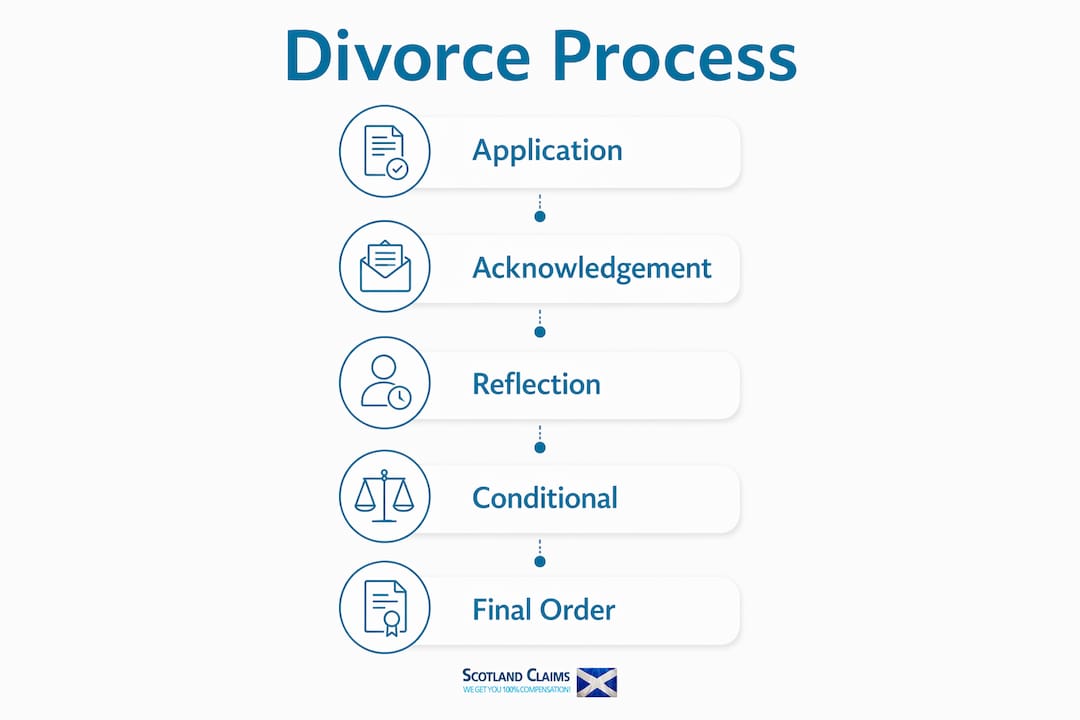
| Stage |
What happens |
Minimum wait |
| Application issued |
D8 form submitted online or by post; marriage certificate attached |
Day 1 |
| Acknowledgement |
Respondent (or co-applicant) acknowledges receipt |
Varies |
| 20-week reflection period |
Mandatory cooling-off before conditional order can be sought |
20 weeks from issue |
| Conditional order |
Court confirms marriage can legally end |
After 20 weeks |
| 6-week wait |
Minimum gap before applying for final order |
6 weeks from conditional order |
| Final order |
Marriage legally dissolved |
After 6-week wait |
Applications are filed through the HMCTS online divorce service or by post using form D8. The statement of irretrievable breakdown sits at the heart of the application: without it, the court cannot proceed. Financial and child arrangements are entirely separate processes and are not resolved by the divorce order itself.
Pro Tip: Do not delay applying for a financial consent order. The divorce becoming final does not automatically protect you from future financial claims by your former spouse.
What do the new legal terms mean?
The terminology changes under the 2020 Act were designed to make the process clearer for people without legal representation.
| Old term |
New term |
What it means in practice |
| Decree nisi |
Conditional order |
Court confirms the marriage can end; not yet final |
| Decree absolute |
Final order |
Marriage is legally dissolved |
| Petitioner |
Applicant |
The person (or persons) who started proceedings |
| Respondent |
Respondent |
Unchanged; the other party to the marriage |
The legal effect of each stage is identical to the old system. Only the language changed. Plain English terms mean applicants representing themselves can follow the process without needing to decode Victorian legal vocabulary.
What is the real impact of no fault divorce, and what are the common misconceptions?
Removing blame from the process reduces conflict at the point of application, but it does not make divorce simple or fast.
The biggest misconception is that no fault divorce means a quick divorce. The mandatory six-month minimum applies in every case. A second widespread misunderstanding is around finances: there is no automatic 50/50 split of assets. Financial settlements are negotiated separately and depend on individual circumstances, the length of the marriage, and each party’s needs.
Child arrangements are equally separate. There is no legal presumption that mothers receive custody. Courts focus on the child’s welfare, not on which parent filed for divorce or why.
Contesting a divorce is no longer possible on the merits. A respondent who disagrees with the decision cannot prevent it. Financial settlements and child arrangements remain live legal questions, however, and unresolved disputes there can add months or years to the overall process.
Professional commentary on the no fault divorce laws in England and Wales has been broadly positive, though experts are clear that the reforms do not remove the need for legal advice.
Aidan Jones of Relate has highlighted that the 20-week reflection period serves a genuine purpose: it gives couples time to consider reconciliation, access mediation, and make practical arrangements before the divorce becomes irreversible. Legal advisers consistently warn against using the application to air grievances, since doing so increases costs and delays without affecting the outcome. The divorce will proceed regardless.
For complex financial or child matters, professional guidance remains critical even though solicitors are not compulsory for the divorce application itself.
How do you actually apply for a no fault divorce?
The application is made online via the HMCTS divorce service at gov.uk, or by post using the D8 form. You will need your original marriage certificate or a certified copy, translated into English if it was issued abroad.
The court fee for a divorce application is £592 (correct at the time of publication; check gov.uk for the current figure). Fee remission is available if you are on a low income. Once the application is issued, the court sends the documents to the respondent, who must acknowledge receipt. In a joint application, both parties confirm they wish to proceed after the 20-week period has elapsed. Knowing when to seek legal advice before filing can save significant time and cost if your circumstances are complex.
How does no fault divorce affect financial settlements?
The divorce order itself does not divide assets. Financial settlement requires either a negotiated consent order approved by the court, or a contested financial remedy application if agreement cannot be reached.
Courts consider a range of factors: the length of the marriage, each party’s income and earning capacity, housing needs, and contributions made. Conduct is rarely relevant. Extreme misconduct might be considered in financial remedy proceedings in exceptional cases, but raising such allegations generally delays settlement rather than improving the outcome. Property is one of the most contested areas; questions around whether a family home must be sold are common, and the answer depends on the specific financial order made. Understanding property division in divorce is worth doing early, before positions become entrenched.
How does the new system compare to the old fault-based process?
Before april 2022, divorce required proving one of five facts: adultery, unreasonable behaviour, desertion, two years’ separation with consent, or five years’ separation without it. The practical result was that most couples cited unreasonable behaviour simply to avoid a two-year wait, even when the separation was amicable.
The old system forced conflict into the legal process at the very start. Allegations had to be specific enough to satisfy the court, which meant detailing a spouse’s conduct in writing. That document then became part of the court record. Under the current no fault divorce process, none of that is necessary. The statement of irretrievable breakdown replaces all five facts. The emotional difference is real: couples who would previously have had to draft a list of complaints can now simply confirm the marriage is over and move forward. The process is less adversarial from day one, which tends to make financial and child arrangement negotiations easier to conduct.
Key takeaways
No fault divorce in England and Wales, introduced by the Divorce, Dissolution and Separation Act 2020, requires only a statement of irretrievable breakdown and takes a minimum of six months from application to final order.
| Point |
Details |
| Single ground only |
Irretrievable breakdown is the sole basis; no fault or conduct needs to be proved. |
| Minimum six-month timeline |
The 20-week reflection period plus 6-week wait means no divorce completes faster than six months. |
| Terminology updated |
Decree nisi became conditional order; decree absolute became final order. |
| Finances and children are separate |
The divorce order does not resolve assets or child arrangements; these need separate legal processes. |
| Contesting is not possible |
A respondent cannot oppose the divorce on its merits under the 2020 Act. |
FAQ
What are the grounds for no fault divorce in England and Wales?
The sole ground is irretrievable breakdown of the marriage. Under the Divorce, Dissolution and Separation Act 2020, the applicant’s statement of irretrievable breakdown is taken as conclusive evidence; no further proof is required.
Is there a minimum time before you can divorce in England?
Yes. You must have been married for at least one year before applying. The divorce process itself then takes a minimum of six months due to the mandatory 20-week reflection period and the 6-week wait before the final order.
Does a wife automatically get half the assets in a divorce in England?
No. There is no automatic 50/50 split. Financial settlements are negotiated separately from the divorce and depend on individual circumstances, including the length of the marriage, each party’s needs, and their respective contributions.
What is the main disadvantage of no fault divorce?
The mandatory waiting periods mean the process still takes at least six months, even when both parties agree. Financial and child arrangements also remain entirely separate, so a no fault divorce does not resolve those disputes on its own.
Scotland Claims Injury Lawyers specialises in personal injury claims across Scotland, including road traffic accidents, workplace injuries, and slips and trips, on a no win no fee basis. We take no success fee from your compensation, so you keep all that you are awarded.
Recommended