How to secure knee injury compensation in Scotland

TL;DR:
- Knee injury claims in Scotland are complex, with compensation influenced by factors like personal contribution and evidence quality. Proving negligence alone may not guarantee full payout due to contributory negligence, which can reduce damages proportionally. Prompt reporting, thorough evidence gathering, and working with experienced solicitors are essential to maximize compensation and navigate the process effectively.
Knee injury claims in Scotland are far more complicated than most people assume. If you have been hurt in an accident at work, on the road, or in a public place, you might believe that proving someone else caused your injury is enough to guarantee full compensation. It is not. Factors such as your own contribution to the accident, the quality of your evidence, and how quickly you act can all dramatically change the final payout you receive. This guide walks you through Scottish law, the key mistakes to avoid, how compensation is calculated, and the practical steps to build the strongest possible claim.
Table of Contents
Key Takeaways
| Point |
Details |
| Partial responsibility reduces awards |
Even if you are partly at fault, you can still claim, but expect a reduced payout. |
| Evidence strengthens your claim |
Collecting medical records, witness statements, and thorough documentation improves your case. |
| Professional guidance pays off |
No-win no-fee experts can help avoid costly mistakes and maximise your compensation. |
| Follow the correct process |
Adhering to claim procedures and deadlines is vital for a successful outcome. |
How knee injuries are treated under Scottish law
Understanding the legal framework before you start a claim gives you a real advantage. Scottish personal injury law is built on the principle of negligence. To succeed, you must show that another party owed you a duty of care, that they breached it, and that the breach directly caused your knee injury. This applies whether you were hurt in a road traffic accident, a slip in a supermarket, or a workplace incident involving faulty equipment.
However, proving another party was negligent does not automatically mean you receive the full amount. Scottish courts also consider whether you contributed to your own injury. This concept is called contributory negligence, and it can reduce your award significantly.
The law in this area flows from the Law Reform (Contributory Negligence) Act 1945. Under this legislation, compensation is reduced by the proportion of responsibility attributed to you. So if a court finds you were 30% responsible for your own knee injury, you would receive 70% of the calculated award. You are not left empty-handed, but you will receive less than the full amount.
Common situations where contributory negligence arises in knee injury cases include:
- Not wearing appropriate footwear in a known hazardous workplace
- Ignoring safety signs warning of wet or uneven surfaces
- Walking while distracted by a mobile phone when you slipped on a public pavement
- Failing to use a seatbelt during a road traffic accident, which worsened the knee injury on impact
- Continuing to use damaged equipment at work after being warned of the risk
Each of these scenarios does not kill your claim. The courts simply apportion responsibility and adjust the compensation figure accordingly.
“Scottish claimant outcomes can be reduced where the injured person is found partly responsible; courts apportion damages so a claimant may still recover but at a reduced level.” This reflects directly how the Law Reform (Contributory Negligence) Act 1945 operates in practice across Scotland.
If you want to understand how this legal framework applies to your specific situation, the knee injury claims guide sets out the key eligibility criteria in plain language. You can also review starting a claim step-by-step to see what the full process looks like from the beginning.
Common pitfalls in knee injury claims
Knowing the law is one thing. Avoiding the practical mistakes that cost claimants money is another entirely. Many people with genuine, strong cases end up receiving reduced awards simply because they made avoidable errors early on. Here are the most damaging ones.
-
Failing to report the accident promptly. Whether your injury happened at work, in a shop, or on the road, you must report it to the responsible party as soon as possible. At work, this means entering it in the official accident book. In a public place, it means notifying the manager or owner. Delays raise doubt about the severity of your injury and whether the accident truly happened as described.
-
Not seeking medical attention immediately. Some knee injuries feel manageable in the hours after an accident. Do not wait. Seeking medical attention creates an official, dated record linking your injury to the accident. If you delay by several days or weeks, insurers and courts may argue the injury occurred elsewhere or was pre-existing.
-
Admitting partial fault without legal advice. In the panic and stress following an accident, people sometimes say things like “I should have been more careful” or “I wasn’t really watching where I was going.” These statements can be used against you. Never admit fault before speaking to a solicitor. Let the facts and evidence tell the story.
-
Poor evidence gathering. Photographs of the scene, CCTV footage, witness names, and contact details are all vital. Many claimants assume someone else will capture this information. They do not. Act quickly because CCTV footage is routinely overwritten within days.
-
Underestimating the long-term impact. A knee injury can affect your earning capacity, mobility, and quality of life for years. Many claimants settle early for a sum that feels reasonable but fails to account for future medical costs, rehabilitation, and ongoing loss of income.
Where contributory negligence is found, recovery is still possible but the reduction can be substantial. Avoiding these five mistakes is the most practical way to protect your full entitlement.
Pro Tip: Start a dedicated notes file on your phone immediately after the accident. Record dates, symptoms, conversations with employers or doctors, and every cost incurred, no matter how small. This real-time record is far more persuasive than trying to reconstruct events months later.
You can review successful case examples to see how solid evidence and prompt action have led to stronger outcomes for claimants in Scotland.

Estimating compensation and assessing responsibility
Once you understand the legal rules and common pitfalls, the most pressing question for most claimants is: how much could I actually receive? Compensation for a knee injury in Scotland is typically made up of two categories.
General damages cover pain, suffering, and loss of amenity. This includes the physical pain of the injury itself, the psychological impact of reduced mobility, and the effect on your daily activities and hobbies. A minor knee sprain that heals in weeks might attract a few thousand pounds. Severe ligament damage, cartilage injuries, or cases requiring surgical intervention can attract awards of £50,000 or considerably more.
Special damages cover financial losses that are directly traceable and quantifiable. These include medical expenses, physiotherapy costs, travel to hospital appointments, loss of earnings while off work, and the cost of any home adaptations required. Every receipt and payslip matters here. Special damages are calculated precisely, so documentation is everything.
The final figure is then adjusted based on contributory negligence. The table below illustrates how a shared responsibility finding changes the actual payout.
| Total assessed compensation |
Claimant’s share of responsibility |
Reduction applied |
Final payout |
| £40,000 |
0% |
£0 |
£40,000 |
| £40,000 |
20% |
£8,000 |
£32,000 |
| £40,000 |
35% |
£14,000 |
£26,000 |
| £40,000 |
50% |
£20,000 |
£20,000 |
This illustrates exactly why damages can still be recovered even when you share partial responsibility, but also why minimising your attributed share matters so much to your final outcome.
To get an initial estimate based on your specific injury type, the compensation calculator gives you a realistic starting point. For a more detailed assessment, speaking with injury lawyers in Scotland early in the process allows you to understand your position before committing to any particular course of action.
Getting a professional case assessment early is not just about knowing a number. It shapes your entire strategy, telling you which evidence to prioritise and how to respond to any offers made by insurers.
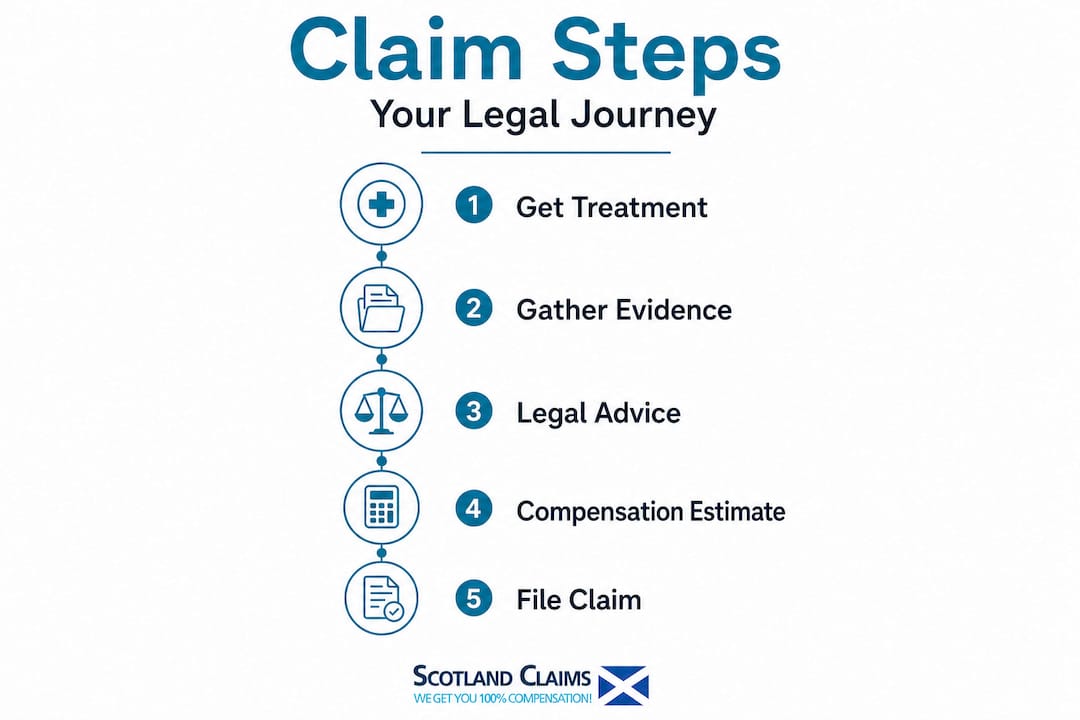
The process for making a knee injury claim in Scotland
Knowing the process from start to finish removes the uncertainty that causes many claimants to hesitate or make poor decisions under pressure. Here is the standard sequence of events for a knee injury claim in Scotland.
-
Seek medical treatment immediately. Your health comes first. A&E records, GP notes, and any specialist referrals all form the foundation of your medical evidence. Request copies of all records.
-
Report the accident formally. At work, use the accident book. On public property, notify the owner in writing. After a road accident, ensure a police report is filed if required.
-
Gather evidence at the scene. Photographs of the location, hazard, or vehicles involved. Names and contact details of witnesses. CCTV request letters sent promptly to relevant businesses.
-
Consult a specialist solicitor. A solicitor with experience in personal injury law will assess the strength of your claim, advise on contributory negligence risk, and outline the likely range of compensation.
-
Submit your formal claim. Your solicitor issues a letter of claim to the responsible party. They have a set period to admit or deny liability.
-
Negotiate a settlement. Most knee injury claims settle out of court. Your solicitor will negotiate on your behalf to secure the best possible figure.
-
Court proceedings if necessary. If liability is disputed or the offer is inadequate, your solicitor may issue court proceedings. In Scotland, partial recovery under contributory negligence remains available but every step must be followed correctly.
| Stage |
Typical timeframe |
| Initial medical treatment |
Immediate |
| Evidence gathering |
First 1 to 4 weeks |
| Legal consultation |
Within first 2 weeks |
| Letter of claim and response |
1 to 3 months |
| Negotiation and settlement |
3 to 12 months |
| Court proceedings (if required) |
12 to 24 months |
Solicitor-led claims consistently achieve higher settlement figures than self-managed ones, largely because solicitors understand how to frame contributory negligence arguments and how to value future losses accurately. When checking credentials, look for solicitors regulated by the Law Society of Scotland and always confirm they offer a no win no fee arrangement before engaging their services.
For a detailed walkthrough of each stage, the injury claim step guide takes you through the full process in plain terms. You can also review how consultations typically work via the legal consultation workflow resource.
Why ‘partial responsibility’ confuses most claimants — and what actually matters
After years of observing how knee injury claims unfold in Scotland, one pattern stands out clearly. Most claimants who struggle with their claims are not struggling because they were at fault. They are struggling because they spent their energy debating blame instead of building their case.
Contributory negligence causes enormous anxiety. People convince themselves that if they admitted any fault at all, even casually at the scene, their claim is worthless. Others go the opposite direction and dig in stubbornly, insisting they bear zero responsibility, which can make them appear unreasonable to a court. Neither approach serves you well.
Courts are far less interested in who said what in the heat of the moment and far more interested in the documented facts. A clear timeline, corroborated witness statements, consistent medical records, and physical evidence of the hazard that caused your injury are what actually move the needle. Outcomes are shaped by the claimant’s degree of responsibility, but clarity and preparation are often more decisive than any argument about blame.
The claimants who achieve the best results focus on one thing above all else: making the facts undeniable. They document everything from day one, they follow medical advice religiously and keep records of every appointment, and they work with a solicitor who knows how to present their case in a structured, credible way.
Pro Tip: Do not try to predict how much responsibility a court will assign to you. That is your solicitor’s job. Your job is to gather and preserve every piece of evidence that shows what happened, when it happened, and how it affected you.
If you want to see how this approach has worked in practice, personal injury claim case studies from Scotland illustrate how preparation and evidence quality have produced strong outcomes even in cases where initial fault was disputed.
Expert support for your knee injury claim
Applying what you have read here becomes far simpler when you have experienced specialists in your corner. Scotland Claims connects you with solicitors who specialise specifically in no win no fee knee injury claims, meaning you pay nothing upfront and face no financial risk if your case is unsuccessful. Every penny of your compensation stays with you. Our network of injury lawyers in Scotland handles everything from evidence gathering through to final settlement, removing the stress of navigating the process alone. To find out more about how the arrangement works and what it means for you, visit our no win no fee experts page and request a free callback today.
Frequently asked questions
Can I claim compensation if I was partly responsible for my knee injury?
Yes, you can still claim compensation, but the amount may be reduced in line with your share of responsibility, as courts apportion damages and reduce awards rather than dismissing claims outright.
How long do I have to start a knee injury claim in Scotland?
You typically have three years from the date of the injury to start your claim in Scotland, so acting promptly is strongly advisable.
Will making a knee injury claim cost me anything upfront?
Most solicitors offer a no win no fee service, meaning you pay nothing upfront and only a pre-agreed fee applies if your claim succeeds.
What evidence do I need for a successful knee injury claim?
Medical records, a formal accident report, witness statements, photographs of the scene, and any receipts for related expenses all help build a strong claim.
Does contributory negligence apply to all types of knee injury claims in Scotland?
Yes, Scottish courts may apply contributory negligence in any type of personal injury claim, applying the Law Reform (Contributory Negligence) Act 1945 to apportion damages where the injured person bears some responsibility.
Recommended