How to request a legal callback for personal injury claims
TL;DR:
- Requesting a legal callback is crucial for early advice and avoiding claim delays.
- Prepare key details and evidence before your callback to ensure a swift, effective consultation.
- Most solicitors respond within hours to one business day, with free initial contact on a no win no fee basis.
Waiting for legal help after a personal injury is genuinely stressful. You are dealing with pain, possibly lost income, and a mounting sense of uncertainty about what comes next. Here is the thing: the sooner you get proper legal advice, the better your chances of a successful compensation claim. In Scotland, the three-year time limit (known as the triennium) on personal injury claims means that every week of inaction costs you. This guide walks you through exactly how to request a legal callback, what to prepare, what to expect, and how to avoid the mistakes that slow everything down.
Table of Contents
Key Takeaways
| Point |
Details |
| Prepare key details |
Having your personal and incident information ready ensures a faster callback. |
| Choose the right contact method |
Phone or online forms are quickest for most Scottish solicitors. |
| Avoid common mistakes |
Check your information is complete and respond promptly to missed calls. |
| Track confirmation timing |
Expect solicitor contact within one business day of a proper callback request. |
| No win no fee options |
Most callback services for personal injury in Scotland are free and risk-free to request. |
Understanding the need for a legal callback
A legal callback is exactly what it sounds like. You submit your contact details and some basic information about your situation, and a qualified solicitor calls you back at an agreed time to discuss your case. It is not a commitment. It is not a contract. It is simply a structured first conversation that helps you understand where you stand.
Why does this matter so much? Because legal consultation is key to understanding your rights and options after an injury. Without speaking to a solicitor early, you risk making decisions that could weaken your claim, such as accepting a low settlement offer from an insurer or missing a deadline without realising it.
The role of solicitors in Scottish claims is far more than paperwork. They assess liability, gather evidence, negotiate with insurers, and advise you on what realistic compensation looks like. None of that can happen until you make that first contact.
There are several situations where requesting a callback is the right move:
- You have been injured in a road traffic accident and are unsure who is at fault
- You suffered a workplace injury and your employer is disputing your account
- You slipped or tripped on a public or private property and are unsure who is liable
- You received an initial offer from an insurer and want to know if it is fair
- You simply do not know where to begin and want plain-English guidance
“The single biggest mistake injured people make is waiting too long to speak to a lawyer. A free initial consultation costs nothing and can tell you everything you need to know about whether you have a valid claim.”
That consultation begins with a callback. It is the gateway to everything else.
What you need before requesting a callback
Knowing why a callback is vital leads naturally to being prepared. Turning up to that call without the basics is like arriving at a doctor’s appointment without being able to describe your symptoms. You will get a response, but it will not be as useful as it could be.
Having key details ready helps lawyers provide precise initial advice. That is not just good practice. It is the difference between a solicitor being able to give you a clear assessment in one call versus needing multiple follow-ups before they can even tell you if you have a case.
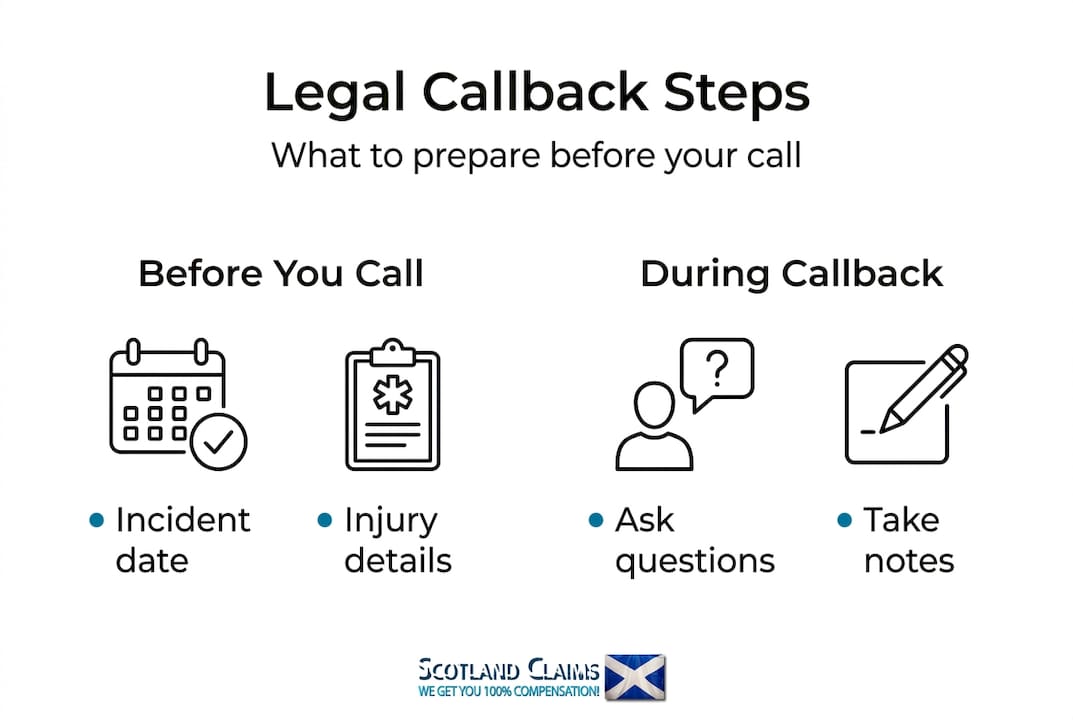
Here is a summary of what to gather before you submit your callback request:
| Information needed |
Why it matters |
| Full name and contact number |
So the solicitor can reach you at the right time |
| Preferred callback time |
Avoids missed calls and wasted attempts |
| Date and location of the incident |
Confirms the claim is within the time limit |
| Description of injury |
Helps assess the severity and likely compensation range |
| Name of the other party or employer |
Identifies who the claim is against |
| Any witness details |
Strengthens your version of events |
| Existing documents or evidence |
Speeds up the initial advice process |
Beyond the table above, make sure you have the following ready before the call:
- Any photographs of the accident scene or your injuries
- Medical records, GP letters, or A&E discharge notes
- An accident book entry if the incident happened at work
- Any correspondence from insurers or the other party
- Your National Insurance number if the claim involves lost earnings
- CCTV or dashcam footage if available
For injuries such as those covered under a back injury claims process, the type and location of your injury will directly affect the questions the solicitor asks. The more specific you can be, the better the initial advice.
Pro Tip: Before you make contact, write down three to five questions you want answered during the callback. Things like “Do I have a valid claim?”, “How long will this take?”, and “What is my claim likely to be worth?” are all reasonable starting points. This stops your mind going blank when the solicitor calls.
Step-by-step: How to request your legal callback
With everything in place, it is time to request your callback. Here is exactly how to proceed.
Step 1: Choose your solicitor or legal service. Look for a firm that specialises in personal injury claims in Scotland and operates on a no win no fee basis. This means no upfront costs and no fees if your claim is unsuccessful.
Step 2: Select your preferred contact method. You can request callbacks via phone, web form, email, or live chat depending on the service you use. Each method has strengths depending on your urgency and personal preference.
Step 3: Submit your request with clear, complete information. Include your name, contact number, a brief summary of your injury, the date it occurred, and your preferred callback times. Do not leave fields blank or give vague descriptions.
Step 4: Wait for confirmation. A reputable service will confirm your request, often within minutes online. Keep an eye on your inbox and make sure your spam filter is not blocking legal correspondence.
Step 5: Follow up if needed. If you have not heard anything within one business day, a brief follow-up call or email is entirely appropriate. Persistence is not rudeness when your legal rights are on the line.
Here is a comparison of the main contact methods:
| Method |
Pros |
Cons |
Typical response time |
| Phone call |
Immediate human contact |
May face a queue during peak hours |
Instant to 30 minutes |
| Online form |
Fast, available 24/7 |
Slightly impersonal |
Same day to next day |
| Email |
Allows detailed explanation |
Can be slower |
1 to 2 business days |
| Live chat |
Quick, written record kept |
Not all firms offer this |
Minutes |
Understanding the legal consultation workflow in advance helps you know what each step leads to and why it is designed that way.
Pro Tip: Online forms submitted outside of business hours are often reviewed first thing in the morning, meaning you can get a callback scheduled overnight. If you are anxious to get moving, submitting a form in the evening may actually be faster than waiting until morning to phone.
Common mistakes and tips for a smoother callback
After submitting your request, it is wise to anticipate what could go wrong. The most preventable delays in getting legal help are caused by simple, avoidable errors on the claimant’s side.
Missed or incomplete information is a common delay in the legal callback process. Solicitors cannot progress with a case assessment if they do not know basic facts. Here are the most frequent mistakes people make:
- Providing a contact number that is incorrect or no longer in use
- Not specifying preferred callback times, leading to missed calls
- Failing to mention the type of injury or the circumstances of the accident
- Leaving out the approximate date of the incident
- Not mentioning existing medical evidence or documentation
- Submitting a request and then being unavailable for hours or days afterwards
- Using vague descriptions such as “I had an accident” without further detail
“Being reachable is just as important as making contact in the first place. If a solicitor calls at the agreed time and cannot get through, the process resets and your case loses momentum. Make sure your phone is charged, available, and that you are somewhere you can speak privately.”
To avoid these issues, double-check your contact details before submitting any form. Specify at least two preferred callback windows. If your situation is particularly urgent, say so clearly. Solicitors prioritise cases where time is genuinely short.
It also pays to explore your options. Finding injury lawyers with free consultations in Scotland means you can get expert input without any financial risk before committing to a particular firm.
Keep your phone on during your specified callback window. This sounds obvious, but it is one of the most frequently reported reasons for missed callbacks. If you are expecting a call between 10am and 12pm, do not schedule a meeting during that time.
What to expect after your callback request
Once your callback is requested, here is what you should expect and how to get the most out of the process.
Clients can expect confirmation and initial advice within hours to one business day. That is the benchmark for a reputable personal injury service in Scotland. If you are waiting beyond that without any contact, something has gone wrong and you should follow up.
Here is what typically happens after your request:
- Confirmation message: You receive an email or text confirming your request has been received and a callback time has been noted
- Verification call: The solicitor may send a brief text or automated message before calling to confirm you are available
- Initial callback: A qualified solicitor or legal adviser contacts you at the agreed time to discuss your situation in plain English
- Case assessment: The solicitor asks structured questions about your injury, how it happened, who was responsible, and what evidence you have
- Next steps outlined: If your claim appears viable, the solicitor will explain what happens next and what the no win no fee arrangement involves
If you do not hear back within one business day, follow up by phone rather than email. A call takes 30 seconds and gets a faster response. Mention that you submitted a callback request and the approximate time you did so.
Before the call itself, review the legal consultation stages so you understand the structure of what you are about to go through. Knowing the solicitor will ask about liability, injury severity, and losses helps you frame your answers more clearly and confidently.
You can also verify the solicitor’s credentials. In Scotland, personal injury solicitors should be registered with the Law Society of Scotland. Asking for the solicitor’s full name and firm at the start of the call is completely normal and professionally expected.
Why a well-prepared callback request makes all the difference
Here is something that often goes unsaid in guides like this. There is a widespread assumption that speed is everything when it comes to getting legal help after an injury. Reach out fast, say what you can, and let the lawyers do the rest. It is an understandable instinct, especially when you are in pain and feeling overwhelmed.
But rushing through a callback request without preparation is frequently counterproductive. We have seen cases where claimants submitted requests with incorrect phone numbers, or described their injuries so vaguely that a solicitor could not even determine which area of law applied. Those cases did not move faster. They moved slower, because they required follow-up contact just to get back to square one.
An experienced solicitor can help far more effectively when the key facts are clear from the start. The first callback becomes a genuine assessment rather than an orientation exercise. That means faster decisions on whether to proceed, faster gathering of evidence, and ultimately a faster resolution.
There is also something to be said for the impression you make. This is not about performance. It is about practicality. A solicitor who receives a well-prepared callback request knows immediately that you are a serious claimant who has thought about their situation. That clarity carries through the entire case.
Before you reach out, consider exploring accident helpline alternatives to understand the range of services available in Scotland. Not all legal services are equal, and knowing your options helps you choose a firm that is genuinely right for your circumstances.
Three minutes of preparation before submitting your callback request can save days of back-and-forth. Write down the date of your accident. Note the name of anyone involved. Think about what evidence you already have. That is not a significant ask when the potential outcome is thousands of pounds in compensation and the vindication of your legal rights.
Get connected with a Scottish no win no fee solicitor today
Now that you know exactly how to request a legal callback and what to prepare, the next step is straightforward. Scotland Claims connects injury victims with specialist injury lawyers in Scotland who operate on a no win no fee basis, meaning you pay nothing upfront and owe nothing if your claim is unsuccessful. You keep 100% of your compensation. Before you reach out, use the compensation calculator to get a realistic sense of what your claim could be worth. Then explore the no win no fee options available to understand exactly how the arrangement protects you. Your callback could be the conversation that changes everything.
Frequently asked questions
How quickly will I get a call back after submitting my request?
Most solicitors respond within hours to one business day, particularly when your request includes complete and accurate information.
Follow up by phone rather than waiting and check that the contact number you provided is correct and active.
Is there a charge for requesting a legal callback for a personal injury?
No, the initial callback request is free, and under a no win no fee arrangement you pay nothing unless your claim succeeds.
Having key details ready such as your full name, contact number, the date and nature of your injury, and any evidence you hold will allow the solicitor to give you precise, useful advice from the very first call.
Recommended