Why seek free legal advice for injury claims in Scotland
TL;DR:
- Free legal advice for injury claims in Scotland includes no win no fee and legal aid options.
- Specialist injury solicitors achieve higher compensation and have in-depth knowledge of Scottish law.
- Acting promptly is crucial as claims must be initiated within three years, or rights may be lost.
Most people who suffer an injury in Scotland assume that getting proper legal help will cost them money they simply don’t have. That assumption stops thousands from claiming the compensation they deserve every year. The reality is quite different. Scottish law provides clear, well-established routes to free initial legal advice, and specialist solicitors can take on your case with no upfront payment required. This guide explains who qualifies, how the main funding routes work, what the claims process looks like from start to finish, and what pitfalls to avoid along the way.
Table of Contents
Key Takeaways
| Point |
Details |
| No upfront legal costs |
Most Scottish injury claims are started without paying any fees thanks to ‘no win no fee’ or legal aid. |
| Higher success with specialists |
Solicitors with Scottish injury expertise win more cases and secure larger settlements for clients. |
| Legal aid protects compensation |
If eligible, legal aid ensures you keep 100% of your award and covers all costs. |
| Watch for exclusions |
Insurance policies and claim value can limit access to free legal help, so always check your position. |
| Advice boosts outcomes |
Early, expert advice leads to faster, higher-value resolutions for injury victims. |
Why free legal advice matters after an accident
An injury doesn’t just hurt. It disrupts your income, piles up costs, and can leave you facing months of rehabilitation. When you’re already under financial pressure, the idea of paying a solicitor’s hourly rate feels impossible. That’s the single biggest reason why so many injured people in Scotland never pursue a claim at all, and it’s a costly mistake.
The good news is that the barrier most people imagine simply doesn’t exist in the way they think. Free legal advice for personal injury claims is not a rare exception. It’s the standard approach. Individuals in Scotland seek free legal advice for personal injury claims primarily through ‘no win no fee’ arrangements or legal aid, both designed to remove upfront costs and financial risk entirely.
The people who typically seek this kind of help include:
- Workers injured on the job, including those in construction, manufacturing, and care
- Drivers and passengers involved in road traffic accidents
- Shoppers or pedestrians hurt in slips, trips, or falls on public or private property
- Families pursuing claims on behalf of children or incapacitated relatives
A common misconception is that free advice means low-quality advice. In practice, solicitors who offer free consultations and no win no fee arrangements are highly motivated to assess your case honestly. They only earn a fee if they win, so they won’t take on weak cases. This actually works in your favour.
“Seeking specialist legal advice early is one of the most important steps an injured person can take. Delay costs both time and compensation.”
Understanding your personal injury rights in Scotland is the foundation of any successful claim. The sooner you act, the stronger your position.
Understanding ‘no win no fee’ and legal aid options
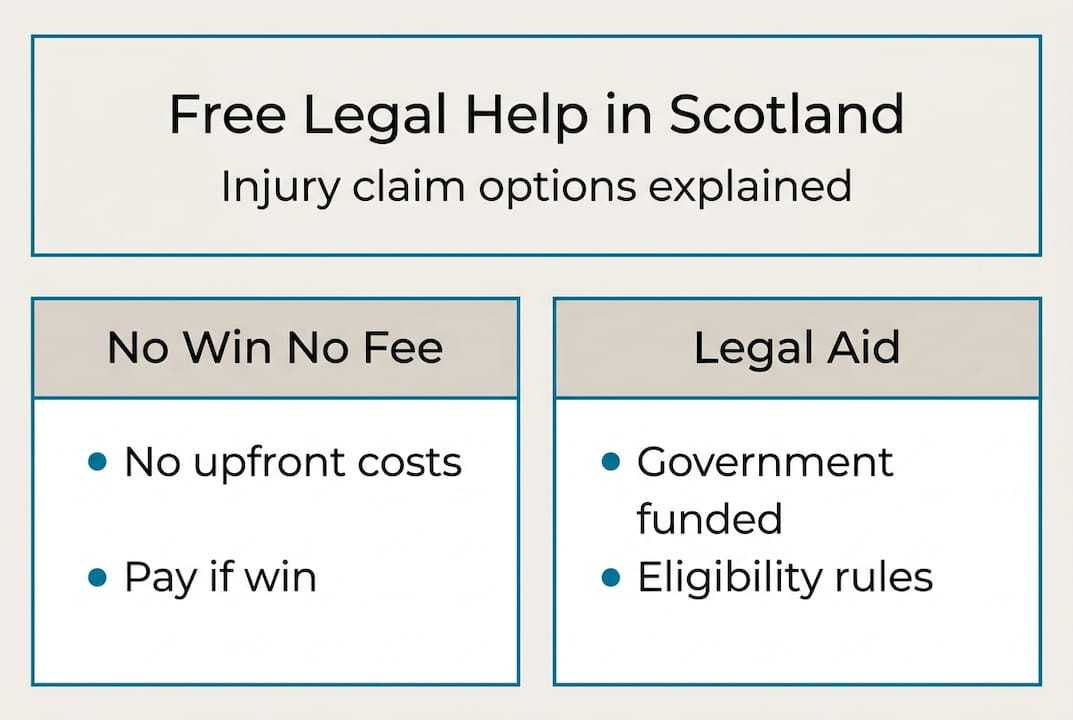
There are two primary routes to free legal representation in Scotland. Each has different eligibility rules, costs, and benefits. Knowing which applies to you is the first step.
No win no fee (formally called a Conditional Fee Agreement, or CFA) means your solicitor takes no payment unless your claim succeeds. If you win, Scotland Claims charges no success fee at all on any type of claim, meaning you keep 100% of your compensation - while most other large firms charge up to 20% including VAT. See our no win no fee guide for full details. After the Event (ATE) insurance is usually arranged to cover your opponent’s legal costs if you lose, so you’re protected either way.
Legal aid is a government-funded scheme. Legal aid is available for personal injury claims if you meet financial eligibility criteria, your claim has better than a 50/50 chance of success, and the case is not considered low value. Crucially, if you win under legal aid, you keep 100% of your compensation.
| Route |
Eligibility |
Your upfront cost |
Success fee |
If you lose |
| No win no fee |
Most claimants |
None |
None (Scotland Claims deducts 0%; most large firms charge up to 20% inc. VAT) |
ATE insurance covers costs |
| Legal aid |
Financial means test + merits |
None |
None |
Costs covered by scheme |
Here’s how the process typically unfolds once you make contact:
- Free initial consultation to assess your claim’s viability
- Funding route agreed, either no win no fee or legal aid application
- Evidence gathering, including witness statements and accident reports
- Medical assessment to document your injuries formally
- Negotiation with the defendant or their insurer
- Settlement or court proceedings if agreement isn’t reached
Pro Tip: Before your first consultation, check whether you already have Before the Event (BTE) legal expenses insurance. This is often included in home or car insurance policies and can cover your claim at no cost to you at all. Check your policy documents carefully.
To understand whether your situation qualifies, review the injury claim eligibility criteria in detail, or find a solicitor offering free consultations to get a direct assessment.
Step-by-step: What happens when you seek free legal advice
Knowing what to expect removes a lot of the anxiety around starting a claim. The process is more straightforward than most people assume.
Your first step is a free consultation. A specialist injury solicitor will review the facts, assess liability, and give you an honest view of your prospects. There’s no obligation to proceed. If your case looks viable, they’ll agree a funding route and begin gathering evidence.
Here’s a realistic timeline for a typical personal injury claim in Scotland:
| Stage |
Typical timeframe |
| Initial consultation and case assessment |
1–2 weeks |
| Evidence gathering and medical report |
4–12 weeks |
| Negotiation with defendant/insurer |
3–6 months |
| Settlement or court hearing |
6–18 months total |
The figures are encouraging. Around 90% of claims settle before reaching court, which means most claimants avoid the stress of a hearing entirely. Specialist firms also report success rates of approximately 90%, and specialists secure 25–30% higher compensation on average compared to generalist solicitors.
One critical point: in Scotland, you generally have three years from the date of your accident or diagnosis to start a claim. Missing this deadline almost always means losing your right to compensation entirely. There are exceptions for children, who have until their 21st birthday, and for those who lack mental capacity.
- Contact a specialist solicitor as soon as possible after your accident
- Preserve all evidence: photographs, medical records, witness details
- Keep a diary of symptoms, missed work, and financial losses
- Attend all medical appointments and follow treatment plans
- Do not discuss your claim on social media
Pro Tip: Bring a written summary of events, your GP or hospital records, and any correspondence with insurers to your first consultation. Solicitors can move faster when the groundwork is already done.
For more on finding the right injury lawyer in Scotland, it’s worth comparing a few firms before committing.
Risks, pitfalls, and edge cases to watch for
Free legal advice routes are genuinely accessible, but there are complications that catch people off guard. Being aware of them puts you in a much stronger position.
One of the most common surprises involves Before the Event (BTE) insurance. If you already have BTE cover through your home or motor insurance, legal aid may be refused on the grounds that alternative funding exists. Always check your existing policies before applying for legal aid.
Other pitfalls to watch for:
- Low-value claims: Legal aid is not available for claims considered too low in value. If your injuries are minor, no win no fee is usually the better route.
- Missing time limits: The three-year deadline is strict. Waiting too long, even by a few weeks, can end your claim.
- Court of Session costs: Cases heard in the Court of Session involve higher potential costs. Understand which court your case is likely to be heard in before proceeding.
- ATE insurance misunderstandings: ATE premiums are often absorbed into the settlement rather than paid upfront, but you should confirm this with your solicitor at the outset.
“Transparency around fees and funding is now a legal requirement. Any solicitor who is vague about costs or success fees should raise immediate concern.”
The eligibility rules for legal aid are specific and worth reviewing carefully. And if you’re unsure whether your situation qualifies, the advantages of working with injury lawyers include having someone assess your options clearly and without obligation.
Why specialist legal advice makes a difference
Not all solicitors are equal when it comes to personal injury claims in Scotland. A generalist solicitor may handle your case competently, but the numbers show a clear gap in outcomes.
Specialist solicitors outperform generalists by 25 to 30% in compensation awarded, largely because of their deep understanding of Scottish law nuances. Scotland has its own legal system, and terms like solatium (compensation for pain and suffering) are calculated differently here than in England and Wales. Getting these figures right requires experience.
Key advantages of choosing a specialist:
- Detailed knowledge of Scottish court procedures and which court suits your claim
- Experience negotiating with major insurers who handle claims routinely
- Understanding of solatium, loss of earnings, and future care calculations specific to Scots law
- Accreditation through the Law Society of Scotland, which you can verify independently
“A specialist solicitor doesn’t just know the law. They know how insurers behave, where defendants typically push back, and how to counter it effectively.”
Always check that your solicitor holds a current practising certificate and, where possible, a specialist personal injury accreditation. The Law Society of Scotland maintains a public register. This takes two minutes and could make a significant difference to your outcome.
The uncomfortable truths most people miss about free injury advice
Here’s something worth saying plainly: when a solicitor offers to take your case for free, it’s not charity. It means they’ve assessed your situation and believe it’s worth fighting for. ‘Free’ in this context is really just ‘risk managed.’ The solicitor carries the financial risk so you don’t have to.
Legal reforms over the past decade have made transparency the norm, not the exception. Success fees are capped. ATE insurance is standard. Hidden costs are far less common than they once were. The system, for all its complexity, is genuinely designed to give injured people access to justice.
What we’ve seen consistently is that people who seek advice early, before evidence fades and deadlines loom, achieve significantly better outcomes. Those who wait, or worse, try to handle insurers themselves, often settle for far less than they’re entitled to. Insurers are experienced negotiators. You deserve someone equally experienced on your side.
Choosing a specialist lawyer isn’t just about compensation. It’s about having someone who understands exactly what you’ve been through and knows how to translate that into a fair result.
Ready to claim in Scotland? How we can help
At Scotland Claims, our specialist injury lawyers offer free initial consultations with no obligation to proceed. Whether you’ve been hurt in a road accident, at work, or through a slip or fall, we can assess your claim quickly and clearly. Our no win no fee arrangements mean you pay nothing upfront and keep 100% of your compensation if we don’t succeed. From back injuries to more complex claims, our team has the expertise to maximise your award. Get in touch today to find out where you stand.
Frequently asked questions
Is free legal advice really free for injury claims in Scotland?
Yes, initial legal advice is genuinely free. No win no fee and legal aid ensure you won’t pay anything upfront if you’re eligible, removing all financial risk from the outset.
What if I lose my injury claim? Will I pay opponent costs?
ATE insurance covers opponent costs if your case is unsuccessful, so you are fully protected against paying the other side’s legal fees.
Who can get legal aid for personal injury in Scotland?
Legal aid is available to those who meet financial eligibility rules and have a claim with a realistic, better than 50/50 chance of success that is not considered low in value.
Are there time limits for starting an injury claim in Scotland?
You must usually start your claim within three years of the accident or diagnosis. Children have until their 21st birthday, and different rules apply for those lacking mental capacity.
Why should I choose a specialist solicitor for my claim?
Specialist solicitors secure 25–30% more in compensation on average, thanks to their expertise in Scottish injury law and experience negotiating with insurers.
Recommended