Claim Fast After an E Scooter Accident in Scotland With No Win No Fee
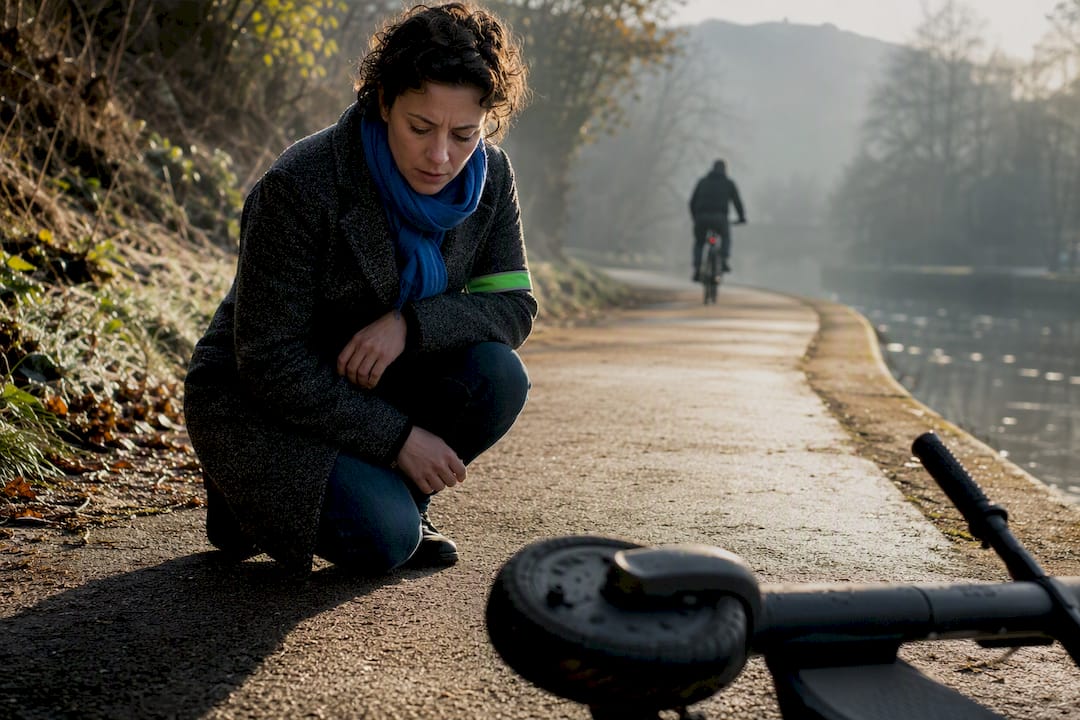
Private e-scooters are illegal to ride on Scotland’s roads, pavements and parks, full stop. They fall under the Road Traffic Act 1988 as motor vehicles, and Police Scotland has the power to seize them on sight. But illegality on the rider’s part does not switch off your right to claim if someone else’s negligence caused your injuries. If you were hurt in an e-scooter collision, speak to a specialist Scottish solicitor at Scotland Claims Injury Lawyers before evidence disappears.
TL;DR:
- Riding private e-scooters on any public road, pavement, or park in Scotland is illegal under current law, with no active rental trials currently permitted.
- Compensation claims can still be made after an e-scooter collision, but finding an insurance provider or liable defendant is usually more difficult in Scotland.
- Immediate evidence gathering, including police incident numbers, photos, and medical records, is crucial within the first 48 hours to support a civil claim.
- Legal advice from a specialist Scottish personal injury solicitor is essential, as the insurance gap for private riders complicates recovery and early legal action improves outcomes.
Table of Contents
Legal status in Scotland: why private e-scooters are unlawful in public and the rental-trial gap
An e-scooter is legally classed as a Powered Light Electric Vehicle, or PLEV. That single classification is the reason the whole legal picture looks so strange to most riders. PLEVs meet the definition of a “motor vehicle” under the Road Traffic Act 1988, which means anyone using one on a public road, pavement, cycle path or park needs the same things a car driver needs: a valid licence, road tax, registration, and third-party insurance. Almost no private e-scooter meets those requirements, because manufacturers do not build them to be type-approved or insured for public roads.
The Law Society of Scotland has been blunt about this: private e-scooters are illegal to ride in public anywhere in Scotland, and lawful use is restricted to private land where the owner has given permission. There is also an older piece of legislation quietly propping up part of the pavement ban. The Highway Act 1835 prohibits “carriages” from footways, and courts have treated e-scooters as falling within that old definition when ridden on pavements.
Where this gets confusing is the rental side. The UK government introduced SI 2020/663, secondary legislation that lets local authorities in England, Wales and Scotland run authorised rental e-scooter trials with proper insurance and speed limits. English cities including Bristol and Newcastle jumped on this. Scotland has not run a single trial. Transport Scotland has told commentators that further devolved legislative changes and Traffic Regulation Order amendments are needed before any Scottish council could realistically launch one, and that groundwork has not been completed.
The practical upshot for anyone reading this in Scotland:
- Riding a privately owned e-scooter on any public road, pavement, cycle lane or park is illegal, regardless of speed or care taken.
- The only lawful public use of a rental e-scooter would be inside an authorised trial, and no such trial currently operates anywhere in Scotland.
- Riding on private land is lawful only with the landowner’s explicit permission, and only if that land is genuinely private, not a public park or common area.
- Being hit by, or colliding with, an illegally ridden e-scooter does not automatically bar an innocent victim from claiming compensation.
Enforcement and penalties in Scotland: seizures, fines and penalty points
Police Scotland is not treating this as a grey area. Under section 165A of the Road Traffic Act 1988, officers can seize any vehicle being used without insurance or a valid licence, and e-scooters fall squarely within that power. Between 1 January and 30 September 2024, Police Scotland recorded 281 seizures of e-bikes and e-scooters, and the force has repeated its warning that these devices are not permitted on public roads, pavements or other public spaces.
Riding uninsured is an offence under section 143 of the same Act. Combine that with no licence, and someone stopped on a private e-scooter can be looking at more than one penalty at once.
| Offence |
Typical consequence |
| No insurance (section 143) |
Fixed penalty and points, or prosecution; vehicle seizure |
| No valid licence for the vehicle class |
Fixed penalty; potential prosecution |
| Riding on the pavement |
Fixed penalty under pavement/footway offences |
| Riding without lawful authority in a public space |
Seizure under section 165A; device may not be returned without proof of insurance and licence |
A seizure does not end the story for an injured third party. If you were knocked down by a rider whose e-scooter was later seized, that seizure record and the police incident number become useful evidence for your civil claim, separate entirely from any criminal penalty the rider faces. Criminal and civil proceedings run on parallel tracks: a fixed penalty notice against the rider does not deliver you compensation, and a civil claim does not depend on the rider being prosecuted. If the device is seized before your solicitor can inspect it, ask the police for the seizure reference early, since retrieving it later gets harder.
Who can be held liable and what compensation routes exist
Liability in an e-scooter case runs on the same negligence principles as any other road accident: did someone owe you a duty of care, did they breach it, and did that breach cause your injury? The rider is usually the obvious starting point, but they are rarely the only possible defendant.
- The rider is liable where careless or reckless riding caused your injury, whether that is running a red light, mounting a pavement at speed, or failing to give way to a pedestrian.
- The device owner, if different from the rider, such as a parent whose child was riding, or an employer whose staff member was using a company-provided device for deliveries.
- An employer, where the e-scooter was being used for work purposes and the employer’s own liability insurance responds.
- A premises owner or local authority, if defective surfacing, poor lighting or an unsafe road layout contributed to the collision independently of the rider’s actions.
The insurance question changes everything about how easy recovery actually is. Where a rental operator is involved in an authorised trial, GOV.UK guidance confirms that the operator must provide insurance and the rider needs a valid driving licence, which gives an injured claimant a clear, identifiable insurer to pursue. Since no such trial exists in Scotland, that route is not currently available here. A private rider, by contrast, is almost never insured in any way that satisfies compulsory motor insurance rules, and the Law Society of Scotland notes this creates a genuine recovery gap for injured third parties.
That gap does not mean no claim is possible. It means your solicitor needs to look harder for a viable defendant or insurance policy, whether that’s the rider’s household contents cover (if it happens to extend to personal liability), an employer’s public liability policy, or your own uninsured driver protection if you hold a motor policy yourself. Contributory negligence can also reduce what you recover: if you stepped into a cycle lane without looking, or the rider was clearly breaking the law but you were also partly careless, a court can reduce your award proportionately rather than refuse it outright.
What you do in the first 48 hours after an e-scooter collision often decides whether a claim succeeds. Evidence for these cases disappears fast: riders leave the scene, footage gets overwritten, and injuries that seem minor at first can turn out to need ongoing treatment.
- Get medical attention first, even if the injury feels minor. A head knock or wrist sprain can hide something more serious, and NHS Greater Glasgow & Clyde has warned about rising e-scooter injury severity, including head trauma and fractures.
- Photograph everything at the scene: the e-scooter, the road or pavement surface, any visible injuries, and the wider location showing lighting, signage or hazards.
- Get the rider’s details if they stay, including a phone number, and note the e-scooter’s appearance if they flee.
- Call the police and ask for an incident number. This becomes a key reference for both the criminal side and your civil claim.
- Track down witnesses and ask for contact details before they walk off.
- Request CCTV or doorbell footage from nearby shops or homes quickly, since most systems overwrite within days or weeks.
- Keep every receipt and medical note connected to the injury, from GP letters to physiotherapy invoices.
- Contact a solicitor promptly rather than waiting to see how the injury heals.
Scottish personal injury claims generally must be raised within three years of the date of the accident, with limited exceptions for children or cases involving latent injuries that only become apparent later. Missing that window usually ends any right to compensation, so early advice matters even if you are unsure whether you have a case.
Pro Tip: Ask the attending police officer for the crime or incident reference number before you leave the scene. Without it, tracking down the full report later can take weeks and delay your claim.
Scotland Claims Injury Lawyers offers a free initial assessment of what happened, helps gather the evidence outlined above, and works on a No Win No Fee basis throughout, so there is no upfront cost to finding out where you stand.
Insurance issues and common barriers to recovery
Most private e-scooters simply cannot be insured in any way that satisfies compulsory motor insurance rules, which is the single biggest practical obstacle in these claims. Riding uninsured on a road breaches section 143 of the Road Traffic Act 1988, and because no UK insurer market has developed for privately owned devices used on public roads, almost every private rider is technically breaking the law the moment they set off, insured or not.
That leaves injured third parties in an awkward position. A rider’s household or contents insurance rarely extends to injuries they cause while riding a motor vehicle in public, since most policies specifically exclude motorised transport from personal liability sections. Before assuming a policy will help, ask the insurer directly whether e-scooter use is excluded; many policies contain a blanket motor vehicle exclusion buried in the small print.
- Check whether the rider had any personal liability cover that might respond, even if unlikely.
- Look at whether an employer or business was involved, since work-related motor claims can open up an employer’s liability route.
- If your own motor insurance includes uninsured driver protection, ask your insurer whether it applies here.
- Consider whether legal expenses insurance attached to a household policy could fund early investigation while liability is established.
Why instruct a specialist Scottish personal injury solicitor now
E-scooter cases are messier than a standard road traffic claim because the vehicle itself sits outside normal insurance and licensing systems. That is exactly the kind of complexity a specialist Scottish solicitor is built to untangle, tracing insurers, employers and third parties that a general practice might miss.
Scotland Claims Injury Lawyers focuses solely on personal injury claims in Scotland, covering road traffic accident, workplace injuries and slips or trips. That stands in sharp contrast to the typical arrangement at many other Scottish firms, where a success fee of of up to 20% including VAT is taken directly from the client’s award.
What you can expect from the process:
- A free assessment of your case, with no obligation to proceed.
- Evidence gathering, including police reports, medical records and witness statements.
- Negotiation directly with the liable party or their insurer.
- Settlement where possible, or court proceedings where necessary to secure fair compensation.
- No upfront costs and no success fee are taken from your award if you win.
Impact of e-scooter accidents on pedestrian and cyclist rights
Pedestrians and cyclists carry none of the legal risk in these collisions but often bear the physical cost. If you are walking on a pavement and an e-scooter rider strikes you, you have done nothing wrong, and the illegality sits entirely with the rider, not you.
That distinction matters for how a claim gets argued. A pedestrian struck on a footway can point to the rider’s unlawful presence there in the first place as part of establishing negligence, alongside how they were actually riding. Cyclists sharing a lane with fast-moving, near-silent e-scooters face a different problem: e-scooters can reach speeds that outpace a cyclist’s ability to react, and the absence of any indicator or bell on most private devices removes normal warning cues.
Shared surfaces such as canal towpaths, shared-use paths and pedestrianised precincts see a disproportionate share of these incidents, partly because riders mistakenly believe those areas are exempt from the general ban. They are not. A pedestrian struck by any vehicle retains full rights to pursue a claim, and the fact that the offending vehicle was an illegally ridden e-scooter rather than a car does not weaken that position. If anything, it strengthens it, since the rider was breaking the law by being there at all.
Differences between e-scooter accident law in Scotland and other UK jurisdictions
England has working rental e-scooter trials in dozens of towns and cities; Scotland has none. That single fact creates a real divergence in how claims unfold either side of the border. A pedestrian injured by a rental e-scooter in an English trial city has a clear operator and an insurance policy to pursue, because GOV.UK’s trial framework requires it. A pedestrian injured in Glasgow or Edinburgh by a private e-scooter has no such operator, because there is no lawful rental scheme to have one.
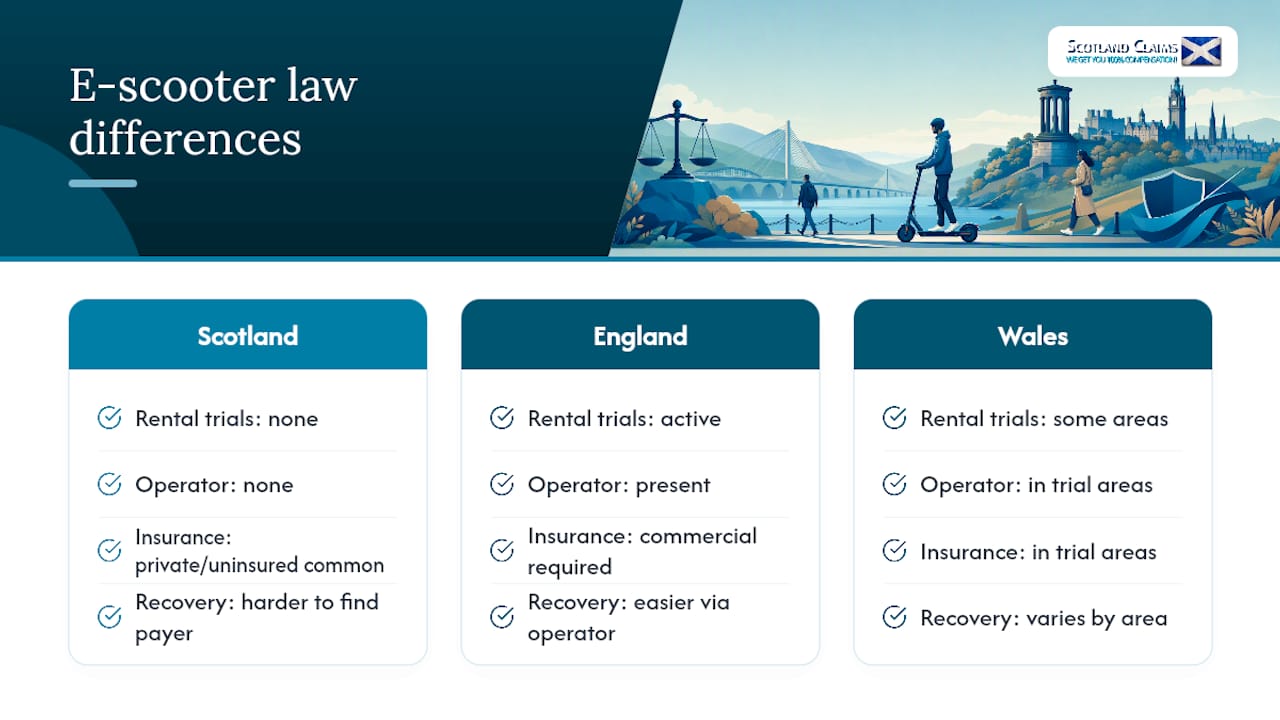
The underlying criminal law is broadly similar across Great Britain, since the Road Traffic Act 1988 applies UK-wide and PLEVs are treated the same way everywhere the Act reaches. What differs is the practical trial infrastructure sitting on top of that law. Wales has trialled schemes in some areas too, again leaving Scotland as the outlier with a fully authorised trial gap.
For claimants, the difference is less about rights and more about routes to recovery. A Scottish claimant dealing with a private, uninsured rider generally has to work harder to find a paying defendant than someone in a trial city dealing with an operator’s commercial policy. This is precisely why early legal advice from a solicitor who understands the Scottish position specifically, rather than generic UK guidance, makes a genuine practical difference to outcome.
Recent or upcoming legislative changes affecting e-scooter accident law in Scotland
Nothing has fundamentally shifted the legal position in Scotland recently, and that stasis is itself the story. SI 2020/663 has sat on the books since 2020 as the enabling instrument for rental trials, yet Scottish councils have not used it. Transport Scotland has acknowledged engagement with the Department for Transport on the issue, but has identified that further devolved primary and secondary legislation, plus Traffic Regulation Order amendments, would need to happen before any trial could launch north of the border.
There is no confirmed timetable for that work. Riders and campaigners in Scotland continue to push for a UK-wide overhaul of PLEV rules that would create a proper legal category for private e-scooters, similar to how e-bikes were eventually accommodated, but no such reform has passed into law at the time of writing. Until that changes, the current position holds firm: private e-scooters remain illegal in public across Scotland, with enforcement continuing at the level Police Scotland has already demonstrated through its 2024 seizure figures.
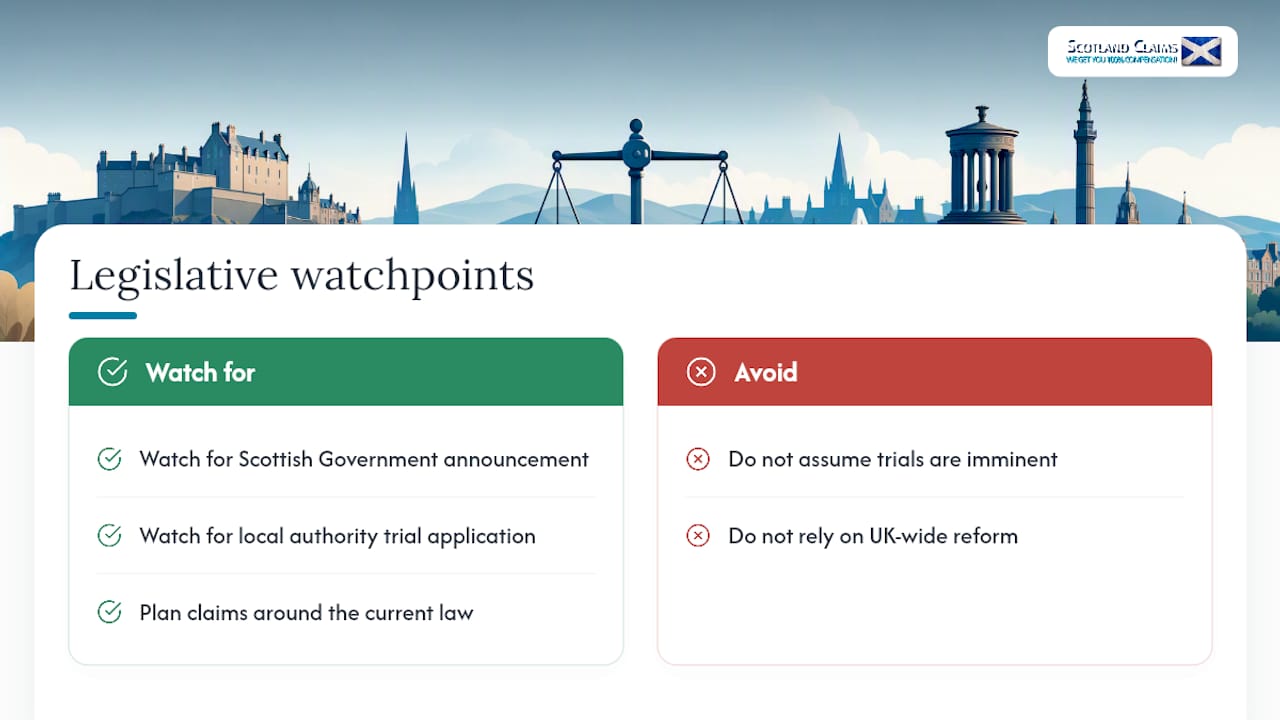
Anyone monitoring this space should watch for two things: any Scottish Government announcement about devolved e-scooter legislation, and any local authority formally applying to run a trial. Neither has happened yet, and claimants should plan around the law as it stands today rather than anticipated reform that has no confirmed date.
Legal responsibilities of e-scooter riders regarding road safety
Even setting aside the question of whether riding in public is lawful at all, e-scooter riders carry the same basic road safety duties as any other road user. GOV.UK’s user guidance for trial areas sets out minimum age limits, licence requirements and a clear rule against riding while intoxicated, and those standards reflect the wider duty of care every rider owes to others nearby, private or rental.
A rider who mounts a pavement, ignores a red light, weaves through pedestrians at speed, or rides without lights after dark is not just breaking a specific rule. They are breaching the general duty of care that underpins every negligence claim in Scottish law. That breach becomes the foundation of a civil case if it causes injury, regardless of whether the rider is also facing a fixed penalty or prosecution for the same conduct.
Riders also carry responsibility for maintaining their device. A poorly maintained brake system or a device with no functioning lights at night adds a second layer of fault on top of any reckless riding, and a solicitor building your case will look at both. Riders who lend their e-scooter to someone else, particularly a minor, can face questions about whether that decision itself was reasonable given the rider’s age, experience and the conditions.
What the evidence actually tells us about e-scooter claims in Scotland
The gap between the law and everyday behaviour on Scotland’s streets is wide, and it is not closing quickly. Nearly 300 seizures in nine months tells you enforcement is active, not theoretical, yet private e-scooters remain a common sight on Glasgow and Edinburgh pavements. That contradiction is the real story here, not a legal technicality.
What gets overlooked in most guidance on this topic is the insurance gap, not the illegality itself. Most people assume that because riding is illegal, claims must be impossible. That is wrong, and it is the single biggest misconception worth correcting. The rider’s illegal status has no bearing on your right to claim as an innocent victim; the real obstacle is finding a solvent, identifiable defendant or policy to pursue, which is a practical evidence problem, not a legal barrier.
If you take one thing from this article, it should be speed. Evidence in these cases decays faster than in a standard car accident claim, because there is no registration plate to trace and no compulsory insurer to write to automatically. Acting within days, not months, of an e-scooter collision gives a solicitor the best chance of identifying who can actually pay.
— Roger
Start a free No Win No Fee claim with Scotland Claims
Scotland Claims Injury Lawyers takes nothing from your compensation. While most other Scottish firms deduct a success fee of up to 20% including VAT from a client’s settlement, our No Win No Fee arrangement means you keep 100% of what you’re awarded, with no upfront costs and nothing to pay if the claim doesn’t succeed.
If you’ve been injured in an e-scooter collision, whether as a rider, pedestrian or cyclist, get in touch with the date, location and nature of your injuries to hand, along with any police reference number, witness details and photographs you managed to gather. Use the compensation calculator to get an early sense of what your claim could be worth, then submit your details through our No Win No Fee claims service for a free, no-obligation assessment from a solicitor who understands Scottish e-scooter cases specifically.
This article is general information, not a substitute for advice from a qualified lawyer. Consult a qualified legal professional about your own circumstances before acting on anything here.
Sources
FAQ
Will police stop me for riding a private e-scooter in Scotland?
Yes. Police Scotland actively enforces the ban on private e-scooters in public spaces and recorded 281 seizures of e-bikes and e-scooters between January and September 2024 alone.
What happens if a driver hits an illegal e-scooter rider?
The illegality of the e-scooter does not automatically shield a negligent driver from liability, and each case turns on who breached their duty of care and whether the rider’s own conduct contributed to the collision.
What is the punishment for riding an e-scooter illegally in Scotland?
Riders can face a fixed penalty and points for offences including no insurance and pavement riding, alongside seizure of the device under section 165A of the Road Traffic Act 1988.
What is the latest update on e-scooter law in Scotland?
Private e-scooters remain illegal in all public spaces, and while SI 2020/663 permits rental trials in principle, none currently operate in Scotland because further devolved legislative changes are still required.
Can I still claim compensation if the e-scooter rider who hit me was uninsured?
Yes, though recovery is harder without an identifiable insurer; a solicitor will look at the rider’s assets, any employer involved, or other liable parties, and Scotland Claims Injury Lawyers offers a free assessment to explore your options with no success fee taken from any compensation won.
Recommended