Win a Glasgow Council Claim With No Upfront Cost or Success Fee
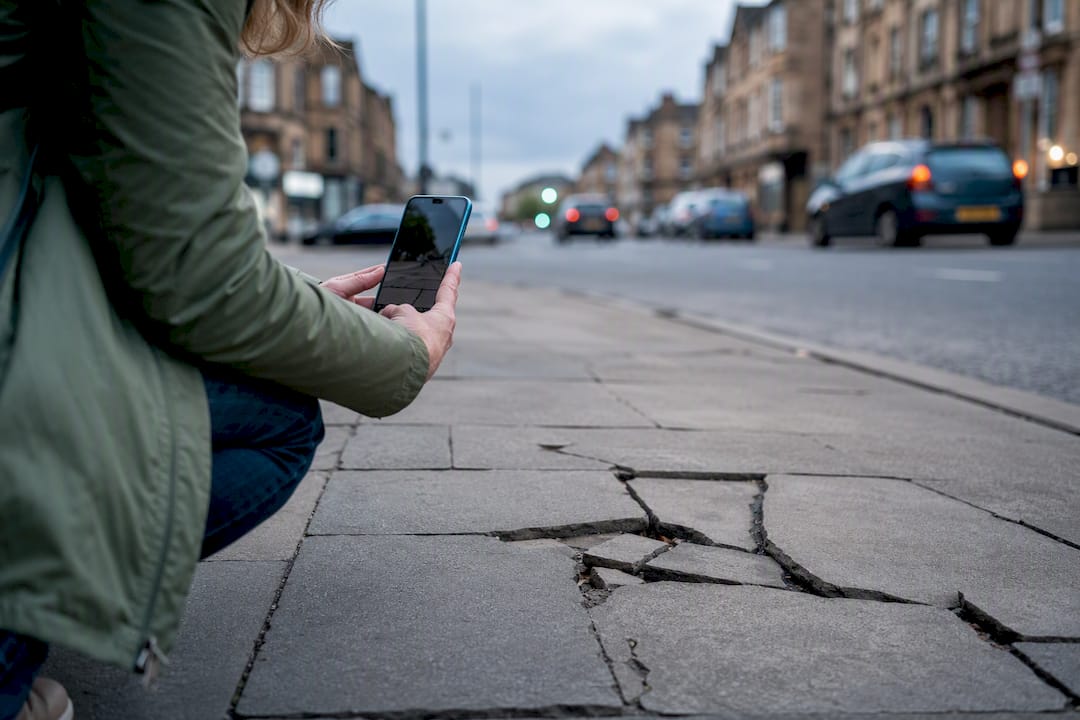
You can make a council claim in Glasgow if you can show Glasgow City Council’s negligence caused your injury or property damage, most commonly through a pothole, a broken pavement slab, or a failure to maintain a road they knew was dangerous. The first thing to do is preserve evidence and note the exact location and date. If the incident happened close to three years ago, get a legal check immediately, because the triennium is running out.
TL;DR:
- Gathering photographic evidence from multiple angles within 48 hours strongly supports proving the defect’s existence and details; retaking photos after some days can undermine the council’s defense.
- Precise documentation of the incident location, timing, witness contact details, CCTV footage, and medical notes significantly increases the chances of a successful claim.
- Submitting a formal online claim with all supporting evidence, and keeping proof of submission, is crucial to demonstrate timely filing and proper process.
- Defects must pose a genuine danger and be known about long enough for the council to have fixed them; small cracks or ordinary wear are less likely to lead to liability.
- Legal action must typically be initiated within three years of the incident or awareness, and delaying can forfeit the right to claim, especially if evidence is lost or the defect is repaired.
Table of Contents
What evidence to gather for a Glasgow council claim
Courts want specifics, not a vague memory of “a bad pothole on some street near the shops.” The evidence you collect in the first 48 hours often decides whether a claim succeeds or dies quietly months later.
- Photograph the defect from several angles, including one wide shot showing the surrounding pavement or road, and one close-up with a coin or tape measure for scale.
- Record the exact street name, nearest property number, and the date and time of the incident.
- Get names and phone numbers from anyone who saw it happen, and ask them to jot down what they saw while it’s fresh.
- Request nearby CCTV or dashcam footage quickly, since many systems overwrite after a few weeks.
- See a GP or attend A&E even for a minor-seeming injury, because contemporaneous medical notes carry far more weight than a description written months later.
- Keep receipts and written quotes for any repairs, from a bent wheel rim to a cracked phone screen.
Reporting a defect through Glasgow’s Roads and Lighting Faults system flags the hazard to the council, but it is not the same as making a compensation claim. Keep the fault reference number anyway. It becomes useful evidence that the council knew about the defect.
Pro Tip: Photograph the defect again a few days later if it’s still there. A second dated photo showing the hazard was left unrepaired often does more to undermine the council’s defence than the original photo alone.
How to submit a claim to Glasgow City Council
Filing correctly, and being able to prove you filed on time, matters as much as the strength of your evidence.
- Go to Glasgow City Council’s compensation and claims page and complete the online claims form, which asks for the exact location, the date, a description of the defect, and details of your injury or damage.
- Attach your photos, any witness statements, medical letters, and repair quotes directly to the online submission where the form allows it.
- If you submit by post or email instead, use recorded delivery or request a read receipt, so you have proof of the date the council received your claim.
- Note down any reference number the council issues on acknowledgement, and keep the confirmation email or letter safe.
- Expect an acknowledgement within a couple of weeks, followed by an investigation period during which the council checks its inspection records for that stretch of road or pavement.
A RALF fault report and a compensation claim are two different processes that work together. The report tells the council to fix the hazard; the claim is your formal request for damages, and only the claim starts the process that can lead to a payout.
The legal test and the defences the council will use
Scots law on this comes down to one core question: was the defect dangerous enough, and known about long enough, that a competent council should have fixed it? Not every crack or dip in a pavement counts. The law distinguishes between a genuine hazard and a “mere imperfection” that any reasonable person would expect to navigate safely.
The council’s main line of defence is the statutory inspection system. If Glasgow City Council can show it operated a reasonable, regularly followed inspection and repair regime for that road or pavement, that goes a long way toward defeating a claim, even where an accident genuinely happened.
A council’s failure to follow its own inspection policy is strong evidence of negligence, but the courts do not treat it as conclusive on its own. Judges weigh it alongside the size and location of the defect and whether an authority of ordinary competence would have acted on it.
Scottish case law consistently returns to measurement evidence, and Pocock v The Highland Council is the case most solicitors cite. Defect depth, often measured against a rough 20mm threshold, gets scrutinised closely, because it separates a genuine trip hazard from ordinary wear and tear that the Court of Session has said councils aren’t expected to eliminate entirely.
- Ask the council for its inspection and maintenance logs for the relevant stretch, ideally through a Freedom of Information request.
- Keep your own measurement evidence, taken at the time, as a check against whatever the council’s own inspectors recorded.
- Remember that liability generally requires proximity and foreseeability, not just the fact that an accident happened somewhere on council land.
How long do you have to make a claim?
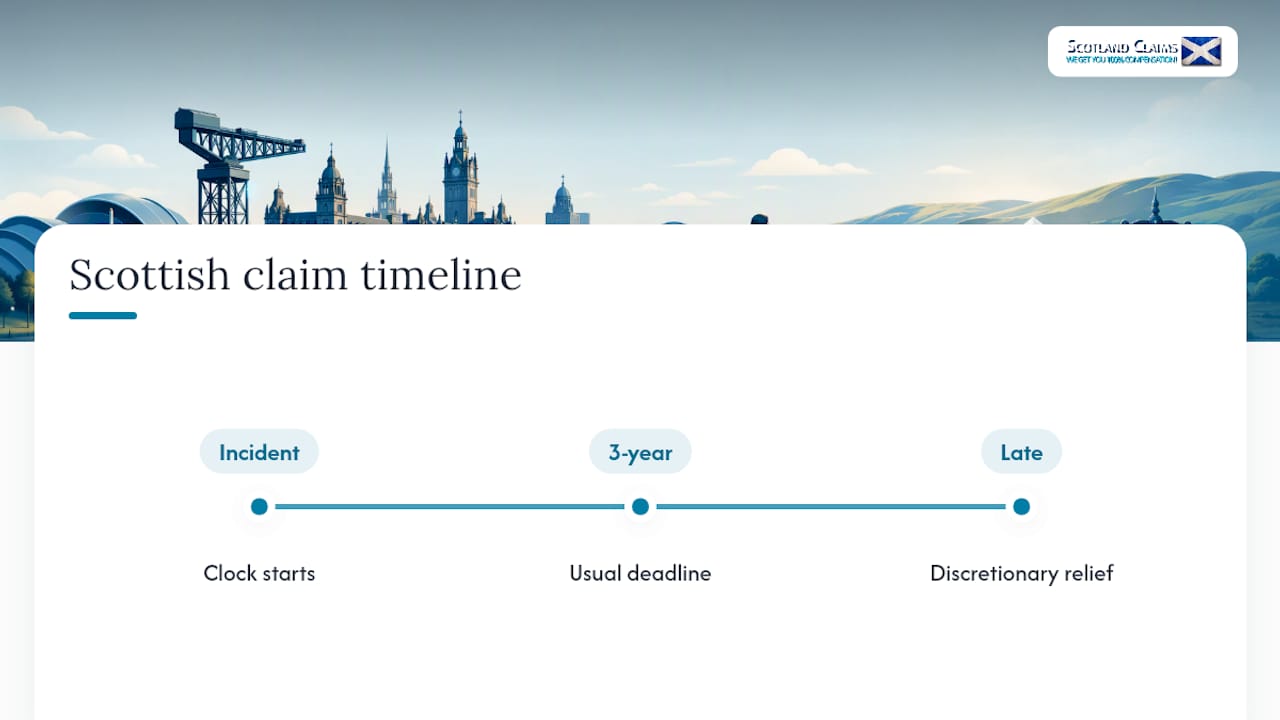
You generally have three years from the date of the incident, or from the date you first became reasonably aware of your injury, to raise a court action under the Prescription and Limitation (Scotland) Act 1973. After that, a claim is usually time barred.
Courts can occasionally allow a late claim in narrow circumstances, but this is discretionary and far from guaranteed, so treat the triennium as a hard deadline rather than a fallback option. If your incident happened close to three years ago, don’t wait for a “better time” to get advice. Speak to a solicitor now, because preparing even a basic claim pack takes time you may not have left.
If Glasgow City Council rejects your claim
A rejection letter isn’t the end of the road. It’s usually the start of a more focused stage of the process.
- Read the rejection carefully. Common reasons include a claim that the council had no prior knowledge of the defect, an argument of contributory negligence on your part, or a dispute over exact timing.
- Request the council’s inspection logs, CCTV footage, and repair history for the location if you haven’t already, using a Freedom of Information request where the council hasn’t volunteered them.
- Gather any further measurement evidence, expert reports, or additional witness statements that strengthen your position.
- Weigh negotiation against court action. A solicitor can often reopen negotiations with fresh evidence before litigation becomes necessary.
- Get a solicitor involved at this stage if you haven’t already. Building a court-ready case, complete with expert input and properly structured witness evidence, is far harder to do without one.
When to instruct a solicitor for your Glasgow council claim
If your injury is more than minor, if the council is disputing its inspection record, or if your three-year deadline is approaching, that’s the point to bring in a specialist rather than keep gathering evidence alone. Scotland Claims Injury Lawyers offers a free assessment of your case, and if you go ahead, you pay nothing upfront and no success fee. It’s one of the lowest, most straightforward arrangements available in Scotland.
At first instruction, your solicitor will review your evidence, submit Freedom of Information requests for the council’s inspection records, draft a formal claim pack, and open negotiations with the council on your behalf. Whether your case involves a road traffic accident, a workplace injury, or a slip or trip on a council-maintained pavement, the same no upfront cost principle applies.
Use the compensation calculator to get a rough sense of what your claim could be worth, then head to the injury lawyers page to request a free callback. You can also read more about how the No Win No Fee arrangement works before you decide anything.
A note from Roger on the single biggest mistake claimants make
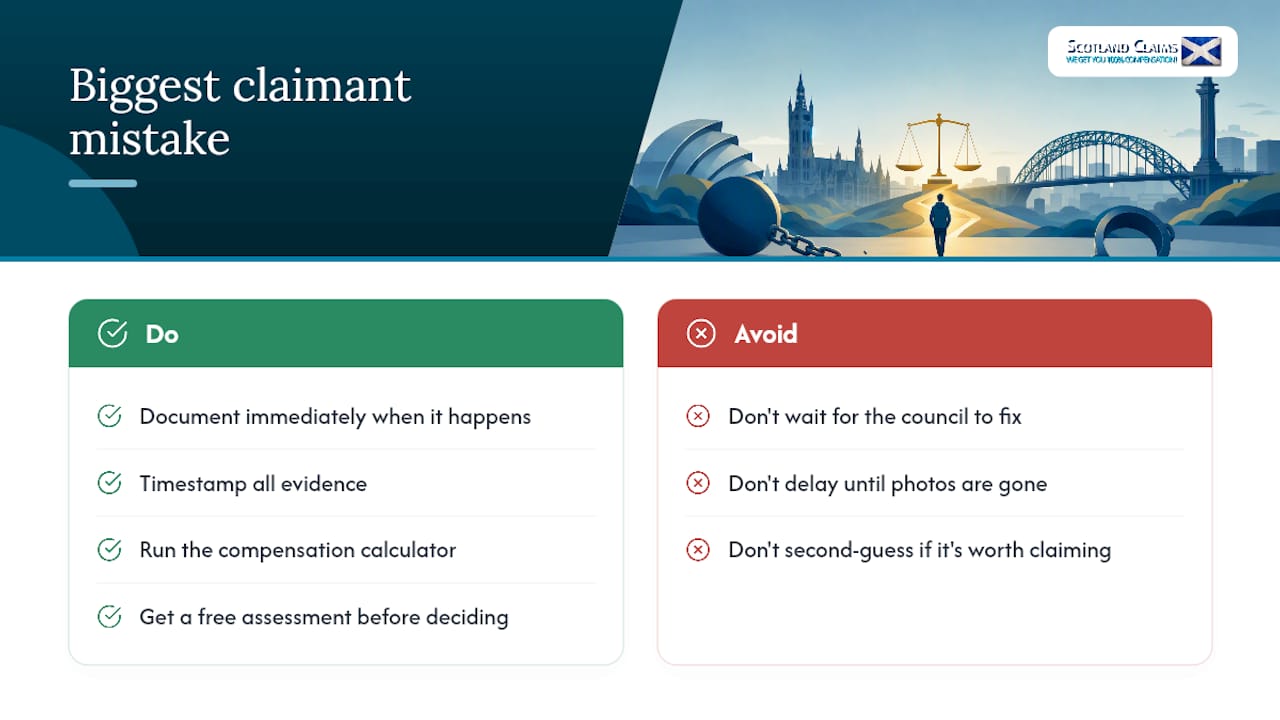
The pattern I see again and again isn’t weak legal arguments. It’s evidence that arrived too late. People wait, hoping the council will “sort it out,” and by the time they seek advice the defect has been repaired and the photos are gone.
Document everything the moment it happens, timestamp it, and don’t second-guess whether it’s “worth” claiming. Run the numbers through the compensation calculator and get a free assessment before you decide it isn’t.
— Roger
This article is general information, not a substitute for advice from a qualified lawyer. Consult a qualified legal professional about your own circumstances before acting on anything here.
Sources
FAQ
How do I make a claim against the council in Glasgow?
Complete Glasgow City Council’s online compensation form with the exact location, date, description of the defect, and supporting evidence such as photos, witness details, and medical or repair records.
Can I claim compensation for pothole damage from the council?
Yes, if you can show the council knew or should have known about the pothole and failed to repair it within a reasonable time, you can claim for both injury and vehicle or property damage.
How do I speak to someone at Glasgow City Council about my claim?
Glasgow City Council handles claims and general enquiries through its online complaints and information service, which also covers Freedom of Information requests for inspection records.
How long do I have to make a council claim in Glasgow?
You generally have three years from the incident date, or from when you became aware of your injury, under the Prescription and Limitation (Scotland) Act 1973, so acting early protects your position.
What happens if Glasgow City Council rejects my claim?
You can request their inspection and repair records, gather further evidence, and either renegotiate or proceed to court action, ideally with a solicitor handling the process on a No Win No Fee basis.
Recommended