100% of Your Compensation in Scotland: CICA or Civil Claim?

If you searched “cica claim Scotland” because you were hurt in an accident that wasn’t your fault, this article covers civil personal injury compensation, not criminal injury awards. You need a Scotland-based personal injury solicitor who works on a no win no fee basis, understands the pre-action protocol, and can assess your case for free.
TL;DR:
- Most claims are settled within six to nine months if liability is admitted early and medical evidence is clear; complex cases may take over a year.
- The three-year time limit for injury claims starts from the accident date or when the injury becomes known, with extensions for children, latent injuries, and fatalities.
- Scotland’s no win no fee model guarantees claimants keep 100% of their compensation, with no success fee deducted or upfront costs required.
- Civil injury claims must follow a pre-action protocol involving a letter of claim, evidence exchange, and settlement attempts before court proceedings.
- Proper evidence collection, including medical records, photographs, witness details, and financial documents, significantly speeds up case valuation and settlement.
Table of Contents
Who can claim and the time limits you must know in Scotland
Anyone injured in Scotland through another party’s negligence can usually bring a claim, whether that is a road traffic accident, a workplace injury, or a slip or trip on someone else’s property. The person bringing the case is called the pursuer, and the test is straightforward: did someone else’s carelessness cause your injury? If the answer is yes, you have grounds to claim.
Time limits are where people trip up. Scots law generally gives you a few years from the date of the accident, or the date you became aware of your injury, to raise court proceedings. Miss that window and your claim is almost always barred, regardless of how strong the evidence is.
There are important exceptions worth knowing:
- Children: the three-year clock doesn’t start until the child turns 16, so claims on behalf of injured children can often wait longer without being time-barred.
- Latent injuries: conditions that only become apparent years later (certain industrial illnesses, for example) run from the date of knowledge, not the date of exposure.
- Fatal cases: relatives of someone who died from an accident have three years from the date of death, or from when they became aware the death was linked to negligence.
If you’re within a few months of your three-year deadline, don’t wait for the “right time” to call a solicitor. Court papers take time to prepare, and a rushed claim near the deadline is a weaker one. Scotland Claims Injury Lawyers’ guide on personal injury claim time limits in Scotland sets out the detail if you’re unsure where you stand.
How no win no fee works in Scotland and your protections
Most personal injury claims in Scotland are funded through speculative fee arrangements, commonly known as no win no fee. Under this model, your solicitor takes on the financial risk of the case; if the claim fails, you typically owe nothing for the legal work itself. If it succeeds, the solicitor usually deducts a success fee from your compensation before you’re paid out.
That’s where most firms and the big brand solicitors part ways with what claimants actually need. The Law Society of Scotland’s guidance on the Style Success Fee Agreement requires solicitors to give clients a clear, written agreement and a cooling-off notice before anyone signs anything, so you understand exactly what you’re agreeing to before you commit. This followed statutory changes under the Civil Litigation (Expenses and Group Proceedings) (Scotland) Act 2018, which put success fee agreements on a proper legal footing.
Qualified One-way Cost Shifting, known as QOCS, adds another layer of protection. In most personal injury actions, QOCS means that if you lose, you generally won’t have to pay the defender’s legal costs, provided you haven’t behaved fraudulently or unreasonably during the case. That removes one of the biggest fears people have about going to court: the risk of ending up worse off than before.
Here’s where Scotland Claims Injury Lawyers differs from the standard model entirely:
- No success fee deducted from your settlement, ever.
- No upfront costs to start your claim.
- A free case assessment before you commit to anything.
- 100% of your compensation stays with you, compared with up to 20% (including VAT) taken by many big brand solicitors elsewhere.
Pro Tip: Always ask a solicitor to state their success fee percentage in writing before you sign anything. If they can’t give you a straight answer, that’s a warning sign, not a technicality.
The compulsory pre-action protocol and a practical timeline for a typical claim
Most personal injury claims of relatively low value in Scotland must follow a compulsory pre-action protocol before anyone goes near a courtroom. The idea is simple: force early honesty on both sides so cases settle without litigation wherever possible.
- Letter of claim: your solicitor sends the defender (or their insurer) a formal letter setting out what happened, why they’re liable, and the nature of your injuries.
- Information exchange: both sides share relevant evidence, medical information, and their position on liability within set timescales.
- Attempt to settle: the defender has a defined window to admit or deny liability and make an offer before court action becomes necessary.
- Litigation, if needed: only if settlement talks fail does the case proceed to court, where Chapter 43 of the Scottish courts rules sets out exactly what must be included in the pleadings.
A straightforward whiplash claim with clear liability can settle within six to nine months. More complex cases, particularly those involving long-term injuries or disputed liability, can run well beyond a year while medical evidence develops and specialists assess long-term prognosis.
What speeds things up: an early admission of liability from the other side, clean medical evidence, and a claimant who responds promptly to requests for information. What slows things down: contested liability, injuries that haven’t stabilised enough for a doctor to give a firm prognosis, and evidence submitted late in the process. If your injury is still evolving, your solicitor may deliberately hold off settling too early, because a premature valuation can leave you under compensated for costs that only become clear months later.
Evidence checklist: documents to gather before you start a claim
Strong evidence shortens the whole process. The sooner your solicitor has the full picture, the faster they can value your claim and put pressure on the other side to settle fairly.
Gather these where possible:
- Medical records, A&E discharge notes, and any GP letters relating to your injury.
- A police report or accident report book entry, if one was completed at the scene.
- Photographs of the accident scene, any hazard involved, and your injuries, ideally timestamped.
- Contact details for any witnesses who saw what happened.
- Payslips or proof of earnings if you’ve lost income.
- Receipts and invoices for treatment, medication, travel to appointments, or care you’ve needed.
Requesting medical records is usually a case of writing to your GP practice or the hospital that treated you; most respond within a few weeks. Photograph your injuries as they develop, not just once, since bruising and swelling often look worse a few days later than immediately after the accident.
Pro Tip: Keep a simple diary of how your injury affects daily life, work, and sleep. Solicitors use this to support pain and suffering claims, and it’s far more convincing when written at the time rather than reconstructed months later.
For more detail on building a strong evidence file, see Scotland Claims Injury Lawyers’ guide on the role of evidence in injury claims.
The Criminal Injuries Compensation Authority, or CICA, handles applications from people injured as a direct result of violent crime, and it operates entirely separately from civil personal injury claims against a negligent driver, employer, or occupier. If your injury came from a road traffic accident, a workplace accident, or a slip or trip caused by someone’s carelessness rather than a criminal assault, CICA isn’t the route for you, and you don’t need to contact it at all.

That distinction matters because the two systems have different rules, different time limits, and different bodies deciding your case. CICA applications are assessed against a tariff scheme run by a UK government body, while civil claims like yours are pursued directly against the negligent party (or their insurer) through a Scottish solicitor, using the pre-action protocol and, if necessary, the Scottish courts.
If you were genuinely the victim of a violent crime, CICA’s own application service is the correct place to apply, and that process sits outside what Scotland Claims Injury Lawyers handles. But if you were hurt because a driver ran a red light, a warehouse floor was left wet without a warning sign, or a piece of machinery at work wasn’t properly guarded, none of that involves CICA. Your route is a civil negligence claim, and the good news is that route comes with a clear structure: a letter of claim, an exchange of evidence, and a solicitor working to secure compensation from the party actually responsible.
Knowing which system applies to you before you start saves weeks of wasted effort. Get that first decision right, and everything after it moves faster.
Typical timeline for a CICA claim from application to payment
CICA’s own process runs on a separate timetable from civil personal injury claims, and it’s worth understanding why the two shouldn’t be confused. CICA typically takes many months, sometimes over a year, to reach a decision on a violent crime application, because it assesses eligibility against strict criteria before any tariff payment is considered.
Civil negligence claims in Scotland, by contrast, follow the timeline set by the pre-action protocol you read about above: a letter of claim, a defined response window, and either a negotiated settlement or a court action if liability is disputed. A road traffic accident claim with clear liability can realistically settle inside six to nine months, far faster than most CICA applications, precisely because the pre-action protocol forces early engagement rather than a lengthy central assessment process.
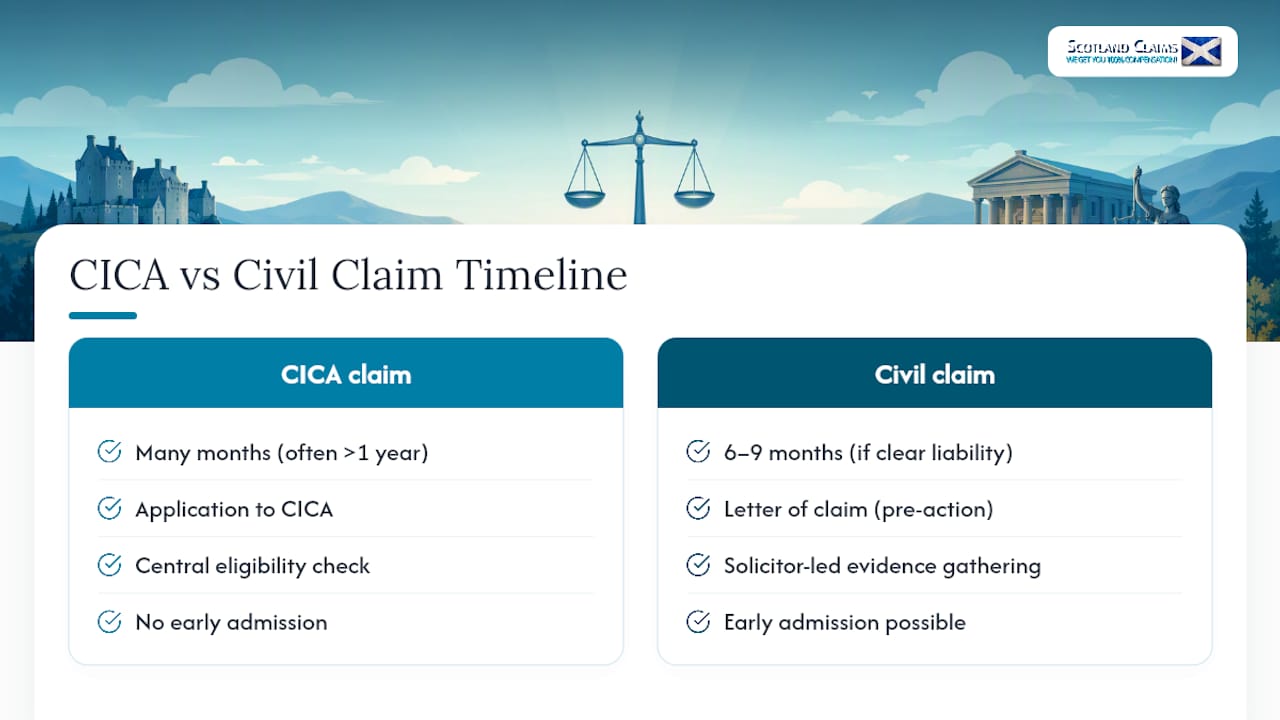
This is one of the practical reasons it matters to identify your claim type correctly at the outset. If you were injured by another driver’s negligence, a defective workplace, or an unsafe premises, you’re not waiting on a government body to review an application queue. You’re working with a solicitor who can start writing your letter of claim within days of taking instructions, gathering medical evidence in parallel, and pushing the other side toward an early admission of liability.
Scotland Claims Injury Lawyers’ entire model is built around moving civil claims quickly: free assessment, no upfront cost, and a solicitor who begins building your case as soon as you instruct them, rather than waiting on a lengthy separate review process that doesn’t apply to your situation in the first place.
What types of injuries and scenarios actually qualify for compensation in Scotland
CICA’s eligibility criteria cover injuries caused by violent crime, which is a narrow and specific category that doesn’t extend to the situations most people searching this phrase have actually experienced. If your injury falls outside that criminal context, a different, broader eligibility test applies, and it’s the one that covers the vast majority of accidents people in Scotland actually suffer.
Civil personal injury claims in Scotland cover a much wider range of everyday scenarios, provided negligence caused the harm:
- Road traffic accidents: as a driver, passenger, cyclist, or pedestrian, where another road user’s carelessness caused the collision.
- Workplace accidents: falls from height, machinery injuries, manual handling injuries, or exposure to unsafe working conditions.
- Slips, trips, and falls: on wet floors without warning signs, damaged pavements, or poorly maintained premises.
- Whiplash and soft tissue injuries: the most common outcome of low-speed road traffic collisions, often more disruptive to daily life than people expect.
The eligibility test for these claims isn’t about whether a crime occurred. It’s about whether someone owed you a duty of care and failed to meet it. A driver owes other road users a duty to drive carefully. An employer owes staff a duty to maintain safe systems of work. A shop owner owes customers a duty to keep floors free of hazards. Breach that duty and cause an injury, and you very likely have grounds for a civil claim, regardless of whether any criminal offence was ever committed.
Scotland-specific differences worth understanding
Scotland runs its own civil justice system, separate from the courts and rules that apply in England and Wales, and that separation matters more than most guides admit. The Scottish Civil Justice Council’s pre-action protocol is a distinct requirement, and it doesn’t map directly onto schemes used elsewhere in the UK, such as England’s Official Injury Claim portal for smaller road traffic claims. Citizens Advice notes this portal option for some low-value claims south of the border, but it simply doesn’t apply north of it; Scotland has its own procedure entirely.
That distinction catches people out constantly. Someone researching their options online often lands on guidance written for England, follows steps that don’t exist in Scots law, and wastes weeks before realising the process doesn’t fit their jurisdiction at all. Scottish court procedure, governed by rules like Chapter 43 of the Scottish courts rules, has its own pleading requirements, its own timetables, and its own approach to expenses and cost protection through QOCS.
This is precisely why instructing a solicitor who practises specifically in Scotland, rather than a UK-wide firm applying generic templates, tends to produce a smoother claim. Scotland Claims Injury Lawyers works exclusively within Scottish procedure, which means your letter of claim, your evidence timetable, and your court pleadings (if it ever gets that far) are drafted against the rules that actually govern your case, not a set borrowed from a different jurisdiction.
What to expect during the assessment of your claim and possible outcomes
Once your solicitor has your evidence and medical records, they’ll assess liability, the strength of the evidence, and a realistic value for your claim before anything is sent to the other side. This assessment stage typically involves reviewing medical reports, checking whether liability is likely to be admitted or disputed, and calculating both your general damages (for pain and suffering) and special damages (for financial losses such as lost earnings or care costs).
One thing worth knowing upfront: the amount you’re eventually paid isn’t always the headline figure quoted in a settlement offer. The Scottish Law Commission’s 2024 report on damages for personal injury highlights how deductions, such as recovery of certain public costs, and management arrangements for awards involving children can reduce or restructure the net sum a claimant actually receives. A good solicitor explains this early, so there are no surprises at settlement.
Possible outcomes generally fall into three categories. The defender admits liability early and a settlement is negotiated, often the fastest route. The defender disputes liability, requiring further evidence exchange and possibly negotiation extending over several more months. Or, in a minority of cases, the matter proceeds to court because no settlement can be reached, at which point Chapter 43 procedure governs how the action is pleaded and heard.
Whatever the outcome, Scotland Claims Injury Lawyers’ commitment stays the same throughout: no success fee comes out of your award, so whatever sum you’re assessed as entitled to receive is the sum you keep. For a fuller breakdown of what deductions can apply, see the firm’s guide on CRU deductions and what claimants in Scotland must know.
Why instructing a Scotland specialist actually changes the outcome
Roger has spent years watching claimants lose value simply by instructing the wrong kind of firm, not the wrong solicitor as an individual, but the wrong model. A UK-wide firm applying generic templates to a Scottish claim, or a big brand solicitor quietly taking 20% including VAT off the top of a settlement, both produce the same result: less money in the claimant’s pocket than the case actually warranted.
Local expertise isn’t a nicety here. A solicitor who knows Scottish court procedure inside out drafts a stronger letter of claim, anticipates how a defender’s insurer will respond, and doesn’t waste months following a process built for a different jurisdiction. That’s time and money that stays with the claimant rather than disappearing into avoidable delay.
The no success fee promise isn’t a marketing line either. It’s the difference between a claimant keeping every pound they’re awarded and a claimant watching a fifth of it vanish before the cheque even arrives. That gap, on a mid-sized claim, is real money that changes lives.
— Roger
Start your no win no fee claim with Scotland Claims Injury Lawyers
Getting started takes minutes. Use the compensation calculator to get an early estimate of what your claim could be worth, then request a callback or fill in the online form to arrange your free assessment. Have your accident date, a rough outline of what happened, and any medical or police reference numbers ready. Whether your injury involved a road traffic accident, a fall at work, or a back injury from a slip or trip, a specialist solicitor will review your case at no cost and explain your options plainly. Visit the no win no fee claims page to see exactly how the process works and start your claim today.
Primary sources and further reading
The legal points in this article draw on the Scottish Civil Justice Council’s pre-action protocol, the Law Society of Scotland’s success fee agreement guidance, Chapter 43 of the Scottish courts rules, and the Scottish Law Commission’s 2024 damages report.
For further reading on your own situation, see Scotland Claims Injury Lawyers’ guides on time limits for personal injury claims, what to do after an accident, and the full personal injury claims guide for Scotland.
This article is general information, not a substitute for advice from a qualified lawyer. Consult a qualified legal professional about your own circumstances before acting on anything here.
Sources
FAQ
Is a CICA claim the same as a personal injury claim in Scotland?
No. CICA covers victims of violent crime through a UK government body, while a personal injury claim in Scotland is a civil case against a negligent driver, employer, or property owner, pursued through a Scottish solicitor.
How long do I have to start a personal injury claim in Scotland?
Generally three years from the date of the accident or the date you became aware of your injury, with exceptions for children and fatal cases.
Will I lose money if my claim doesn’t succeed?
Under Qualified One-way Cost Shifting, most pursuers are protected from paying the defender’s legal costs if the claim is unsuccessful, provided the case wasn’t conducted fraudulently or unreasonably.
Does Scotland Claims Injury Lawyers take a success fee?
No.
Medical records, photographs of your injuries and the accident scene, witness contact details, and financial evidence such as payslips or receipts for treatment and travel costs.
Recommended