Burn injury claim Scotland: how to start (no win no fee)

If another party’s negligence caused your burn, you can normally make a personal injury claim in Scotland. That is the direct answer, and it applies whether the burn happened at work, on the road, in a public place, or through a faulty product.
The single most urgent thing to do right now is protect the evidence and check your triennium: the three-year window Scottish law gives you to raise court proceedings. Get copies of your medical records, photograph the injury as it heals, and note down anyone who witnessed what happened.
- Confirm the date of injury (or the date you realised it was caused by negligence)
- Request your medical records and keep every appointment letter
- Photograph the burn at different healing stages
Pro Tip: Do this even if you are unsure whether you will pursue a claim. Evidence degrades fast, memories fade faster, and you can always decide not to proceed later.
Scotland Claims Injury Lawyers assesses burn injury claims for free and works on a no win no fee basis.
Key Takeaways
A burn caused by someone else’s negligence in Scotland is normally claimable within three years, and choosing a no win no fee solicitor who takes no success fee protects your full compensation.
| Point |
Details |
| Check the triennium immediately |
You generally have three years from injury (or date of knowledge) to raise a claim in Scotland. |
| Collect evidence early |
Medical records, healing photographs, and witness details all strengthen causation and value. |
| Understand your heads of loss |
General damages, lost earnings, care costs, and future treatment can all form part of a burn award. |
| Expect 12 to 18 months typically |
Straightforward claims settle faster; contested or severe cases can take considerably longer. |
| Choose Scotland Claims Injury Lawyers |
Free case assessment, no win no fee, and no success fee, so clients keep all of their compensation. |
This article is general information, not a substitute for advice from a qualified lawyer. Consult a qualified legal professional about your own circumstances before acting on anything here.
Table of Contents
What counts as a burn injury claim in Scotland?
A burn injury claim exists wherever someone else’s carelessness caused you physical harm, and that harm includes scarring and, in some cases, psychiatric injury linked to disfigurement or trauma. Scottish law asks a simple question: did the person or organisation responsible for your safety fail in that duty, and did that failure cause your burn?
Liability commonly arises from:
- Workplace accidents — contact with hot machinery, chemical spills, or missing protective equipment
- Road traffic collisions — fires or scalds following a crash caused by another driver
- Defective products — faulty electrical goods, unsafe heaters, or poorly labelled chemicals
- Occupier negligence — scalding water in rented accommodation, unsafe hot surfaces in shops, cafés or public buildings
Note this article covers personal injury claims only, not clinical negligence.
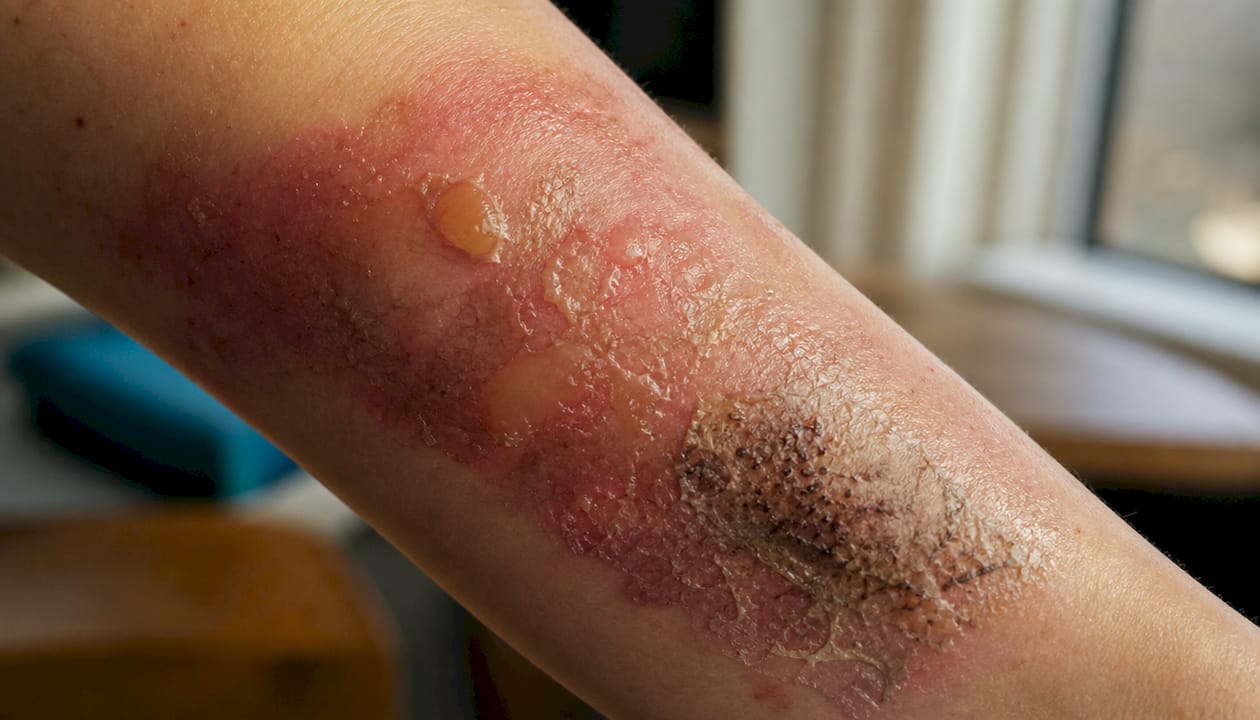
Severity matters enormously to your claim’s value. Burns are generally graded from superficial (reddening, no lasting mark) through partial thickness (blistering, some scarring risk) to full thickness (permanent scarring, potential need for skin grafts and long-term treatment). The deeper the burn and the more visible the scarring, the higher the compensation is likely to be.
What can you claim for and how is compensation worked out?
Burn compensation in Scotland is built from several separate heads of loss, not one lump figure. A solicitor adds these together based on medical evidence, not guesswork.
- General damages — for pain, suffering and loss of amenity (the impact on your daily life and enjoyment)
- Past and future loss of earnings — time off work already lost, plus any reduced earning capacity going forward
- Care and assistance — the value of help you’ve needed from family or paid carers
- Medical and treatment costs — dressings, physiotherapy, skin grafts, scar revision surgery
- Scarring and psychiatric injury — separately valued where disfigurement causes ongoing distress or conditions like PTSD
- Future care costs — where a severe burn leaves lasting functional or cosmetic effects
Scotland doesn’t use the same fixed multiplier tables you might read about in guidance written for other jurisdictions. Valuation instead relies heavily on independent medical reports and, increasingly, on principles discussed in the Scottish Law Commission’s 2024 report on damages for personal injury, which looks closely at deductions from awards and how damages for children are managed.
To put severity into perspective: a minor scald with no visible scarring after six months sits at the lower end of the scale, while a full-thickness burn requiring grafts and leaving permanent scarring on a visible part of the body sits considerably higher, often with an additional award for future treatment and care built in. A specialist solicitor’s job is to get the medical evidence that proves exactly where your injury sits on that scale.
What is Scotland’s time limit for a burn injury claim?
You generally have three years, the triennium, from the date of your injury to raise court proceedings in Scotland. Miss it, and in most cases your right to claim disappears entirely, regardless of how strong your evidence is.
The clock doesn’t always start on the day of the accident. If your burn injury only became apparent later, for instance a scar that worsened or a psychiatric injury diagnosed months afterwards, the triennium can run from your “date of knowledge” instead. Getting that starting date right is often the difference between a valid claim and a timebarred one.
There are recognised exceptions. For children, the three-year period doesn’t start until they turn 16. For adults who lack the mental capacity to raise a claim, the clock may be suspended altogether. Courts also retain limited discretion to allow a late claim in rare, exceptional circumstances, but you should never rely on that discretion being granted.
Because working out the correct start date isn’t always straightforward, it’s worth reading up on how the three-year injury rules apply to your specific situation, or simply getting a solicitor to check it for you early.
What evidence do you need for a burn claim?
Strong evidence turns a plausible burn injury claim into a winnable one. Build this file from day one:
- Medical records and treatment notes, including A&E and GP records
- Photographs of the burn taken immediately and at intervals as it heals
- Contact details for anyone who witnessed the incident
- Accident or incident reports, particularly from employers
- Health and safety records if the burn happened at work
- The product itself, its packaging, or model details if a defective item caused the injury
- A police report where relevant, such as a road traffic collision
Early medical attention does more than treat the injury. It creates a contemporaneous record linking the burn directly to the incident, which strengthens both causation and the eventual valuation. The type of evidence you prioritise shifts depending on the cause: a workplace burn needs health and safety paperwork and colleague statements, while a defective product burn needs the item preserved and, ideally, its purchase receipt. Reviewing how evidence works in Scottish injury claims before you speak to anyone else involved can help you avoid losing something you’ll need later.
How long does a burn injury claim take in Scotland?
Most burn injury claims follow a recognisable path, though the pace depends heavily on how contested liability is and how complex your medical picture turns out to be.
- Initial enquiry and evidence gathering — your solicitor reviews the incident and starts collecting medical and witness evidence
- Pre-action protocol — for many claims valued at £25,000 or less, a compulsory pre-action protocol requires a detailed Letter of Claim and early disclosure between both sides
- Liability response and medical reports — the other party responds, and independent medical evidence establishes the extent of your injury
- Negotiation or court proceedings — most claims settle here; unresolved cases proceed to the sheriff court, the All-Scotland Sheriff Personal Injury Court, or the Court of Session
Most personal injury claims resolve within 12 to 18 months, though complex burn cases involving long-term care needs or disputed liability can run considerably longer, particularly when expert medical evidence or court listings cause delays.
Pro Tip: Instructing a solicitor early doesn’t just protect your triennium. It means the pre-action protocol’s paperwork gets moving sooner, which in practice tends to shorten the overall timeline rather than complicate it.
How do you choose the right burn injury solicitor?
Not every personal injury solicitor has real experience with burns, and scarring cases in particular need someone who knows how to secure the right medical evidence.
Look for:
- Proven experience specifically with burn and scarring claims, not just general personal injury work
- Familiarity with Scottish court procedure, including sheriff courts and ASSPIC
- A transparent, written no win no fee agreement
- A named solicitor who will handle your file personally, not a call centre
At your first call, ask these questions:
- Have you handled burn injury cases recently, and what were the outcomes?
- Who exactly will manage my file day to day?
- What evidence do you need from me immediately?
- How does your no win no fee arrangement actually work?
- Will I face any disbursements even if the claim succeeds?
- What is a realistic timescale for a case like mine?
- Do you have access to specialist burns medical experts?
- How will you keep me updated?
- What happens if the other side disputes liability?
Treat vague answers on fees, reluctance to name your solicitor, or heavy pressure to sign immediately as red flags. Citizens Advice also points claimants towards trade unions and other referral routes if you’re unsure where to start.
A Scotland-first view on what actually protects your claim
The conventional advice on burn injury claims tends to focus on compensation brackets, as if the number is the whole story. It isn’t. The triennium is the real gatekeeper here: a strong case with brilliant medical evidence is worthless if it lands in front of a solicitor after the three-year window has closed. That’s the single fact this whole topic hinges on, and it’s the one most guides bury halfway down the page instead of leading with it.
The second thing people underestimate is how much a well-organised early file speeds everything up. Scotland’s compulsory pre-action protocol front-loads the evidence burden onto claimants, so someone who arrives with photographs, medical notes and a clear timeline genuinely moves faster through the system than someone who turns up with a vague recollection and no paperwork.
The fee structure question deserves more scrutiny than it gets, too. Many solicitors take up to 20% of your settlement as a success fee. Scotland Claims Injury Lawyers doesn’t charge one at all. On a serious burn claim worth tens of thousands of pounds, that difference isn’t small print, it’s the difference between a genuine full recovery and a quiet deduction nobody explained clearly at the start.
How Scotland Claims Injury Lawyers can help with your burn claim
Scotland Claims Injury Lawyers works specifically with claimants across Scotland who’ve suffered burns through someone else’s negligence, whether that’s a workplace accident, a road collision, or a faulty product. Specialist solicitors handle the medical evidence, value your future care needs properly, and manage the pre-action protocol paperwork so you don’t have to chase it yourself.
Getting started costs nothing either, a free case assessment tells you where you stand before you commit to anything.
If you’ve been burned through negligence and want a clear answer on your options, get in touch with Scotland Claims Injury Lawyers for a free, no-obligation case assessment by phone or through the online claim form.
Sources
FAQ
How much compensation will I get for a burn?
It depends entirely on severity and long-term impact. Minor burns with no lasting scarring attract lower general damages, while full-thickness burns needing grafts and causing permanent scarring attract considerably more, plus awards for future care and treatment.
How much is my burn claim worth overall?
Your claim’s total value combines general damages for pain and suffering with special damages like lost earnings, medical costs, and future care, so two people with similar burns can still receive very different totals depending on their circumstances.
What is the hardest injury to prove?
Injuries without obvious physical signs, such as psychiatric harm linked to scarring, are typically harder to prove than a visible burn, which is why independent medical evidence and contemporaneous records matter so much.
How long does a personal injury claim take in Scotland?
Most claims resolve within 12 to 18 months, though contested liability or complex medical evidence can extend that timeline considerably.
Recommended