ASBO meaning UK: what you need to know in Scotland

TL;DR:
- An ASBO in Scotland is a civil order that restricts antisocial behavior to prevent alarm or distress. Breaching it becomes a criminal offense, with penalties including fines, imprisonment, or a criminal record. The application process relies on evidence from multiple agencies, and early intervention methods often prevent the need for orders.
An Anti-Social Behaviour Order, commonly known as an ASBO, is a civil court order that restricts a person from behaving in ways that cause alarm or distress to others. In Scotland, ASBOs operate under the Antisocial Behaviour etc. (Scotland) Act 2004 and apply to individuals aged 16 or over. The term “asbo asbo” appears frequently in online searches, reflecting genuine public confusion about what these orders actually do, who issues them, and what happens when someone breaks one. This guide cuts through that confusion with clear, up-to-date information including 2026 legal changes.
What does ASBO mean and what behaviours does it cover?
An ASBO is defined as a civil order issued by a sheriff court in Scotland to prevent specific acts of antisocial behaviour. The order does not create a criminal record on its own. It becomes a criminal matter only if the person named in the order breaks its conditions.
The Antisocial Behaviour etc. (Scotland) Act 2004 sets out the legal basis. Scotland retained this framework after England and Wales replaced ASBOs with Criminal Behaviour Orders and Community Protection Notices in 2014. That distinction matters. If you are in Scotland, the ASBO system still applies to you directly.
Behaviours that qualify for an ASBO
The following types of conduct regularly form the basis of ASBO applications in Scotland:
- Persistent harassment of neighbours or members of the public
- Intimidation, threatening language, or aggressive confrontations
- Excessive and repeated noise disturbance affecting others
- Vandalism or deliberate damage to communal property
- Drug-related activity causing distress to a community
- Persistent verbal abuse or racially aggravated conduct
What ASBOs do not cover
ASBOs are not a catch-all tool for neighbourhood disputes. A one-off argument with a neighbour does not qualify. Eccentric or unusual behaviour that does not cause genuine alarm or distress falls outside the scope of the legislation. Mental health conditions are also a relevant consideration. Courts and agencies are expected to take a person’s circumstances into account before pursuing an order.
Pro Tip: If you are unsure whether a situation qualifies as antisocial behaviour under the 2004 Act, contact your local council’s community safety team before taking any formal steps.
How are ASBOs applied for and granted in Scotland?
Local authorities and Registered Social Landlords are the primary bodies that apply for ASBOs in Scotland. Private individuals cannot apply directly. The process requires evidence that the behaviour has been serious or persistent and that other interventions have already failed.
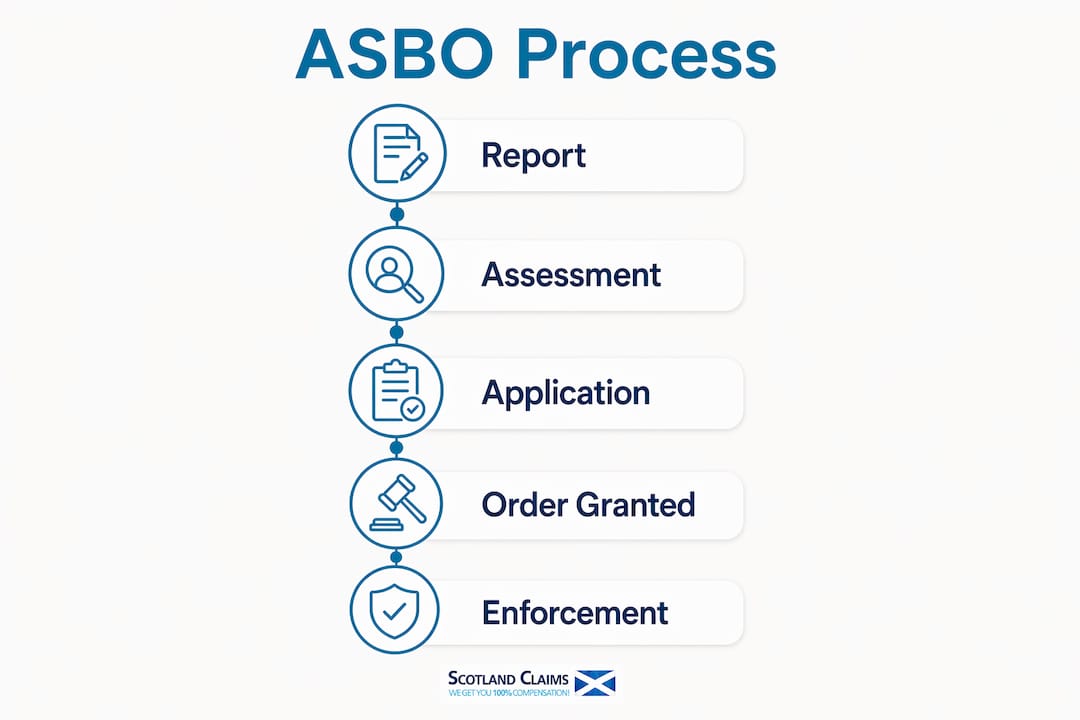
The typical application process follows these steps:
- The affected party reports the behaviour to the council, housing association, or Police Scotland.
- The responsible agency documents incidents, collects witness statements, and gathers supporting evidence.
- Other measures such as warnings, mediation, or acceptable behaviour contracts are attempted first.
- If those measures fail, the agency prepares a formal application to the sheriff court.
- The sheriff court reviews the evidence and decides whether to grant the order.
- If granted, the ASBO sets out specific prohibitions tailored to the individual’s conduct.
Multi-agency cooperation involving Police Scotland, local councils, housing providers, NHS services, and third sector organisations is central to building a credible case. Data protection laws create real barriers to information sharing between agencies, which can delay applications significantly. Practitioners must coordinate carefully to gather the evidence needed for a successful application.
Pro Tip: If you are a victim of persistent antisocial behaviour, keep a written log of every incident with dates, times, and descriptions. This record becomes critical evidence if an ASBO application goes to court.

What are the consequences of breaching an ASBO?
Breaching an ASBO is a criminal offence in Scotland. That is the single most important fact to understand about these orders. The civil nature of the original order changes the moment a condition is broken.
Penalties for breach
- Prosecution in the criminal courts
- An unlimited fine at the discretion of the court
- A custodial sentence of up to five years on indictment
- A criminal record, which can affect employment and housing prospects
- Further restrictions added to the existing order
The financial penalties attached to antisocial behaviour have also increased. Fixed penalty notice fines rose from £40 to £70 as part of updated legal measures introduced in march 2026. That increase reflects a deliberate policy decision to make financial penalties a more credible deterrent.
The 2026 Antisocial Behaviour Fixed Penalty Offences Order also amended the list of offences eligible for fixed penalty notices. Certain offences were removed from the regime while new ones were added. This reflects the Scottish Parliament’s approach of making targeted, gradual updates to ASB legislation rather than wholesale reform.
If you are subject to an ASBO and face breach proceedings, legal advice in Scotland is not optional. The consequences of a conviction are serious and long-lasting.
How do communities and local authorities manage antisocial behaviour?
ASBOs are one tool within a much wider system. Local authorities in Scotland embed their antisocial behaviour strategies within broader Community Safety and Justice Plans, which means ASB management sits alongside policing, housing, and social care priorities.
The range of tools available to agencies before an ASBO is sought includes:
| Tool |
Purpose |
| Verbal and written warnings |
First response to low-level behaviour |
| Acceptable Behaviour Contracts |
Voluntary agreements to stop specific conduct |
| Mediation services |
Resolve disputes between neighbours or community members |
| Community Justice Plans |
Coordinate support for individuals with complex needs |
| CCTV and noise monitoring apps |
Gather evidence and deter repeat behaviour |
A 2025 review of local authority ASB strategies found that many councils face instability in delivery because antisocial behaviour functions are non-statutory. That means they are not legally required in the same way as other council services, so they are vulnerable to budget cuts. Funding reductions directly affect how quickly and effectively agencies can respond to complaints.
Public expectations are also a persistent challenge. A 2025 review found widespread misunderstanding among the public about how quickly ASBOs can be enforced. The reality is that building a case takes time. Evidence must be gathered, other interventions must be tried, and court processes must be followed. Communities that expect an ASBO to appear within days of a complaint are routinely disappointed.
Pro Tip: If your council or housing association seems slow to act, ask specifically which stage of the process your complaint is at. Agencies are required to follow a structured process, and knowing where you are in it helps manage expectations.
Technology is playing a growing role. Noise monitoring applications and CCTV footage now form part of evidence packages in ASBO applications. Place-based solutions, where agencies focus resources on specific streets or estates with high ASB rates, have shown results in several Scottish local authority areas.
Key takeaways
An ASBO in Scotland is a civil order that becomes a criminal matter the moment it is breached, making compliance non-negotiable for anyone subject to one.
| Point |
Details |
| Legal basis |
ASBOs in Scotland operate under the Antisocial Behaviour etc. (Scotland) Act 2004. |
| Who applies |
Only local authorities or Registered Social Landlords can apply; private individuals cannot. |
| Breach is criminal |
Breaking an ASBO condition is a criminal offence carrying fines or imprisonment. |
| 2026 penalty increase |
Fixed penalty notice fines rose from £40 to £70 under updated 2026 legislation. |
| Multi-agency process |
Effective ASBO applications depend on coordinated evidence from Police Scotland, councils, and housing providers. |
ASBOs in practice: what the system gets right and where it falls short
Roger’s perspective on ASBOs is shaped by watching how the gap between public expectation and legal reality plays out time and again.
The 2004 Act gave Scotland a workable framework. Retaining ASBOs while England and Wales moved to a different system was a deliberate choice, and it has largely served Scottish communities well. The order is flexible. A sheriff can tailor the prohibitions to the specific behaviour, which means a well-drafted ASBO is genuinely targeted rather than a blunt instrument.
The problem is not the law. The problem is the machinery around it. Multi-agency approaches are described as a strength in every review I have read, yet those same reviews document persistent funding reductions that hollow out the very partnerships they praise. You cannot have effective multi-agency working when each agency is cutting its community safety team.
The 2026 fixed penalty increases are a positive step. Raising fines from £40 to £70 sends a clearer signal that antisocial behaviour carries real financial consequences. The Scottish Parliament Criminal Justice Committee’s preference for gradual, targeted updates rather than wholesale reform is also sensible. Stability in the legal framework matters to practitioners who need to know what tools they have.
What concerns me is the public understanding gap. People affected by antisocial behaviour often feel let down when an ASBO does not materialise within weeks. That frustration is understandable but misplaced. The process is deliberately rigorous because these orders restrict a person’s freedom. Rushing that process would create its own legal problems. The answer is better communication from agencies about timelines, not a faster but less evidenced system.
Early intervention remains the most underused tool. Acceptable Behaviour Contracts and mediation resolve a significant proportion of cases before they reach the ASBO threshold. Investing in those earlier stages is cheaper and often more effective than pursuing a court order. Scotland’s communities deserve both the legal tools and the resources to use them properly.
— Roger
Legal support when antisocial behaviour affects you
Antisocial behaviour can have serious consequences beyond the immediate distress it causes. If you have been physically injured as a result of an incident linked to antisocial behaviour, you may have grounds for a personal injury claim. Scotland Claims Injury Lawyers specialises in personal injury claims in Scotland and operates on a No Win No Fee basis. That means you pay nothing upfront and keep 100% of your compensation if your claim succeeds. Most solicitors take a success fee of up to 20% from your settlement. Scotland Claims Injury Lawyers takes nothing. If you are considering a claim, use the compensation calculator to get an early estimate of what you may be entitled to.
FAQ
What is an ASBO in the UK?
An ASBO is a civil court order that prohibits a person from specific behaviours causing alarm or distress. In Scotland, it operates under the Antisocial Behaviour etc. (Scotland) Act 2004 and applies to individuals aged 16 or over.
Does Scotland still use ASBOs?
Yes. Scotland retained the ASBO framework after England and Wales replaced it with Criminal Behaviour Orders in 2014. The 2004 Act remains the primary legislation as of 2026.
What happens if you breach an ASBO in Scotland?
Breaching an ASBO is a criminal offence. It can result in prosecution, an unlimited fine, or a custodial sentence of up to five years on indictment, as well as a permanent criminal record.
Who can apply for an ASBO in Scotland?
Local authorities and Registered Social Landlords are the bodies that apply for ASBOs. Private individuals cannot apply directly and must report concerns to their council or housing association.
What are the 2026 changes to antisocial behaviour penalties in Scotland?
The 2026 Antisocial Behaviour Fixed Penalty Offences Order increased fixed penalty notice fines from £40 to £70 and amended the list of offences eligible for fixed penalty notices, reflecting ongoing updates to Scottish ASB legislation.
Recommended