
Most law firms in Scotland routinely take a 20% cut of your final settlement, but that money belongs in your pocket, not theirs. If you're struggling with a sprained or broken ankle, you're already facing enough stress from reduced mobility and lost earnings whilst you recover. You shouldn't have to sacrifice a significant portion of your ankle injury compensation scotland settlement just to get the expert legal help you need. We believe in total financial transparency and protective advocacy for every person we represent.
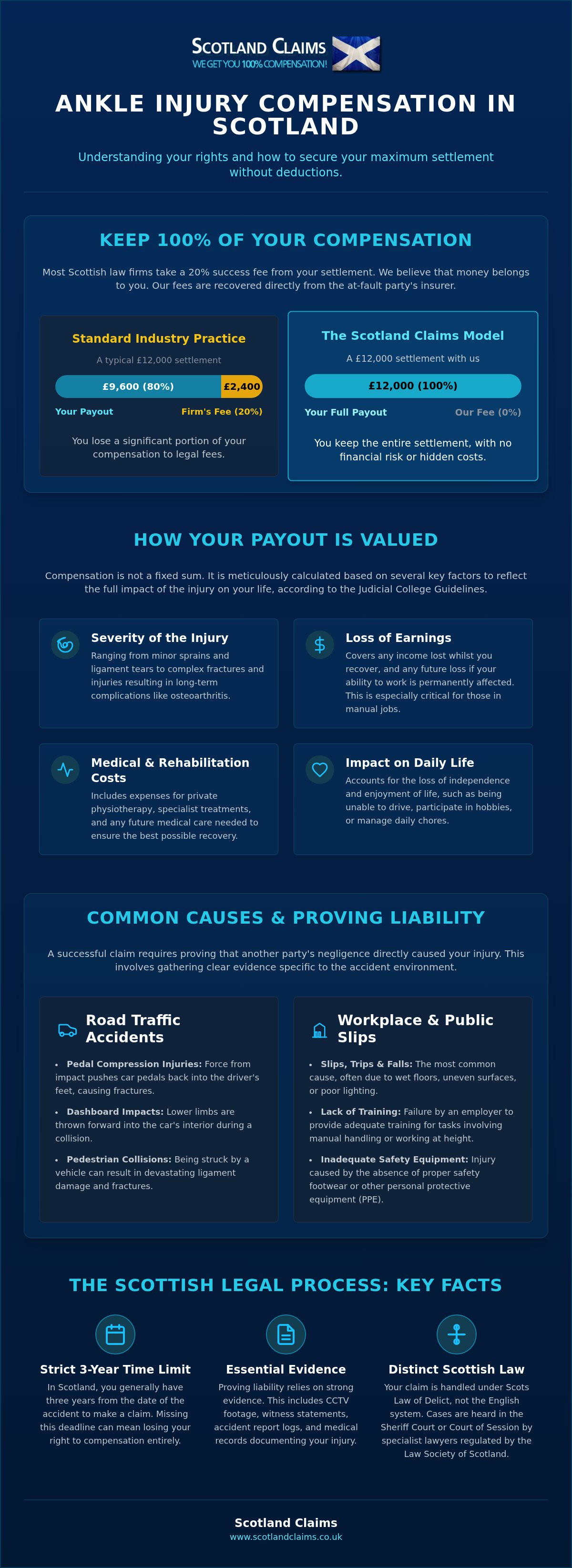
You probably feel that the legal system is designed to benefit big firms rather than the individuals they serve. It's a valid worry when standard success fees can turn a £12,000 award into £9,600 overnight. This article reveals how you can secure the maximum financial recovery for your pain and suffering without any financial risk. We'll break down the updated April 2026 Judicial College Guidelines for ankle injuries and explain our unique model that guarantees you keep 100% of your payout.
Key Takeaways
- Secure the maximum ankle injury compensation scotland settlement whilst keeping 100% of your award with zero success fees.
- Learn how the updated 2026 Judicial Redress guidelines determine the value of your claim based on the severity of your injury.
- Identify the essential evidence needed to prove liability in road accidents or workplace slips and protect your right to a payout.
- Understand the strict three-year time limit for Scottish claims to ensure you don't lose your chance for financial recovery.
- Discover how fees are recovered directly from the insurer so you retain the full value of your settlement for pain and lost earnings.
Understanding Ankle Injury Claims Under Scottish Law
When you suffer a sprain, strain, or fracture due to someone else's negligence, you have a legal right to seek redress. In Scotland, this process is governed by a distinct legal framework known as delict. Understanding Ankle Injury Claims Under Scottish Law is vital because the rules here differ significantly from those in England and Wales. We don't use the English court system; instead, your case will be heard in the Sheriff Court or, for high-value claims, the Court of Session in Edinburgh. This specialist jurisdiction ensures that your claim is assessed by experts who understand Scottish precedents and local regulations.
Securing the right ankle injury compensation scotland requires more than just proving you were hurt. You must demonstrate that a third party, such as an employer or a local council, breached their duty of care. Because we operate on a 100% compensation model, we focus entirely on your recovery. We recover our fees from the defendant's insurer, meaning you never have to worry about our costs eating into your settlement. This assertive approach levels the playing field against large insurance companies that often try to underpay claimants.
The Impact of an Ankle Injury on Your Independence
An ankle injury does more than cause physical pain; it strips away your daily freedom. If you can't put weight on your foot, you can't drive to work, visit the shops, or enjoy your favourite weekend walks. These restrictions often lead to a direct loss of earnings, especially if your job requires you to be on your feet. Beyond the immediate wage gap, you may face hidden expenses for private physiotherapy to speed up your recovery. Without specialist rehabilitation, a simple ligament tear can lead to long-term complications like early-onset osteoarthritis. We ensure your claim accounts for these future medical needs and the total financial hit to your household.
Why Your Claim Must Be Handled in Scotland
It is a common mistake to think any UK solicitor can handle your case. To get the best result, you need an authorised injury lawyer in Scotland who is regulated by the Law Society of Scotland. This regulation provides you with a layer of protection and ensures your solicitor meets the highest professional standards. Many online "claims farmers" simply capture your data and sell it to the highest bidder, often a firm with no physical presence in Scotland. We handle your claim locally. This direct connection prevents your case from being lost in a generic UK-wide system and ensures that every penny of your 100% compensation guarantee is protected.
Common Causes of Ankle Injuries and Proving Liability
Proving liability is the cornerstone of a successful claim. Whether your injury occurred on a busy road, within a factory, or on a local high street, you must establish that another party's negligence was the direct cause. This process isn't always straightforward. It requires a methodical collection of evidence, such as CCTV recordings, accident report logs, and witness statements. When Calculating Ankle Injury Payouts, Scottish courts examine the specific circumstances of the breach of duty. We work with you to secure the medical evidence needed to categorise your injury, which is vital for your ankle injury compensation scotland claim.
Different environments carry different risks. In industrial settings, the lack of proper footwear or training might be the issue. On the road, it's often a lapse in driver concentration. Regardless of the setting, the goal remains the same: ensuring you aren't left out of pocket for an accident that wasn't your fault. We provide the assertive advocacy needed to challenge insurers who try to dodge responsibility. By choosing a specialist, you ensure that the nuances of your accident are fully understood and documented.
Ankle Injuries from Road Traffic Accidents
Your ankles are highly susceptible to trauma during a vehicle collision. Drivers often experience pedal compression injuries, where the force of an impact pushes the pedals back into the feet. This frequently results in complex fractures or severe crushing. Dashboard impact injuries are also common, occurring when the lower limbs are thrown forward into the interior of the car. Pedestrians in Scottish town centres are equally at risk, often suffering devastating ligament tears when struck by moving vehicles. You can explore your rights further in our guide to Road Traffic Accident Claims. We make sure the responsible driver's insurance covers your full recovery.
Accidents at Work and Employer Negligence
Under the Health and Safety at Work etc. Act 1974, your employer must provide a safe working environment. Ankle injuries are common in workplaces where manual handling is required or where floor surfaces aren't properly maintained. Falling from height, even from a low step-ladder, can result in life-changing joint damage. If your employer failed to provide adequate training or safety equipment, they've been negligent. A dedicated Accident at Work Scotland solicitor will help you navigate the complexities of employer liability. We handle the hard work so you can focus on getting back on your feet.
Public Liability: Slips, Trips, and Falls
Local councils have a statutory duty to maintain public pavements and walkways. If you've tripped over a protruding paving slab or fallen due to a poorly marked hazard, the council may be liable for your injuries. Similar rules apply to private businesses like supermarkets or shopping malls. If a spill isn't cleared or a floor is left wet without warning signs, the business has failed in its duty of care. Proving these claims often depends on quick action, such as photographing the defect or spill immediately. Consulting a Slip and Fall Lawyer ensures you have the expertise to challenge these organisations. You might want to speak to a specialist today to begin your journey toward 100% compensation.
How Much Compensation? Calculating Ankle Injury Payouts in 2026
The value of your claim isn't a guess. Scottish courts rely on the 18th edition of the Judicial College Guidelines, updated in April 2026, to provide a structured framework for payouts. Your settlement is divided into two distinct parts. First is "solatium," which covers your physical pain and emotional distress. Second is "special damages," which reimburses the financial hit you've taken. To get the maximum ankle injury compensation scotland, your solicitor must meticulously document both. Our 100% compensation model ensures that when we win a £12,000 settlement, you receive £12,000. Many other firms would leave you with just £9,600 after their success fee.
Several factors influence the final sum. The severity of the initial trauma, the length of your recovery, and any permanent impact on your lifestyle all play a role. If your injury prevents you from returning to your previous job or requires long-term medical care, your settlement will reflect that future burden. You can get a tailored estimate by using our Personal Injury Compensation Calculator. We focus on the details that insurance companies try to ignore.
Compensation Brackets for Ankle Injuries
The 2026 guidelines categorise injuries based on their long-term prognosis. Minor injuries involve soft tissue damage or simple sprains where recovery happens within a few months. These awards are typically at the lower end of the scale. Moderate injuries include ligament tears, such as the Achilles, or fractures that require surgical intervention. According to the April 2026 guidelines, moderate ankle injuries typically attract between £18,150 and £35,130. Severe injuries involve complex fractures leading to chronic mobility issues, joint fusion, or long-term disability. These cases command the highest settlements due to the life-changing nature of the damage.
Special Damages: Recovering Out-of-Pocket Expenses
Financial recovery goes beyond your physical injury. If you're self-employed, a broken ankle can stop your income entirely. We claim for your past and future loss of earnings to ensure your household isn't penalised. You can also recover travel costs for hospital appointments and the price of specialist equipment like crutches or orthopaedic boots. A vital but often overlooked area is "care and assistance." If family members have helped with your daily needs whilst you're immobile, we can claim for the value of their time. This ensures the support you received amongst your loved ones is recognised and compensated as part of your total settlement.
The 3-Year Time Limit and Essential Evidence in Scotland
Time is your greatest enemy in a personal injury case. In Scotland, the law is governed by a strict three-year deadline known as the "triennium." This isn't a suggestion; it's a statutory requirement under the Prescription and Limitation (Scotland) Act 1973. If you haven't raised a court action before the three-year anniversary of your accident, your right to seek ankle injury compensation scotland is usually lost forever. We've seen too many people miss out on their 100% settlement because they waited until the last minute. Acting quickly allows us to build the strongest possible case whilst the facts are still fresh.
The Scottish 'Triennium' Rule
The triennium rule requires a court action to be formally raised within three years. Simply hiring a solicitor isn't enough to stop the clock. There are specific exceptions, such as for children, where the three-year period only begins when they turn 16. Similarly, the limit may be adjusted for individuals who lack the mental capacity to manage their own affairs. In rare cases, the "date of knowledge" rule applies. This is the date you first realised your injury was significant and caused by someone else's negligence. If you're approaching the deadline, you must seek specialist advice immediately to protect your claim.
Secure your right to claim with an expert Scottish solicitor
Evidence Needed to Win Your Case
Winning a claim requires clear, undeniable proof. You should start by photographing the scene of the accident. If you tripped on a defective pavement, use a coin or ruler to show the depth of the hole. If you were in a road accident, take photos of the vehicle positions and the damage. Reporting the incident to your employer or the police is also vital. It creates a contemporaneous record that is difficult for insurers to dispute. We then use this data to build a comprehensive evidence pack to ensure your recovery is fully funded.
An independent medical assessment is the final piece of the puzzle. We arrange for you to see a specialist who will evaluate the long-term impact on your mobility. This report is essential for categorising your injury under the 2026 Judicial Redress guidelines. Our solicitors often work with expert witnesses, such as accident reconstruction specialists, to prove liability. This methodical approach to ankle injury compensation scotland ensures we don't leave your settlement to chance. We handle the complex evidence gathering so you can focus on your physical recovery.
Why Choose Scotland Claims Injury Lawyers for Your Ankle Injury?
Selecting the right legal representative is the most critical decision you'll make following an accident. At Scotland Claims Injury Lawyers, we don't just process paperwork; we act as your protective advocate against insurance companies. Most firms in the UK market operate on a model that prioritises their profit over your recovery. They routinely deduct a 20% success fee from your final settlement. We believe this is wrong. When you pursue ankle injury compensation scotland, your award is intended to cover your pain, suffering, and financial losses. It shouldn't be used to subsidise a law firm's overheads. Our commitment to 100% compensation is what sets us apart as a fair specialist in the Scottish legal market.
The 100% Compensation Advantage
The difference in your bank balance is substantial. If your ankle injury results in a £12,000 settlement, a standard solicitor leaves you with £9,600 after their cut. Scotland Claims Injury Lawyers ensures you receive the full £12,000. We achieve this by recovering our legal costs directly from the at-fault party's insurer. This isn't a "too good to be true" scenario; it's a specialist approach based on transparency and integrity. By eliminating hidden fees and surprise charges, we remove the financial anxiety that often stops people from seeking justice. You'll work directly with qualified solicitors regulated by the Law Society of Scotland, ensuring your case is handled with the highest professional standards.
Start Your Risk-Free Claim Today
You shouldn't have to navigate the aftermath of an injury alone. Our 'True No Win, No Fee' model means you face zero financial risk. If your claim isn't successful, you don't owe us a penny. This empowers you to challenge even the largest corporations without fear of legal bills. Our 24-hour freephone helpline is always available, providing you with immediate support whenever you need it. During your initial assessment, we provide a clear, no-nonsense evaluation of your case. There is no obligation to proceed, just honest expert advice. You can take the first step right now by using our Compensation Calculator Scotland to estimate your potential settlement. Let Scotland Claims Injury Lawyers handle the insurers whilst you focus on getting back on your feet.
Take the First Step Toward Your Full Recovery
Securing the maximum ankle injury compensation scotland settlement doesn't have to be a stressful or expensive gamble. You now understand that the April 2026 Judicial Redress guidelines offer a clear path to valuing your pain and financial loss. You also know that the strict three-year triennium rule means acting today is the only way to protect your legal rights. Most importantly, you've seen how our unique model ensures you keep every penny of your award. We don't believe in success fees because your money should support your recovery, not our profits.
Our team of No Win No Fee specialists is authorised by the Law Society of Scotland to provide the expert advocacy you deserve. We handle the complex evidence gathering and negotiations whilst you focus on healing. You can move forward with absolute confidence, knowing that our 100% Compensation Guarantee is designed to put your interests first. Don't let a standard law firm take a 20% cut of your future settlement.
Start your 100% compensation claim now: call our 24-hour freephone helpline on 0800 611 8132
You have the power to reclaim your independence and secure the financial support you need. We are ready to stand as your protective expert and fight for the result you deserve. Your journey back to health starts with a single, risk-free conversation.
Frequently Asked Questions
How much compensation can I get for an ankle injury in Scotland?
Compensation amounts are determined by the severity of your injury and its financial impact. According to the 18th edition of the Judicial College Guidelines published in April 2026, a moderate ankle injury payout typically falls between £18,150 and £35,130. This figure covers your pain and suffering, known as solatium. You can also claim for special damages, which include lost wages and medical costs, to ensure your final settlement reflects the true cost of your accident.
Can I make an ankle injury claim if the accident was partly my fault?
You can still claim if you were partly responsible for the accident. This is known as contributory negligence. A court or insurer will assign a percentage of fault to each party involved. If you are found 25% responsible, your final award is simply reduced by that amount. We fight to ensure your liability is kept as low as possible so you retain the maximum value of your claim.
What is the time limit for making an ankle injury claim in Scotland?
The time limit for starting an ankle injury compensation scotland claim is three years from the date of the accident. This is a strict Scottish legal rule called the triennium. You must formally raise a court action before this three-year anniversary passes. Starting early is vital because it gives your solicitor enough time to gather evidence like CCTV footage and medical reports before they are lost or forgotten.
How long does an ankle injury compensation claim usually take?
Most straightforward claims are settled within 6 to 12 months. If the at-fault party disputes liability or your injury is complex, the process can take longer. We prioritise efficiency to move your claim through the system as quickly as possible. Our methodical approach ensures that speed never comes at the expense of the final settlement value. We keep you updated at every stage of the process.
Do I have to go to court for an ankle injury claim?
It is highly unlikely that you will need to appear in court. Over 90% of personal injury claims in Scotland are settled through negotiations with the insurer before a hearing is necessary. We prepare every case as if it were going to court to show the insurer we are serious. This assertive strategy often forces them to offer a fair settlement much earlier in the process.
Is it really 100% compensation with no success fees?
Yes, we operate a genuine 100% compensation model with zero success fees. Unlike many high-street firms that deduct up to 20% of your payout, we recover our legal costs directly from the opponent's insurance company. This means the settlement figure agreed upon is the exact amount that arrives in your bank account. We believe your compensation belongs to you, not your solicitor.
What happens if my ankle injury claim is unsuccessful?
If your claim is unsuccessful, you won't pay us a penny in legal fees. Our "No Win No Fee" agreement protects you from financial risk. We also ensure you have After the Event (ATE) insurance in place to cover the opponent's legal costs if the case is lost. This protective framework makes seeking justice entirely risk-free, allowing you to focus on your recovery without worrying about hidden bills.
Can I claim for an ankle injury that happened at work?
You have a legal right to claim if you were injured at work due to employer negligence. Employers must follow strict health and safety regulations to keep you safe. If they failed to provide proper training or a hazard-free environment, they are liable for your injury. Making a Work Injury Claim is a standard process, and your employer's liability insurance will cover the cost of your settlement.