
If you’re injured at work in Scotland, does telling your manager mean the incident has been formally reported? Not necessarily. The workplace injury reporting procedure scotland workers need to understand has distinct steps: notify your employer, make sure the incident is recorded and, in some cases, the employer must make a formal RIDDOR report. A compensation claim is separate.
It’s understandable to be unsure who to tell, how quickly to act or what details to record. Reporting promptly and checking the record is accurate can help preserve a clear account of the incident. It doesn’t guarantee compensation or mean that a RIDDOR report is required.
This guide explains who to notify, what information to record and when an employer may need to report an injury under RIDDOR. It also explains how workplace reporting differs from making a claim, and when legal guidance may help you understand your options. The steps you take after an incident can matter, so use this practical guide to decide what to do next.
Key Takeaways
- Follow the workplace injury reporting procedure scotland workers need to know: notify the right person at work and make sure the incident is recorded.
- Agency, temporary and contract workers may need to tell both their workplace contact and their own employer or agency.
- An internal accident record, a RIDDOR report and a compensation claim serve different purposes.
- Keep a clear account of when, where and how the incident happened, including the task and any equipment involved.
- A report records what happened, but it doesn’t decide fault or claim eligibility. Independent legal guidance can help you understand your options.
Workplace injury reporting procedure in Scotland: why report an incident?
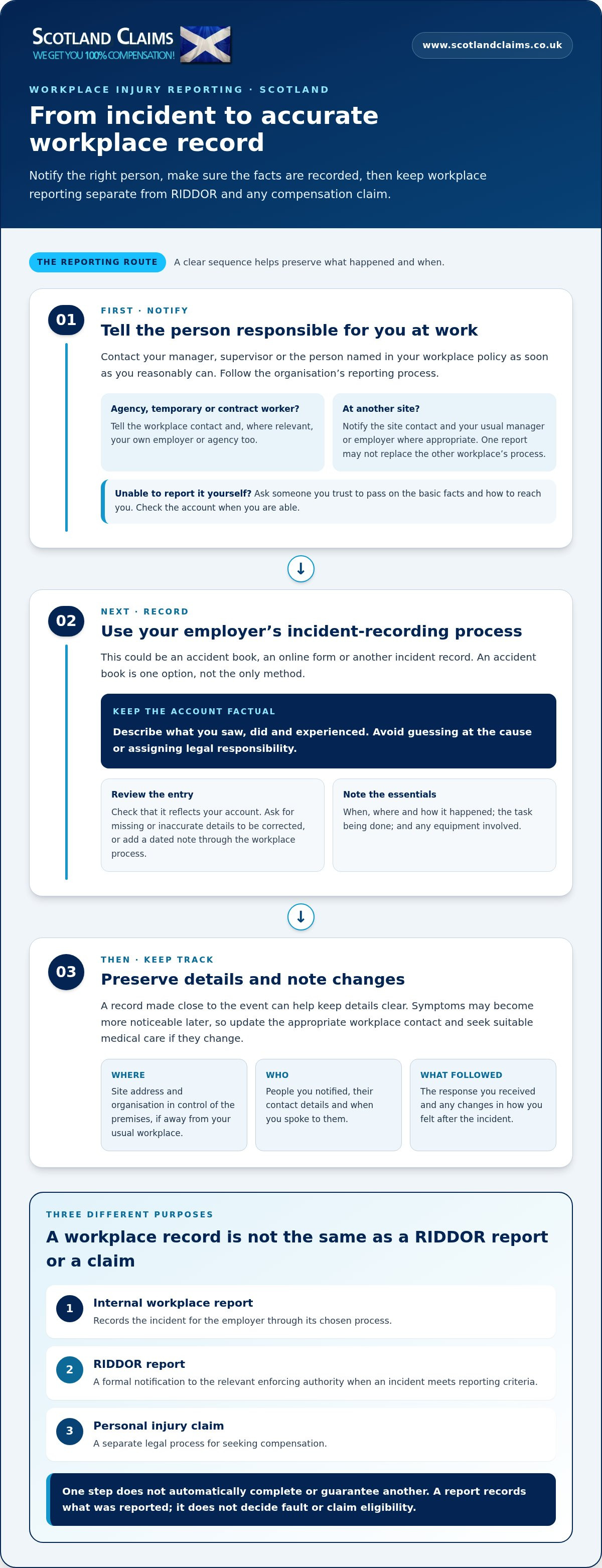
You may be unsure whether to report an injury straight away, particularly if it seems minor or you’re not yet certain how badly you’re hurt. A clear workplace injury reporting procedure scotland workers can follow starts by notifying the appropriate person at work and making sure the incident is recorded through the employer’s process. The record can help document what happened, but it doesn’t decide who was at fault or whether you can claim compensation.
Keep the three processes separate. An internal workplace report records an incident for the employer. A RIDDOR report is a formal notification to the relevant enforcing authority when an incident meets reporting criteria. A personal injury claim is a separate legal process for seeking compensation. Completing one step does not automatically complete or guarantee another.
What counts as reporting a workplace injury?
Tell your manager, supervisor or the person named in your workplace reporting policy, then follow the process they direct you to use. This could mean completing an accident book, an online form or another incident record. An accident book is one way to document an injury, but it isn’t the only method a workplace may use.
Give a straightforward account of what happened and describe the injury as accurately as you can. Stick to what you saw, did and experienced. Don’t guess at the cause or state that a particular person or organisation is legally responsible. If you’re asked to review the entry, check that it reflects your account. If details are missing or inaccurate, ask for the record to be corrected or add your own dated note through the workplace process. A clear factual account is more useful than speculation.
Why record an injury even if it seems minor?
Some symptoms become clearer after the incident. A sore wrist may worsen later in the shift, or discomfort may become more noticeable the following day. If that happens, update the appropriate workplace contact and seek suitable medical care. Keep track of changes instead of assuming the first report captures everything that follows.
A record made close to the event can help preserve details while they’re fresh in your memory. It may also help you explain later how your symptoms developed. It isn’t proof of fault by itself, and an incident entry doesn’t establish entitlement to compensation. It records what you reported and when.
For a broader overview of workplace accident rights and compensation in Scotland, see the work injury claims guide. If an injury leads to a legal dispute, personal injury actions may be heard in Scotland’s Sheriff Personal Injury Court. Scotland Claims Injury Lawyers’ Scottish injury lawyers can help you understand whether your circumstances may support a work injury claim. The reporting record is one part of the picture, not a decision on liability or compensation.
Who should you tell about an injury at work in Scotland?
After an injury, you may be unsure whether to speak to your supervisor, a site manager or someone in your own organisation. Start with your manager or supervisor, or the person named in your workplace policy. The right contact can depend on where you were working and your employment arrangement. This workplace injury reporting procedure scotland guide explains who to notify and what to do if the incident happened away from your usual workplace.
Start with the person responsible for you at work
Tell your manager, supervisor or designated workplace contact as soon as you reasonably can. Follow the organisation’s process for notifying them and recording the incident. If you’re an agency worker, contractor or temporary worker, you may also need to notify your agency or your own employer. Telling the host business alone may not ensure the people responsible for your employment know what happened.
If you’re too injured or unwell to report the incident yourself, ask someone you trust to contact the relevant people for you. They can pass on the basic facts, such as where and when it happened and how to reach you. When you’re able, check that the account reflects your experience and provide any missing details.
What if the injury happened away from your usual workplace?
An injury at a client’s premises, a temporary site or during work-related travel may involve different reporting contacts. If you can, tell the person responsible at the location, such as the site contact. Also notify your usual manager or employer where appropriate. Reporting the incident to someone at the site doesn’t automatically replace your own workplace’s process.
Note the site address, the organisation in control of the premises and the name or contact details of anyone you notified. This helps distinguish the place where the incident happened from the organisation you normally report to. If you work through an agency, include your agency contact in the notification chain.
What if you are self-employed or work through an agency?
There isn’t one reporting route that fits every self-employed or agency arrangement. The appropriate contact can depend on your work status, the site and who controls it. Tell the relevant site contact about the incident, then consider which employer, agency or other organisation also needs to know. Keep your factual account consistent, even if you notify more than one person.
Record who you spoke to, when you contacted them and what response you received. The HSE’s RIDDOR Regulations guidance explains the formal reporting framework. This is separate from telling someone at work so the incident can be recorded internally.
Clear communication helps keep the incident account traceable, but it doesn’t establish fault or decide whether compensation is due. Scotland Claims Injury Lawyers handles workplace injury claims in Scotland and can provide guidance about a possible claim as a separate step from workplace reporting. Find out more about guidance about a possible work injury claim.
When does a workplace injury need a RIDDOR report in Scotland?
Not every workplace injury needs a formal notification. RIDDOR 2013 applies across the UK, including Scotland, and covers specified work-related incidents. A clear workplace injury reporting procedure scotland workers can understand separates the employer’s internal record from a RIDDOR report and a personal injury claim. Each serves a different purpose, and none automatically replaces the others.
| Step | What it does | Who is responsible? |
|---|
| Internal record | Documents an incident under the employer’s process. Injuries causing incapacity for more than three days must be recorded, even if they don’t meet the RIDDOR reporting threshold. | The employer’s workplace process, with the worker providing an accurate account. |
| RIDDOR report | Notifies the enforcing authority when an incident meets the legal criteria. | Usually the employer or person in control of the work premises. |
| Compensation claim | Seeks compensation through a separate legal process. An incident record or RIDDOR report does not establish liability or guarantee a claim. | The injured person can seek independent legal guidance about their options. |
Which workplace incidents may be reportable?
Whether an incident is reportable under RIDDOR depends on the injury and its circumstances. Specified injuries include fractures other than to fingers, thumbs or toes, amputations, permanent loss of sight, certain serious crush injuries, serious burns covering more than 10% of the body, and loss of consciousness caused by a head injury or asphyxia.
A work-related accident that leaves a worker unable to perform their normal duties for more than seven consecutive days must also be reported. The responsible person must notify the enforcing authority within 15 days of the incident. Injuries causing incapacity for more than three days must be recorded, but don’t need a RIDDOR report on that basis alone. A minor injury, near miss or absence from work doesn’t automatically make an incident reportable. The specific criteria matter.
Who makes the report, and where does it go?
The worker’s role is to report the incident internally and provide accurate information. The formal RIDDOR duty generally rests with the responsible person, usually the employer or the person in control of the premises or work activity. Depending on the workplace, the enforcing authority may be the Health and Safety Executive (HSE) or the local authority. The responsible person should identify the correct authority rather than assume every report goes to the same one.
You can ask whether a RIDDOR report has been considered and who is handling it. You aren’t responsible for submitting the employer’s report. The HSE accepts reports online; fatal and specified injuries can also be reported by phone. If you’re unsure whether the incident has been formally reported, keep your own record of who you asked and when. A RIDDOR notification supports regulatory oversight. It isn’t a compensation claim, and it doesn’t decide fault or your eligibility to claim.
What details and evidence should you keep after a workplace injury?
Once you’re safe and urgent health needs have been addressed, write down what you remember and keep relevant records together. A practical workplace injury reporting procedure scotland workers can follow is to make a dated, factual note, preserve useful evidence where it’s safe to do so, and update the record if symptoms or circumstances change. You don’t need to prove who was responsible just to record what happened.
A checklist for your records
Work through these details while the event is still fresh in your memory:
- Record the date, time and location. Include the specific area, such as a loading bay or stairwell, rather than only the building name.
- Describe the task and sequence of events. Note what you were doing immediately before the injury, what happened and what you noticed afterwards. Separate what you saw from what you think may have caused it.
- Identify any equipment or conditions involved. Record the item, vehicle, tool or surface, and relevant details such as its position or condition, if known.
- List witnesses and people notified. Note names and contact details where appropriate, who you told at work, when you told them and any incident reference you received.
- Preserve relevant material safely. If appropriate, take photographs of the area or equipment without putting yourself or anyone else at risk. Keep relevant messages, emails, shift records or instructions, and note where the originals are stored.
- Track what happens next. Record when symptoms appear or change, medical appointments, advice received and any work you miss because of the injury.
Keep the account clear and the records intact
Use plain, specific language. For example, “I slipped near the entrance and landed on my left hand” describes what you experienced. “The employer caused the accident” is a conclusion, not an observation. If you’re uncertain about a detail, say so instead of filling gaps with a guess. Submit any workplace form through the required process, and keep a copy or note of what you sent and when.
Keep your notes and copies somewhere secure. Don’t alter an original message, photograph or document to make it look clearer. If you need to add information later, make a separate dated note explaining what you’re adding and why. This preserves the original record and shows when your understanding developed.
If symptoms appear later
Injuries don’t always feel serious straight away. If symptoms develop or worsen, seek appropriate medical advice and explain when they first appeared and what happened at work beforehand. Once you recognise a possible connection, notify your employer promptly and ask how to update the incident record. A delay in noticing symptoms doesn’t automatically prevent you from reporting them or prove that a claim will succeed. Keep a dated note of the change and any steps you take.
After reporting a workplace injury: when to seek legal guidance in Scotland
Reporting an injury is an important step, but it doesn’t decide who was at fault, whether anyone is legally liable or whether you’re entitled to compensation. An internal incident record, a RIDDOR notification and a personal injury claim are separate processes. A report can preserve an account of what happened, but it isn’t a claim form and doesn’t guarantee a particular outcome.
Does making an incident report start a compensation claim?
No. A compensation claim involves a separate assessment of the circumstances, the injury, its effects and the available evidence. You may want legal guidance if your account of the incident is disputed, your symptoms continue or worsen, you’re losing income, or you’re unsure how your records may be relevant. You don’t need to wait for a RIDDOR report before asking about your options.
The Scottish injury lawyers at Scotland Claims Injury Lawyers handle workplace injury claims for people across Scotland. The firm offers a no-obligation assessment to help you understand whether your circumstances may support a claim. An assessment isn’t a promise that a claim will succeed. It’s an opportunity to discuss the facts and possible next steps with a specialist personal injury firm authorised and regulated by the Law Society of Scotland.
It’s reasonable to ask how legal fees work before deciding what to do. Scotland Claims Injury Lawyers says clients keep 100% of their compensation, with legal fees recovered from the at-fault party’s insurer. The firm charges no success fee, and nothing is owed if a claim is unsuccessful. These terms explain the firm’s fee approach; they don’t establish liability or guarantee compensation. The Scottish No Win No Fee guide explains the arrangement in more detail.
What support can an injured worker expect?
Specialist guidance can help you understand how the incident account, medical information and effects on your work may be considered together. This can be useful if there are different accounts of what happened, your recovery is taking longer than expected, or you’re concerned about lost earnings. Keep relevant records available, but don’t assume any single document decides the outcome.
If you’re uncertain, you can take a measured next step without treating the report as a commitment to claim. Scotland Claims Injury Lawyers offers a no-obligation assessment and has a 24-hour freephone helpline. Speak to the team about your situation on 0800 611 8132.
Take a confident next step
The workplace injury reporting procedure scotland workers follow can help preserve an accurate account, but it can’t answer every question about responsibility or compensation. If you’re unsure what your records mean for your situation, an individual assessment can help you understand your options without committing you to a claim.
Scotland Claims Injury Lawyers is authorised and regulated by the Law Society of Scotland. The firm says clients keep 100% of compensation, with no success fee and legal fees recovered from the at-fault party’s insurer. Nothing is owed if a claim is unsuccessful. These terms don’t guarantee that a claim will succeed, but they give you a clear basis for asking about the process.
You can start an assessment online or call the 24-hour freephone helpline on 0800 611 8132.
Frequently Asked Questions
Do I have to report an injury at work in Scotland?
Notify your employer about an injury at work as soon as you can, even if it seems minor. Use the workplace process so there’s a record of what happened and when. The workplace injury reporting procedure scotland workers follow is separate from RIDDOR rules, which apply to certain reportable incidents. If you’re unsure whether to report a small injury, recording it can help if symptoms change later.
Who should I report a workplace injury to?
Tell your manager or supervisor, or the contact named in your workplace policy. If that person isn’t available, notify another appropriate workplace contact and keep a note of who you spoke to. Agency and temporary workers may also need to notify their agency or employer. If you’re injured at a client’s site, tell the site contact as well as your usual manager where appropriate.
Does my employer have to report my injury under RIDDOR?
Only if the incident meets RIDDOR’s criteria. These include specified injuries and work-related accidents that leave an employee unable to do their normal duties for more than seven consecutive days. That over-seven-day injury must be reported within 15 days of the incident. The responsible person, usually the employer or person in control, submits the report to the relevant enforcing authority, which may be the HSE or a local authority.
How soon should a workplace injury be reported?
Tell your workplace contact as soon as you’re safe and able to do so. A prompt report helps keep your account close to the time of the incident, but follow your employer’s reporting process and any stated time limits. If the injury causes more than seven consecutive days of incapacity, the responsible person must make a RIDDOR report within 15 days. That formal deadline isn’t a reason to delay telling your employer.
What should I do if my employer does not record my accident?
Send your account to your manager or the designated contact in writing, such as by email, and keep a copy with the date you sent it. Ask how the incident can be added to the workplace record and note any reply. If the entry is inaccurate, explain which details need correcting. You can still keep your own factual notes and relevant records, even if the employer’s process hasn’t captured them.
Can I report a workplace injury if symptoms started later?
Yes. Notify your employer once you realise the symptoms may relate to the workplace incident, and explain when they began or changed. Seek appropriate medical advice and keep a dated note of the symptoms and any appointments. A gap between the incident and the onset of symptoms doesn’t automatically prevent you from reporting it. Be clear about the timing rather than presenting later symptoms as if they began immediately.
Is reporting an accident at work the same as making a compensation claim?
No. Reporting tells your employer what happened, while a RIDDOR notification is a formal report for qualifying incidents. Neither starts a compensation claim or decides liability. A claim is assessed separately, taking account of the circumstances, injury and supporting evidence. In Scotland, the general time limit for a personal injury court action is three years from the accident or date of knowledge, but exceptions can apply. Seek legal guidance about your circumstances and deadlines.
Can I make a workplace injury claim in Scotland without paying upfront?
Scotland Claims Injury Lawyers handles workplace injury claims on a no-win, no-fee basis. The firm charges no success fee and clients keep 100% of compensation, with legal fees recovered from the at-fault party’s insurer. Nothing is owed if a claim is unsuccessful. These terms don’t mean every case will qualify or succeed, so an assessment is needed to discuss your circumstances and the applicable fee arrangement.