
What if the key to understanding your injury claim is seeing its effects set out in pounds and pence? If you’re asking “what is a schedule of loss in Scotland?”, it’s a document that organises the compensation being sought and explains how the injury has affected your finances. Legal terminology can make the process feel harder than it needs to be, particularly when online examples relate to employment tribunals rather than personal injury claims.
This guide explains what a schedule may include, what it cannot establish on its own, and how evidence can support each claimed loss. It may cover compensation for pain and the impact on your life, as well as past and potential future financial losses, such as lost earnings, treatment costs, travel and care. Keeping clear records can help explain the figures.
The focus here is Scottish personal injury claims. You’ll learn how supporting evidence fits into the process and how a solicitor can help organise the details, so you’re better prepared to discuss your circumstances and the losses you may be able to claim.
Key Takeaways
- Understand what is a schedule of loss in Scotland and how it sets out the financial impact of an injury claim.
- Identify past and possible future losses to discuss, including income loss and injury-related expenses.
- Match each claimed loss to useful records, such as wage slips, receipts or other supporting evidence.
- Keep dates and figures organised, and update them as your circumstances and evidence develop.
- A specialist solicitor can help assess how your evidence relates to the losses claimed. A schedule supports valuation and negotiation, but it does not guarantee compensation.
What is a schedule of loss in a Scottish personal injury claim?
An injury claim can involve more than the injury itself. Time away from work, additional travel and other expenses may affect your finances. If you’re searching for what is a schedule of loss in scotland, the key point is that it organises the losses being claimed and explains how the figures were reached.
For a Scottish personal injury claim, a schedule of loss is an organised breakdown of the financial and other losses said to result from an injury. It sets out the value being sought and can support settlement discussions. It does not guarantee that a court or the other party will accept every item or award the amount claimed.
Terminology and procedure can depend on the claim and where it is being handled. Scotland’s court framework includes the Sheriff Personal Injury Court, but the relevant process and documents depend on the circumstances. Scotland Claims Injury Lawyers’ Scottish personal injury solicitors can explain how your losses relate to your claim.
What does a schedule of loss do?
A schedule turns the separate effects of an injury into a structured account. It identifies each loss, the period it relates to and the calculation or explanation behind the figure. For example, a claim for reduced earnings should show the dates and figures behind the amount, rather than an unexplained total.
This structure helps the parties see what is being claimed and where further information may be needed. It can focus settlement discussions on particular amounts or evidence. But listing a loss is not the same as proving it. Each item must be considered in the context of the injury, the supporting evidence and the applicable Scottish procedure.
Why employment tribunal examples may not fit
Search results often use “schedule of loss” in an employment context. This can be confusing if you’re pursuing an injury claim. Employment tribunal guidance may relate to claims such as unfair dismissal, and the relevant rules and terminology can differ between jurisdictions.
Those examples may illustrate the general idea of listing claimed amounts, but their awards, categories and terminology should not be transferred automatically to a Scottish personal injury claim. Employment and injury claims involve different circumstances and processes. Focus on the losses connected to your injury and how you can explain them, rather than assuming an employment tribunal template fits. This is a clearer starting point for discussing your claim with a solicitor.
What losses can a Scottish injury claim schedule include?
Understanding what is a schedule of loss in scotland also means knowing that the items included depend on how the injury has affected your life and finances. A schedule may separate losses that have already happened from possible future losses. Neither category is automatic: each item needs to relate to the injury and be considered in light of the circumstances, evidence and applicable Scottish procedure.
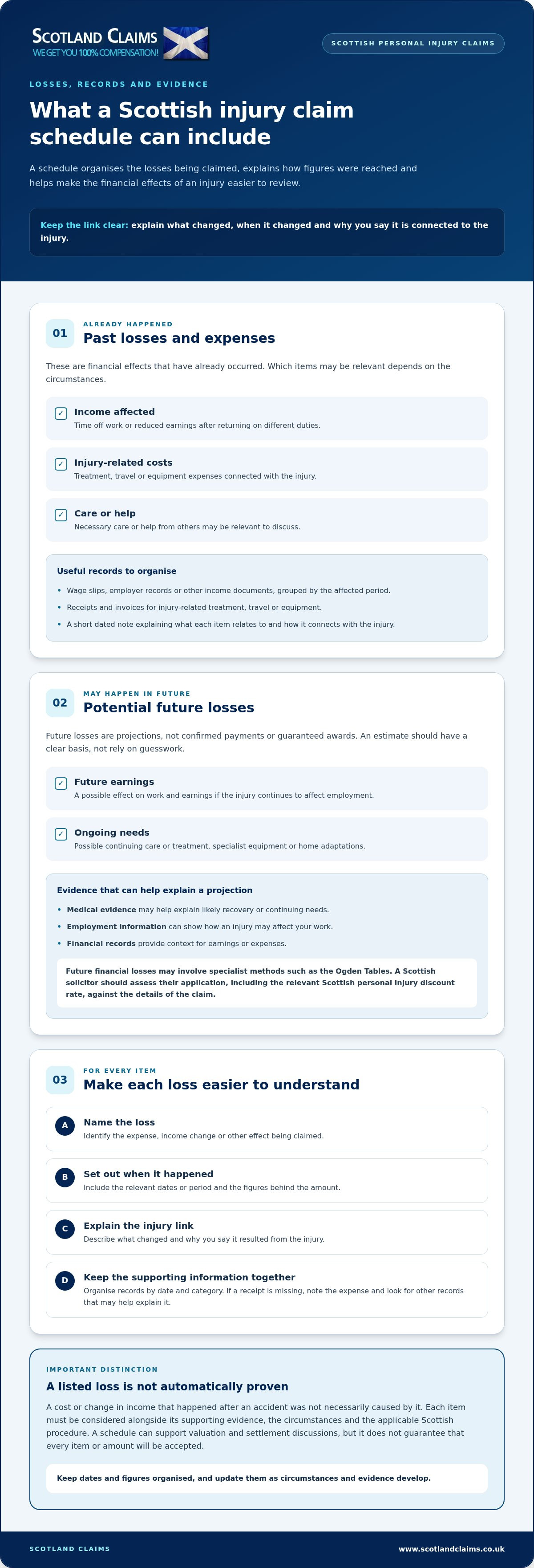
Each claimed loss needs a clear, explainable link to the injury. A cost or change in income that happened after an accident was not necessarily caused by it. Set out what changed, when it changed and why you say it is connected to the injury.
Past losses and expenses after an injury
Past losses are financial effects that have already occurred. Depending on your circumstances, they might include income lost while off work, reduced earnings after returning on different duties, or costs connected with treatment and travel. Necessary care or help from others may also be relevant to discuss with a solicitor. These are examples, not automatic entitlements.
Make records easier to review by organising them by date and category. For example:
- Group wage slips, employer records or other income documents by the period affected.
- Keep receipts and invoices for injury-related treatment, travel or equipment together.
- Add a short note explaining what each item relates to and how it connects with the injury.
This helps show the amount claimed, when the loss arose and why it is included. If you cannot find a receipt, note the expense and look for other records that may help explain it. Do not treat an estimate as equivalent to a documented cost. Tell your solicitor what information you do have.
Future losses and continuing effects
Future losses are projections, not confirmed payments or guaranteed awards. They may be considered if an injury is expected to affect future earnings, require ongoing care or treatment, or lead to costs such as specialist equipment or home adaptations. Whether an item is relevant and how it should be assessed depend on the evidence and your circumstances.
Medical evidence may help explain likely recovery or continuing needs. Employment information can show how an injury may affect your work, while financial records provide context for earnings or expenses. Consider these sources together. An estimate should have a clear basis, not rely on guesswork.
Calculating future financial losses may involve specialist methods such as the Ogden Tables. A Scottish solicitor should assess their application, including the relevant Scottish personal injury discount rate, against the details of your claim. The All-Scotland Sheriff Personal Injury Court provides official information about Scotland’s personal injury court. The appropriate procedure and terminology can depend on the case.
If you’re unsure which past or potential future losses may be relevant, discuss your circumstances in a no-obligation injury claim assessment with Scotland Claims. A solicitor can help relate the evidence to the losses being considered, without treating an estimate as a promised result.
How is a schedule of loss supported and assessed?
A clear schedule links each amount to an explanation and relevant evidence. The strength of that evidence matters, as does whether the loss is connected to the injury and fits the facts of the claim. A document can be neatly organised yet still raise questions if figures are unsupported, dates are unclear or the claimed loss may have another cause.
The examples below are practical illustrations, not a checklist of Scottish legal requirements. The relevant evidence varies from case to case. The Damages (Scotland) Act 2011 is part of the legal background for personal injury damages. A solicitor can assess how the law and procedure apply to your claim.
Which documents may help explain a claimed loss?
Gather records that relate to the loss and the period it covers. Payslips or employer records may help explain an income change, while receipts and invoices may show an expense. Relevant medical or rehabilitation records can provide context for the injury’s effects. Keep available evidence separate from records or updates you are still waiting for.
| Loss category | Example records | What they may help explain |
|---|
| Income disruption | Payslips, employer records | Dates and amount of a change in earnings |
| Injury-related expenses | Receipts, invoices | What was paid, when and for what purpose |
| Continuing effects | Relevant medical or rehabilitation records | Context for an ongoing need or limitation |
These records do not prove a loss by themselves. One document may support the amount or timing, while other evidence may be needed to explain the connection to the injury. If a document is missing, note what you are still trying to obtain rather than presenting an unsupported figure as confirmed.
How to present figures clearly
For each entry, record the date or period, amount, calculation basis and supporting evidence. Explain any assumption in plain language. Separate expenses already incurred from future estimates, and label estimates clearly so they are not mistaken for confirmed payments. If a figure changes, keep the earlier information and note why the updated amount differs.
A Scottish injury compensation calculator can provide an estimate, but it is not a formal legal valuation or a prediction of settlement. It cannot assess every fact or replace a solicitor’s review of evidence, causation and the circumstances of your claim. Treat the result as a starting point for discussion, not an amount you are guaranteed to receive.
To understand how evidence relates to the figures in your claim, discuss the details through a no-obligation claim assessment with Scotland Claims. A solicitor can help identify what supports each entry and what needs clarification, without promising that any particular amount will be accepted.
What should you check before relying on a schedule of loss?
A schedule is most useful when its entries are clear, supported and up to date. Check that each loss is identified separately, the dates are clear and the figure can be explained. If you’re still asking what is a schedule of loss in scotland, remember that it is a working account of claimed losses, not a fixed outcome. It may need updating as your recovery, work situation or evidence changes.
A simple preparation checklist
Use this sequence to organise information for discussion with your solicitor. It can help you spot gaps without having to decide for yourself whether a particular loss will be accepted.
- Identify each loss. Group items by type, such as income changes or expenses, rather than combining unrelated amounts.
- Record dates. Note when each loss began, the period it covers and whether it has ended or is continuing.
- Gather evidence. Keep copies of source records, such as wage documents, receipts or invoices, and link each record to the relevant entry.
- Explain the figure. Write down how you reached the amount and distinguish an estimate from a loss already incurred.
- Review and flag gaps. Update figures when circumstances change. Record unanswered questions instead of guessing missing amounts.
Keep original documents as well as organised copies. If an employer record or invoice is still outstanding, make a note of it. A solicitor can help identify whether more information is needed and how it relates to the claim.
Common errors that can weaken clarity
Small inconsistencies can make a schedule harder to understand. Check for these issues before treating the figures as ready for review:
- Unsupported amounts: a total without a source or explanation is difficult to assess.
- Duplicated costs: check that the same expense has not been entered under more than one heading.
- Unclear date ranges: state the period covered so separate entries do not overlap unintentionally.
- Estimates presented as confirmed: label projected costs or future effects as estimates, and explain what they are based on.
Check whether an apparent loss overlaps with another item. For example, if two records appear to cover the same period or expense, flag this for your solicitor rather than counting both without explanation. The relationship between the injury and each claimed amount matters, so timing alone does not establish a connection.
Employment tribunal templates may use different categories and terminology. Do not copy one into a Scottish personal injury claim without legal advice. The appropriate terminology and court document format can depend on the claim and forum. Your solicitor can review the structure and figures before you rely on the schedule in the process.
How can a Scottish solicitor help with a schedule of loss?
A schedule needs to reflect the injury and the evidence, not just add up figures. A specialist solicitor can review whether each claimed loss relates to your circumstances, whether the calculation is clear and whether further information may be needed. They can also explain how the document fits into the claim process in Scotland, where terminology and procedure can depend on the case.
Scotland Claims handles personal injury claims across Scotland. Its personal injury solicitors in Scotland can help you understand how your records relate to the losses you’re considering. You do not need to complete a schedule before requesting an assessment. An early discussion can clarify what information may be useful and what questions remain.
What to discuss during an initial claim assessment
Start with the essentials. Explain how the injury happened, its effects on your health and day-to-day life, and the financial losses you’re concerned about. Describe any changes at work and whether you expect costs or difficulties to continue.
Available records can help the solicitor understand the situation. These might include payslips, employer information, receipts, invoices or relevant medical documents. If some records are missing or your figures are estimates, explain what you know, what you are unsure about and what evidence you may be able to obtain. The assessment is a chance to discuss your circumstances, not a test of whether you have prepared a complete legal document.
Understand the fee arrangement before proceeding
Before deciding how to proceed, make sure you understand the costs and terms that apply to your claim. Scotland Claims works on a no-win, no-fee basis. If your claim is unsuccessful, you owe nothing under this arrangement. You keep 100% of your compensation, with legal costs recovered from the at-fault party’s insurer. This does not mean a claim will succeed or that compensation is guaranteed.
Scotland Claims explains its fee arrangement in plain language, including how it applies to your circumstances. Clear cost information helps you consider the next step with a better understanding of the financial terms. A solicitor can also help connect the evidence you have with the losses you want to discuss, without treating an estimate as a promised award.
If you’re unsure what records to bring or how to describe your losses, you can still request an assessment. Set out what happened as clearly as you can and raise any uncertainties. A solicitor can explain how the information may relate to your claim and what further details could help, without promising acceptance, compensation or a particular result.
Take the next step with a clearer picture
Understanding what is a schedule of loss in scotland can help you approach your claim with better questions, but you do not need to resolve every figure or evidence gap alone. A discussion with a solicitor can help you decide what to clarify next and how the information you have relates to your circumstances.
Scotland Claims is authorised and regulated by the Law Society of Scotland. Its 24-hour freephone helpline is available for initial enquiries. You keep 100% of your compensation, with legal costs recovered from the at-fault party’s insurer. No claim outcome is guaranteed, but clear guidance can help you consider your options with greater confidence.
Take this one step at a time. Start with the facts and records you have, then get guidance on what may help move the discussion forward.
Frequently Asked Questions
Is a schedule of loss the same as a compensation offer in Scotland?
No. A schedule sets out the losses and amounts being claimed; an offer is a proposal to settle the claim. The other party may respond to the listed losses with an offer that differs from the amount claimed. Discuss any offer with your solicitor before deciding how to respond. Do not treat the schedule total as money already agreed or payable.
Can I prepare a schedule of loss before I know the final impact of my injury?
Yes. You can begin recording known losses and flag future effects as uncertain. If you’re asking “what is a schedule of loss in scotland” while your recovery is ongoing, treat the document as something that may need updating, not a final statement. Note what is confirmed, what is an estimate and what remains unclear. A solicitor can advise how developments may affect the claim and its valuation.
What happens if I leave a loss out of my schedule?
Tell your solicitor promptly if you notice an omitted item. Whether it can be added, and what steps are needed, may depend on the claim’s stage, the evidence and the applicable procedure. Do not assume an omission can always be corrected without consequence, or that it is automatically too late. Explain the loss, when you became aware of it and what records may support it.
Do I need receipts for every expense in a schedule of loss?
Not necessarily. A receipt can be useful, but if one is missing, tell your solicitor rather than leaving the item unexplained or inventing a figure. Other material, such as a bank statement, invoice, appointment record or written note made at the time, may help clarify what happened. Useful evidence depends on the expense and circumstances. Your solicitor can assess what may support that entry.
Can I use an employment tribunal schedule of loss template for a Scottish injury claim?
Do not assume an employment tribunal template is suitable. It may be designed for different types of claims, awards and procedures, so its headings can mislead you about what belongs in a personal injury claim. You can use a template as a rough organisational aid, not as authority on Scottish court requirements. A Scottish personal injury solicitor can advise on the terminology and format for your case.
Does a schedule of loss guarantee the amount I will receive?
No. The figures in a schedule are amounts being claimed, not a promise of payment or a guaranteed award. The other side may dispute whether a loss was caused by the injury, whether the evidence supports it or how it was calculated. The outcome depends on the circumstances and evidence in the claim. Treat estimates carefully, and get advice before relying on a total as an expected settlement.
Can a solicitor help me prepare a schedule of loss in Scotland?
Yes. A solicitor can help identify relevant losses, review how they relate to your injury and organise the supporting information. You do not need a completed schedule to request an initial assessment. Explain what happened, how it has affected you and what financial changes you have noticed. Scotland Claims offers no-obligation claim assessments, so you can discuss your circumstances and understand possible next steps.