
An uneven pavement trip claim in Edinburgh may still be possible even if you didn’t report the defect before you fell. In Scotland, the general time limit for starting a pavement injury claim is three years from the accident date. You’ll need to show that someone responsible for the pavement failed in their duty and that this caused your injury.
It’s understandable to worry that not reporting the hazard straight away has weakened your case. An earlier report can help establish what was known, but photographs, medical records and witness details can also help explain what happened and support your account.
This guide explains what affects responsibility for an uneven pavement, what evidence to preserve and what to do after a fall. It also covers Scotland’s time limit and the information that can help establish the impact of your injuries and related losses.
Key Takeaways
- Not reporting the pavement defect before your fall doesn’t automatically rule out a claim. Other evidence can help show what happened.
- Photograph the hazard and accident location as soon as possible, and keep treatment records, witness details and records of financial losses.
- Responsibility depends on who maintained the area and whether a breach of duty caused your injury.
- In Scotland, the general time limit for starting a pavement injury claim is three years from the date of the accident.
- A fall inside a shopping centre may involve the occupier rather than the local council, so identifying who controlled the location matters.
Can I Claim for Tripping on Uneven Pavement?
You may be able to claim if a pavement defect caused your injury and someone responsible failed in their duty. In Edinburgh, responsibility may depend on the hazard, its location and any circumstances that increased the danger.
Uneven Pavements and Pedestrian Hazards
A raised paving slab can catch a pedestrian’s foot, while a sunken section may cause a stumble or fall. The surroundings can affect the risk: poor lighting may hide a defect, and missing warning signs can leave pedestrians unaware of a hazard. Consider the surface and conditions around it, including visibility and whether a warning was present.
Other pedestrian areas can present similar risks. A broken kerb or uneven path may disrupt a walking route, especially where there is little room to avoid it. What matters is how the defect affected the route you were using, not simply whether the surface looked worn.
Common Pavement Defects and Trip Risks
Examples include loose or raised paving slabs, broken edges, cracks, sunken surfaces and missing covers. Each can obstruct pedestrians differently: a raised edge may catch a shoe, while a missing cover can leave a sudden opening in the walking surface. A photograph that shows the defect alongside the surrounding paving can help explain its shape and position.
Assess the route from a pedestrian’s perspective. A small defect beside a clear alternative path may pose a different risk from one directly across a narrow walkway. Poor lighting, missing signs or other surrounding hazards may also increase the danger, so record these conditions alongside the damaged surface.
Emergency Road and Pavement Hazards
In Edinburgh, an immediate danger on a road, footway or cycleway is treated as an emergency if it presents a high risk of loss of life or limb. Missing ironworks, including manholes and gully grills, are emergency issues. Damaged pedestrian guard rails likely to cause injury also fall into this category.
These urgent hazards differ from defects that need assessment but do not present an immediate, severe danger. If you encounter a missing cover or damaged rail, note its exact location and the risk it creates for pedestrians. This helps you describe the hazard clearly when reporting it.
A defect alone does not establish a claim. You must connect the hazard to your fall and injury, and show that a responsible party failed to take reasonable care. For example, a raised slab may be relevant, while evidence that poor lighting made it harder to see could help explain the circumstances.
Think through what happened before and during the fall: the route you were taking, where your foot caught, the surface condition and any warning signs. These details help distinguish a trip caused by a dangerous pavement defect from an accident with no identifiable maintenance failure.
Can I claim if I did not report the defect to the council before the accident?
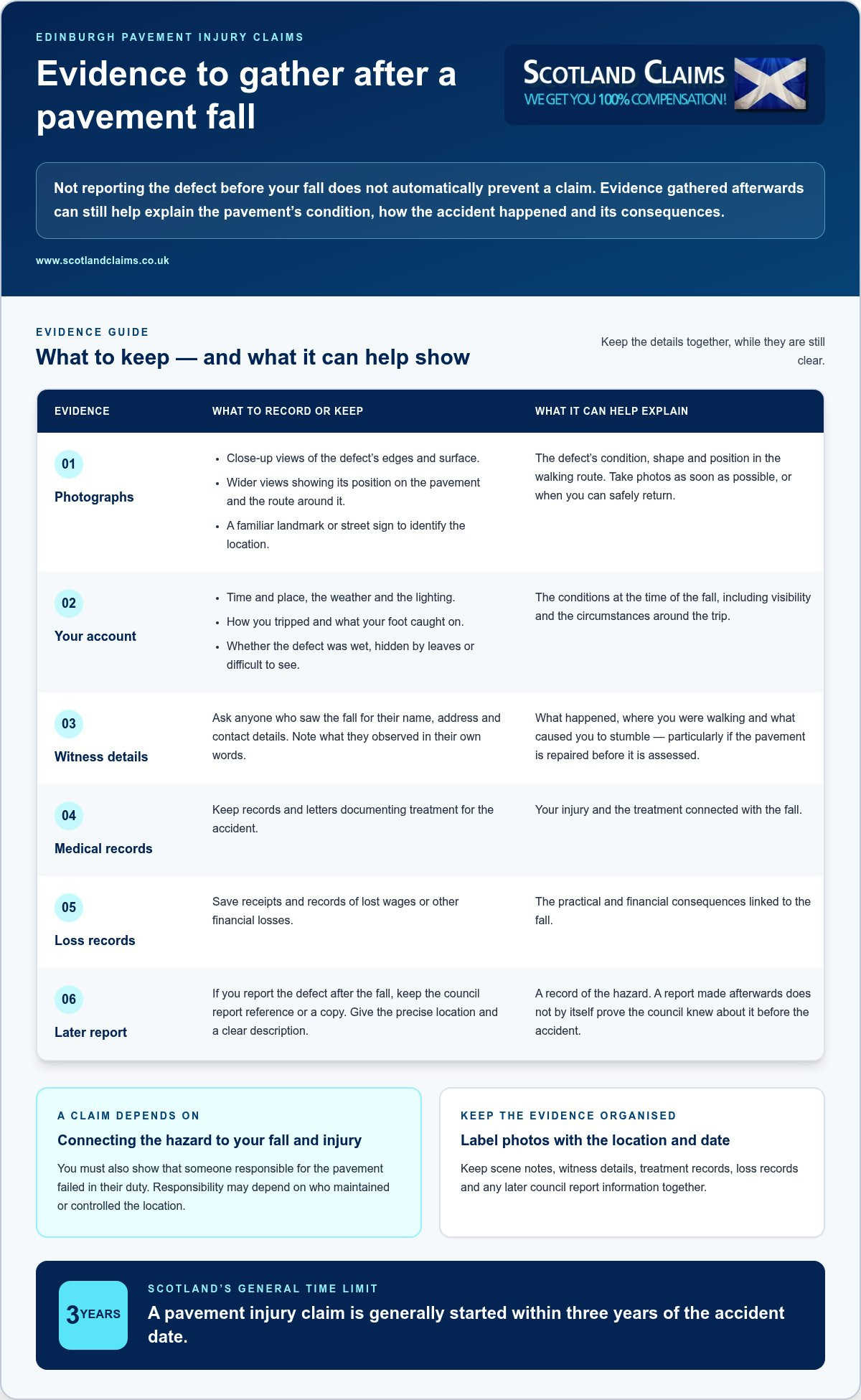
Yes. Not reporting the defect before your fall does not automatically prevent a claim. Evidence gathered afterwards can still help show the pavement’s condition, how the accident happened and its consequences for you.
Costs depend on the case and are provided after a quote request; relevant factors include liability, the evidence, your injuries and financial losses. A no-win-no-fee arrangement should be explained in its agreement, including how fees are handled and what happens if the claim doesn’t succeed.
To report damaged pavement in Edinburgh, use the City of Edinburgh Council’s road and pavement reporting route, giving the precise location and a clear description. For an immediate threat to safety, call 0800 23 23 23 Monday to Thursday from 8am to 5pm, or Friday from 8am to 3.40pm; outside those hours, call 0131 200 2000 on weekdays from 5pm to 8am and at weekends.
Evidence to Gather After a Pavement Fall
Start with the scene. Photograph the defect as soon as possible, or when you can safely return. Take close-up views of its edges and surface, then wider views showing its position on the pavement and the route around it. Include a familiar landmark or street sign to identify the location.
Record details the photographs cannot capture. Write down the time and place, the weather, the lighting and how you tripped. Note whether the defect was wet, hidden by leaves or difficult to see. These details help describe the conditions at the time, rather than relying on memory later.
Photographs and Witness Details
If someone saw your fall, ask for their name, address and contact details. Record what they observed in their own words, such as where you were walking and what caused you to stumble. A witness may help clarify events if the pavement is repaired before anyone assesses it.
Keep medical records and letters documenting treatment for the accident. Save receipts and records of lost wages or other financial losses. Together, these documents can connect the fall to your injury and show its practical consequences.
Keep your evidence together. Label photographs with the location and date, and retain council report references or copies if you report the defect later. Reporting after the fall creates a record of the hazard, but does not by itself prove the council knew about it beforehand.
If you need help understanding how evidence supports a pavement injury claim, slip or trip claims information can explain the next steps.
Can you claim for a pavement trip in Scotland?
You may be able to claim if someone’s failure to maintain a pavement caused your injury. In Scotland, compensation can reflect both the injury and financial losses linked to the fall.
Injuries and Psychological Effects
A pavement fall can cause soft-tissue injuries, fractures, a head injury or facial scarring. The effects on daily life matter too. Pain or fear after a fall, for example, may affect walking, sleep, work or confidence outdoors. Keep treatment records and note changes to your usual activities, including any ongoing distress or reduced independence.
Compensation for Injuries and Financial Losses
Compensation may include general damages for pain, suffering and effects on quality of life. Special damages can cover financial losses such as medical bills, rehabilitation, physiotherapy, travel to appointments, home care and lost income. Keep receipts, wage records and other documents linking each expense to the injury.
These examples show how injury type and recovery affect valuation; they do not replace evidence about your own symptoms, treatment and losses.
Scottish Personal Injury Claim Time Limits
In Scotland, the general time limit for starting a pavement injury claim is three years from the date of the accident. For a child injured in a pavement accident, the three-year period begins on their 16th birthday. Note the accident date and seek advice early, so evidence and records can be gathered whilst they remain available.
England has a separate limitation rule. A person generally has 3 years from the accident date to bring a personal injury claim against the responsible party. That England rule is not the time limit to apply to an Edinburgh accident; use the Scottish period above.
For a claim, evidence needs to connect the pavement fall, the injury and its consequences. Medical records can show diagnosis and treatment, while receipts and wage records help explain financial losses. A consultation can help organise the relevant details, including how the injury has affected work, walking and everyday tasks.
Record the full impact over time. A fracture may require rehabilitation, while soft-tissue symptoms may affect routine activities during recovery. Keep appointment letters and treatment notes, and record any missed work or help needed at home. These details give a fuller account of the injury than a single description of the accident.
Local council pavement-maintenance responsibilities
The City of Edinburgh Council is responsible for roads and footpaths in its area. Scotland’s 32 local councils are responsible for roads and footpaths within their respective areas.
A pavement injury claim against a Scottish local roads authority may be brought under the Roads (Scotland) Act 1984. The relevant authority depends on where you fell and who managed that route.
The Council’s Reasonable-Steps Defence
A council may rely on its inspection and repair processes when responding to a claim. The key question is what it did about the hazard, taking its condition and risk into account. An earlier report, for example, may raise questions about when the council received it and what action followed.
In Edinburgh, the City of Edinburgh Council says an inspector will assess a reported road or pavement problem within five working days, excluding public holidays. The Council assesses reports according to hazard and risk. Inspection records, repair decisions and the defect’s condition can help show whether the response addressed the danger.
That assessment period does not itself prove that the council caused an accident or acted unreasonably. A successful claim needs evidence connecting a responsible party’s failure to the hazard and your injury. Keep report references, photographs and correspondence, and compare the report date with the fall and any later response.
Council or Occupier Responsibility
First establish exactly where you tripped. A public footpath in Edinburgh may point to the local roads authority, while a privately managed area may involve a different responsible party. Record nearby signs, entrances and boundaries, and note whether the defect was on a public pavement or inside managed premises.
A trip inside a Scottish shopping centre is a claim against the occupier under the Occupiers' Liability (Scotland) Act 1960, rather than a claim against the council, according to the UK legislation database. The occupier is the party responsible for the premises, so identify the centre and the precise indoor location.
The location can affect who is responsible for maintenance. A damaged route leading to a shopping centre may be outside its premises, while a defect inside a concourse may be under the occupier’s control. Photographs of entrances, signs and the surrounding area can help distinguish between them.
When reporting an Edinburgh pavement problem, provide the street name, the precise location and a clear description of the defect. The Council’s inspection response and the hazard’s condition are relevant evidence, but neither determines liability on its own. Keep report details with your records, especially if the accident happened after you first reported the problem.
Proving responsibility for a defective pavement
To establish responsibility, you need to connect the pavement hazard to your fall and injury. Evidence should show who maintained the route, what defect existed and how it caused the accident.
Defect Size and Inspection Guidelines
Measure or photograph the defect beside a ruler or another object showing scale. Some Scottish councils use internal guidelines treating pavement defects of 20 mm or more as needing immediate repair. That figure is not a legal threshold. A UK public liability claim may also consider a rule of thumb around 1 inch (2.5cm), but each case depends on its circumstances.
Size is only one part of the assessment. Record the depth compared with the surrounding paving, the defect’s position and whether pedestrians could avoid it. A shallow raised edge across a narrow walking route may create a different risk from a deeper defect beside an unobstructed path. Edinburgh Category 5 potholes are assessed as posing no risk and requiring no action, but that category alone doesn’t decide liability for an uneven pavement trip claim edinburgh.
Showing that damage existed is not enough. You must establish that the occupier or landowner owed you a duty of care, breached it and caused your injuries. In Scotland, the responsible party may be the local authority, council or company maintaining the pavement. Evidence of the defect and its effect on your route helps support each part of your account.
Repairs Made After an Accident
If the pavement is repaired after your fall, gathering evidence promptly becomes more important. The defect may look different when inspected, so photograph it as soon as you can and preserve any images taken before repairs. Note when the photographs were taken and identify the location with a street name, nearby building or other recognisable feature.
Record when the pavement changed, if you saw repair work, and keep any council report details or correspondence. These records help establish the sequence of events. A later repair does not, by itself, prove the council accepted liability or that the defect caused your fall.
Build a clear evidence file. Include witness details, medical records and photographs that show the hazard’s scale and surroundings. Add documents relating to financial losses, such as receipts or records of missed work. Together, these details help explain the impact of the accident and connect it to your fall.
Compare your evidence with the route’s inspection and repair history, if available. An earlier report about the same location may help establish what was known and when. If there was no earlier report, photographs, witness accounts and evidence of the defect’s condition can still help explain the risk it presented.
Get help with a pavement injury claim today by contacting Scotland Claims Injury Lawyers.
Scotland Claims Injury Lawyers: Road Traffic Accident Claims
Scotland Claims Injury Lawyers handles Slip or Trip Claims for people injured in falls, including pavement accidents. If you’re unsure whether a defect caused your injury, the firm can help you understand the evidence and pursue a claim.
The firm works on a no-win-no-fee basis and promises 100% compensation. This means it recovers its fees from the at-fault party and passes the entire settlement to you. Keep your photographs, medical records and details of any financial losses together so the circumstances and impact of your fall are clear.
For support with a pavement injury claim, contact Scotland Claims Injury Lawyers to discuss your situation.
Take the next step with confidence
Your next step is to turn the information you’ve gathered into a clear plan. An uneven pavement trip claim in Edinburgh depends on how the defect, responsibility and injury fit together in your circumstances. Setting out these points can help you focus on the questions that matter before moving forward.
Scotland Claims Injury Lawyers handles Slip or Trip Claims, as well as Road Traffic Accident Claims and Work Injury Claims. You can discuss your circumstances and understand the practical next steps. The aim is to make the process easier to understand, so you can make an informed decision about pursuing a claim.
You’ve already taken a useful step by learning how responsibility and evidence may affect a claim. Move forward at your own pace, with a clearer idea of what to consider next.
Frequently Asked Questions
What makes a pavement defective?
A pavement may be defective if its condition creates a trip risk for pedestrians, such as a loose slab, broken edge or abrupt change in level. No single measurement settles every case: consider the defect’s depth, position and visibility alongside the surrounding route. A raised edge across a narrow walkway may present a different risk from similar damage beside a clear, level alternative.
Can I claim if I was not looking where I was going?
Not necessarily. Looking away does not, by itself, establish that you caused the accident or defeat a claim. The key issues are whether the responsible party owed you a duty, breached it and caused your injury. The circumstances matter: a hidden defect in poor light differs from an obvious obstruction on a clear, open route. Explain accurately what you were doing before you fell.
Do I need to prove the council was told about the hazard?
No. A report made before the fall can help show that the council knew about a hazard, but it is not the only relevant evidence. Your account, photographs, witnesses and the pavement’s condition can help establish what caused the accident. Council inspection and maintenance records may also clarify what the authority knew and what steps it took, even if you did not report the defect yourself.
Does Scots law treat pavement trips differently from English law?
Yes. Scottish pavement claims may be brought under the Roads (Scotland) Act 1984, while the Highways Act 1980 is cited for public highway maintenance in England and Wales. The responsible body and legal framework depend on where the fall happened. An Edinburgh incident must be considered under Scottish law; a fall in England or Wales involves that jurisdiction’s framework.
How Much Compensation?
Compensation depends on the injury, recovery and documented effects on daily life. Injury severity, complications, lasting symptoms and proven financial losses all affect valuation.
How long does it take to settle a pavement accident claim?
A pavement accident claim in Scotland may take six months to over a year to settle. The timeline depends on how quickly responsibility can be established, whether the injury has stabilised and how complete the medical and financial records are. Disputes about inspections or the cause of the fall can add steps. An organised evidence file helps keep the assessment focused.
Can I claim compensation for tripping on uneven pavement in Edinburgh?
You may bring an uneven pavement trip claim in Edinburgh if a defect caused your injury and a party responsible for the route failed in its duty. The pavement’s condition alone is not enough: evidence must connect the hazard, the responsible authority or occupier, and the harm. Keep records of the accident’s impact, including missed work or changes to your usual activities.
What evidence should I collect after an Edinburgh pavement trip accident?
Preserve original photographs and note when each was taken, rather than relying only on edited copies. Mark the precise location on a map, or write down the nearest street number, junction or landmark. Keep a dated record of symptoms and any changes to walking or work. If a witness later provides a written account, record when it was prepared and retain their contact details.