
A workplace injury settlement belongs entirely to the injured worker, yet many traditional solicitors routinely deduct up to 20% of your final payout. If you are dealing with painful physical trauma, lost wages, and restricted mobility after an accident, pursuing trip hazard at work compensation should never jeopardise your financial recovery. You might also feel apprehensive about workplace friction or uneasy about challenging your employer, even when poor safety standards directly caused your fall.
Your employer is legally required to maintain compulsory liability insurance specifically to cover these incidents, meaning compensation is paid by insurers rather than your workplace directly. In this 2026 guide, you will discover how to secure full compensation for workplace trip injuries without sacrificing your settlement to legal fees. We examine your legal protections under Scots law, clarify the strict three-year time limits, and demonstrate how to recover 100% of the financial settlement you are owed with zero personal financial risk.
Key Takeaways
- Understand your employer's legal duty under Regulation 12 of the Workplace Regulations 1992 to keep walkways and work areas free from physical obstructions.
- Learn how Scottish courts calculate your settlement by combining solatium for pain and suffering with full recovery of past and future financial losses.
- Discover how to claim your full trip hazard at work compensation without sacrificing up to 20% of your settlement to standard solicitor success fees.
- Master the critical evidence-gathering steps required immediately after an accident, including the correct way to log injuries in the workplace accident book.
- Recognise why distinct Scots law procedures and the strict three-year limitation period demand specialist representation from regulated Scottish solicitors.
Workplace Trip Hazards and Employer Negligence Under Scots Law
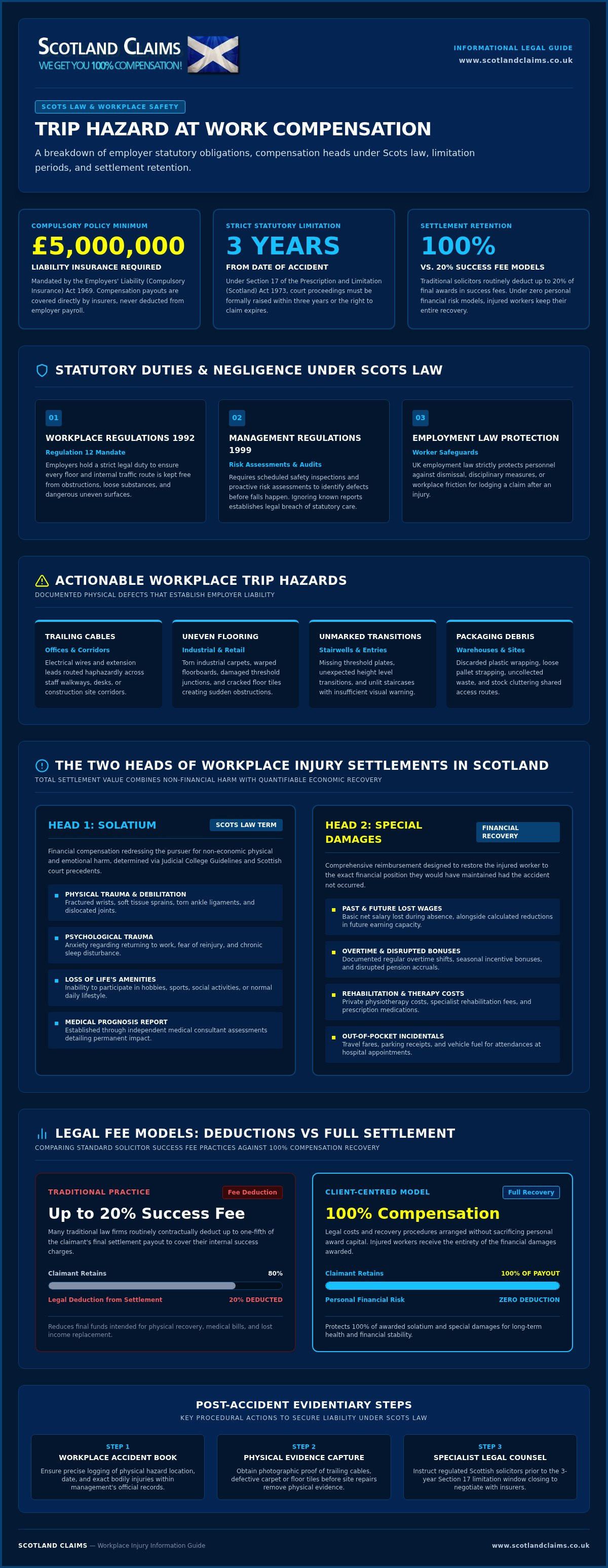
Every Scottish employer operates under strict legal duties to safeguard staff from preventable floor hazards. Under Regulation 12 of the Workplace (Health, Safety and Welfare) Regulations 1992, employers must ensure every floor and traffic route remains free from obstructions, loose substances, and uneven surfaces. In Scots law, establishing an employer's breach of this duty forms the foundation for securing trip hazard at work compensation.
Filing a claim does not target your co-workers or threaten your employer's immediate payroll. By law, under the Employers' Liability (Compulsory Insurance) Act 1969, every UK business must carry at least £5 million in liability insurance. Payouts come directly from that insurer. Additionally, UK employment law protects you from dismissal, disciplinary action, or unfair treatment simply for seeking damages after a workplace accident.
Time limits remain non-negotiable. Under Section 17 of the Prescription and Limitation (Scotland) Act 1973, you have exactly three years from the date of the accident to raise court proceedings. Waiting too long extinguishes your legal right to claim, regardless of injury severity.
Common Workplace Trip Hazards That Justify Legal Action
Actionable workplace trip injuries typically stem from avoidable poor housekeeping across offices, warehouses, retail spaces, and building sites:
- Trailing electrical cables routed haphazardly across desks, gangways, or site corridors.
- Uneven floor surfaces, including torn industrial carpets, warped floorboards, and cracked tiles.
- Unmarked level transitions, such as missing threshold plates, sudden changes in floor height, or unlit stairwells.
- Discarded packaging debris, loose pallet strapping, and neglected waste cluttering shared access routes.
Specialist representation ensures these physical defects translate into actionable proof of liability when seeking work injury claims.
Employer Statutory Responsibilities and Risk Assessment Breaches
Management cannot dismiss physical hazards as simple bad luck. Under the Management of Health and Safety at Work Regulations 1999, employers must conduct routine risk assessments and schedule regular safety inspections to identify floor defects before an employee falls. When safety audits are ignored, negligence is legally established.
A breakdown in hazard reporting protocols often seals liability. If workers previously flagged a damaged step or loose cable and supervisors failed to fix it, this demonstrates an active breach of statutory care. When pursuing Scots law solatium awards alongside reimbursement for lost wages, proving management failed to enforce its own inspection regime ensures the insurer cannot shift blame onto you.
Calculating Trip Hazard at Work Compensation: Solatium and Financial Losses
Workplace injury settlements in Scotland divide cleanly into two core heads of claim: solatium and special damages. Under Scots law, solatium represents financial compensation specifically calculated to redress the pursuer for physical pain, mental distress, and the overall loss of life's amenities, assessed against benchmarks set by previous Scottish judicial determinations and the Judicial College Guidelines. Special damages cover every quantifiable financial hardship you face after the fall.
Your financial recovery extends far beyond baseline wages. A comprehensive claim reclaims lost overtime, missed annual bonuses, disrupted pension contributions, and future earnings if your injury restricts your capacity to work. It also recoups out-of-pocket expenses: private medical fees, physiotherapy, prescription costs, and travel to hospital appointments. To evaluate what your specific circumstances might be worth under current valuation bands, use our compensation calculator.
Solatium: Valuing Physical Injuries and Emotional Suffering
Workplace falls frequently cause painful, debilitating trauma. Solatium valuations account for the exact severity of soft tissue sprains, fractured wrists, torn ankle ligaments, and dislocated joints. It also accounts for psychological trauma, such as anxiety returning to the work floor or sleep disturbance triggered by chronic pain. An independent consultant prepares a detailed medical report, establishing the definitive prognosis that Scottish courts rely on to value your injury.
Special Damages: Recovering Financial Losses and Care Costs
Every penny lost due to employer negligence is recoverable under Scots law. Special damages compile these concrete losses through clear financial evidence:
- Earnings interruption: past lost salary, unworked shifts, and lost promotion opportunities.
- Medical expenses: private rehabilitation, MRI scans, and necessary adaptations to your home.
- Family care claims: reasonable monetary compensation under the Administration of Justice Act 1982 for relatives who assist with personal care, cleaning, or driving while you recover.
Typical Settlement Factors for Workplace Fall Injuries
Insurance payouts hinge on recovery duration and long-term functional impairment. A complete recovery within months settles differently than an injury causing permanent weakness or early-onset osteoarthritis. Insurer representatives often attempt to reduce settlements by alleging contributory negligence, arguing you failed to look where you walked.
Retaining your full settlement matters just as much as its gross size. While legislation sets a statutory 20% cap on personal injury success fees for speculative fee agreements, choosing a model where the insurer covers legal fees ensures you do not lose a fifth of your financial award. If you want to check where your claim stands without risk, you can explore your options with Scotland Claims Injury Lawyers.
Comparing Legal Fee Models: 20% Success Fees vs 100% Compensation
Most workers assume every No Win, No Fee arrangement operates identically. In reality, funding agreements vary significantly across Scotland. Many personal injury law firms routinely deduct the maximum allowable 20% success fee from your financial settlement. When pursuing trip hazard at work compensation, handing over one-fifth of your payout to legal representatives drastically reduces the funds meant to support your recovery.
Scotland Claims operates under a fundamentally different model. By recovering our legal expenses entirely from the negligent employer's insurer under established Scottish court procedural rules, we ensure our clients keep every penny awarded. You never face hidden deductions or sudden administrative invoices.
How Traditional No Win No Fee Success Deductions Work
Under Scottish statutory regulations, law firms can charge up to 20% of the first £100,000 recovered as a success fee. Traditional firms market their services as cost-free, yet deduct thousands from your payout at settlement. Some competitors also shave off hidden disbursement levies, administrative handling fees, and medical report surcharges, further eroding the damages intended to cover lost wages and treatment.
The Scotland Claims 100% Compensation Guarantee
Our guarantee ensures zero deductions from your final award. Because Scottish employers have a duty to keep transit routes safe under Regulation 12 of the Workplace (Health, Safety and Welfare) Regulations 1992, their insurers are liable for the resulting harm and the pursuer's reasonable legal expenses.
The financial difference between these models is immediate and substantial:
- £5,000 minor injury settlement: You retain the full £5,000 with Scotland Claims, compared to £4,000 with a 20% deduction firm.
- £12,000 moderate fracture settlement: You retain all £12,000 with Scotland Claims, whereas a competitor takes £2,400, leaving you with £9,600.
- £30,000 serious joint injury settlement: You keep the entire £30,000 with Scotland Claims, avoiding a painful £6,000 fee deduction that reduces a competitor payout to £24,000.
Financial Protection and Zero Hidden Costs
Pursuing justice shouldn't introduce financial peril. Thanks to Qualified One-Way Costs Shifting (QOCS) in Scotland, honest pursuers are protected against defender expenses if an action fails. Combined with our contractual guarantee of no success fees under any circumstances, you face zero personal financial exposure throughout the litigation process. Read our detailed guide to No Win No Fee Scotland to learn more about protecting your damages.
Essential Steps to Take After a Workplace Trip Accident
Swift action immediately following an injury often determines whether an insurer accepts liability or disputes your claim. Securing trip hazard at work compensation requires contemporaneous proof before management cleans up the area, repairs floor defects, or alters working conditions. Taking deliberate, methodical steps protects your legal standing from day one.
Reporting the Incident and Securing Medical Attention
Report the fall immediately to a supervisor and insist on logging it in the workplace accident book. Document the precise physical defect that caused your fall, such as an unsecured extension lead or an uneven floor tile. If management refuses or delays recording the incident, send a factual email to your line manager to create an undeniable digital timestamp.
Seek medical assessment right away from an NHS Scotland minor injuries unit, A&E department, or your local GP. Tell the attending medical staff exactly how the trip occurred so clinical notes record the precise physical mechanism of your trauma.
Gathering Contemporaneous Evidence at the Scene
Physical hazards disappear quickly once an incident happens. Capture clear smartphone photos of the hazard from multiple angles before anyone moves it. Place a familiar item, such as a coin or pen, beside the defect to show its scale and elevation. Because automated workplace CCTV systems routinely overwrite footage within days, submit a written request for video preservation immediately. Gather phone numbers and email addresses from colleagues, agency staff, or site visitors who witnessed your fall or saw the obstruction earlier.
Navigating Employer Relations and Statutory Protections
Workers often worry that taking legal action will sour professional relationships or lead to dismissal. Employment law protects staff against dismissal or disciplinary action for asserting statutory health and safety rights. Your compensation is paid exclusively by the compulsory liability insurer, shielding day-to-day operations. Discover your options through our dedicated injury at work advisory team.
Speak with our Scottish personal injury specialists today
Instructing Specialist Personal Injury Solicitors in Scotland
Securing fair trip hazard at work compensation requires legal representation firmly grounded in Scots law. Cross-border claims management companies frequently pass Scottish cases to unqualified call centres or English firms unfamiliar with distinct Scottish civil court procedures. Operating continuously since 2006 under Kerr Brown Solicitors, Scotland Claims provides protective, expert advocacy for injured workers. Regulated by the Law Society of Scotland, our team focuses entirely on securing full financial recovery for pursuers.
Why Jurisdiction Matters: Scottish Courts vs English Courts
Workplace injury litigation in Scotland does not follow English civil procedure rules. Most workplace fall actions proceed through the All-Scotland Personal Injury Court (ASPIC) in Edinburgh or local Sheriff Courts under the compulsory Scottish Pre-Action Protocol. Adhering to these strict timetables demands direct advocacy from specialist Scottish practitioners. Working with experienced injury lawyers in Scotland ensures your claim satisfies Scottish evidentiary rules while observing the strict three-year time limit.
The Claims Process: From Freephone Assessment to Payout
Resolving your claim follows a transparent, methodical path designed to eliminate stress:
- Initial consultation: Call our 24-hour freephone helpline or complete an online enquiry for an immediate, no-obligation assessment of your accident.
- Medical prognosis: We arrange an independent examination with an accredited Scottish medical consultant to document the exact scope of your physical injuries.
- Settlement negotiation: Our solicitors present documented financial losses and medical evidence directly to the employer's liability insurer, holding them accountable to court benchmarks.
- Disbursement: Your compensation is transferred directly to your bank account without administrative delays.
Your Injury, Your Claim: Start Your Journey Today
When pursuing trip hazard at work compensation, you shouldn't have to surrender a percentage of your damages to legal deductions. Under our true No Win, No Fee model, we recover our legal expenses directly from the defender's insurer. If your claim doesn't succeed, you pay nothing. Contact Scotland Claims through our 24-hour freephone line today to begin your claim and retain 100% of the settlement you deserve.
Secure Your Full Entitlement Without Legal Deductions
Suffering an injury from an unaddressed workplace hazard shouldn't create personal financial strain. Employers bear clear statutory duties to maintain safe walkways, and their compulsory liability insurance exists specifically to cover your rehabilitation and lost wages. When pursuing trip hazard at work compensation, you deserve every penny awarded for your trauma without losing a fifth of your settlement to traditional solicitor deductions.
Operating continuously via Kerr Brown Solicitors since 2006 and authorised and regulated by the Law Society of Scotland, Scotland Claims defends your rights under Scots law. Backed by our 100% Compensation Guarantee with zero success fee deductions, our team ensures you keep your complete settlement award. You can reach our specialists anytime through our 24-hour freephone helpline on 0800 611 8132.
Claim your 100% compensation with Scotland Claims today
Take the first step toward full financial recovery today with complete peace of mind.
Frequently Asked Questions
Can I be fired for claiming trip hazard at work compensation in Scotland?
No, your employer cannot legally dismiss you for seeking trip hazard at work compensation. UK employment legislation strictly protects workers from unfair dismissal, detriment, or retaliatory disciplinary action for asserting statutory health and safety rights. If an employer attempts to penalise or terminate your contract because you raised an injury claim, you would possess grounds for an automatic unfair dismissal claim at an employment tribunal alongside your personal injury action.
How much compensation will I receive for a trip hazard injury at work?
Your total trip hazard at work compensation depends on the severity of your physical injury and quantifiable financial losses. Scottish solatium covers physical trauma and emotional distress, assessed under Judicial College Guidelines alongside previous court awards. On top of that, your special damages claim recovers 100% of out-of-pocket expenses, including lost past and future earnings, medical fees, and travel costs. Using an online compensation calculator provides a clear initial estimate.
What is the time limit for making a workplace trip claim in Scotland?
Under Section 17 of the Prescription and Limitation (Scotland) Act 1973, you have three years from the date of the accident to raise court proceedings. Missing this statutory deadline extinguishes your legal right to claim compensation completely. While three years might seem substantial, building solid medical evidence, lodging protocol notices, and obtaining CCTV footage takes time. Instructing a Scottish solicitor early ensures all crucial procedural steps are completed well before this limitation cutoff.
How does the Scotland Claims 100% compensation model work without hidden fees?
We operate under a true cost-recovery model where our legal fees are paid directly by the at-fault employer's insurer. Traditional law firms often exploit statutory regulations to deduct a 20% success fee directly from client damages. We never deduct success fees, administration fees, or hidden handling costs from your payout. When we secure a settlement, you keep 100% of the award transferred directly into your bank account.
What happens if my workplace trip compensation claim is unsuccessful?
You face zero financial risk and pay nothing if your claim fails. Under our No Win, No Fee terms and Scottish Qualified One-Way Costs Shifting (QOCS) rules, honest pursuers are legally shielded from paying defender expenses. You will never receive surprise invoices, consultation bills, or unexpected administration fees from us. We assume the operational risk entirely so you can pursue justice without worrying about personal financial vulnerability.
What should I do if my employer refuses to record the trip in the accident book?
Send a factual, detailed email to your line manager and HR department immediately to create an undeniable digital paper trail. Specify the exact time, location, hazard dimensions, and injuries sustained, while stating clearly that management declined to record the entry. You should also seek urgent medical attention from NHS Scotland or your GP, ensuring doctors record the workplace trip hazard as the primary cause of your physical trauma.
Who pays my workplace injury compensation, my employer or their insurance company?
Your employer's liability insurer pays the full financial settlement, not your employer directly. Under the Employers' Liability (Compulsory Insurance) Act 1969, every UK employer must carry at least £5 million in commercial coverage. Your claim proceeds through direct negotiations between our specialist Scottish solicitors and the insurance claims handlers. This arrangement ensures workplace operations remain uninterrupted and colleagues face no direct financial hardship because of your claim.