
If you're searching for “top rated injury lawyers edinburgh”, a directory score is only one part of the decision. You also need to know whether a firm handles your type of accident in Scotland, explains its fee terms clearly and keeps you informed. It's reasonable to want a clear answer about whether a success fee or another deduction could reduce your compensation.
This guide sets out practical checks for comparing injury solicitors, including Scottish regulation, relevant claim types, communication and costs. Scotland Claims Injury Lawyers handles road traffic accident, workplace injury and slip or trip claims across Scotland, including Edinburgh. It operates on a no-win, no-fee basis, takes no success fee or deduction from a client's settlement, and recovers legal costs from the at-fault party's insurer. You'll also find out how to interpret ratings and what to prepare for a free, no-obligation assessment.
Key Takeaways
- When comparing top rated injury lawyers edinburgh, look beyond star ratings to Scottish regulation, relevant claim experience and clear communication.
- Use five practical checks to compare firms, from whether they handle your accident type to how they explain their fees.
- Scotland Claims handles road traffic accident, workplace injury and slip or trip claims, and charges no success fee.
- Read the fee terms before proceeding, including how legal costs are recovered and whether anything is deducted from your settlement.
- A free, no-obligation assessment and Scotland Claims’ 24-hour freephone helpline offer a straightforward way to discuss your options.
What should “top rated injury lawyers in Edinburgh” actually mean?
A high star rating can help you spot firms to research, but it won’t tell you whether a solicitor is the right fit for your Scottish injury claim. The phrase top rated injury lawyers edinburgh might refer to a directory position, review score or professional credential. Each reflects something different, and none can guarantee a particular result or show by itself how a firm will handle your accident and keep you updated.
Use ratings as one part of a practical shortlist, not as a definitive league table. Compare the firm’s claim focus with your accident, its Scottish regulation, the clarity of its fee explanation and how it communicates. For example, if you were injured in a road collision, a firm that handles road traffic accident claims is a more relevant match than a high general ranking alone.
What evidence is useful when comparing injury lawyers?
It helps to separate four types of information. Professional regulation relates to a solicitor’s authorisation and professional obligations. Voluntary accreditation may indicate additional experience or assessment against a scheme’s criteria. Directory rankings provide one comparison signal, while online reviews describe individual clients’ reported experiences. These are not interchangeable, and none proves that your claim will succeed.
When you see a rating or credential, check who issued it, what it measures and whether it is current. Scotland Claims is authorised and regulated by the Law Society of Scotland. That is relevant information about professional regulation, not an independent ranking or a promise about the outcome of a claim.
Why does local Scottish experience matter?
Personal injury claims in Scotland follow Scottish legal processes, which differ from those elsewhere in the UK. The person making a claim is generally called the pursuer, and the person being claimed against is the defender. A broad Personal Injury Law Overview can explain the general concept, but it does not replace information about the Scottish context.
Edinburgh is a useful location to include in your search, but your claim does not have to be handled face to face. Look for a firm that understands the Scottish process and can explain how it relates to your circumstances. Scotland Claims serves claimants across Scotland, including Edinburgh. Read more about its injury lawyers across Scotland as you compare your options.
How to compare Edinburgh injury lawyers: five checks before choosing
Apply the same five checks to each firm you consider. This gives you a consistent way to compare its fit for your claim, rather than relying on a headline rating.
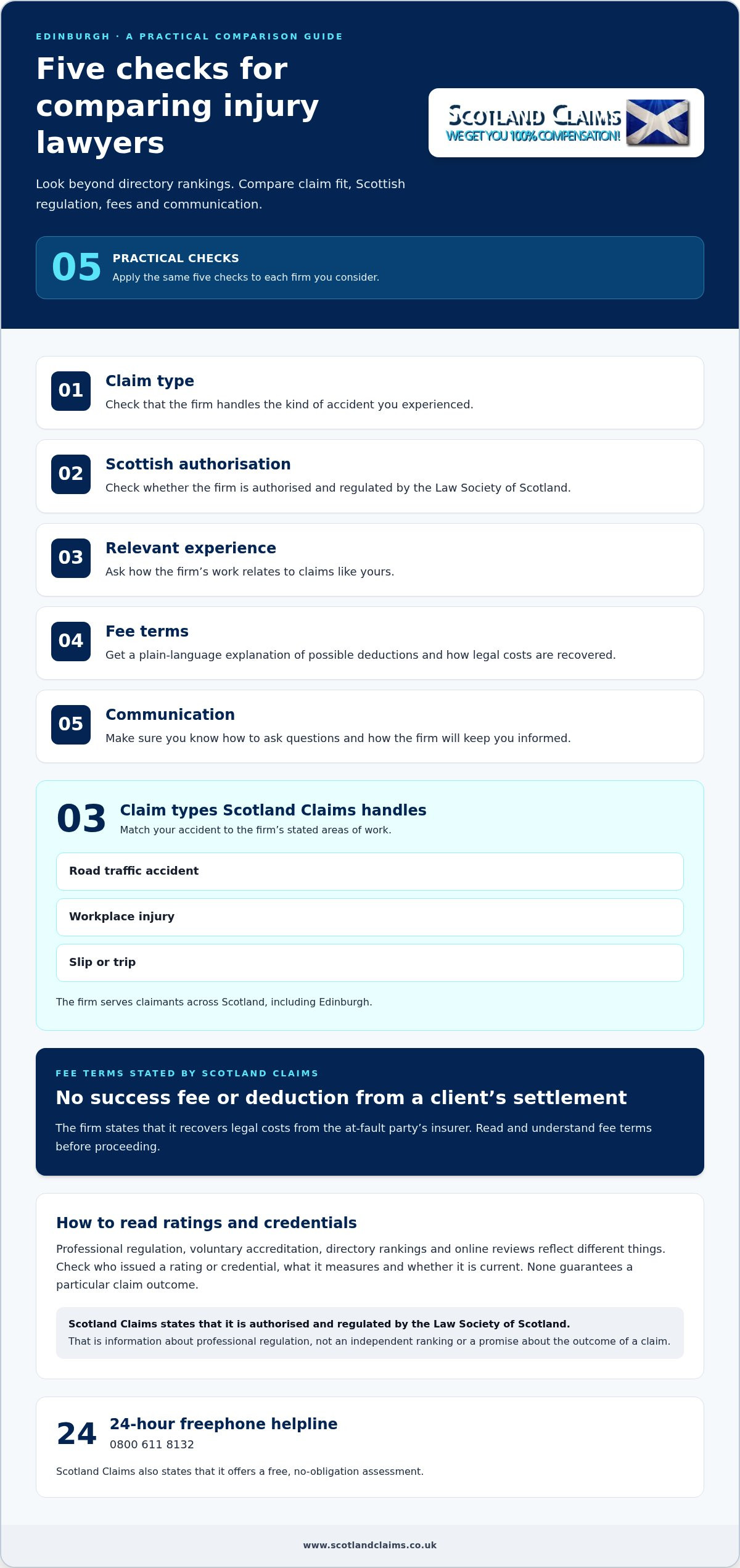
- Claim type: Does the firm handle the kind of accident you experienced?
- Scottish authorisation: Is it authorised and regulated by the Law Society of Scotland?
- Relevant experience: Can it explain how its work relates to claims like yours?
- Fee terms: Are possible deductions and the recovery of legal costs explained in plain language?
- Communication: Do you know how you can ask questions and receive updates?
A directory ranking cannot guarantee the outcome of a claim. Treat it as one research tool, then check whether the firm’s work, costs and service suit your circumstances.
Does the lawyer handle your type of injury claim?
Match your accident to the firm’s stated areas of work. A road traffic accident, an injury at work and a slip or trip are different claim situations, so check that the firm handles the type of incident you experienced. Scotland Claims handles road traffic accident, workplace injury and slip or trip claims. For more context on the Scottish system, read this Scottish personal injury solicitors guide.
Are regulation, fees and communication clear?
Authorisation by the Law Society of Scotland is a useful professional trust check. Next, focus on the written fee terms. Check what happens if a claim succeeds or is unsuccessful, whether a deduction could be taken from your compensation, and how legal costs are handled. A clear explanation lets you understand the arrangement before you decide.
Communication matters too. Find out who will handle your questions and how the firm will keep you informed. Scotland Claims is authorised and regulated by the Law Society of Scotland. It charges no success fee or deduction from a client’s settlement, and recovers legal costs from the at-fault party’s insurer. Its free, no-obligation assessment gives you a chance to discuss your circumstances and understand the terms. The 24-hour freephone helpline is on 0800 611 8132.
| Check | Why it matters | What Scotland Claims states |
|---|
| Claim type | The firm’s work should fit your accident. | Handles road traffic, workplace and slip or trip claims. |
| Scottish authorisation | Shows the relevant professional regulation. | Authorised and regulated by the Law Society of Scotland. |
| Relevant experience | Helps you assess whether the firm’s focus fits your situation. | Specialist personal injury firm serving claimants across Scotland, including Edinburgh. |
| Fee terms | Explains how legal costs relate to your compensation. | Charges no success fee and recovers legal costs from the at-fault party’s insurer. |
| Communication | Clear ways to ask questions and receive updates reduce uncertainty. | Offers a free, no-obligation assessment and a 24-hour freephone helpline. |
Use these checks to compare the top rated injury lawyers edinburgh and decide which approach suits your needs. If Scotland Claims’ services fit your situation, you can request a free, no-obligation assessment to discuss your next step.
Edinburgh injury lawyer shortlist: where Scotland Claims fits
A useful shortlist compares firms on the same practical points: where they serve, which claims they handle, their regulation, how they explain fees and how you can make an initial enquiry. A ranking alone cannot establish which firm is objectively best for your circumstances. Use it as a starting point, then compare the details that affect your claim.
Scotland Claims: a Scottish injury-claim option for Edinburgh residents
Scotland Claims serves people across Scotland, including Edinburgh. Its personal injury work covers road traffic accidents, workplace injuries and slips or trips. The firm is authorised and regulated by the Law Society of Scotland. It charges no success fee or deduction from a client’s settlement and recovers legal costs from the at-fault party’s insurer. Clients keep their full settlement under the firm’s stated fee model. Read more about its injury lawyers in Scotland service.
These details give you a clear basis for comparing claim fit and costs. They are not an independent rating and cannot predict the result of an individual claim. Consider whether your accident matches the firm’s areas of work and whether you understand its explanation of fees and next steps.
How to make a fair shortlist beyond one firm
Directories and professional resources can help you research, but use them alongside checks of the details that matter to your case. APIL and Legal 500 are resources for exploring lawyers and legal-sector information, not Edinburgh injury law firms themselves. For any firm you consider, review its current Edinburgh presence, personal injury work, regulation and published fee information using reliable, up-to-date sources.
Compare each option consistently. Note the areas it serves, the claim types it handles, its regulatory status, how it explains legal costs and deductions, and whether it offers an initial assessment. Don’t base your decision on an unverified star score, award or outcome claim. When weighing up the top rated injury lawyers edinburgh, clear information and a suitable service fit are more useful than a ranking on its own.
Scotland Claims offers a free, no-obligation assessment to help you understand your options without committing to proceed. If its approach suits your circumstances, you can read about starting a personal injury claim.
No Win No Fee Scotland: Understand Deductions First
“No win, no fee” describes an arrangement where you do not pay the solicitor’s fee if your claim is unsuccessful, subject to the terms of your agreement. It does not mean every claim will succeed. Before proceeding, understand what happens in either outcome and how the solicitor’s costs are handled if your claim succeeds.
If you’re comparing top rated injury lawyers edinburgh, the no-win, no-fee label alone is not enough. Read the written agreement and check whether a success fee or another deduction could come from your settlement, and what you would owe if the claim is unsuccessful. Fee arrangements can differ between firms, so focus on the terms that apply to your claim.
What does 100% compensation mean at Scotland Claims?
Scotland Claims charges no success fee and makes no deduction from your settlement. The firm recovers its legal costs from the at-fault party’s insurer, so clients keep their full settlement. It also states that clients pay nothing if their claim is unsuccessful. This describes the firm’s fee terms, not a promise that a claim will succeed or that a particular amount will be recovered.
In plain English, the settlement is the compensation paid in relation to your claim. Legal costs are the costs of handling the legal work. They are related, but they are not the same thing. Scotland Claims recovers its legal costs from the at-fault party’s insurer rather than deducting them from the client’s settlement. Read the firm’s No Win No Fee Scotland guide for more detail on its approach.
What should you understand before starting a claim?
Read the agreement before signing. Make sure you can explain what you would pay if the claim succeeds and what happens if it does not. If any wording is unclear, ask for a plain-language explanation before deciding.
- Settlement: the compensation agreed or awarded in your claim. No amount or result can be guaranteed in advance.
- Legal costs: the costs associated with the solicitor’s work. Check who is responsible for these and how they are recovered.
- Success fee or deduction: check whether the agreement allows one to be taken from your compensation.
Scotland Claims operates on a no-win, no-fee basis, charges no success fee and makes no deduction from the client’s settlement. Its free, no-obligation assessment helps you understand your options and the firm’s stated terms before deciding whether to proceed.
How to start an Edinburgh injury claim with confidence
Searching for top rated injury lawyers edinburgh can help you create a shortlist, but making an initial enquiry does not commit you to pursuing a claim. Start with the details you know, request an assessment, understand the proposed terms and then decide whether to proceed. You do not need to have every document ready before making an enquiry.
What information can help with an initial assessment?
A brief account of what happened can help the firm understand your circumstances. Note the date and location of the accident, how it occurred and what injury you experienced. If available, keep relevant photographs, correspondence and medical information together. This might include images of the scene or injury, messages about the incident, or details of treatment you have received.
Missing paperwork does not need to stop you asking about your options. Share what you know and explain what information you still need to find. The assessment can help you understand what may be useful as the claim progresses.
What happens after you make an enquiry?
Scotland Claims offers a free, no-obligation assessment of your circumstances. Make an online enquiry or call the 24-hour freephone helpline on 0800 611 8132. Use the assessment to discuss your situation, the claims process and costs before deciding whether to take things further. An assessment does not guarantee that a claim will succeed or that compensation will be awarded.
Before deciding, make sure you understand the written agreement. Scotland Claims states that clients pay nothing if a claim is unsuccessful, and that it takes no success fee or deduction from a client’s settlement. Its legal costs are recovered from the at-fault party’s insurer. If a term is unclear, ask for it to be explained so you can make an informed decision without pressure.
Prepare a few questions alongside the basic accident details. You might want to understand what happens next if the firm considers your circumstances suitable, how you will receive updates and how the fee terms apply to your claim. Then decide in your own time.
Choose your next step with confidence
The right firm is not necessarily the one with the highest directory position. Compare Scottish authorisation, experience with your type of accident, clear communication and written fee terms. These checks help you assess whether a solicitor fits your circumstances instead of relying on a rating alone.
Scotland Claims serves people across Scotland, including Edinburgh. Clients keep 100% of their settlement, with no success fee or settlement deduction, and legal costs are recovered from the at-fault party’s insurer. A free, no-obligation assessment is a straightforward way to discuss your situation and understand the terms before deciding. You can also call the 24-hour freephone helpline on 0800 611 8132.
If you’re still comparing the top rated injury lawyers edinburgh, focus on the information that matters to you and whether the answers are clear. You can take an initial step without committing to proceed.
Get clear on your options, then decide what feels right for you.
Frequently Asked Questions
Who are the top rated injury lawyers in Edinburgh?
Directory rankings and online reviews can help you build a shortlist, but they do not guarantee a result or show whether a firm suits your accident. Scotland Claims is an option for people in Edinburgh, handling road traffic, workplace and slip or trip claims across Scotland. Compare its services, regulation, fees and communication with what you need from a solicitor.
How do I choose an injury lawyer in Edinburgh?
Choose by fit and clarity, not ratings alone. Check that the firm handles your type of accident, is authorised and regulated in Scotland, and can explain how its work relates to your circumstances. Read the written fee terms carefully, including any possible deduction from compensation and what happens if the claim is unsuccessful. Consider how you will receive updates and ask questions. Scotland Claims offers a free, no-obligation assessment to discuss your circumstances and its fee terms.
Can I claim compensation after an accident in Edinburgh?
You may be able to claim if you were injured in an accident in Scotland that was not your fault, but eligibility depends on the circumstances and evidence. Scotland Claims assesses road traffic accidents, workplace injuries and slips or trips. Keep notes about when and where the accident happened, how you were injured, and any relevant photographs or medical information. An assessment can help clarify whether your circumstances may support a claim, but no outcome is guaranteed.
How much do injury lawyers in Edinburgh charge?
Fees and deductions depend on the solicitor’s agreement, so read the written terms before deciding. Scotland Claims charges no success fee and makes no deduction from a client’s settlement. It recovers its legal costs from the at-fault party’s insurer. Make sure you understand how costs are handled if a claim succeeds or is unsuccessful, and whether the agreement includes any other charges.
What does 100% compensation mean with Scotland Claims?
Scotland Claims uses “100% compensation” to mean that it takes no success fee or deduction from the client’s settlement. The firm recovers its legal costs from the at-fault party’s insurer, rather than deducting them from the compensation paid to the client. This describes the firm’s fee model. It does not mean every claim will succeed or guarantee a particular settlement amount.
What happens if my no-win, no-fee injury claim is unsuccessful?
Scotland Claims states that clients pay nothing if their claim is unsuccessful. Under its no-win, no-fee arrangement, you do not pay the firm’s fee in that situation. No-win, no-fee does not mean a claim is certain to succeed. Read the written agreement before proceeding so you understand what happens if the claim is unsuccessful and can raise any questions about costs.
Are injury solicitors in Edinburgh regulated in Scotland?
Regulation is a useful trust check, separate from directory rankings, accreditations and online reviews. Check that the solicitor or firm you are considering has the relevant Scottish authorisation, and understand who will handle your claim. Scotland Claims serves personal injury claimants across Scotland, including Edinburgh.