
“No win, no fee” doesn’t tell you exactly what happens to your compensation if your claim succeeds. A success fee is a solicitor’s fee that becomes payable after a successful claim, and the amount depends on the agreement. This guide explains success fees in Scotland, including how they’re calculated and what the rules mean for your settlement.
It’s reasonable to want a clear figure before you sign. The agreement should explain how the fee is worked out, what you and your solicitor must do, and what could happen if the claim doesn’t succeed. Scottish success fee agreements must also give you at least 14 days to cancel.
Here, you’ll see illustrative calculations and learn how to understand the amount you could retain from a settlement. You’ll also find out what to look for in the agreement and how Scotland Claims Injury Lawyers’ 100% compensation approach differs: the firm recovers its fees from the at-fault party and passes the entire settlement to you.
Key Takeaways
- A success fee is payable if a claim succeeds; the agreement explains how it is calculated and what may be deducted.
- Scottish rules set limits on success fees for personal injury claims, but the percentage in your agreement affects what you retain.
- Understand the cancellation period and what you could owe if you end the agreement later.
- Use settlement examples to see how a fee could affect your compensation, while accounting for any outlays or insurance costs.
- Clear communication matters: understand what you must do as the client and what your solicitor is responsible for.
What does Success fees mean?
A success fee is a solicitor’s charge linked to the outcome of a claim. In Scottish personal injury cases, regulations set maximum fees that may be taken from damages. The agreement explains the fee and the circumstances in which it becomes payable. Understanding these terms helps you see how the arrangement could affect the compensation you retain.
Success-fee agreements and no-win-no-fee
A success-fee agreement sets out the solicitor’s fee if your claim succeeds and what happens if it fails. “No win, no fee” describes the funding arrangement in everyday terms. Generally, you don’t pay the solicitor’s fee for their work if the claim is unsuccessful. The distinction matters because outlays and insurance may be treated separately under the agreement.
Personal injury claims are a key example of Scottish cases that can use success fee agreements. The 2020 Regulations exclude damages-based success fee agreements for family law proceedings in Scotland. For other cases, the claim type and the contract’s terms determine how the arrangement works. The name alone does not reveal the applicable percentage or whether expenses sit outside the fee.
In practical terms, “no win, no fee” describes when payment is due; the fee agreement sets out how much may be payable after success. A solicitor’s quoted percentage can be lower than the statutory maximum. The written terms therefore matter: they identify the rate for your claim and how the fee is calculated against damages recovered.
How success fees work under Scottish law
Scottish law treats a success fee as payment due following a successful claim, with no fee or a reduced fee if the claim fails. It becomes payable only after you obtain a financial benefit, or your solicitor receives one for you, directly or indirectly because of their work. The agreement links the payment to that outcome.
The Civil Litigation (Expenses and Group Proceedings) (Scotland) Act 2018 gives Scottish Ministers power to set percentage caps. Under the Success Fee Agreements (Scotland) Regulations 2020, the maximum for personal injury claims is 20% of the first £100,000 of damages, 10% of damages over £100,000 and up to £500,000, and 2.5% of damages above £500,000.
These are tiered limits, not one percentage applied to the entire award. The maximum success fee includes VAT and unrecovered outlays or expenses. A success fee or fee uplift is not recoverable from the defendant in a personal injury claim, so it can affect the damages you retain.
For a personal injury claim, the agreement cannot require you to pay amounts beyond the success fee and relevant insurance premiums. The maximum is a ceiling, not automatically the fee charged. The written agreement should state the applicable percentage and calculation before you sign. For local support with a Scottish injury claim, Scottish injury lawyers can explain the relevant legal support.
Can You Cancel the Agreement?
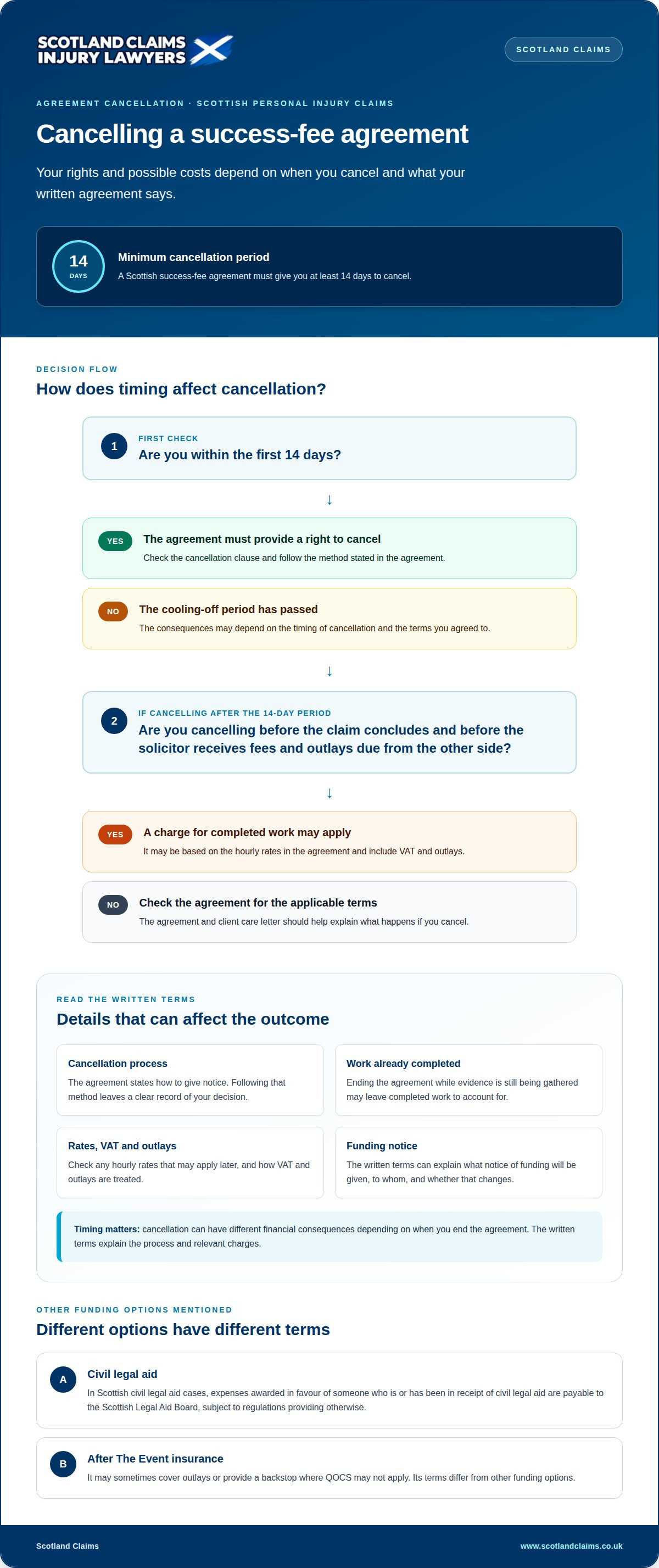
Yes. A Scottish success fee agreement must give you a minimum 14-day period to cancel. That cooling-off period gives you time to read the funding terms, consider the effect of ending the arrangement, and raise anything you don’t understand before proceedings progress.
Start with the written agreement and client care letter. Together, these documents should help you understand who is handling your injury claim, how the solicitor’s fee is calculated, and what happens if you cancel. Look for the cancellation process, any hourly rates that may apply later, and how VAT and outlays are treated.
Cancellation can carry different financial consequences depending on when you end the agreement. If you cancel after the 14-day cooling-off period, but before the claim concludes or the solicitor receives fees and outlays due from the other side, the solicitor may charge for completed work. The charge can use the hourly rates in the agreement and include VAT and outlays.
That means the date and circumstances of cancellation matter. For example, ending the agreement while evidence is still being gathered may leave work to account for, even if proceedings have not concluded. Read the relevant clause before giving notice, and follow the agreement’s stated method so there’s a clear record of your decision.
Funding terms also explain how the arrangement is communicated during a claim. Ask your solicitor to set out in writing what notice of funding will be given, to whom, and if that changes. This helps you understand how the opposing party and court are informed, rather than assuming that cancellation automatically ends every financial obligation.
Alternative funding may include legal aid or an After The Event insurance policy. In Scottish civil legal aid cases, expenses awarded in favour of a party who is or has been in receipt of civil legal aid are payable to the Scottish Legal Aid Board, subject to regulations providing otherwise. After The Event insurance may sometimes cover outlays or provide a backstop where QOCS may not apply. Each option has different terms, so compare its effect on your claim’s funding.
If you’re considering ending an agreement, tell your solicitor promptly and ask for a written account of completed work, rates and outlays. A client refusing advice on a tender was given as an example of a reason a solicitor might withdraw from an agreement. That is distinct from you using your cancellation rights; the agreement’s terms explain the consequences of either route.
For an injury claim, an estimate of possible damages can help you consider funding decisions alongside the likely value of your case. Use the personal injury compensation calculator as one part of that assessment.
Client and solicitor obligations
A Scottish success fee agreement sets out how the solicitor and client will work together during the claim. Read it for the agreed services, the fee calculation, and any responsibilities affecting evidence, decisions or communication. These terms matter throughout litigation: a missed document or delayed decision can affect how the solicitor progresses the case.
As the client, give your solicitor accurate information about the incident, injury and its effects. Pass on relevant records and respond to reasonable requests promptly. Tell the solicitor if your symptoms, work situation or care needs change. For example, new medical information may alter the evidence supporting a personal injury claim or the assessment of future loss.
Your decisions also matter. The solicitor explains the options and their consequences, while you provide instructions on significant steps such as settlement. If advice is unclear, ask for the reasoning in writing before deciding. A record helps both sides understand what was discussed and why a particular course was chosen.
The agreement should explain which outlays are covered, how they are handled, and whether they may be recovered from the other side. Outlays can include medical reports, expert opinions and court fees. In many cases, they are recovered if the claimant wins. Keep receipts and pass on information about expenses so the solicitor can account for them accurately.
The Law Society of Scotland’s Style Success Fee Agreement is guidance, not a mandatory form. The Law Society says a solicitor departing from it must show good reason. This gives the written agreement practical importance: it records the chosen terms and clarifies any difference from that guidance. It does not replace the need to understand what you are agreeing to.
Solicitors and counsel must also be able to end their relationship with a client for good reason, and professional obligations may require them to do so. The Faculty of Advocates has expressed this view. If a solicitor withdraws, the agreement’s termination provisions become important. They explain what happens to work already completed, fees and outlays, and how the claim can proceed.
Some cases require extra attention to potential conflicts. The draft 2020 Regulations said that, in a Scottish case with expected future care loss of more than £1 million, the solicitor must take steps to avoid a potential conflict concerning periodical payments for future care loss. That example shows why solicitors must identify issues that could affect independent advice.
Good cooperation is not simply paperwork. Clear instructions, prompt updates and written records help the solicitor assess evidence, explain choices and account for costs. If you are pursuing a work injury claim, keep information about time off and changes to your work available for the case.
Illustrative success-fee calculations
A percentage turns a settlement figure into an estimated success fee, but the agreement determines the actual charge. The examples below use the stated maximum of 20% for each settlement. They show the maximum fee including VAT, then the approximate compensation retained before outlays or insurance.
| Illustrative settlement | Maximum success fee | Approximate amount retained |
|---|
| £5,000 | £1,000 | £4,000 |
| £20,000 | £4,000 | £16,000 |
| £75,000 | £15,000 | £60,000 |
For the £5,000 example, multiplying £5,000 by 20% gives a maximum success fee of £1,000. The same calculation gives a £4,000 maximum fee from £20,000, leaving about £16,000. On £75,000, the maximum is £15,000, leaving about £60,000.
These are illustrations, not a promise of what you will receive. Each figure assumes the maximum percentage applies to the full settlement. The actual percentage in a success fee agreement can be lower. Check whether the agreement uses a different rate, and how the calculation treats the compensation recovered in your injury claim.
The retained amounts in the table are before outlays or an insurance premium. Outlays can include medical reports, expert opinions and court fees. In many cases, outlays are recovered from the other side if the claimant wins. The final amount you retain therefore depends on the agreed percentage and any relevant expenses or premium.
To understand how a percentage affects your own claim, ask Scotland Claims Injury Lawyers for written examples at settlement levels of £5,000, £20,000 and £75,000. Compare each example against the agreement's fee calculation, VAT treatment and any insurance premium. This makes it easier to see how a change in compensation alters the fee and the amount left after deductions.
A maximum is a ceiling, not an automatic charge. For instance, the £75,000 illustration shows a £15,000 maximum at 20%, but a lower contractual percentage would produce a lower fee. The agreement's wording controls the calculation, including which damages it applies to and how VAT is included.
Use the table as a starting point when assessing funding for Scottish injury claims. It isolates the success fee from other possible expenses, so it cannot show every deduction in a real case. A written breakdown from Scotland Claims Injury Lawyers can set out the percentage, estimated fee and treatment of outlays and insurance for each proposed compensation figure.
How do success fees work under Scottish law?
Understanding how a success fee is explained in Scotland starts with the legal framework, not just the solicitor’s contract. The Civil Litigation (Expenses and Group Proceedings) (Scotland) Act 2018 gives Scottish Ministers power to set maximum charges through regulations. The Success Fee Agreements (Scotland) Regulations 2020 provide rules for these agreements. Together, they set boundaries around fees and the terms a client accepts.
The agreement links payment to a successful outcome. A success fee becomes payable only after you receive a financial benefit, or your solicitor receives one for you, directly or indirectly because of their work. If the claim fails, the agreement generally means you don’t pay the solicitor’s fee for that work. Other financial risks, such as outlays, still need separate consideration.
For a success fee explained in Scotland, the personal injury payment limits are central. The law restricts what the agreement can require you to pay: it cannot require amounts beyond the success fee and relevant insurance premiums. The maximum fee includes VAT and unrecovered outlays or expenses. An agreement providing for a fee above the regulatory maximum is unenforceable to the extent of that excess.
That limit governs the solicitor-client arrangement; it doesn’t make the defendant responsible for the success fee. In Scottish personal injury claims, a fee uplift isn’t recoverable from the defendant. The agreement and settlement therefore determine how the fee affects the damages you retain, while separate rules address expenses payable between parties.
One such protection is qualified one-way costs shifting, or QOCS. Under section 8 of the 2018 Act, a person bringing a personal injury claim and conducting proceedings appropriately is protected from an award of expenses against them for expenses relating to the claim. QOCS applies to personal injury claims raised on or after 30 June 2021.
That protection has limits. A court may disapply QOCS where there is fraudulent representation, manifestly unreasonable conduct or an abuse of process. A tender-related exception can also affect expenses. Where it applies, the amount is 75% of damages awarded to the pursuer, calculated without offsetting expenses due to the pursuer before the tender date.
These rules address different risks. The success fee concerns what your solicitor may charge under the agreement. QOCS concerns whether you may have to pay the opposing party’s expenses. Outlays, including medical reports, expert opinions and court fees, are another issue; they may be recovered from the other side if you win, but their treatment should be clear in your funding terms.
A clear explanation of a success fee in Scotland should distinguish the contract’s fee calculation from QOCS and outlay rules. Check the agreement for its fee calculation, insurance terms and treatment of expenses. Then consider how QOCS applies to the proceedings and whether a listed exception is relevant. That distinction helps you understand the costs covered by the contract and separate risks attached to litigation.
Scotland Claims Injury Lawyers: Zero success fee
Scotland Claims Injury Lawyers handles Scottish personal injury claims on a zero success fee basis. Its approach is to recover its fees from the at-fault party and pass the entire settlement to you, rather than deducting a success fee from your compensation. This is the firm’s 100% compensation approach.
If you’ve been injured in a road traffic accident, at work, or in a slip or trip, this may be a relevant option. The funding arrangement and your responsibilities still matter, so understand the written terms before proceeding. The firm can help with these types of claims in Scotland.
Contact Scotland Claims Injury Lawyers to discuss your injury claim.
Choose the funding arrangement that fits your claim
A practical explanation of success fees in Scotland helps you assess the agreement, but your next step is deciding what support suits your circumstances. Focus on how fees are handled, what happens if plans change, and whether the funding terms are clear enough for you to make an informed choice.
Scotland Claims Injury Lawyers handles road traffic accident, slip or trip, and work injury claims. Its zero success fee approach means it recovers its fees from the at-fault party and passes the entire settlement to you. If your injury falls within one of these claim types, you can discuss whether this approach fits your situation.
Taking that step can help you move forward with a clearer understanding of your claim and its funding. You deserve to make your decision with confidence.
Frequently Asked Questions
Is It Called No Win No Fee Everywhere?
No, the wording varies between legal systems and funding arrangements. In Scotland, a solicitor-client contract may be called a success fee agreement, while “no win, no fee” describes the arrangement in everyday language. The label alone doesn’t tell you the fee, expenses or cancellation terms. Read the agreement itself, especially if you’ve moved between jurisdictions or are comparing information written for another part of the UK.
What Does No Win No Fee Mean in Scotland?
In Scotland, “no win, no fee” generally means your solicitor’s fee for their work is not payable if your personal injury claim is unsuccessful. If you succeed, the agreement explains when and how the fee is due. It doesn’t automatically settle every expense or insurance question. For example, medical reports and court fees may be treated separately, so the written funding terms remain important.
What Happens If You Lose?
If a Scottish personal injury claim fails under a no-win, no-fee arrangement, you generally don’t pay your solicitor’s fee for work on the claim. That doesn’t mean every possible cost disappears. Outlays, insurance and the rules applying to court expenses can affect the position. Ask for a clear explanation of those separate items before proceedings begin, so you understand what the agreement covers if the outcome is unsuccessful.
Are There Any Financial Risks?
Yes, depending on the agreement and circumstances. Outlays such as expert opinions or court fees may need separate funding, and an insurance premium may be relevant. Qualified one-way costs shifting protects eligible Scottish personal injury claimants from certain expenses awards, but exceptions apply, including fraudulent representation, manifestly unreasonable conduct or abuse of process. A tender can also affect expenses. These risks are distinct from the solicitor’s success fee.
Can a firm charge more than the cap?
A success fee agreement is unenforceable to the extent that it provides for a fee above the amount permitted by regulations. The cap is a legal ceiling, not a standard rate that every firm must charge. If another enactment imposes a lower limit, that lower maximum applies. Your written agreement should identify the percentage charged and how it is calculated, so you can distinguish the agreed fee from the statutory maximum.
What is a success fee in Scotland?
In Scotland, a success fee is a solicitor’s fee linked to a successful claim. The agreement provides for payment if you obtain a financial benefit, and no fee or a reduced fee if the claim fails. For example, compensation received after a settlement may trigger payment under the agreed terms. The fee agreement should explain the calculation and its relationship to damages, VAT and any relevant insurance premium.
What is the success fee cap in Scotland?
For Scottish personal injury claims, the maximum is 20% of the first £100,000 of damages, 10% above £100,000 and up to £500,000, then 2.5% above £500,000. The maximum includes VAT and unrecovered outlays or expenses. These are statutory limits, not automatic charges. A firm may agree a lower percentage, and the written contract sets out the rate that applies to your claim.
How are success fees calculated in Scottish personal injury claims?
The calculation applies the relevant percentage to the damages recovered, subject to the statutory tiers and the agreement’s terms. For instance, a claim crossing a threshold may involve different percentages for separate portions of the award, rather than one rate across the whole sum. The maximum is inclusive of VAT. Your final retained compensation may also depend on the agreed fee and any relevant insurance premium or expenses.