
What if the three-year clock for a personal injury claim doesn’t start when you think it does? If you’re searching for the statute of limitations personal injury scotland, the key point is that the deadline depends on the legal facts of your case, not simply when you contact an insurer or solicitor.
It’s understandable to assume the accident date settles the question. For many claims, court proceedings must be started within three years of the injury. However, a later date of knowledge, an injury in childhood or other circumstances may affect how the time limit applies. Telling an insurer about your injury isn’t the same as starting court proceedings, so delay can matter.
This guide explains the usual time limit, possible start dates and records that can help clarify your position, including medical documents, accident reports and correspondence. Scotland’s rules differ from those in England and Wales, and individual circumstances can change the calculation. If you’re unsure whether time is running out, Scotland Claims Injury Lawyers can assess your circumstances and explain the next steps.
Key Takeaways
- The statute of limitations personal injury Scotland depends on the circumstances, so use general guidance as a starting point, not as a personal deadline calculation.
- Gather accident records, medical documents and correspondence to help establish dates and facts relevant to your claim.
- Adult, childhood, later-known injury and fatal claims may be treated differently. Scotland Claims can assess the dates and circumstances of your claim.
- If the deadline may be close, act promptly. Notifying an insurer or solicitor does not necessarily stop the court time limit.
- Scotland Claims provides no-win, no-fee representation, with no success fee charged to the client.
What is the personal injury time limit in Scotland?
Many Scottish personal injury claims are subject to a three-year time bar. People often search for the “statute of limitations personal injury Scotland”, but Scots law usually describes this deadline as a time bar. In general, court proceedings must be raised within the applicable period. Reporting an accident, contacting an insurer or making an initial enquiry does not, by itself, start court proceedings or stop the time limit.
What does “time bar” mean in Scots personal injury law?
A time bar is a legal deadline. If the relevant period expires before court proceedings are raised, the claim may be prevented from proceeding, subject to any applicable exception. The main legislation is the Prescription and Limitation (Scotland) Act 1973. Section 17 sets out the three-year limitation period for relevant personal injury actions and the date-of-knowledge rules. The right deadline depends on the claim’s facts and type, so the general rule is a guide, not a personal calculation.
“Raising” a claim means taking the formal step of starting court proceedings. Sending an accident report, discussing the matter with an insurer or asking for an assessment is not the same thing. Even active correspondence about a possible settlement should not be assumed to protect the court deadline.
Does the three-year period always start on the accident date?
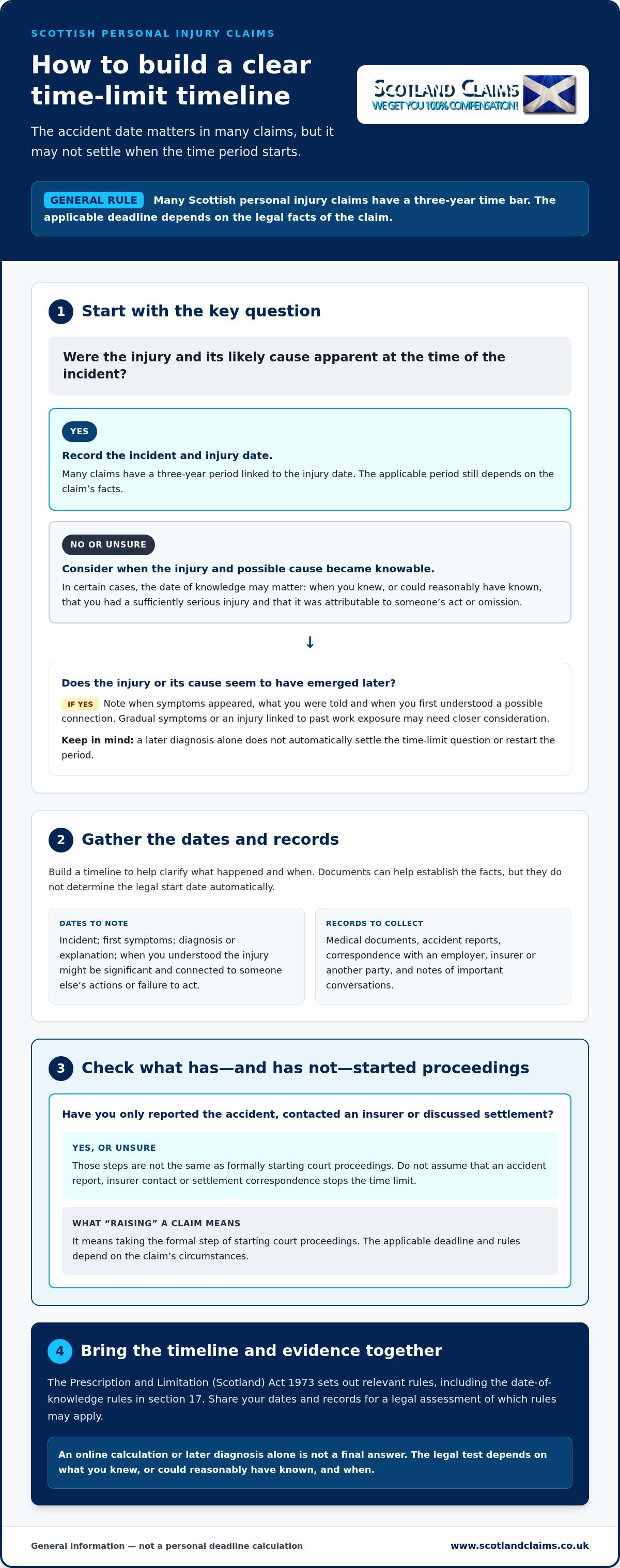
The accident date is an important starting point in many claims, particularly when the injury and its likely cause are apparent at the time. But some injuries develop or become recognisable later. Section 17 also makes the date of knowledge relevant in certain cases. In broad terms, this concerns when you knew, or could reasonably have known, that you had a sufficiently serious injury and that it was attributable to someone’s act or omission. Scotland Claims can assess how that test may apply to your circumstances.
For example, someone with a condition that develops gradually may not immediately connect it to past exposure at work. The date of diagnosis alone does not automatically settle the issue. The medical history, what was known earlier and when the possible cause became clear may all matter.
General rule: many claims have a three-year period linked to the injury date, but the date of knowledge or other case-specific rules may affect the calculation.
The Sheriff Personal Injury Court provides background on a court that hears personal injury cases in Scotland, but the applicable time bar comes from legislation. Find information about Scotland Claims’ Scottish personal injury solicitors and the claims they handle.
How is the deadline for a personal injury claim in Scotland calculated?
Start by building a clear timeline, but don’t treat an online calculation as a final answer. The Prescription and Limitation (Scotland) Act 1973 sets out the relevant rules, including when the date of knowledge may affect the calculation. That date can be legally complex, so Scotland Claims can assess the facts against the legal test.
A personal injury deadline assessment depends on legally relevant dates and the specific facts of the claim.
- Record key dates. Note when the incident happened, when symptoms first appeared and when a diagnosis or explanation was communicated to you.
- Identify the injury. Write down what was injured, how it has affected you and whether the condition developed or changed over time.
- Consider what you knew. Record when you first understood that the injury might be significant and connected to someone else’s actions or failure to act.
- Arrange a legal assessment. Share the timeline and evidence with Scotland Claims so its solicitors can consider which limitation rules may apply to your claim.
Which dates and records should you gather?
Collect documents that may help establish the timeline, such as medical records, accident reports and correspondence with an employer, insurer or another party. Keep notes of important conversations and when information was given to you. These records can help Scotland Claims assess what happened and when. They don’t determine the legal start date automatically, and a later diagnosis alone does not settle the time-limit question.
When can the date of knowledge become relevant?
The issue may need closer assessment if an injury or its possible cause wasn’t apparent at first. For example, symptoms might emerge gradually, or you may only later learn that a condition could be linked to an earlier incident. That doesn’t mean every later diagnosis restarts the three-year period. The legal test depends on what you knew, or could reasonably have known, and when. Read our guide to Scottish personal injury law for more background.
If you’re searching for the statute of limitations personal injury Scotland, use general information to understand the issue, not to set your own deadline. Dates, medical evidence and the circumstances of the injury all matter. Scotland Claims can review those details and explain what steps may be needed. Find out more about our Scottish personal injury solicitors.
Which personal injury claim situations can change the time-limit analysis?
The usual three-year rule doesn’t fit every situation in the same way. Age, when an injury or its cause became knowable, and whether the claim follows a death can all affect which dates need legal review. The table is a general guide only, not a definitive calculation of your deadline.
| Situation | General guide |
|---|
| Adult injury | The three-year period commonly runs from the injury date, though the facts may affect the calculation. |
| Injury during childhood | Special rules may apply. Generally, the period does not begin until the injured person turns 16; a parent or guardian may be able to raise a claim earlier. |
| Later-known injury | The date of knowledge may be relevant if the injury or its possible cause wasn’t apparent at first. A later diagnosis does not automatically restart the clock. |
| Fatal claim | Different limitation provisions can apply. The date of death may be relevant to the time limit for relatives’ claims. |
How can age or a later-discovered injury affect the deadline?
If the injured person was a child, their age when the injury happened matters. The general rule is that the three-year period starts when they turn 16, giving them until their 19th birthday to raise a claim themselves. A parent or guardian may bring a claim on their behalf before then. Specific circumstances can affect how the rules apply, so don’t rely on these dates as a final assessment.
A condition that develops gradually can also make the timeline less straightforward. Scotland Claims’ solicitors may need to examine when you knew, or could reasonably have known, about the injury and its possible connection to another party’s actions.
Are fatal injury claims and late claims treated differently?
Yes. Fatal claims have distinct provisions, and the relevant start date may differ from the date of the original accident. Scottish courts also have limited discretion to allow certain actions to proceed after the usual period where it is equitable to do so. This is a technical exception, not an extension you can assume will be granted. A case-specific legal review is essential.
For context on the rules and court procedures, the Scottish Civil Justice Council’s Personal Injury Committee considers practice and procedure for personal injury actions in Scottish civil courts. If your circumstances involve a collision or workplace accident, Scotland Claims also handles road traffic accident and work injury claims.
The phrase statute of limitations personal injury Scotland is often used in searches, but exceptions and judicial discretion depend on the legal details. Get an assessment of your dates before concluding that a claim is out of time or that an exception applies.
What should you do if your Scottish injury claim deadline may be close?
Act promptly if you’re unsure how much time remains. Scotland Claims can review the relevant dates and circumstances, while you gather the information you already have. Don’t wait until you have every document before requesting an assessment.
- 1. Write down the dates. Note when the accident happened, when symptoms began, when you sought medical help and when you received any diagnosis or explanation about the injury.
- 2. Preserve the evidence. Keep medical records, photographs, incident reports, witness details and letters or emails about the accident. Save copies in one place so they’re easy to find.
- 3. Avoid delay. Don’t assume that discussions with an insurer, an accident report or an initial legal enquiry protects the deadline.
- 4. Request a Scottish legal assessment. Share your timeline and available evidence with Scotland Claims so its solicitors can consider which time-limit rules may apply and whether more information is needed.
Contacting an insurer or solicitor does not necessarily stop the court time limit. In general, it is the formal step of raising court proceedings that matters. Don’t rely on an enquiry, ongoing correspondence or settlement discussions to preserve a claim.
What information helps a solicitor assess the time limit?
Prepare a short account of what happened, where it happened and how you were injured. Add the dates you know, when symptoms appeared and any relevant medical appointments or diagnoses. Include incident reports, letters and emails, plus details of earlier contact with an insurer or legal representative. If a date is uncertain, say so rather than guessing.
This information helps Scotland Claims identify the timeline and the questions that may need further evidence or legal analysis. An initial review can clarify what needs to be investigated, but it can’t guarantee a particular deadline or outcome.
Why shouldn’t you wait for every document?
Evidence gathering and time-limit assessment can proceed in parallel. You can begin by sharing the information you already have and provide further records as they become available. An incomplete file is a reason to explain what’s missing, not necessarily a reason to postpone seeking advice.
If your Scottish claim deadline is uncertain or appears close, seek legal advice promptly. The phrase statute of limitations personal injury Scotland may help you find general guidance, but an online summary can’t calculate your individual deadline. Scotland Claims can assess your Scottish personal injury claim and explain the next steps.
How can Scotland Claims help you understand a personal injury time bar?
Working out whether a personal injury claim is within time can depend on more than the date of an accident. Scotland Claims is a specialist personal injury firm serving people across Scotland. Its solicitors can assess your circumstances, review the timeline and explain which issues may need closer legal attention. This can help you understand the time-bar position and possible next steps, without treating a general rule as a guaranteed answer for your case.
What happens during an initial claim assessment?
You can discuss what happened, the injury, key dates and any records you already have. These may include medical information, accident reports, photographs or correspondence with an insurer. The solicitor can use those details to identify questions about when the relevant period may have started and whether more evidence or legal analysis is needed.
An initial assessment is not a guarantee that you’re eligible to claim, that a claim will succeed or that you’ll receive a particular amount of compensation. Its purpose is to review your circumstances and outline potential next steps. If the deadline may be close, sharing the dates you know can help focus the assessment.
How does the no-win, no-fee approach address cost concerns?
Scotland Claims provides representation on a no-win, no-fee basis. If your claim is unsuccessful, you don’t pay for its legal services. The firm recovers its legal costs from the at-fault party’s insurer, not from your settlement, and charges no success fee. You keep 100% of your compensation.
These funding terms are separate from the legal question of whether a claim is within time. If you’re searching for the statute of limitations personal injury Scotland, an individual review can help distinguish the general time-bar rules from the facts that matter in your case. Scotland Claims’ solicitors are authorised and regulated by the Law Society of Scotland, and can discuss the accident, injury and timeline with you.
Get a clear view of the relevant dates and possible next steps before assuming your claim is in time or out of time.
Take the next step with confidence
For most personal injury claims in Scotland, the time bar is three years, but the relevant start date can depend on the injury and your circumstances. Reporting an accident or contacting an insurer doesn’t necessarily protect the court deadline. If you’re unsure about the statute of limitations personal injury Scotland, don’t rely on a general online guide to decide whether your own claim is in time.
Scotland Claims can assess the circumstances and timeline of Scottish personal injury claims. Its solicitors are authorised and regulated by the Law Society of Scotland. The firm’s no-win, no-fee approach includes no success fee charged to the client, and you keep 100% of your compensation. A 24-hour freephone helpline is available for initial enquiries.
An individual assessment can help you understand the relevant dates and possible next steps. You don’t have to work through the time-bar rules alone.
Take the first step towards clarity and make an informed decision about your claim.
Frequently Asked Questions
How long do I have to make a personal injury claim in Scotland?
For most personal injury claims in Scotland, court proceedings must generally be raised within three years. The exact time limit and its starting point can depend on the circumstances, so the phrase “statute of limitations personal injury Scotland” is only a starting point for understanding the rules. Contacting a solicitor or insurer isn’t the same as raising court proceedings. Scotland Claims can assess your deadline if you’re uncertain.
When does the three-year personal injury time limit start in Scotland?
It often starts on the date of injury, but that isn’t the answer in every case. The date of knowledge may be relevant where you didn’t know, and couldn’t reasonably have known, that you had a significant injury caused by someone else’s act or omission. The legal test depends on the facts. Keep a record of when the accident happened, symptoms appeared and medical information was given to you.
Can I claim for an injury diagnosed more than three years after an accident?
Possibly, but a diagnosis after three years doesn’t automatically extend or restart the time limit. The date of knowledge may matter if the injury or its possible cause wasn’t reasonably apparent earlier. Scotland Claims’ solicitors can consider the medical history, what you knew or could reasonably have known, and when. Seek advice promptly rather than assuming your claim is either in time or automatically time-barred.
Does the time limit work differently for a child injured in Scotland?
Yes. As a general guide, where someone was injured before turning 16, the three-year period usually doesn’t begin until their 16th birthday. They can generally raise a claim themselves until their 19th birthday. A parent or guardian may be able to bring a claim on the child’s behalf before then. These rules can depend on individual circumstances, so get a legal assessment before relying on a date.
What happens if I miss the personal injury time limit in Scotland?
If the relevant time limit has expired, the claim may be prevented from proceeding. Scottish courts have limited discretion in certain cases to allow a late action where it is equitable to do so, but this isn’t automatic and shouldn’t be relied on. The outcome depends on the legal and factual circumstances. If you think the deadline has passed, ask Scotland Claims to assess your position promptly.
Does contacting an insurer stop the Scottish personal injury time limit?
No, contacting an insurer doesn’t necessarily stop the court time limit. Reporting the accident, exchanging letters or discussing settlement doesn’t itself mean court proceedings have been raised. The same applies to making an initial enquiry with a solicitor. Don’t assume that ongoing communication protects your position. If the deadline may be approaching, seek legal advice promptly and explain what steps have already been taken.
Is the personal injury time limit the same in Scotland and England?
No. Scotland and England and Wales have separate legal systems and different legislation governing personal injury time limits. Although a three-year period is common in many claims in both jurisdictions, the rules for calculating it and possible exceptions can differ. Advice based on an accident in England may not apply to an injury in Scotland. For an accident in Scotland, have Scotland Claims assess the claim under Scots law.