
Winning your legal case shouldn't mean losing a fifth of your settlement to your own solicitor. Most firms in Scotland still charge a success fee that eats into your recovery, but you deserve the full value of your claim. If you're currently facing financial pressure from being unable to work, you need an honest assessment of the average compensation for slip and fall scotland. You're likely looking for a way to move forward without the risk of hidden legal bills or complex jargon.
This guide provides a clear 2026 roadmap for your recovery process. You'll discover the latest settlement ranges for solatium following the April 2026 Judicial College Guidelines update. We'll explain the vital differences between Scottish and English law, including the strict three-year time limit for raising a claim. You'll learn how our Law Society of Scotland regulated approach ensures you keep 100% of your compensation by recovering fees from the at-fault party's insurer instead of your pocket.
Key Takeaways
- Learn how the 2026 Judicial College Guidelines determine the average compensation for slip and fall scotland based on your specific injury and recovery period.
- Understand the critical role of independent medical reports in establishing a professional valuation for your "solatium" or pain and suffering.
- Master the steps for proving liability against councils or private businesses by securing the right evidence immediately after your accident.
- Discover how to secure 100% compensation by choosing a model where the at-fault party's insurer pays the legal costs instead of you.
- Ensure you act within the mandatory three-year window to raise your claim and protect your financial future.
What is the Average Compensation for a Slip and Fall in Scotland?
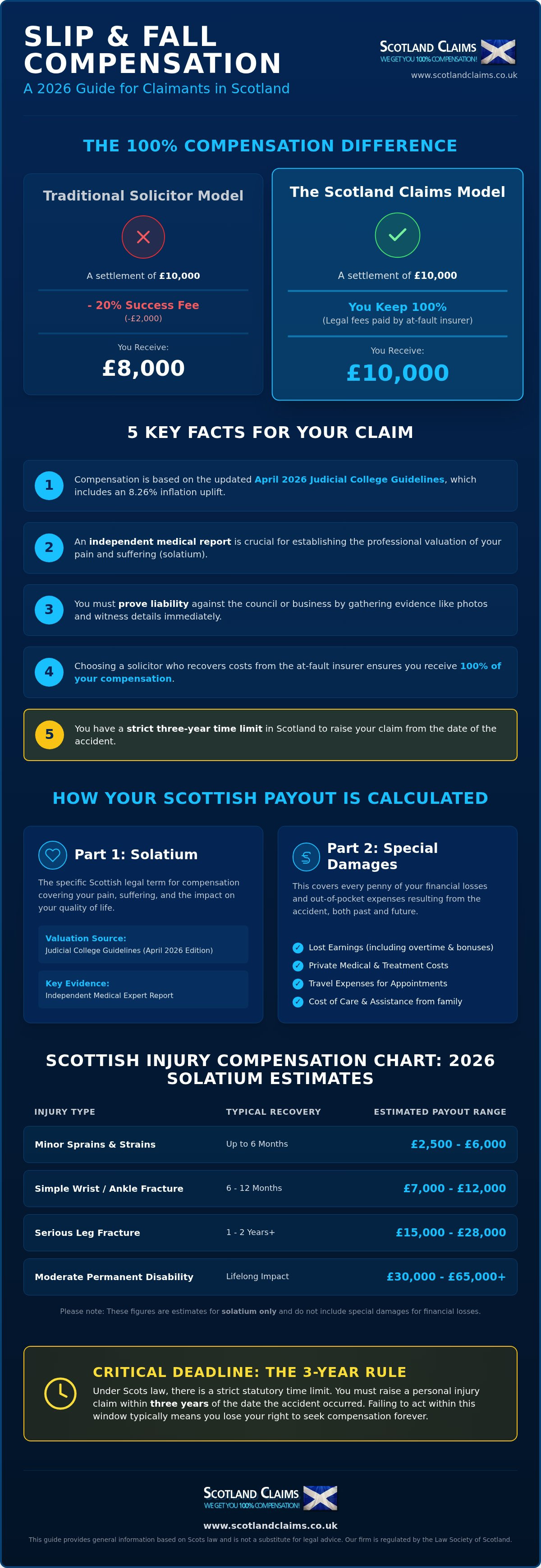
Determining the average compensation for slip and fall scotland isn't about finding a single magic number. It's about identifying a specific range that reflects your unique physical recovery and financial losses. In Scotland, personal injury claims are governed by the Scots law of delict. This system focuses on restoring you to the position you were in before the accident occurred. You must also respect the strict three-year statutory time limit. If you don't raise your claim within three years of the incident, your right to seek legal redress usually expires.
We prioritise your "net compensation". This is the actual amount that arrives in your bank account once the process finishes. Many traditional firms advertise high settlement figures but then deduct a 20% success fee from your award. Our model is different. We ensure you retain 100% of your settlement because we recover our professional costs directly from the at-fault party's insurance provider. This transparency is a core part of our commitment as a firm regulated by the Law Society of Scotland.
Why "Average" Figures Can Be Misleading
Online guides from 2024 or 2025 are already obsolete. The 18th Edition of the Judicial College Guidelines, published in April 2026, introduced an 8.26% inflation uplift across all injury categories. This ensures that payouts keep pace with the current cost of living. Your specific slip or trip claim value also depends on "contributory negligence". If a defender argues you were 20% responsible for your fall, perhaps by not looking where you were walking, your final award is reduced by that percentage. We fight to minimise these deductions to ensure you receive the maximum possible amount.
The Two Components of Your Scottish Settlement
Your total payout consists of two distinct parts. The first is "solatium". This is the specific Scottish legal term for pain, suffering, and the loss of your ability to enjoy life. We use a personal injury compensation calculator to estimate this based on independent medical evidence. The second part is "special damages". This covers every penny you've lost out of pocket. It includes lost wages if you've been unable to work, travel costs to the hospital, and even the cost of private medical treatment. By meticulously documenting both, we build a case that reflects the true impact of the injury on your life.
How Scottish Slip and Fall Payouts are Calculated
"In Scotland, your compensation is a legal right designed to return you to the financial position you were in before the accident." This principle guides how we calculate the average compensation for slip and fall scotland. The process starts with your solicitor gathering evidence to present to the defender's insurer. This isn't a guessing game. It's a methodical process based on precedent and official government statistics which show that around 9,700 personal injury cases are litigated annually in Scottish courts. We follow strict Law Society of Scotland standards to ensure your claim is valued accurately.
Independent medical experts provide the foundation for this valuation. They examine your injuries and provide a detailed report on your prognosis. This report is the primary tool used to negotiate the average compensation for slip and fall scotland. Without a professional medical assessment, an insurance company will likely offer a low settlement that doesn't cover your long-term needs. We use these reports to prove the exact nature of your injuries to the at-fault party's legal team.
The Role of General Damages in Scotland
Scottish law uses the term "solatium" to describe compensation for your physical and mental suffering. Your Personal injury solicitors Scotland will assess the severity of your injury and how long your symptoms are expected to last. A fracture that heals in six months is valued differently than a permanent limp. The April 2026 update to the Judicial College Guidelines ensures these figures reflect current economic realities by applying an 8.26% inflation adjustment to all brackets.
Calculating Special Damages and Future Losses
Beyond your physical pain, we quantify every financial hit you've taken. We account for your immediate needs and long-term requirements by calculating:
- Lost Earnings: This includes your basic salary plus any missed overtime or bonuses you would've received.
- Care and Assistance: Financial value for the time family members spend helping you with daily tasks during recovery.
- Future Losses: Calculated using the +0.5% Personal Injury Discount Rate for injuries with permanent impacts.
- Out-of-Pocket Expenses: Prescriptions, travel to medical appointments, and the cost of damaged clothing or equipment.
It's vital that you keep every receipt and invoice related to your accident. These documents prove your losses and prevent the insurer from disputing your claim. Securing professional legal support early ensures no expense is overlooked and your settlement remains complete.
Scottish Injury Compensation Chart: 2026 Estimates
You need a clear benchmark to understand the potential value of your claim. The figures below represent the 18th Edition of the Judicial College Guidelines, updated in April 2026 to include an 8.26% inflation uplift. These brackets focus on "solatium" and do not include your additional special damages for lost wages or care costs. Please treat these ranges as professional estimates rather than guaranteed sums. Every case in Scotland is unique, and your final settlement depends on the specific medical evidence we gather on your behalf.
| Injury Type |
Minor (Recovery within 1 year) |
Moderate (Ongoing symptoms) |
Severe (Permanent impact) |
| Ankle Injury |
£1,500 – £6,100 |
£15,200 – £31,400 |
£36,800 – £61,200+ |
| Knee Injury |
£1,500 – £6,600 |
£16,400 – £32,800 |
£41,200 – £105,000+ |
| Wrist Injury |
£3,600 – £5,600 |
£6,200 – £15,400 |
£25,800 – £66,400+ |
| Back Injury |
£2,600 – £8,700 |
£13,400 – £41,200 |
£46,200 – £185,000+ |
The average compensation for slip and fall scotland varies significantly based on how the injury affects your daily life and your ability to work. We use these guidelines to ensure the insurance company doesn't underpay you.
Minor vs. Moderate Injury Brackets
Most slip and trip incidents result in minor soft tissue injuries like sprains or strains. These typically attract awards between £1,500 and £5,000 if you recover fully within a few months. However, if you suffer a moderate fracture that requires surgery or leaves you with a permanent scar, the settlement often jumps into five-figure territory. A standard wrist fracture in 2026 carries a guideline range of £4,670 to £13,670. You can get a more tailored estimate by using our compensation calculator Scotland to factor in your specific symptoms.
Serious and Life-Changing Fall Injuries
High-impact falls can result in devastating head or spinal injuries. These claims are complex because they must account for decades of future care and lost earning capacity. For instance, severe brain injuries in 2026 are valued between £372,570 and £533,720 for solatium alone. When a settlement reaches £30,000 or more, our 100% compensation model becomes even more critical. While a traditional firm might take £6,000 or more as a success fee from a £30,000 award, we ensure you keep the entire amount. We believe that the more serious your injury, the more important it is that you retain every penny of your settlement for your future recovery.
Proving Liability for a Fall in Public Places
Proving liability is the essential bridge between your injury and securing the average compensation for slip and fall scotland. You cannot win a settlement simply because you fell. You must prove that the person or organisation in charge of the area failed in their legal duty. This requires a methodical approach to gathering evidence from the moment the accident happens. Without this proof, insurance companies will likely reject your claim regardless of your injury severity.
Your first priority is identifying the defender. Is it the local authority responsible for a cracked pavement or a private business owner who ignored a leak? Once identified, you must gather contemporaneous evidence. Take clear photographs of the defect or hazard immediately. Use a coin or a ruler to show the scale of a trip hazard. Collect names and phone numbers from anyone who witnessed the fall. These witness statements often become the deciding factor in disputed claims when it's your word against a business owner's.
You must also create an official paper trail. Report the incident in the company's accident book or send a formal notice to the council. Visit a doctor or hospital immediately, even for seemingly minor injuries. This creates a medical record that links your physical symptoms directly to the accident date. Finally, instruct a specialist firm that understands the specific procedural rules of the All-Scotland Sheriff Personal Injury Court. They will manage the complex legal filings required to hold the negligent party accountable.
The Occupiers’ Liability (Scotland) Act 1960
This Act is the cornerstone of Scottish slip and trip law. It mandates that anyone in control of a premises must take reasonable care to ensure visitors are safe. Common breaches include wet floors without signage, faulty lighting in stairwells, or loose floorboards. A Slip and fall lawyer Scotland will use this legislation to prove the defender knew, or should have known, about the hazard but failed to fix it. This duty of care is non-negotiable for businesses and public bodies.
Proving Negligence in Pavement and Supermarket Claims
Pavement claims often hinge on the "20mm rule". Scottish councils generally only consider a defect actionable if it's at least 20mm deep. We use specialist evidence to prove these measurements meet the threshold. In supermarkets, acting fast is mandatory. CCTV footage is frequently deleted within 7 to 28 days. We act quickly to secure this footage before it's lost forever. Councils often try to defend claims by showing they have a regular inspection regime. We scrutinise their maintenance logs to identify if the hazard was present during previous checks but ignored.
Start your 100% compensation claim with our specialist team
Maximising Your Payout: The 100% Compensation Difference
Securing a settlement is only half the battle. You must also ensure you actually receive the full amount awarded to you. Most personal injury firms in the UK deduct a success fee from your final payout. This fee is often 20% of your total compensation. We refuse to follow this industry standard. We believe your settlement belongs to you, not your solicitor. Our 100% compensation model is designed to protect your financial integrity during a difficult time.
The difference in your bank account is substantial. Let's look at the maths. If we secure a £12,000 settlement for your injury, you receive exactly £12,000. A firm charging a 20% success fee would take £2,400 from that same award, leaving you with just £9,600. We avoid this by recovering our professional fees directly from the at-fault party's insurance company. We bill the insurer, not you. This ensures that the average compensation for slip and fall scotland stays in your pocket where it belongs.
This approach provides a true No Win, No Fee framework. You face zero financial risk when you start your claim. If your case isn't successful, you pay us nothing. If you win, you keep every penny of the award for your pain, suffering, and lost wages. This transparency removes the fear of hidden legal costs and empowers you to seek justice without hesitation. We stand as a protective expert for our clients, ensuring the legal process is fair and rewarding.
Why Choose a Scotland-Based Specialist?
Scottish law is distinct. You need a team that is authorised by the Law Society of Scotland to handle your case correctly. We provide direct access to qualified professionals who specialise in the Scottish court system. You won't be stuck talking to a call centre operative who doesn't understand the Prescription and Limitation (Scotland) Act. Our local expertise ensures your claim is processed with speed and precision. For more details on how this works, read our No win no fee Scotland guide.
How to Start Your Claim Today
You can begin your recovery process right now by calling our 24-hour freephone helpline on 0800 611 8132. We offer a no-obligation assessment to determine if you have a viable claim. Remember that the three-year rule is strict. Waiting too long can jeopardise your legal rights and prevent you from receiving any compensation at all. Act quickly to secure the evidence needed for your case. You can also value your claim with our 100% compensation calculator to see what you could be entitled to receive.
Secure Your Full Settlement Today
Your path to recovery should be clear and financially secure. We've explained how the 2026 guidelines and the 8.26% inflation uplift impact the average compensation for slip and fall scotland. You now understand that acting within the three-year limit is vital for protecting your legal rights. Most importantly, you've seen how our model eliminates the standard 20% success fee that many other firms still charge.
We are authorised by the Law Society of Scotland and committed to our 100% Compensation Guarantee. We recover our costs from the at-fault party's insurer so you don't have to sacrifice a penny of your award. You deserve a specialist who prioritises your interests over their own profit margins. Our transparent approach ensures you keep the full value of your settlement for your future needs.
Start your claim online and keep 100% of your compensation
Take the first step towards justice with total confidence. Our team is ready to provide the expert guidance you need to move forward without financial risk or hidden charges.
Frequently Asked Questions
How much compensation will I get for a slip and fall in Scotland?
Your final settlement is a combination of solatium for your injuries and special damages for financial losses. While the average compensation for slip and fall scotland varies, minor injuries often reach up to £6,100 whilst severe cases can exceed £60,000. We assess your unique medical prognosis and lost wages to calculate a precise valuation. This ensures the insurance company pays a figure that truly reflects your recovery journey and out-of-pocket expenses.
Is there a time limit for making a slip and fall claim in Scotland?
You generally have three years from the date of your accident to initiate legal proceedings in a Scottish court. This deadline is governed by the Prescription and Limitation (Scotland) Act 1973. If you miss this window, your claim becomes time-barred and you lose your right to seek compensation. For children, the three-year period only starts on their 16th birthday. We recommend starting your claim immediately to ensure evidence remains fresh and accessible.
Can I claim if the fall was partly my fault?
You can still pursue a claim even if you were partially responsible for the accident. This is known as contributory negligence under Scots law. A court or insurer will assign a percentage of fault to both parties. For example, if you are found 25% responsible, you will receive 75% of the total settlement value. We work to challenge these arguments to ensure you retain the highest possible portion of your award.
What is the average payout for a slip and trip on a pavement?
The average compensation for slip and fall scotland on a pavement depends on whether the defect meets the local council's actionable threshold. Most pavement settlements for minor fractures range between £4,670 and £13,670 following the 2026 inflation adjustments. If the injury results in permanent mobility issues, the payout can be significantly higher. We meticulously measure the defect and check maintenance logs to prove the council failed in its statutory duty.
How long does a slip and fall claim take to settle in Scotland?
Most straightforward slip and trip claims in Scotland settle within six to twelve months. If the defender disputes liability or your injuries are complex, the process may take longer to ensure your final prognosis is clear. It's vital not to settle too early before the full extent of your injury is known. We push for a swift resolution whilst maintaining the high standards required by the Law Society of Scotland.
Do I have to pay anything if my claim is unsuccessful?
You pay nothing if your claim is unsuccessful under our No Win, No Fee agreement. We take on the financial risk of the litigation process so you don't have to worry about legal bills. This ensures that everyone has access to justice regardless of their current financial situation. Our firm only receives payment if we successfully secure a settlement for you, providing you with total peace of mind throughout the legal journey.
How can you offer 100% compensation when other firms do not?
We recover our professional fees directly from the at-fault party's insurance company rather than taking a success fee from your award. Most traditional firms deduct 20% or more from your settlement to cover their costs. We believe this is unfair to the victim. By billing the insurer directly, we ensure you keep 100% of your compensation. This transparent model is a core pillar of our commitment to fair specialist advocacy.
What evidence do I need to prove a slip and fall claim?
Successful claims rely on a strong foundation of contemporaneous evidence gathered at the scene. You should seek to provide the following items:
- Clear photographs of the hazard and the surrounding area.
- Contact details for any independent witnesses who saw the fall.
- A copy of the entry in the official accident report book.
- Medical records from your GP or the A&E department.
We use these documents to build an undeniable case for negligence against the defender and secure your settlement.