
A counter-offer can change more than the figure on the table: it may bring the original offer to an end. Understanding a counter offer in a settlement starts with knowing what kind of offer you’re responding to. A Calderbank offer is made on a “without prejudice, save as to costs” basis, so it would not normally be shown to the judge until the outcome has been decided and costs are being considered.
It’s reasonable to negotiate rather than accept an offer that doesn’t reflect your position. But the wording and terms matter: a counter-offer may reject the original proposal, and its effect depends on the offers made.
This article explains how Calderbank offers work, what without-prejudice protection means, and how to frame a counter-offer. You’ll also learn when a response may end the original offer and what to consider before deciding whether to accept, reject or negotiate further.
Key Takeaways
- A Calderbank offer is made “without prejudice, save as to costs”, so it is generally considered by the judge only after the outcome when costs are assessed.
- According to the Ministry of Justice, a Part 36 offer must remain open for acceptance for at least 21 days, known as the relevant period.
- Make a counter-offer with clear terms and a reasoned figure, leaving room for negotiation rather than relying on a fixed template.
- A counter-offer may reject the original offer. Its effect depends on the wording and circumstances of the offers.
- In England and Wales, CPR Part 36 provides a formal framework for making and responding to offers to settle all or part of a civil claim, according to the Ministry of Justice.
Calderbank offers and without-prejudice protection
A Calderbank offer is a settlement proposal marked “without prejudice, save as to costs”. Its wording and timing can affect how a court considers costs if the dispute proceeds.
Without-prejudice counter-offers
A without-prejudice counter-offer is a proposal made during settlement discussions, rather than an admission intended to be used as evidence. It lets the parties put forward terms and respond to an initial offer while negotiating.
For example, a claimant could reject the proposed sum and suggest a different amount. That counter-offer may show a willingness to reach agreement without a trial, but it can also affect whether the original offer remains open. The precise terms matter.
Without-prejudice wording
“Without prejudice, save as to costs” means the offer would not normally be shown to the judge until the case outcome is decided and costs are being considered.
Use the wording to identify the proposal’s intended status, then state its terms clearly, including what the recipient must do to accept. A Calderbank offer may also say that its maker will rely on it when applying for indemnity costs if it is rejected. That wording does not guarantee a costs award.
Calderbank offers and Part 36
The Calderbank principle is associated with the English Court of Appeal decision Calderbank v Calderbank, reported as [1975] 3 All ER 333 (EWCA). A Calderbank offer is flexible: it may be made in writing, face-to-face or by telephone. It may include an acceptance deadline, such as 14 or 21 days, but it has no fixed acceptance timeframe like a Part 36 offer.
Part 36 is a separate formal process. According to the Ministry of Justice, a Part 36 offer must remain open for acceptance for at least 21 days, known as the relevant period. The Ministry of Justice also says payment of a Part 36 settlement sum is usually required in one lump sum within 14 days.
Those Part 36 time limits should not be treated as automatic rules for Calderbank offers. Check the proposal’s terms: its deadline, the amount offered, the claims it covers and any conditions attached. A clear offer gives the recipient a defined choice and helps establish what was proposed if costs are later disputed.
Part 36 consequences can also differ. According to the Ministry of Justice, if a claimant matches or beats its own Part 36 offer at trial, the court may award interest on indemnity-basis costs at up to 10% above base rate. This is a potential court outcome, not an automatic result. Calderbank offers can influence costs too, but their effect depends on the offer and the court’s assessment.
Keep the original offer and every counter-offer together. The sequence can show how each party tried to resolve the dispute, which terms changed and when. That record matters if the court later considers whether either party acted reasonably during negotiations.
Making a counteroffer
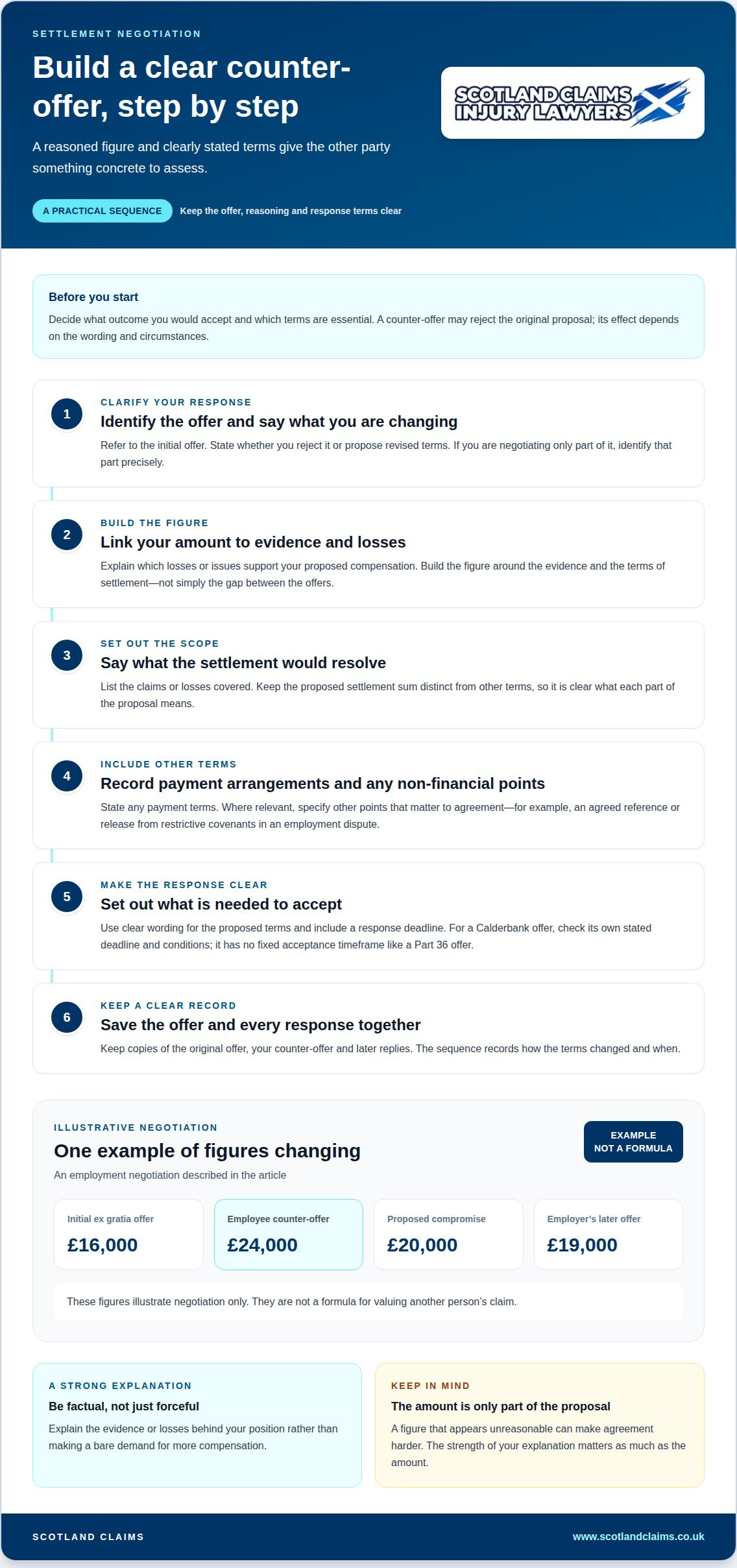
A counter-offer should state the terms you propose and explain why they are reasonable. A letter should set out the amount, its basis, what the settlement covers, any payment terms and a clear response deadline.
Assessing a reasonable counter-offer
A reasonable counter-offer links the proposed compensation to the losses and issues in dispute. A clear rationale gives the other party something concrete to assess and respond to.
For example, one employment negotiation began with an ex gratia offer of £16,000. The employee countered at £24,000 and proposed £20,000 as a compromise. The employer then offered £19,000. These figures illustrate negotiation, not a formula for valuing another person’s claim.
Build your proposed figure around the evidence and settlement terms, not simply the gap between two offers. Consider which losses the payment addresses, what the agreement would resolve, and whether non-financial terms also matter. In an employment dispute, terms might include a reference or release from restrictive covenants. Those issues differ from personal injury compensation, so keep the calculation relevant to the claim being settled.
Preparing the counter-offer letter
A counter-offer letter records your proposed amount, the reasons behind it and the terms needed for agreement. Clear wording helps prevent confusion about what the other party must accept.
Identify the initial offer and state whether you reject it or propose revised terms. Explain the basis for your figure, list what the settlement covers, and set out any payment arrangements or response deadline. If you want to negotiate only part of the proposal, identify that part precisely.
Keep the tone factual. For instance, explain which losses or evidence support your position rather than making a bare demand for more compensation. Distinguish the settlement sum from any other terms, such as agreed wording or payment timing. Keep a copy alongside the original offer and any later response, so the negotiation remains clear.
Before proposing a figure, decide what outcome you would accept and which terms are essential. An ambitious opening figure can leave room to negotiate, but a proposal that appears unreasonable can make agreement harder. The strength of your explanation matters as much as the amount.
Where a personal injury claim is involved, a personal injury compensation estimate can help you organise the factors relevant to your proposed figure. Use the assessment as a starting point for understanding the claim, not as a substitute for explaining the settlement terms in your counter-offer.
Whether a counter-offer rejects an original offer
In the UK, a counter-offer may reject the original proposal, but its effect depends on the wording and circumstances. The risk is losing the chance to accept the initial offer while leaving the dispute unresolved.
Effect on the original offer
A counter-offer proposes different terms instead of accepting the offer as made. The original offer may no longer be available once the other party receives a counter-proposal.
For example, one party offers to settle for a stated sum. The other replies that they will settle only for a different sum. That response may operate as a rejection. A recipient of a Calderbank offer may make a counter-offer that nullifies the original proposal. The exact words and terms remain central.
Outside Part 36, the usual rules on contractual formation determine whether an offer was accepted and a settlement agreement reached. Those rules may also apply when assessing whether a without-prejudice counter-offer rejects an original open offer. The “without prejudice” label alone does not decide the issue. The response’s substance and context matter.
Understanding a counter offer in a settlement means distinguishing a firm alternative from an invitation to discuss. “I reject that figure and will settle only on these revised terms” sets out a different position. By contrast, asking whether the offer could be improved may invite further discussion. The effect depends on the words used, not simply the sender’s intention.
Counter-offer negotiation risks
The main risk is that your counter-offer may close off the option of accepting the original proposal. That matters if you later decide its terms were preferable or the other party refuses your revised position.
A further risk is uncertainty about whether the parties have reached agreement. For instance, you might accept the proposed sum but change a payment condition. That can leave disagreement about whether you accepted the original offer. Identify each changed term and state whether you are accepting, rejecting or proposing an alternative.
In a live dispute, a rejected offer can stall negotiations while each party holds to a different position. If the matter proceeds, both sides face the demands and uncertainty of further dispute resolution. A counter-offer is not just a new figure: it can change the choices available to both parties.
A key part of understanding a counter offer in a settlement is weighing the original terms against the consequences of rejection. If particular wording or its effect is unclear, obtain legal advice before responding. Keep your reply precise, especially where an open offer and a without-prejudice counter-offer are both involved. This creates a clearer record of what each party proposed and whether acceptance remained possible.
Settlement counter-offers
A counter-offer can change the terms under discussion, but its legal effect depends on the offers made. Before acting, distinguish a negotiation proposal from an accepted settlement agreement.
Settlement counter-offer changes
You may be able to withdraw or change a counter-offer before acceptance, but the specific terms and circumstances matter. In England and Wales, a Calderbank offer may generally be withdrawn before the court decides costs; the timing and manner can affect the costs assessment.
That rule concerns Calderbank offers, not every settlement proposal in every part of the UK. Outside Part 36, usual contractual formation rules determine whether an offer has been accepted and an agreement reached. For example, if the other party accepts your counter-offer before you communicate a change, the sequence and wording could become important.
State any change clearly and promptly, identifying which proposal you are revising and which terms remain. Keep the original offer, counter-offer and later communications together. This gives the parties a record of the terms involved and helps clarify whether a settlement was reached. Do not assume that changing your position silently alters a proposal already sent.
Getting solicitor advice
Seek legal advice before counter-offering if the terms could affect your rights, the scope of the claims released or whether an agreement is binding. Advice is especially important when an offer involves several issues, such as payment alongside a reference or other conditions.
For an employee entering into a UK settlement agreement, separate advice on its terms must come from a lawyer, an authorised official or a trade union representative. The agreement must be in writing to be legally binding. These requirements make advice relevant before you accept or negotiate terms that may settle an employment dispute.
In civil litigation, CPR Part 36 provides a formal framework for parties in England and Wales to make and respond to offers to settle all or part of a claim, according to the Ministry of Justice. A Part 36 proposal can carry different consequences from a Calderbank offer, so legal advice can help identify which process applies and what your response may mean.
For a dispute in Scotland, do not assume that an England and Wales procedure applies. Clarify the kind of offer you have received, the forum handling the case and the exact terms proposed. If those points are unclear, take advice before sending a counter-offer. This helps you weigh the effect of changed terms against the resolution you are seeking.
How should I calculate a reasonable settlement counter-offer in the UK?
There is no single figure that makes a counter-offer reasonable in every UK settlement. Build your proposed amount from the evidence, the losses involved and the terms you want resolved.
Start by identifying what the initial offer covers. Separate the amount offered from any conditions, such as a reference or payment arrangements. Then list the losses and issues your claim includes. In an employment dispute, this may involve lost income and the practical effect of finding other work. In a personal injury claim, consider the injury’s impact and the losses connected to it. The relevant factors depend on the type of claim.
Next, assess how well the available information supports each part of your position. Negotiations are generally ready to begin when the parties can realistically evaluate liability and damages. If important evidence is missing, that may affect how confidently either side can value the dispute. An employer may also have overlooked the employee’s circumstances or ability to return to work. A counter-offer can explain those points rather than simply naming a higher figure.
Set an opening position that is ambitious but reasoned, and leave room to move. A figure the other party sees as credible can help establish a useful negotiating range. But an unexplained demand may distract from the evidence and make agreement harder. Link each requested amount to a specific loss or issue, and distinguish essential terms from points you could negotiate.
For example, imagine an initial offer that addresses lost earnings but overlooks evidence about ongoing difficulty returning to employment. A counter-offer could explain the additional impact, identify the supporting information and propose revised terms. The amount should follow from that assessment, not an arbitrary increase or a generic settlement figure. The clearer the link between evidence and requested compensation, the easier it is for the other party to assess your proposal.
Before sending your response, organise the calculation into clear components:
- Identify which losses and issues the original offer addresses.
- Connect each requested change to evidence about liability, damages or impact.
- State which terms matter most to reaching a complete settlement.
- Explain why your proposed figure is a reasonable basis for negotiation.
Keep the explanation proportionate to the information available. If the evidence changes, the basis for your proposed amount may change too. A well-supported counter-offer gives the other party a clear position to accept, reject or discuss. It also helps you judge any revised offer against the losses and terms that matter in your claim.
Scotland Claims Injury Lawyers
Scotland Claims Injury Lawyers can help if a personal injury settlement offer or counter-offer affects your claim. Its work includes road traffic accident, work injury and slip or trip claims, helping you understand how the proposed terms relate to your circumstances.
If you’re weighing a figure, the Personal Injury Compensation Calculator can help you consider compensation. Scotland Claims Injury Lawyers also promises 100% compensation: it recovers its fees from the at-fault party and passes the entire settlement to you.
If you’d like support with a personal injury settlement, contact Scotland Claims Injury Lawyers.
Choose your next step with confidence
A settlement decision can shape what happens next, so give yourself space to consider the outcome you need. Understanding a counter offer in a settlement helps you approach that decision deliberately, rather than reacting to pressure or focusing only on the amount offered.
Before you respond, consider which terms matter most to you and what you would need to move forward. Think about the practical consequences of accepting, continuing negotiations or allowing the dispute to proceed. Keeping your priorities clear can help you assess any revised proposal against the result you actually want.
If the proposed settlement relates to a personal injury claim, Scotland Claims Injury Lawyers can help you understand your position and consider your next step. You can seek support with a road traffic accident, workplace injury or slip or trip claim.
Take the time you need to make an informed decision. A considered response puts you in a stronger position to move forward.
Frequently Asked Questions
Is there room for negotiation?
Yes, you can negotiate a settlement rather than accept the first proposal. You may suggest a different amount, request changes to other terms, or ask for time to consider the offer. For example, you might agree with the proposed payment but seek a change to the wording of a reference. The other party can accept, reject or respond with revised terms.
What is a Formal Settlement Offer?
A formal settlement offer is a proposal intended to resolve some or all of a dispute on stated terms. In civil proceedings in England and Wales, it may be made under CPR Part 36 or on a Calderbank basis. The label matters because the route used affects how the offer is handled and may influence costs if the case continues. Read its terms carefully.
What is a settlement agreement?
A settlement agreement records the terms the parties have agreed to resolve a dispute. In a UK employment matter, it must be in writing to be legally binding, and the employee must receive separate advice on its terms from an eligible adviser. Before signing, identify which claims and payments the document covers. Its wording defines the matters settled, so omissions or unclear terms can cause difficulty.
What is a counter-offer in a settlement negotiation?
A counter-offer is a response that proposes different terms from those in the offer received. You might suggest a revised payment, change a condition or make acceptance dependent on another term. For example, a recipient could agree to the proposed amount only if the settlement also includes an agreed reference. The other party then decides whether to accept, reject or make another proposal.
What happens legally when you make a counter-offer to a settlement offer in the UK?
Outside the Part 36 context, usual contractual formation rules determine whether an offer has been accepted and a settlement reached. A counter-offer can therefore change the parties’ positions and may end the original proposal. The result depends on the exact wording and sequence of communications. Keep dated copies of offers and replies, especially if the dispute later turns on whether agreement was reached.
Does making a counter-offer reject the original settlement offer?
It may. For example, replying “I will settle only on these revised terms” can communicate rejection of the original offer and propose a replacement. A request to discuss whether the original terms could change may have a different effect. The distinction depends on the language used and context, not merely what you intended. If preserving the original offer matters, make your position explicit before responding.
How does a settlement counter-offer differ from a Part 36 offer in England and Wales?
A counter-offer is a proposed response with revised terms; Part 36 is a formal civil-litigation procedure. According to the Ministry of Justice, a Part 36 offer must stay open for acceptance for at least 21 days, called the relevant period. A Calderbank offer has no equivalent strict acceptance timeframe. Part 36 has specific procedural requirements, so an ordinary counter-offer should not be assumed to have Part 36 effect.