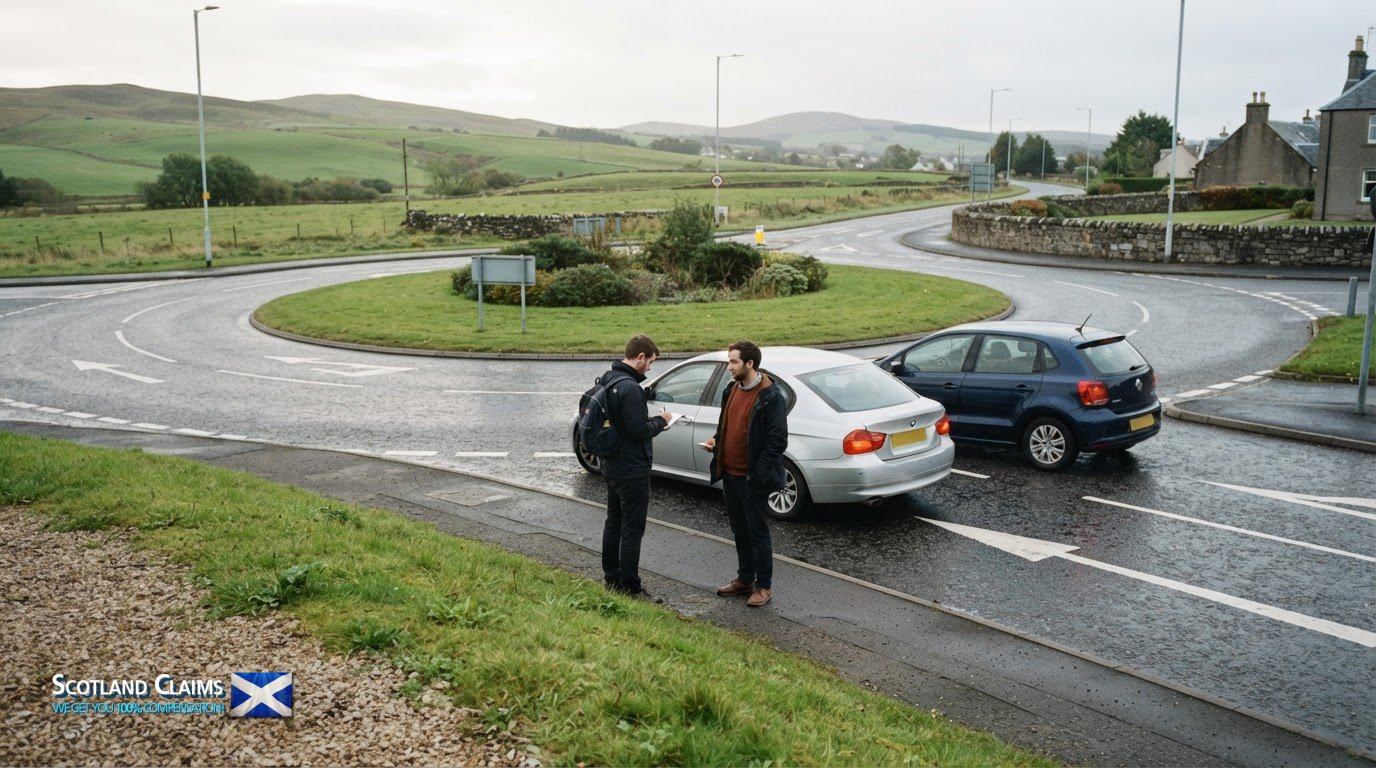
What if the driver who had priority still shares responsibility for a roundabout collision? After a crash, drivers may give very different accounts of their lanes, signals and movements. That’s why roundabout accident fault in Scotland isn’t always clear from who entered first or where the vehicles collided.
It makes sense to look at the road rules. The Highway Code says drivers approaching a roundabout should give way to traffic approaching from the right, unless signs or road markings say otherwise. But the rules alone don’t decide fault. Each driver’s actions and the available evidence matter, and responsibility can sometimes be shared.
This guide explains how fault is assessed after a roundabout crash in Scotland, what evidence may help clarify events and what steps you can take next. You’ll learn why lane position, signals, road markings and the point of impact may all matter, even when accounts conflict. If you’re worried you’ll be blamed wholly or partly, a Scottish solicitor can assess the circumstances and explain whether you may have a claim.
Key Takeaways
- Roundabout accident fault scotland depends on each driver’s actions, the layout and the evidence, not simply where the vehicles collided.
- Lane position, signals and manoeuvres can be disputed. No collision pattern automatically proves who was responsible.
- Photographs, witness details and clear records may help establish vehicle positions, visibility and timing.
- Prepare your account of the collision, the evidence available and information about your injuries so a solicitor can assess disputed liability.
- Scotland Claims Injury Lawyers offers a no-obligation assessment and a 24-hour freephone helpline. Under its no-win, no-fee arrangement, successful clients keep 100% of their compensation, with no success fee.
Roundabout accident fault in Scotland: what determines responsibility?
Responsibility after a roundabout collision is assessed by looking at what each driver did, the road layout and the evidence available. The point of impact can help explain how the vehicles moved, but it doesn’t prove fault on its own. For example, damage to a car’s side might be consistent with another vehicle changing lanes. The drivers’ positions and movements before impact still need to be established.
A road-rule breach is relevant evidence, but it doesn’t automatically decide civil liability. The wider question is whether either driver failed to take reasonable care and whether that failure contributed to the collision. If you’re researching “roundabout accident fault scotland”, keep that distinction in mind: the Highway Code informs an assessment, but the full circumstances matter.
How roundabout priority and road positioning inform fault
The Highway Code’s general guidance is that drivers approaching a roundabout should give way to traffic approaching from their right, unless signs or road markings indicate otherwise. That principle is especially relevant when a driver is entering. It doesn’t remove the need to consider what happened once vehicles were on the roundabout or as they left it.
Road positioning, signs and markings help show which routes drivers could reasonably follow. The Highway Code also advises drivers to choose the correct lane for their intended exit and signal as appropriate, including signalling before leaving. A signal, or the absence of one, may help explain what another driver could anticipate, but it needs to be considered alongside the road layout and other evidence. For a general explanation of how roundabouts organise traffic movement, see Roundabout (traffic circle).
Roundabouts differ. A lane may continue around the junction or lead to a particular exit, and markings can vary. A disagreement about who was in the correct lane therefore needs to be considered in context, rather than settled by assuming every roundabout has the same layout.
Can responsibility be shared after a Scottish roundabout collision?
Yes. Evidence may indicate that more than one driver’s actions contributed to a crash. One driver might have entered when it wasn’t safe to do so, whilst another may have changed lanes without adequate care. That doesn’t automatically mean either account is wholly right or wrong. Each driver’s actions need to be considered in light of the circumstances and evidence.
In plain English, contributory negligence means the injured person’s own lack of care contributed to their injury. If that is established, it may reduce the compensation recoverable rather than automatically preventing a claim. A disagreement over lane position or priority therefore doesn’t, by itself, rule out a potential claim.
A solicitor can compare the accounts with the available evidence and assess how responsibility may be viewed. Scotland Claims’ Scottish injury solicitors can assess the circumstances of a road traffic accident claim. Clear evidence can help, but conflicting accounts are a reason to examine the facts carefully, not to assume you have no options.
Which roundabout manoeuvres commonly lead to disputed fault?
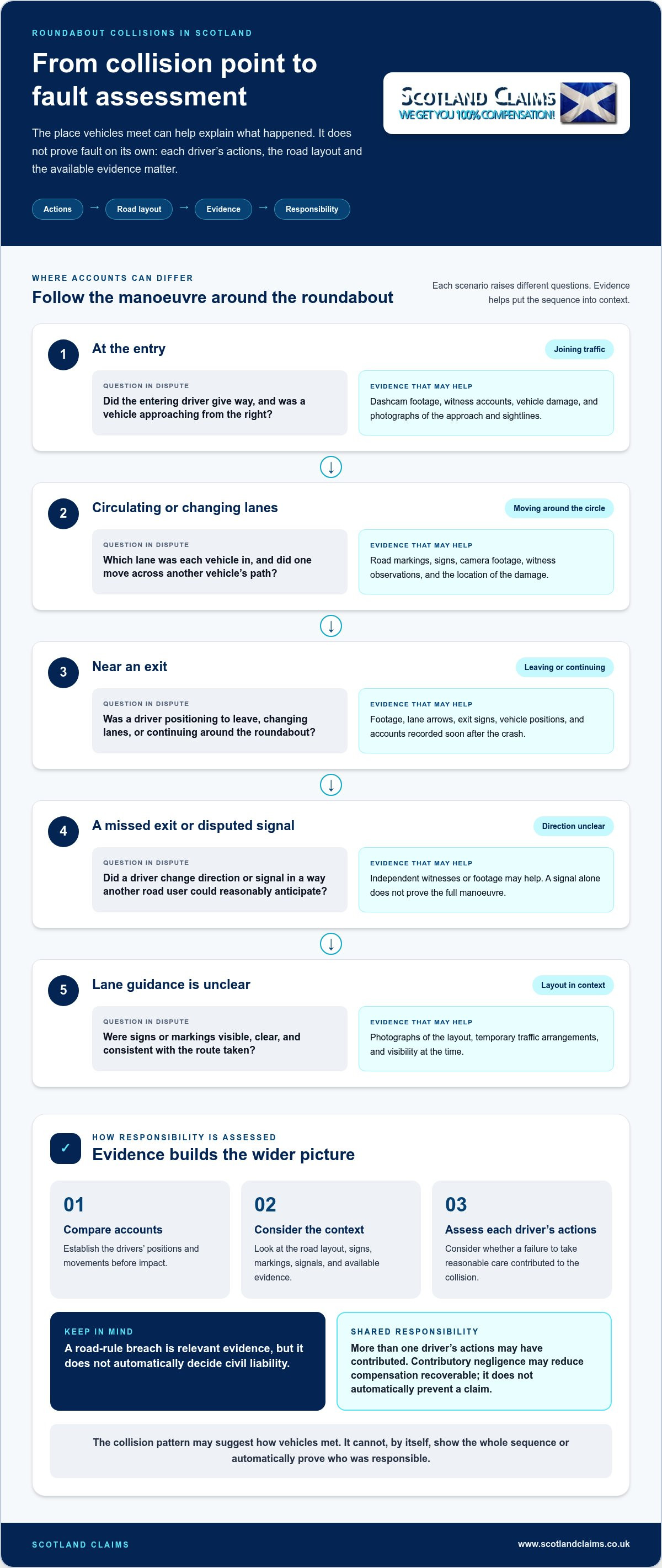
Roundabout collisions can happen during different parts of a manoeuvre: entering, moving around the circle or taking an exit. The damage pattern may suggest how vehicles met, but it can’t show the whole sequence by itself. The same type of collision can lead to different liability findings, depending on the drivers’ actions, the road layout and the supporting evidence.
The Highway Code’s roundabout guidance helps frame questions about priority, lanes and signalling. The official Highway Code: Roundabout Rules is useful context, but the details of each collision still need to be examined. These common scenarios show what may be disputed and what could help clarify it.
| Collision scenario | Disputed issue | Evidence that may clarify events |
|---|
| Collision as a vehicle enters | Whether the entering driver gave way, and whether a vehicle was approaching from the right. | Dashcam footage, witness accounts, vehicle damage and photographs showing the approach and sightlines. |
| Impact between vehicles circulating | Which lane each vehicle occupied and whether one moved across another vehicle’s path. | Road markings, signs, camera footage, witness observations and the location of damage. |
| Collision near an exit | Whether a driver was positioning to leave, changing lanes or continuing around the roundabout. | Footage, lane arrows, exit signs, vehicle positions and accounts recorded soon after the crash. |
| Missed exit or disputed signal | Whether a driver changed direction or signalled in a way another road user could reasonably anticipate. | Independent witnesses or footage may help. A signal alone doesn’t prove the full manoeuvre. |
| Collision where lane guidance is unclear | Whether signs or markings were visible, clear and consistent with the route taken. | Photographs of the layout, temporary traffic arrangements and visibility at the time. |
Entering, circulating and changing lanes
At the entry, accounts may differ over how close traffic on the roundabout was and whether there was a safe opportunity to join. Once circulating, drivers may disagree about their lane or direction, particularly if one vehicle was alongside another. A scrape to the side can help indicate where contact occurred, but it won’t establish by itself who moved or when. Markings, signs and independent observations can help reconstruct the sequence.
Exiting, signalling and unclear layouts
Near an exit, one driver may say they were leaving whilst another says they were continuing around. A signal can support an account of intended movement, but it isn’t conclusive proof of a driver’s position or actions. Roadworks, poor visibility or confusing lane guidance may also affect what drivers saw and understood. Consider two questions separately: what did each driver do, and what features of the road may have shaped their decisions?
A Scottish Government FOI publication refers to concerns about confusing signage at the A90 Swallow roundabout. That is a location-specific example, not a general rule or proof that signage caused a particular collision. If you’re unsure how the facts affect a potential claim, a solicitor can assess the evidence and disputed accounts. You can also seek help with a Scottish road traffic accident claim.
How do insurers assess conflicting accounts and shared fault?
When drivers give different versions of a roundabout collision, an insurer compares each account with the available independent and physical evidence. This may include the road layout, vehicle positions, damage, photographs, dashcam footage, witness statements and relevant records. The aim is to test whether the details fit together, not simply to decide whose account sounds more confident.
A driver might report that they were established in a lane, whilst the other says they were cut off. The point of impact may help indicate where the vehicles met, but it may not show which vehicle moved or what either driver could see. Evidence is more useful when separate details support the same sequence of events. For instance, a witness’s observation may help explain a photograph that shows only the vehicles after the collision.
What happens when both drivers say they had priority?
Priority is one part of the assessment. An insurer may compare what each driver says with signs, lane markings, damage and independent records. A departure from the Highway Code can be relevant when considering a driver’s conduct, but it doesn’t automatically prove legal liability. The surrounding circumstances still matter, including whether a rule applied to that approach and what each driver could reasonably observe.
Neither an initial report nor a firm account settles fault by itself. A driver may be mistaken about another vehicle’s position, especially if events happened quickly. An insurer’s initial view is also not the same as a complete, final assessment of every available piece of evidence. If important evidence is missing or the accounts remain inconsistent, responsibility may stay disputed and need further examination.
What does shared responsibility mean for a claim?
Sometimes the evidence suggests that more than one driver’s actions contributed to a collision. In Scotland, contributory negligence refers to a situation where the injured person’s own lack of care contributed to their injury. If responsibility is shared, the effect on any compensation depends on the case-specific legal assessment. The collision pattern alone can’t predict a fixed result.
That uncertainty doesn’t automatically mean you can’t pursue a claim. An insurer’s view may be challenged or revised as more evidence is considered, and a specialist solicitor can assess the competing accounts, identify gaps and explain the options. The Scottish road accident claims guide explains the wider claims process. For roundabout accident fault scotland, a careful review of the facts is more useful than assuming a disputed account rules out a claim.
What evidence should you preserve after a roundabout accident?
Useful evidence can disappear quickly, but your safety comes first. Don’t put yourself or anyone else at risk to photograph the scene or speak to witnesses. Seek medical attention if you need it, and deal with immediate hazards before gathering information. Once it’s safe, work through these steps. They can help establish where vehicles were, which direction they were travelling and what each driver may have been able to see.
- 1. Record the essential details. Note the date, time and exact location, along with the vehicles and drivers involved. If you can, record the approach and exit each vehicle was using. These details can help place the collision on the correct part of the roundabout.
- 2. Photograph the scene when safe. Capture lane markings, signs, roadworks, visibility and the vehicles’ positions before anything is moved, if possible. Take clear pictures of damage from more than one angle. Include enough surrounding detail to show where the vehicles were in relation to lanes and exits.
- 3. Identify witnesses. Ask for their contact details and make a brief note of what they say they saw. Keep their observations distinct from your own recollection.
- 4. Preserve recordings and records. Save relevant dashcam footage and keep messages, reports or other records linked to the collision. Write down when and where each item came from.
- 5. Make dated notes. Record your recollection promptly, then keep track of symptoms, appointments and effects on everyday activities.
Photographs, dashcam footage and vehicle damage
Photographs can show the road layout as well as visible damage. If safe, record the approach, signs, lane arrows, surface conditions and any temporary traffic arrangements. Don’t step into moving traffic or delay medical care to get a picture. Dashcam footage may capture a vehicle’s approach, lane position or signals, but its value depends on what is actually visible. Save the original file promptly, as routine recording may overwrite it. Keep an unedited copy and note the camera and recording time. Don’t assume its clock is accurate without checking.
Damage can help indicate where contact occurred, but it may not establish the full sequence. Preserve clear images and avoid relying on a single close-up without context.
Witnesses, CCTV and contemporaneous notes
A witness may have seen the vehicles before impact, not just the aftermath. Note their contact details and, briefly, where they were and what they observed. Don’t coach them or try to make their account fit yours. If nearby premises or road systems may have CCTV, note their locations promptly. Retention periods can vary, so early action may matter. Don’t trespass or put yourself at risk trying to obtain recordings.
Write down your own recollection as soon as practical, separating what you remember from what you later learn. Keep a dated record of symptoms, medical appointments and changes to daily life. These notes can help show how your condition developed. Preserving evidence can support an assessment of roundabout accident fault scotland, but it can’t guarantee a particular finding.
What are your next steps if roundabout accident fault is disputed?
A disagreement about priority or lane position doesn’t mean you have to decide the issue yourself. A solicitor can assess the information available and explain what it may mean for a potential claim. Before seeking advice, gather what you have. You don’t need to resolve every gap first.
A useful starting point is a short, factual summary. Include:
- the date, time and location of the collision, including the approach and exit involved;
- what you remember about each vehicle’s position and movement;
- photographs, dashcam footage, witness details and any information about nearby CCTV;
- details of your injuries, treatment, symptoms and effects on everyday activities.
Keep original recordings and documents where possible. If you’re still waiting for information, make a note of what is outstanding rather than delaying advice. A Scottish solicitor can help identify which details may matter and what further evidence could be relevant. The Scottish road traffic accident claims guide also explains the wider claims process.
What will a solicitor consider when reviewing a disputed collision?
A solicitor will compare each driver’s account with the road layout, signs and markings, available footage, witness evidence and relevant injury records. The assessment looks at how these details fit together, rather than treating one photograph, damage mark or account as decisive. Solicitors specialising in Scottish injury claims can review the overall evidence and explain how disputed liability may affect your options.
How does Scotland Claims Injury Lawyers make a claim assessment lower-risk?
Scotland Claims Injury Lawyers’ qualified solicitors are authorised and regulated by the Law Society of Scotland. Road traffic accident claims are handled on a no-win, no-fee basis. The firm recovers its legal costs from the at-fault party’s insurer rather than deducting them from your settlement. If a claim is unsuccessful, you owe nothing under this arrangement.
Successful clients keep 100% of their compensation, with no success fee. This describes the firm’s fee model, not a promise that a claim will succeed or that liability will be agreed. You can discuss the circumstances through a no-obligation assessment, and a 24-hour freephone helpline is available. This gives you a practical way to ask about your evidence and understand the next steps without assuming the outcome in advance.
If you’re concerned about roundabout accident fault scotland, prepare the details you have and ask Scotland Claims Injury Lawyers for an assessment of your situation.
Take the next step with confidence
If you’re still uncertain about roundabout accident fault scotland, don’t let conflicting accounts stop you asking for a clear assessment. Your collision deserves an individual review based on the information available and what it may show about responsibility.
Scotland Claims Injury Lawyers’ qualified solicitors are authorised and regulated by the Law Society of Scotland. The firm offers a 24-hour freephone helpline, and successful clients keep 100% of their compensation with no success fee. These terms don’t guarantee that a claim will succeed, but they can help you understand the support available before deciding what to do next.
Take the first step by requesting a no-obligation assessment. Share what happened, raise your concerns and get guidance on whether your circumstances may support a claim. Conflicting accounts needn’t be the end of the conversation.
With the right advice, you can make an informed decision about the road ahead.
Frequently Asked Questions
Who is usually at fault in a roundabout accident in Scotland?
There’s no single driver who is automatically at fault in every roundabout collision. Responsibility depends on the particular manoeuvres and what the evidence shows. For example, an insurer may consider whether a driver joined the roundabout safely, followed lane guidance or moved into another vehicle’s path. The location of the damage can be relevant, but it won’t settle the question alone. A case-specific review is needed before drawing conclusions.
Can both drivers be partly at fault in a roundabout collision?
Yes. The evidence may indicate that both drivers’ actions contributed to the collision or injury. For instance, one driver’s movement may have created a hazard, whilst the other may also have had an opportunity to avoid it. If contributory negligence applies, it can affect the compensation recoverable. The impact depends on the circumstances and legal assessment, so don’t assume possible shared responsibility means you have no claim.
Does a driver entering a roundabout always have to give way?
Generally, drivers approaching a roundabout should give way to traffic coming from their right, unless signs or road markings show otherwise. Follow the specific junction guidance, as lane arrows and signs may direct traffic differently. Give way to traffic already on the roundabout where required, and don’t treat another driver’s position as permission to enter if it isn’t safe. The Highway Code’s roundabout rules provide guidance for these decisions.
Can I claim if the other driver denies causing the roundabout accident?
A denial doesn’t automatically prevent you from making a claim. An insurer may assess the available evidence even if the other driver disputes your account. Your recollection, photographs, vehicle damage, witness information and recordings can all help support your version. Keep communication factual and preserve relevant records. A solicitor can review the evidence and explain your options without assuming that the other driver’s denial decides the outcome.
What evidence helps prove fault after a roundabout accident?
Evidence that helps establish the sequence of events may include original dashcam files, photographs showing the wider junction, witness contact details and any incident reference numbers. Keep copies of correspondence with insurers and note when each item was collected. If a recording has a timestamp, check whether the camera clock was accurate. Medical records can document injury, although they may not establish how the collision happened.
Can unclear roundabout signs or lane markings affect a fault decision?
They may be relevant context. Photographs taken from a safe place can show what signs and markings were visible from each approach, while notes about roadworks or poor visibility can preserve details that may later change. Unclear guidance doesn’t, by itself, establish who was legally responsible. An assessment may consider the layout alongside each driver’s decisions and the other available evidence.
How long do I have to make a roundabout accident injury claim in Scotland?
In general, court proceedings for a personal injury claim in Scotland must be raised within three years of the accident. Contacting a solicitor before then doesn’t, by itself, meet the deadline. If an injury wasn’t apparent at first, a date-of-knowledge exception may affect when the period starts. Time-limit rules can depend on individual circumstances, so get legal advice promptly rather than waiting until the deadline is close.